


Most UK small business owners treat branding as a nice-to-have, something to tackle once the business is established. Yet 81% of consumers need to trust a brand before making a purchase, and 41% of British buyers actively avoid businesses with poor branding. This isn’t about logos or colour schemes alone. Branding shapes every customer interaction, influences pricing power, and determines whether your business stands out or fades into the background. For UK entrepreneurs navigating competitive markets, understanding branding’s practical impact can mean the difference between steady growth and stagnation.
Table of Contents
- What is branding and why does it matter for small businesses?
- The tangible return on investment: What can branding do for your business?
- Branding methodologies that work for UK SMEs
- Branding consistency: How to avoid wasted spend and drive sustainable growth
- Branding risks, edge cases, and evolving trends for UK small businesses
- Take the next step: Strengthen your brand with the right tools
- Frequently asked questions
Key Takeaways
| Point | Details |
|---|---|
| Trust is everything | Branding builds lasting customer trust, which drives loyalty and repeat business. |
| Consistent branding pays | Consistency enables UK SMEs to grow revenue, reduce costs, and price at a premium. |
| Simple frameworks work | Practical steps like defining your purpose and visual identity make branding manageable for any SME. |
| Stay current and authentic | Balancing new tech trends with authentic storytelling keeps your brand relevant in 2026. |
What is branding and why does it matter for small businesses?
Branding extends far beyond visual design. It encompasses every perception customers hold about your business: your values, messaging, visual identity, and the emotional response you trigger. When someone hears your business name, they don’t just picture a logo. They recall experiences, feelings, and associations built through consistent interactions.

For UK small businesses, this matters because strong branding builds customer trust and loyalty, essential for standing out in competitive markets. Recent data shows 64% of UK business leaders now prioritise branding as a top strategic concern, recognising its direct impact on revenue and market position.
The tangible benefits of strategic branding include:
- Enhanced credibility with customers and partners
- Clear differentiation from competitors
- Increased customer trust and loyalty
- Ability to command premium pricing
- Reduced marketing costs through word-of-mouth
- Stronger employee alignment and retention
Think of branding as your business’s reputation made visible. Every touchpoint, from your website to your email signature, either reinforces or undermines that reputation. Inconsistency confuses customers and dilutes trust.
“Branding is not just about being seen as better than the competition. It’s about being seen as the only solution to your audience’s problem.”
For practical guidance on building these foundations, explore our branding step-by-step guide tailored for UK entrepreneurs.
The tangible return on investment: What can branding do for your business?
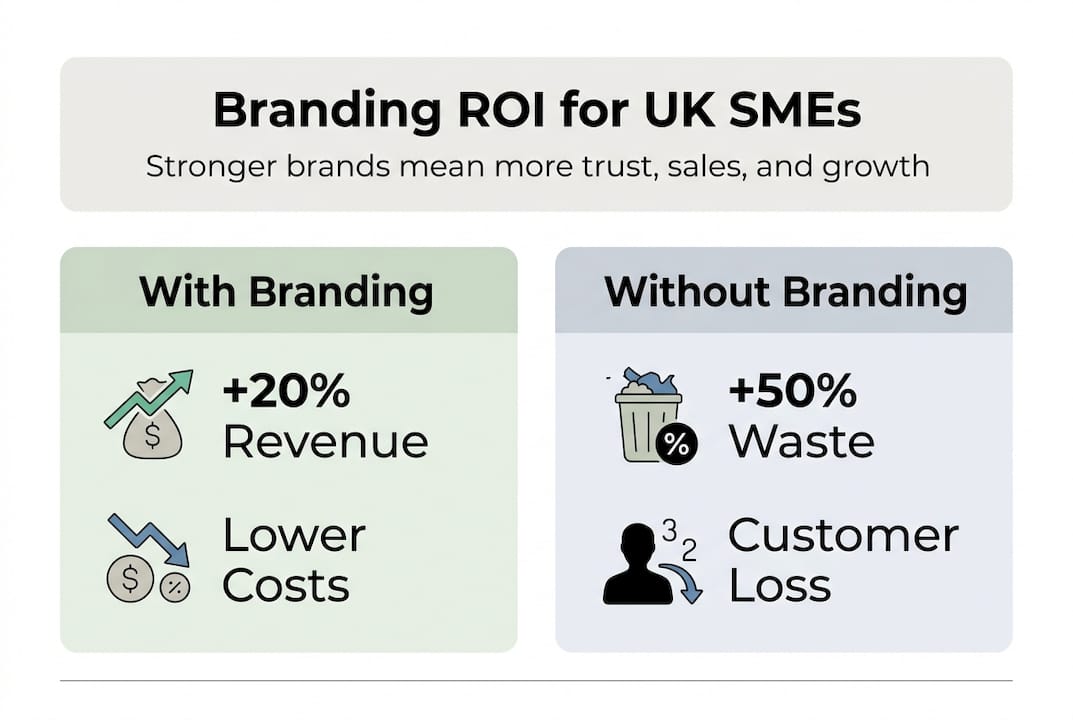
Branding delivers measurable financial returns. Consistent branding drives revenue growth through premium pricing, lower acquisition costs, and higher retention rates. Businesses with cohesive branding can charge up to 16% more than competitors and see revenue increases of 33%.
The numbers tell a compelling story:
| Metric | Strong Branding | Weak/Inconsistent Branding |
|---|---|---|
| Revenue Growth | +33% potential increase | Flat or declining |
| Customer Acquisition Cost | 50% lower | Baseline |
| Customer Retention | +23% improvement | Baseline |
| Pricing Premium | +16% achievable | No premium |
| Marketing Efficiency | 3.5x ROI | 1x ROI |
McKinsey research shows strong brands outperform competitors by 20%, with 20-30% higher ROI and significant marketing efficiency gains. This isn’t theoretical. UK SMEs implementing consistent branding see faster customer conversion, reduced churn, and improved word-of-mouth referrals.
Poor branding wastes resources. Inconsistent messaging forces you to re-educate customers at every interaction, burning up to 50% of acquisition spending on confusion rather than conversion.
Pro Tip: Track branding effectiveness through simple metrics like customer retention rate, conversion rate changes after brand updates, and average transaction value. These indicators reveal whether your branding investment translates into business results.
81% of consumers require trust before purchasing, making brand credibility your most valuable asset.
For broader context on leveraging these gains, review our guide on smart business growth strategies and understand design’s role in branding.
Branding methodologies that work for UK SMEs
Effective branding follows a structured approach. Here’s a proven framework for UK small businesses:
- Define your purpose: Articulate why your business exists beyond profit. What problem do you solve? What change do you create?
- Establish core values: Identify 3-5 principles that guide decisions and behaviour. These become your brand’s backbone.
- Develop visual identity: Create consistent logos, colours, typography, and imagery that reflect your purpose and values.
- Build your voice: Determine how you communicate. Formal or casual? Technical or accessible? This voice should remain consistent across all channels.
- Craft your story: Connect your purpose, values, and offerings into a narrative that resonates with your target audience.
Branding methodologies for SMEs include defining brand purpose, values, visual identity, consistent voice, and storytelling. These elements work together to create recognition and trust.
The approach varies by business structure:
| Sole Proprietor | Multi-Person Small Business |
|---|---|
| Personal brand often equals business brand | Separate business identity required |
| Flexibility to pivot quickly | Need internal alignment processes |
| Authenticity through founder story | Team culture becomes brand expression |
| Lower consistency overhead | Style guides and training essential |
UK audiences value authenticity and local relevance. Reference regional context where appropriate, support community initiatives, and demonstrate genuine commitment to your stated values. British consumers quickly detect performative branding.
Pro Tip: Discover your unique story by asking: What problem did I experience that led me to start this business? What do I believe about my industry that others don’t? Your answers often reveal your most compelling brand narrative.
Workshops and community engagement prove particularly effective for UK SMEs. Consider running a branding workshop for growth to align your team and clarify your positioning.
For additional frameworks, explore our brand building tips, branding strategies for founders, and social media tips tailored for UK markets.
Branding consistency: How to avoid wasted spend and drive sustainable growth
Consistency multiplies branding effectiveness. Every inconsistent interaction forces customers to reassess their understanding of your business, creating friction and doubt.
Common pitfalls of inconsistent branding:
- Different logos or colour schemes across platforms
- Varying tone of voice between website, social media, and customer service
- Misaligned messaging between marketing and sales teams
- Outdated materials still in circulation
- No clear guidelines for partners or contractors
Poor branding wastes acquisition spend and leads to lost opportunities. When customers encounter conflicting brand signals, they question your professionalism and reliability.
Create a basic style guide covering:
- Logo usage rules and variations
- Colour palette with specific codes
- Typography choices for headings and body text
- Voice and tone guidelines with examples
- Key messaging points and value propositions
- Image style preferences
This doesn’t require expensive consultants. A simple document shared with your team prevents drift and ensures everyone represents the brand consistently.
“Brand consistency isn’t about rigidity. It’s about creating a reliable experience that builds trust through repetition and recognition.”
Conduct regular consistency checks:
- Review your website, social profiles, and printed materials quarterly
- Ask a trusted customer or colleague to audit your brand presence
- Check that new team members understand and apply brand guidelines
- Update materials promptly when brand elements evolve
For UK-specific guidance, consult brand consistency ROI data showing how cohesive branding reduces costs and improves performance.
Recognise that consistency challenges often signal deeper issues. If maintaining brand standards feels difficult, you may need to revisit whether your branding truly reflects your business reality. Explore our insights on growth strategy mistakes and develop a business growth roadmap that integrates branding from the start.
Branding risks, edge cases, and evolving trends for UK small businesses
Branding isn’t static. Markets shift, audiences evolve, and your business grows. Navigating these changes requires awareness of risks and emerging trends.
Rebranding considerations: Rebranding risks are high but can deliver 20-30% more leads when executed properly. Approach rebranding in phases: test new elements with small audiences, gather feedback, and roll out gradually. Never rebrand simply because you’re bored with your current identity. Valid reasons include significant business model changes, merger or acquisition, or documented evidence that current branding hinders growth.
Personal branding for sole traders: If you operate as a sole proprietor, personal branding is crucial and often drives more opportunities than traditional business branding. Your expertise, personality, and professional reputation become inseparable from your business offering. Invest in building your personal profile through thought leadership, speaking engagements, and consistent content creation.
AI design tools: Artificial intelligence now generates logos, colour palettes, and design assets quickly and affordably. AI design is accepted if professional, but authenticity concerns remain. Use AI for efficiency, but ensure human oversight maintains brand coherence and emotional resonance. Technology can’t replace strategic thinking about what your brand should communicate.
“The future of branding lies not in choosing between human creativity and AI efficiency, but in combining both to create authentic, scalable brand experiences.”
Emerging branding trends for 2026:
- Radical authenticity: Customers reward transparency and genuine values over polished perfection
- Digital-first engagement: Your online presence often provides the first and most frequent brand interaction
- Sustainability signalling: Environmental and social responsibility increasingly influence UK purchasing decisions
- AI-augmented creativity: Smart use of technology to maintain consistency while reducing costs
- Community-centred branding: Building brand value through genuine relationships rather than broadcast messaging
Stay informed about digital foundations by reviewing why you should build a business website and understanding brand strategy ROI in evolving markets.
Take the next step: Strengthen your brand with the right tools
You now understand why branding matters and how to implement it effectively. The next step is putting these strategies into action with the right resources and support.
KefiHub provides practical guidance tailored for UK small businesses navigating branding challenges. Our business intelligence for SMEs helps you make informed decisions about brand positioning and market opportunities. Stay current with latest design trends that influence how UK audiences perceive and engage with brands.
Whether you’re refining an existing brand or building from scratch, access comprehensive resources at Kefihub to support your branding journey. From strategic frameworks to practical implementation guides, you’ll find the insights needed to create a brand that drives measurable business results.
Frequently asked questions
How soon should a UK small business invest in branding?
Early investment pays back in 6-18 months for businesses above £400k revenue. Start with foundational elements immediately, then scale investment as revenue grows.
What are the first steps to create a brand for my small business?
Start by defining your business purpose, values, and voice, then develop a clear visual identity and brand story. Core elements include brand orientation, identity, marketing, performance, and storytelling.
How does branding affect pricing and sales in the UK market?
Strong, consistent branding lets UK SMEs charge up to 16% more and boosts overall revenue by up to 33% through improved trust and customer loyalty.
What are the main branding mistakes UK business owners make?
The biggest pitfalls are inconsistent branding and underestimating its impact on trust, costing up to 50% in wasted acquisition spend through confused messaging and lost opportunities.
Is personal branding important for sole traders in the UK?
Yes, personal branding is essential and can drive more opportunities for sole proprietors than traditional business branding alone, as your expertise and reputation become your primary differentiators.
Recommended
- Role of branding in startups: strategies for UK founders – Kefihub
- Role of Leadership in UK SMEs: 90% Growth Driven by Leaders – Kefihub
- Why Use Digital Marketing in UK SMEs: 50% More Customers – Kefihub
- 7 Smart Brand Building Tips for UK Small Businesses – Kefihub