


Ninety percent of UK SMEs reported business growth in 2024 with average growth of 27%, indicating leadership’s role in driving optimistic growth strategies despite economic challenges. This compelling data underscores how leadership quality directly shapes SME success. Transformational leadership emerges as the key to unlocking both growth and team effectiveness in smaller businesses. UK SMEs with 1-50 employees need leaders who inspire, empower, and strategically guide their teams through rapid change.
Table of Contents
- Introduction To Leadership In UK SMEs
- Transformational Leadership As A Growth Driver In SMEs
- Leadership Impact On SME Growth And Optimism
- Leadership’s Role In Team Effectiveness And Employee Engagement
- Common Misconceptions About Leadership In SMEs
- Developing Leadership Capabilities For SME Growth
- Conclusion: Leadership With Impact – Next Steps For UK SME Leaders
- Discover Tools To Elevate Your SME Leadership And Growth
Key Takeaways
| Point | Details |
|---|---|
| Transformational leadership drives innovation | This style empowers teams to explore new ideas and deliver sustained business growth. |
| Leadership shapes SME optimism and performance | Effective leaders create strategic clarity that translates directly into measurable business results. |
| Development programs boost leadership capabilities | Peer mentoring and action learning equip SME leaders to manage complex growth challenges. |
| Common misconceptions limit SME potential | Many wrongly believe leadership matters less in small teams when the opposite is true. |
| Balanced decisions ensure sustainable success | Leaders must strategically balance short-term operational needs with long-term investment priorities. |
Introduction to Leadership in UK SMEs
UK SMEs are defined as businesses with 1-50 employees. They form the backbone of the British economy, yet their success hinges disproportionately on leadership quality. In small teams, leaders shape culture, strategy, and daily performance more directly than in larger organisations.
Leadership demands in SMEs differ fundamentally from those in bigger firms. Close team dynamics mean every leadership action ripples through the entire organisation. Resource constraints require leaders to be adaptable, decisive, and personally engaged. You cannot hide behind layers of management or delegate critical decisions away.
Leadership quality is a key differentiator between UK SMEs that scale successfully and those that struggle. Good leadership enables the agility and innovation that smaller businesses need to survive and thrive. Consider these essential leadership functions in SMEs:
- Setting clear strategic direction despite limited resources
- Building trust and psychological safety in close-knit teams
- Making rapid decisions that balance immediate needs with future growth
- Fostering a culture where innovation becomes routine, not exceptional
Your leadership approach determines whether your SME stagnates or scales. Understanding business intelligence for UK SMEs helps leaders make informed strategic choices. The UK SME economic data confirms that leadership quality separates thriving businesses from struggling ones.
Transformational Leadership as a Growth Driver in SMEs
Transformational leadership focuses on inspiring and empowering people to achieve collective goals. This style emphasises vision, intellectual stimulation, individualised consideration, and inspirational motivation. Leaders who adopt this approach encourage teams to think creatively and take ownership of outcomes.
Compare this with transactional leadership, which relies on rewards and penalties to manage performance. Transactional approaches work for routine tasks but rarely inspire innovation. Laissez-faire leadership, where leaders remain hands-off, typically fails in SMEs because small teams need active guidance and support.
| Leadership Style | Focus | SME Suitability |
|---|---|---|
| Transformational | Vision, empowerment, innovation | High: drives growth and engagement |
| Transactional | Rewards, compliance, structure | Medium: useful for operations only |
| Laissez-faire | Minimal involvement, autonomy | Low: too passive for SME needs |
Evidence links transformational leadership to higher innovation and business performance in UK SMEs. Transformational leadership improves employee engagement and retention within SMEs by promoting trust, clear vision, and continuous improvement. This style supports both exploratory innovation, where teams test new ideas, and exploitative innovation, where they refine existing processes.
Transformational leaders integrate innovation as a cultural imperative, not just incidental. They deliberately create environments where experimentation is safe and encouraged. Innovation becomes everyone’s responsibility, not just the leader’s.
Pro Tip: Embed innovation in your culture deliberately from the top, not left to chance. Schedule regular innovation sessions where team members can propose and test new approaches without fear of failure. Celebrate both successful innovations and valuable lessons from unsuccessful attempts.
Explore digital transformation in UK SMEs and growth hacking strategies to see transformational leadership principles in action. Review transformational leadership research for deeper insights into this powerful approach.
Leadership Impact on SME Growth and Optimism
Data reveals the measurable impact of leadership on SME performance. Ninety percent of UK SMEs reported business growth in 2024 with average growth of 27%. This optimism stems from leadership-driven strategic initiatives that position businesses for expansion.
Leadership-driven optimism fuels proactive growth initiatives in SMEs. When you believe in your strategy and communicate that belief effectively, your team follows. This confidence translates into calculated risks, investment in capabilities, and pursuit of new opportunities.
| Growth Factor | Leadership Contribution | Business Outcome |
|---|---|---|
| Strategic clarity | Clear vision and priorities | 27% average growth |
| Team confidence | Inspirational communication | 90% report growth |
| Resource allocation | Balanced investment decisions | Sustained performance |
| Innovation culture | Deliberate empowerment | Competitive advantage |
Leadership effectiveness in SMEs is strongly tied to strategic decision-making that balances short-term operational demands with long-term innovation priorities. You face constant pressure to deliver immediate results while investing in future capabilities. This tension defines SME leadership.
Balancing these competing demands requires discipline and data. You need visibility into key business metrics for UK SMEs to make informed choices. Understanding the analytics role in SME growth helps you spot opportunities and threats early.
Pro Tip: Use data-driven decision-making and maintain strategic flexibility to navigate episodic growth challenges. Build quarterly review processes that assess both operational performance and strategic progress. Adjust course when data signals problems, but stay committed to your long-term vision. Consider engaging business mentors impact who have successfully managed similar growth challenges.
Review UK SME growth statistics regularly to benchmark your performance and validate your strategic assumptions.
Leadership’s Role in Team Effectiveness and Employee Engagement
Your leadership style directly correlates with employee engagement and retention rates. In SMEs, where every team member matters, losing talent disrupts operations and morale. Transformational leadership improves employee engagement and retention by promoting trust, clear vision, and continuous improvement.

Psychological safety emerges as critical for team mental health and productivity. When people feel safe to voice concerns, admit mistakes, and propose unconventional ideas, teams perform better. Transformational leaders create this safety through consistent support and genuine interest in team wellbeing.
Support and trust build motivated, stable SME teams. You demonstrate support by listening actively, providing resources, and removing obstacles. Trust develops when you follow through on commitments and treat people fairly. These behaviours seem basic but prove challenging under pressure.
Consider these leadership behaviours that promote engagement:
- Clear communication about strategy, expectations, and changes
- Regular recognition of individual and team contributions
- Empowerment through delegated authority and decision-making autonomy
- Mental health support including flexible working and open dialogue
- Development opportunities that align with personal and business goals
- Transparent feedback that focuses on growth, not criticism
Your people are your greatest asset in an SME. When you invest in their engagement and wellbeing, they invest discretionary effort in your business. This reciprocal relationship drives performance beyond what systems and processes alone can achieve.
Understanding employment law for SMEs ensures your engagement strategies comply with legal requirements while building trust. Explore leadership and employee engagement research for evidence-based approaches to team motivation.
Common Misconceptions about Leadership in SMEs
Several persistent myths undermine leadership effectiveness in smaller businesses. These misconceptions prevent SME leaders from adopting practices that drive growth and engagement.
Myth: Leadership is less critical in small teams because everyone knows each other. Reality: The opposite is true. Leadership style has disproportionate impact in SMEs with fewer than 50 employees compared to larger firms. Your influence amplifies in close relationships. A single poor leadership decision affects everyone immediately.
Myth: Innovation happens incidentally when talented people work together. Reality: Leaders must embed innovation culture deliberately. Random innovation rarely scales or sustains. You need systems, time, and psychological safety for consistent innovation. Talented people need direction and permission to innovate effectively.
Myth: Leadership development is less important for SME leaders than corporate executives. Reality: Targeted leadership development programs improve outcomes significantly. SME leaders face unique challenges that generic training does not address. You benefit from peer learning with other SME leaders who understand your context.
“Leadership effectiveness in SMEs with fewer than 50 employees creates amplified impact on culture, innovation, and performance compared to larger organisations where leadership influence is diluted across layers.”
These misconceptions persist because they seem intuitively correct. Small teams feel informal and collaborative, creating an illusion that leadership matters less. The data proves otherwise. Your leadership quality determines whether your SME thrives or merely survives.
Challenge these assumptions in your own thinking. Recognise that deliberate leadership practice, continuous learning, and intentional culture building drive SME success. Review SME leadership misconceptions research to understand how these myths limit growth potential.
Developing Leadership Capabilities for SME Growth
Effective SME leaders continuously develop their capabilities through targeted programs and peer learning. Leadership development programs incorporating peer mentoring, action learning, and tacit learning enhance SME leaders’ ability to manage growth challenges effectively.
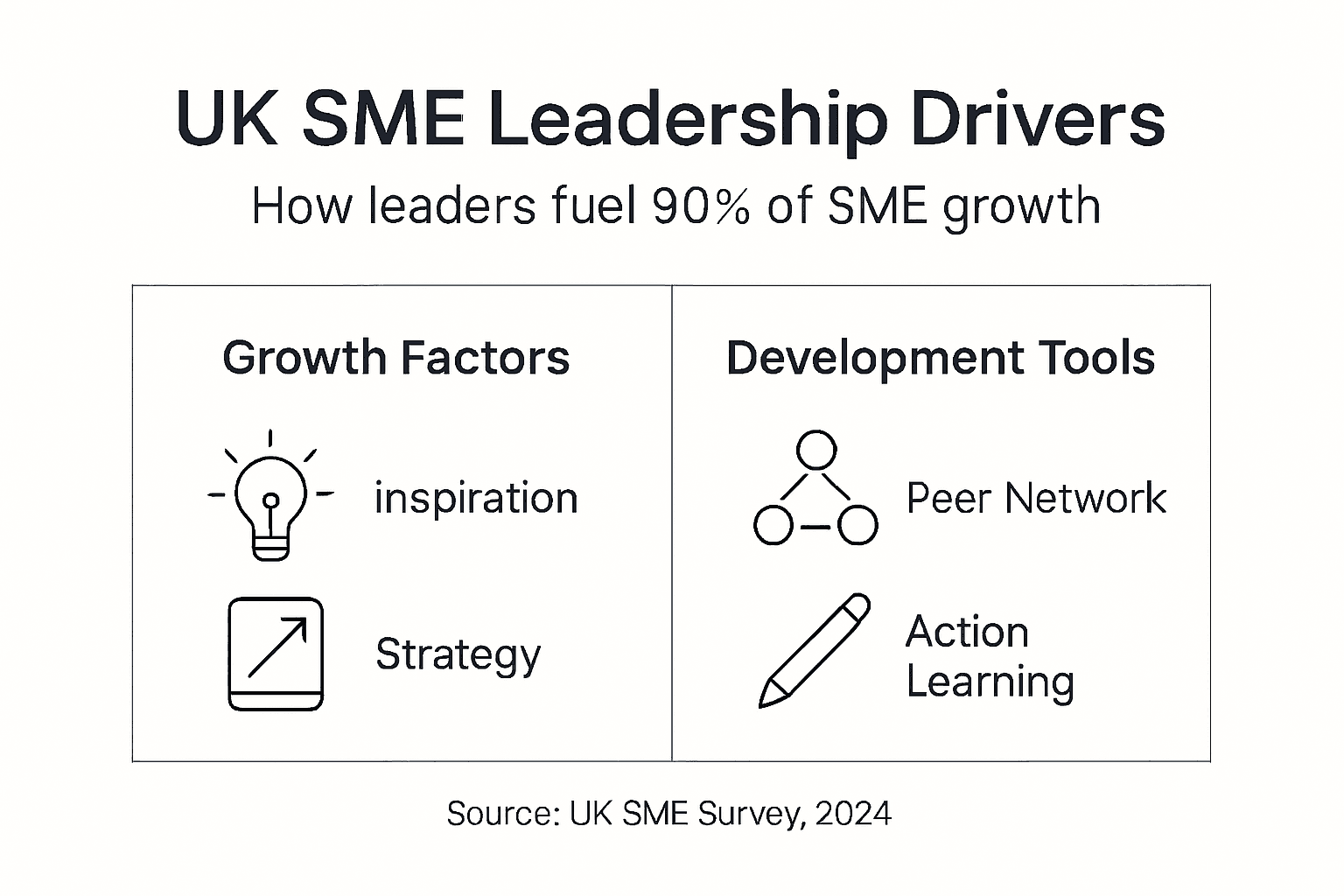
Peer mentoring connects you with other SME leaders facing similar challenges. These relationships provide practical insights that generic business advice cannot match. You learn from others’ mistakes and successes in real time.
Action learning involves tackling real business problems through structured reflection and experimentation. You test approaches, review results, and adjust strategies based on evidence. This method builds practical problem-solving skills faster than classroom learning.
Tacit knowledge sharing transfers the unstated wisdom that experienced leaders accumulate. This includes knowing when to push for growth versus when to consolidate, reading team dynamics accurately, and sensing market shifts before data confirms them.
Follow these steps to build leadership capabilities aligned with SME growth phases:
- Assess your current leadership strengths and development needs honestly
- Join a peer network of SME leaders in similar growth stages
- Commit to action learning projects that address your real business challenges
- Schedule regular reflection time to extract lessons from daily experiences
- Seek feedback from your team about leadership effectiveness and blind spots
- Invest in targeted development programs focused on SME-specific leadership skills
- Share your learning with peers to reinforce concepts and build your network
Ongoing development helps you manage episodic growth and increasing complexity. SMEs rarely grow smoothly. You face periods of rapid expansion followed by consolidation. Each phase demands different leadership capabilities.
Pro Tip: Leverage peer networks for real-time learning and problem solving. When you face a difficult decision or unfamiliar challenge, reach out to peers who have navigated similar situations. Their practical insights often prove more valuable than consultant advice.
Explore business intelligence for SMEs development to understand how data capabilities support leadership decision-making. Review business growth strategies to align your leadership development with strategic priorities.
Conclusion: Leadership with Impact – Next Steps for UK SME Leaders
Leadership quality determines SME success more than any other factor. The evidence is clear: 90% of UK SMEs reported growth in 2024, driven largely by effective leadership that created strategic clarity and team engagement. Your leadership approach shapes culture, innovation, and performance directly.
Transformational leadership offers unique benefits for UK SMEs. This style empowers teams, encourages innovation, and builds psychological safety. When you lead transformationally, you create conditions where people contribute their best work consistently.
Investing in leadership development yields practical performance improvements. Peer mentoring, action learning, and continuous reflection build the capabilities you need to manage growth challenges. These are not theoretical exercises but practical tools that deliver measurable results.
Take action today. Assess your leadership style honestly. Join a peer network. Commit to one development area that will most impact your business. Your growth as a leader directly translates into growth for your SME.
Discover Tools to Elevate Your SME Leadership and Growth
Leadership drives growth, but effective tools amplify your impact. KefiHub offers practical resources designed specifically for UK SME leaders who want to make data-driven decisions and build high-performing teams.
Explore business intelligence for UK SMEs to gain visibility into the metrics that matter most for strategic decisions. Discover how analytics for SME growth transforms raw data into actionable insights. Learn about business automation for SMEs that frees your time for strategic leadership activities. These resources bridge the gap between leadership knowledge and practical implementation, helping you apply insights from this article to drive measurable business results.
FAQ
What is transformational leadership and why is it important for SMEs?
Transformational leadership inspires and empowers teams, fostering innovation and motivation crucial for SME success. Unlike transactional or laissez-faire styles, it drives lasting change and growth in smaller businesses. This approach creates psychological safety where people contribute their best ideas and effort consistently.
How can SME leaders develop effective leadership skills?
Engage in leadership development programs featuring peer networks and real-world problem solving. Continuous learning aligned with SME growth challenges builds leadership capabilities through action learning and tacit knowledge sharing. Join peer mentoring groups where you tackle actual business problems with other SME leaders.
Why is leadership more critical in SMEs than in larger companies?
Leadership in SMEs has a greater effect because leaders have closer influence on culture and team dynamics. Smaller teams mean every leadership action directly affects performance and morale without layers of management to buffer impact. Your decisions ripple through the entire organisation immediately.
What leadership challenges are unique to UK SMEs?
UK SMEs face leadership challenges managing limited resources and balancing short-term versus long-term priorities. Navigating episodic growth cycles requires adaptable leadership approaches that maintain strategic focus while addressing immediate operational demands. Leaders must make high-stakes decisions with incomplete information more frequently than corporate executives.
Recommended
- Business Growth Roadmap: Step-by-Step Path for UK SMEs – Kefihub
- Role of Analytics in Growth: UK SME Impact – Kefihub
- 7 Smart Business Growth Strategies for UK Professionals – Kefihub
- Key Business Metrics Explained: Driving UK Growth – Kefihub