


Over 60 percent of British small businesses struggle to make sense of their own data, leaving owners unsure how to steer growth or spot emerging trends. For business leaders juggling daily operations, the idea of implementing Business Intelligence can feel daunting. This guide breaks down BI into simple steps, showing how accessible tools can help British entrepreneurs finally turn messy spreadsheets into clear, actionable insight without unnecessary fuss.
Table of Contents
- Defining Business Intelligence For UK SMEs
- Key Processes: Data Collection To Insight
- Types Of Business Intelligence Tools And Platforms
- Benefits And Real-World Applications In Small Firms
- Costs, Risks And Common Implementation Challenges
- Practical Steps For Successful Adoption
Key Takeaways
| Point | Details |
|---|---|
| Business Intelligence Empowers SMEs | BI provides small and medium enterprises with actionable insights, enhancing strategic decision-making and competitiveness. |
| Data-Driven Approach is Essential | Effective BI relies on collecting high-quality data, which helps identify trends and opportunities for growth. |
| Accessible BI Tools Enhance Decision-Making | Modern BI tools have transitioned to user-friendly platforms, allowing SMEs to easily analyse data and visualise insights. |
| Implementation Challenges Must Be Managed | SMEs face several challenges when adopting BI, including cost, skills gaps, and integration issues, which require careful planning and solutions. |
Defining business intelligence for UK SMEs
Business Intelligence (BI) represents a powerful strategic approach enabling small and medium enterprises to transform raw company data into meaningful insights. At its core, BI is about converting complex information into actionable knowledge that drives smart decision-making across all business functions.
For UK small businesses, Business Intelligence offers a systematic method to analyse historical and current data, helping entrepreneurs understand performance trends, customer behaviours, and potential market opportunities. By leveraging strategic data analysis, SMEs can move beyond guesswork and develop evidence-based strategies that enhance competitiveness.
BI tools have evolved significantly, becoming more accessible and affordable for smaller enterprises. Modern solutions offer user-friendly dashboards and reporting systems that integrate data from multiple sources like sales records, customer interactions, financial transactions, and marketing campaigns. These tools help UK small business owners visualise complex information through intuitive graphics, enabling faster and more accurate strategic planning.
Key Components of Business Intelligence for SMEs include:
- Data collection and integration
- Performance tracking
- Predictive analytics
- Interactive reporting dashboards
- Real-time insights generation
Pro tip: Start with one or two core metrics relevant to your business and gradually expand your business intelligence capabilities as you become more comfortable with data analysis techniques.
Key processes: data collection to insight
Businesses today generate vast quantities of data, but transforming this raw information into meaningful insights requires a systematic approach. The Business Intelligence cycle represents a strategic method for converting complex data into actionable business knowledge, enabling organisations to make informed decisions efficiently.
The process begins with comprehensive data collection strategies, which involve gathering information from multiple sources such as sales records, customer interactions, financial transactions, and operational metrics. Each data point serves as a potential puzzle piece in understanding broader business performance trends. Small businesses must focus on collecting high-quality, relevant data that directly relates to their strategic objectives.
Once collected, data undergoes critical transformation processes. Advanced analytical tools help UK small businesses clean, integrate, and analyse information through statistical methods and machine learning algorithms. These technologies can identify patterns, predict trends, and generate visual representations that make complex data easily understandable for decision-makers.
Key Steps in Business Intelligence Data Processing:
- Data identification and sourcing
- Data cleaning and validation
- Integration from multiple sources
- Advanced statistical analysis
- Visualisation and reporting
- Strategic insight generation
Pro tip: Invest in user-friendly data integration tools that can automatically connect and standardise information from different business systems, reducing manual data preparation time.
Types of business intelligence tools and platforms
Business Intelligence (BI) tools have revolutionised how small and medium enterprises approach data analysis, offering a range of sophisticated yet accessible solutions. Modern platforms have transformed from complex, expensive systems into user-friendly technologies that can dramatically enhance strategic decision-making for UK businesses.
The landscape of business intelligence platforms now includes cloud-based solutions that provide unprecedented flexibility for small enterprises. These tools typically offer capabilities such as interactive dashboards, data visualisation, predictive analytics, and reporting features that enable businesses to transform raw data into actionable insights quickly and efficiently.
BI tools can be categorised into several key types, each serving different organisational needs. Some focus on data visualisation, creating intuitive graphics that help business owners understand complex information at a glance. Others specialise in advanced analytics, using machine learning algorithms to predict future trends and identify potential business opportunities. Mobile-friendly platforms have also emerged, allowing entrepreneurs to access critical business insights directly from smartphones and tablets.
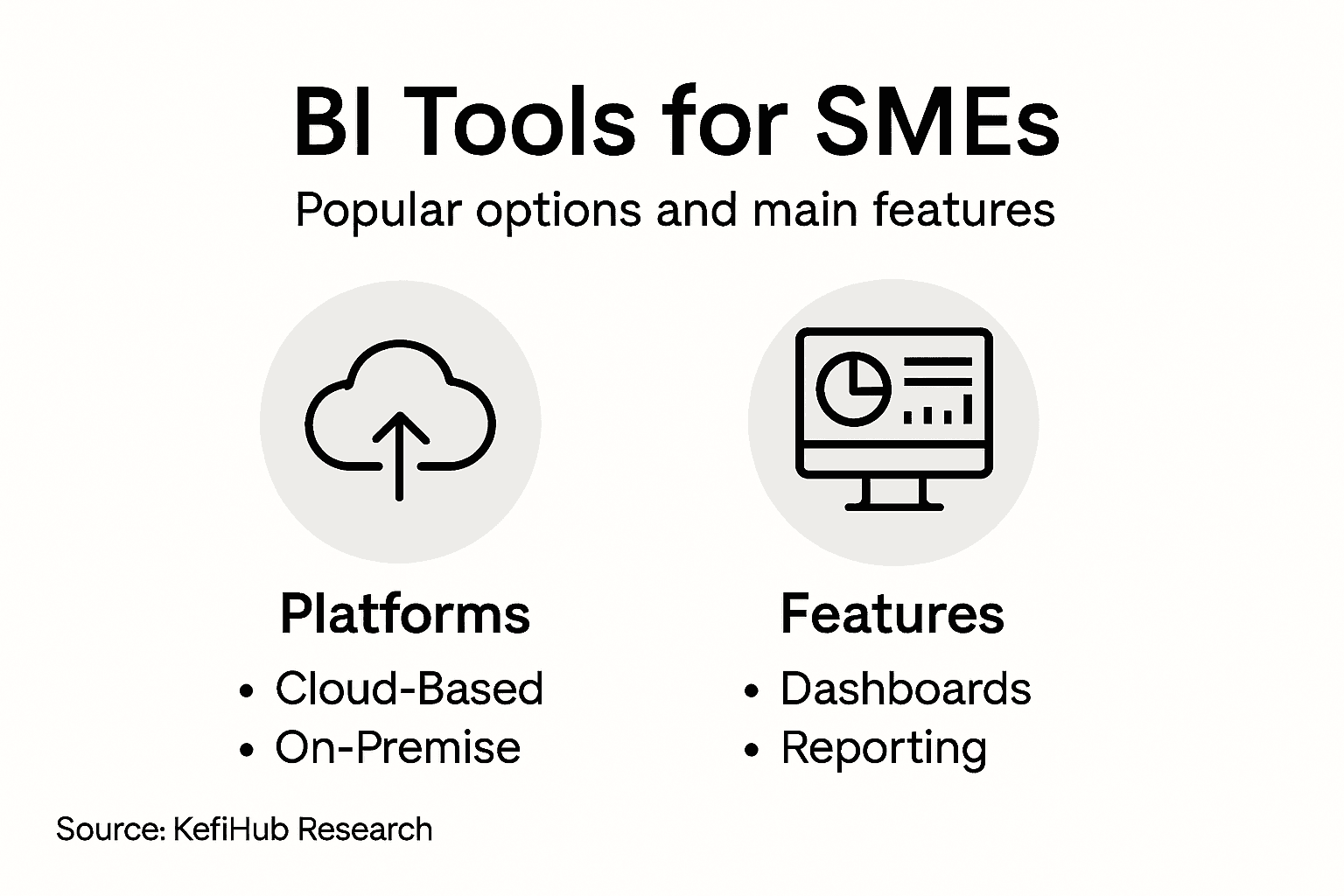
Primary Categories of Business Intelligence Tools:
Here is a summary comparing types of BI tools and their primary advantages for UK SMEs:
| BI Tool Type | Main Benefit | Example Application |
|---|---|---|
| Reporting and Querying | Faster business reporting | Quick sales monitoring |
| OLAP Platforms | In-depth data analysis | Analysing customer trends |
| Dashboarding Solutions | Real-time performance visibility | Tracking daily KPIs |
| Predictive Analytics | Anticipating future trends | Sales forecasting |
| Data Mining Tools | Discovering hidden patterns | Identifying fraud risks |
| Self-Service BI | Reducing IT dependency | Ad-hoc report creation |
- Reporting and querying tools
- Online analytical processing (OLAP) tools
- Dashboarding platforms
- Predictive analytics solutions
- Data mining and clustering tools
- Self-service BI platforms
Pro tip: Start with a free or low-cost BI tool that offers scalable features, allowing your business to grow its data analysis capabilities incrementally without significant upfront investment.
Benefits and real-world applications in small firms
Business Intelligence (BI) offers transformative potential for small UK businesses, providing strategic insights that can level the competitive playing field. By converting complex data into actionable intelligence, BI enables smaller enterprises to make informed decisions typically reserved for larger corporations with extensive resources.

Strategic data analysis for SMEs empowers businesses to uncover hidden opportunities and optimise operational performance. Small firms can now leverage predictive analytics to understand customer behaviours, forecast market trends, and make precise inventory management decisions that directly impact profitability and growth.
Real-world applications of BI span multiple business functions, from financial planning to marketing strategy. Businesses can track key performance indicators, analyse sales patterns, monitor customer satisfaction, and identify potential risks before they become significant challenges. For instance, a small retail business might use BI to understand purchasing trends, optimise stock levels, and personalise marketing campaigns based on customer data.
Key Practical Applications of Business Intelligence:
- Financial performance tracking
- Customer behaviour analysis
- Inventory management optimization
- Sales trend forecasting
- Marketing campaign effectiveness measurement
- Operational efficiency improvement
Pro tip: Begin by identifying three critical business questions you want answered, then select a BI tool that can provide clear, actionable insights addressing those specific challenges.
Costs, risks and common implementation challenges
Business Intelligence implementation for small UK enterprises is not without its complexities. While the potential benefits are significant, businesses must carefully navigate a landscape of financial, technological, and organisational challenges that can potentially derail their data strategy.
Implementation risks for SMEs encompass multiple dimensions that require strategic planning and careful consideration. The primary obstacles include substantial upfront costs, which can strain limited financial resources, technical complexity that demands specialised skills, and potential resistance from staff who may feel uncomfortable with data-driven decision-making approaches.
Small businesses must also consider technological integration challenges, ensuring that new BI systems can effectively communicate with existing software and databases. This often requires significant investment in staff training, potential system upgrades, and potentially hiring external consultants to manage the transition. The risk of selecting an inappropriate tool that does not align with specific business needs can lead to wasted resources and diminished return on investment.
Key Potential Risks in BI Implementation:
To better understand the journey, here is a comparison of challenges and solutions for BI implementation in small UK businesses:
| Challenge | Typical Business Impact | Practical Solution |
|---|---|---|
| High Initial Cost | Strained cash flow | Prioritise cloud BI platforms |
| Staff Skill Gaps | Misuse of BI tools | Targeted staff training |
| System Integration | Data silos remain | Use integration middleware |
| Data Security Risks | Legal/compliance issues | Implement strong data policies |
- High initial investment costs
- Technical complexity
- Staff skill gaps
- System integration challenges
- Data privacy and security concerns
- Potential resistance to cultural change
Pro tip: Conduct a comprehensive internal skills audit and start with a small-scale BI pilot project to minimise financial risks and gradually build organisational data literacy.
Practical steps for successful adoption
Successful Business Intelligence implementation requires a strategic, methodical approach that considers the unique constraints and opportunities of small UK enterprises. Businesses must move beyond viewing BI as a technological solution and understand it as a comprehensive organisational transformation.
Structured roadmap for BI adoption involves carefully planned phases that help mitigate risks and build sustainable data capabilities. This systematic approach allows small businesses to progressively integrate BI tools, ensuring each stage aligns with organisational goals and existing technological infrastructure.
The implementation journey begins with a thorough assessment of current business processes, data management practices, and strategic objectives. Small businesses should prioritise cloud-based BI solutions that offer flexibility, scalability, and lower initial investment. Key considerations include identifying critical business questions, mapping existing data sources, and establishing clear performance metrics that will guide the BI strategy.
Key Steps in BI Adoption Process:
- Conduct comprehensive organisational readiness assessment
- Define specific business intelligence objectives
- Identify and prioritise relevant data sources
- Select appropriate cloud-based BI tools
- Develop staff training and change management plan
- Establish metrics for measuring BI effectiveness
- Create iterative implementation and feedback mechanism
Pro tip: Begin with a small pilot project targeting one specific business function, using this initial implementation to build internal confidence and demonstrate tangible value before broader rollout.
Unlock the Power of Business Intelligence for Your UK Small Business
Many UK small businesses face challenges like high costs, complex technology, and the need for clear strategic insights as they begin their journey with Business Intelligence. This article highlights crucial pain points such as staff skill gaps, system integration difficulties, and data-driven decision-making obstacles. If you are aiming to convert raw data into actionable insights while avoiding costly mistakes, understanding the right tools and practical adoption steps is essential.
At KefiHub we provide clear, reliable and practical guidance tailored for UK small business owners looking to embrace Business Intelligence successfully. Whether you want to explore business intelligence tools and platforms, learn how to overcome common implementation challenges, or discover how to start with a small pilot project, our expert resources will help you build confidence and unlock growth opportunities.
Take control of your business performance today by visiting KefiHub for trusted insights and advice. Start navigating your Business Intelligence journey with clarity and practical support that helps you transform data into valuable decisions.
Frequently Asked Questions
What is Business Intelligence and how can it benefit small businesses?
Business Intelligence (BI) refers to tools and strategies that help small businesses analyse data to gain meaningful insights, improve decision-making, and enhance competitiveness by understanding performance trends and customer behaviours.
What are the key components of Business Intelligence for SMEs?
The key components of Business Intelligence for SMEs include data collection and integration, performance tracking, predictive analytics, interactive reporting dashboards, and real-time insights generation.
How can small businesses implement Business Intelligence effectively?
Small businesses can implement Business Intelligence effectively by following a structured roadmap that includes assessing current processes, defining specific BI objectives, selecting appropriate tools, and developing staff training and change management plans.
What common challenges do small businesses face when adopting Business Intelligence?
Common challenges in BI adoption for small businesses include high initial costs, technical complexity, staff skill gaps, system integration issues, and potential resistance to cultural change.
Recommended
- Why Build a Website: Boosting UK Small Businesses – Kefihub
- 7 Effective Marketing Strategies for SMEs to Drive Growth – Kefihub
- Networking for SMEs Guide: Build Connections for Growth – Kefihub
- Key Business Metrics Explained: Driving UK Growth – Kefihub
- Why Businesses Need Cybersecurity Expertise in 2026