


Over 80 percent of british small businesses struggle to move beyond their initial growth phase. For many entrepreneurs, clearly understanding their business position and setting actionable goals can mean the difference between lasting success and stagnation. Whether you are aiming to expand your reach or navigate rigorous regulatory demands, learning how to assess, plan, and adapt will help future proof your business and keep you ahead in a rapidly shifting marketplace.
Table of Contents
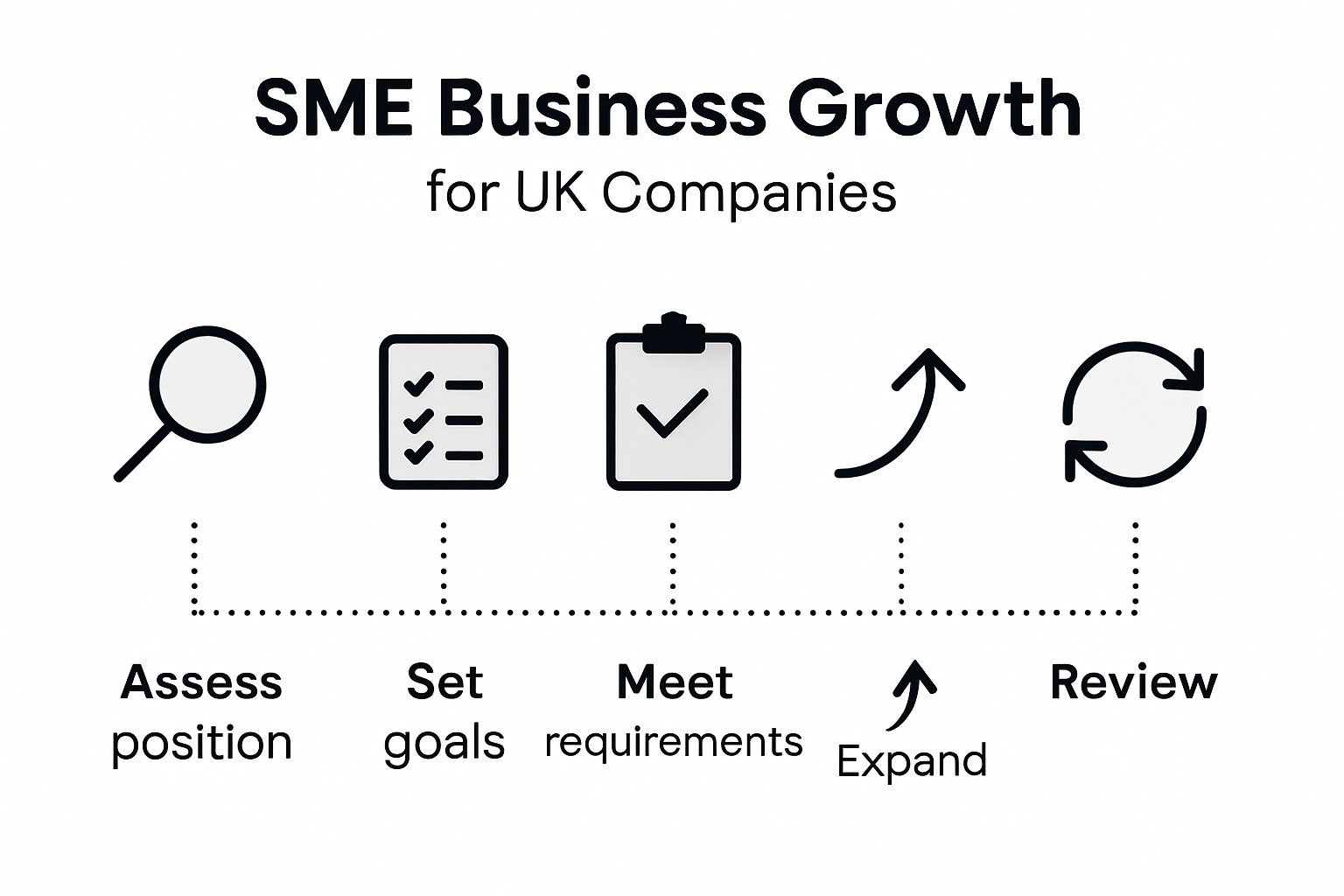
- Step 1: Assess Your Current Business Position
- Step 2: Define Clear and Measurable Growth Goals
- Step 3: Identify Key Legal and Market Requirements
- Step 4: Develop Practical Strategies for Expansion
- Step 5: Review Progress and Adjust Your Roadmap
Quick Summary
| Main Insight | Detailed Explanation |
|---|---|
| 1. Perform a SWOT Analysis | Evaluate your business’s strengths, weaknesses, opportunities, and threats for strategic insight. This identifies areas requiring improvement and informs growth planning. |
| 2. Set SMART Goals | Define Specific, Measurable, Achievable, Relevant, and Time-bound objectives to guide your business strategy effectively. This helps in clearly tracking progress and team motivation. |
| 3. Understand Legal Requirements | Systematically assess regulatory obligations, business structure, tax responsibilities, and employment laws. Ensuring compliance is crucial for sustainable growth. |
| 4. Create Actionable Strategies | Develop specific and implementable strategies across market penetration, product development, and geographical expansion to drive business growth. |
| 5. Regularly Review Progress | Establish a routine for evaluating performance against your goals. Adjust your strategy based on these reviews to maintain responsiveness to market changes. |
Step 1: Assess Your Current Business Position
Understanding your business’s current position is crucial for strategic growth and future planning. This step involves conducting a comprehensive evaluation of your organisation’s strengths, weaknesses, opportunities, and potential challenges.
To effectively assess your business position, start by performing a strategic SWOT analysis that examines your internal capabilities and external market conditions. This process will help you map out where your business currently stands and identify key areas for improvement. Break down your assessment into four critical dimensions:
- Strengths: List your business’s unique advantages, core competencies, and resources that set you apart from competitors
- Weaknesses: Identify internal limitations, skill gaps, or operational inefficiencies that might hinder growth
- Opportunities: Explore potential market trends, emerging technologies, or unexplored customer segments
- Threats: Recognise external factors like competitive pressures, regulatory changes, or economic shifts that could impact your business
Define clear operational objectives that align with your long-term vision. These short-term goals will provide practical guidance for daily operations and help you systematically progress towards your broader business ambitions. Consider metrics like revenue targets, customer acquisition rates, product development milestones, and team performance indicators.
Pro Tip: Be brutally honest during your assessment. Recognising genuine challenges is the first step towards meaningful improvement.
Once you have completed your business position assessment, you will be prepared to develop a targeted strategy that capitalises on your strengths and addresses potential vulnerabilities. The next step involves translating these insights into a concrete growth roadmap.

Step 2: Define Clear and Measurable Growth Goals
Transforming your business strategy requires setting precise and actionable goals that will drive meaningful progress. This crucial step moves your organisation from broad aspirations to concrete, strategic targets that can be systematically pursued and achieved.
To establish effective growth objectives, implement the SMART framework for strategic planning, which provides a robust methodology for goal setting. SMART goals ensure your targets are Specific, Measurable, Achievable, Relevant, and Time-bound. Break down your goals across different business dimensions:
- Financial Goals: Define specific revenue targets, profit margins, and investment objectives
- Customer Acquisition: Set clear targets for new client numbers, conversion rates, and market expansion
- Operational Efficiency: Establish metrics for productivity, cost reduction, and process improvements
- Innovation and Development: Create milestones for product enhancements, technology adoption, and research initiatives
By implementing SMART goals, you create a structured approach that reduces uncertainty and boosts team motivation. Each goal should have a specific numerical target, a clear deadline, and a direct connection to your broader business strategy.
Pro Tip: Regularly review and adjust your goals. Business environments change rapidly, and your objectives should remain flexible and responsive.
Once you have defined your clear and measurable growth goals, you will be prepared to develop a detailed action plan that translates these targets into practical steps. The next stage involves creating a comprehensive strategy to achieve these carefully crafted objectives.
Step 3: Identify Key Legal and Market Requirements
Navigating the complex landscape of legal and market requirements is critical for sustainable business growth. This step involves a comprehensive examination of the regulatory environment and market dynamics that will shape your business strategy.
Utilise the OGSM framework for strategic alignment to systematically evaluate your legal and market requirements. This approach helps you define clear Objectives, Goals, Strategies, and Measures that ensure compliance and strategic positioning. Your assessment should cover multiple critical areas:
- Regulatory Compliance: Understand industry specific legal obligations, licensing requirements, and statutory regulations
- Business Structure: Determine the most appropriate legal entity type for your specific business model
- Tax Obligations: Identify VAT requirements, corporation tax responsibilities, and potential tax incentives
- Employment Law: Review recruitment, workplace, and contractual regulations
- Sector Specific Requirements: Research industry standards and professional accreditations relevant to your business
The European Commission’s SME definition provides valuable insights into understanding your business classification and potential support mechanisms. This classification can impact your access to funding, grants, and specific regulatory frameworks.
Pro Tip: Consult with a legal professional specialising in small business regulations to ensure comprehensive understanding of your specific requirements.
Once you have thoroughly mapped out the legal and market requirements, you will be well positioned to develop a robust compliance strategy. The next stage involves translating these insights into actionable business protocols that protect and propel your enterprise forward.
Step 4: Develop Practical Strategies for Expansion
Expanding your business requires a strategic and measured approach that balances ambition with pragmatic planning. This crucial step transforms your growth aspirations from abstract concepts into actionable, implementable strategies that can genuinely propel your organisation forward.
Setting SMART objectives across different growth categories provides a structured framework for systematic expansion. Your strategic development should encompass multiple dimensions:
- Market Penetration: Identify opportunities to increase market share within existing customer segments
- Product Development: Explore innovations or enhancements that can attract new customer interest
- Geographic Expansion: Consider potential new territories or customer markets
- Diversification: Investigate complementary services or product lines that align with your core competencies
- Digital Transformation: Implement technological solutions that improve operational efficiency and customer engagement
Each strategic approach requires careful evaluation of potential risks, resource requirements, and expected returns. Consider creating detailed implementation plans that include specific milestones, resource allocation, and performance metrics. Prioritise strategies that align closely with your core business strengths and demonstrate clear potential for sustainable growth.
Pro Tip: Maintain flexibility in your expansion strategies. Regular review and adaptation are key to navigating changing market conditions.
Once you have developed your practical expansion strategies, you will be prepared to create a comprehensive implementation roadmap. The next stage involves translating these strategic insights into concrete action plans that can drive your business forward.
Step 5: Review Progress and Adjust Your Roadmap
Successful business growth requires continuous monitoring, reflection, and strategic recalibration. This crucial step transforms your initial plans into a dynamic, responsive strategy that adapts to changing market conditions and organisational capabilities.
Setting clear goals and performance indicators enables precise measurement of your business progress. Establish a systematic review process that encompasses multiple evaluation dimensions:
- Financial Performance: Track revenue, profit margins, and return on investment
- Operational Efficiency: Assess productivity, cost management, and resource utilisation
- Market Positioning: Analyse customer acquisition, retention rates, and market share
- Strategic Milestone Achievement: Evaluate progress against predefined objectives
- Team Performance: Review individual and collective contributions to business goals
Conduct quarterly comprehensive reviews that provide a holistic view of your business performance. During these assessments, critically analyse both quantitative metrics and qualitative insights. Be prepared to make decisive adjustments to your strategy, reallocate resources, or pivot approaches that are not delivering expected outcomes.
Pro Tip: Develop a culture of transparency and continuous improvement. Involve your team in review processes to gain diverse perspectives and foster collective commitment.
By maintaining a rigorous and adaptive approach to progress review, you create a resilient framework for sustainable business growth. The ongoing process of assessment and adjustment becomes a fundamental driver of your long term success.
Unlock Your UK SME’s Full Potential with Expert Guidance
Navigating the complexities of business growth can be overwhelming, especially when balancing strategic goals with legal and market demands. This article on building a clear business growth roadmap highlights challenges such as setting SMART objectives, managing regulatory compliance, and adapting strategies through continuous review. If you are striving to transform ambitions into actionable steps while overcoming operational hurdles KefiHub offers the insights and practical advice you need. Explore in-depth analysis and proven tactics tailored specifically for UK small and medium enterprises.
Dive into our Business Archives – Kefihub to discover valuable resources that complement this step-by-step guide. Whether you need expert commentary on legal requirements, digital transformation, or market expansion, our platform delivers clear, reliable support designed to accelerate your growth. Take control of your business future by visiting KefiHub today and start turning your roadmap into real-world success.
Frequently Asked Questions
How can I assess my current business position for growth?
To assess your current business position, perform a SWOT analysis that examines your strengths, weaknesses, opportunities, and threats. List specific advantages and limitations, and identify any potential market opportunities.
What are SMART goals, and how do I set them for my business’s growth?
SMART goals are Specific, Measurable, Achievable, Relevant, and Time-bound objectives that guide your business strategy. To set them, break down your targets into financial, customer acquisition, operational efficiency, and innovation categories, ensuring each goal has clear metrics and deadlines.
What legal and market requirements should I research for my business?
You should examine key legal obligations, including regulatory compliance, business structure, tax obligations, and employment law. Create a checklist of these requirements to ensure all aspects are covered before moving forward with your growth strategy.
How can I develop effective strategies for business expansion?
Develop strategies by focusing on market penetration, product development, geographic expansion, diversification, and digital transformation. Prioritise initiatives that align with your strengths and prepare detailed implementation plans with specific milestones and resource allocations.
How often should I review my business progress and adjust my roadmap?
Conduct comprehensive reviews of your business progress quarterly to assess financial performance, operational efficiency, and market positioning. Use this regular review to make necessary adjustments to your strategy, ensuring that you remain responsive to changing market conditions.
What steps should I take if my growth strategy isn’t delivering expected outcomes?
If your growth strategy isn’t yielding results, conduct a thorough assessment of your performance metrics and identify areas needing improvement. Be prepared to pivot your approach and reallocate resources effectively, aiming to implement these changes within 30 days to stay on track.
Recommended
- Starting a Small Business UK: Step-by-Step Legal Guide – Kefihub
- Business Plans: Why Every UK Venture Needs One – Kefihub
- How to Avoid Common Business Mistakes for UK Professionals – Kefihub
- Starting a Small Business UK: Step-by-Step Legal Guide – Kefihub