


Over half of all website traffic in 2026 comes from SEO, yet many UK small businesses still overlook this powerful channel. Neglecting SEO means losing customers to competitors who rank higher in search results. This guide delivers practical, affordable SEO strategies tailored to 2026 realities, helping you boost visibility, attract local customers, and achieve sustainable growth in an increasingly competitive digital landscape.
Table of Contents
- The Evolving Role Of SEO In 2026
- Adapting SEO For AI And New Search Algorithms
- Leveraging Local SEO For Small Business Growth
- Quantifying SEO Impact For UK Small Businesses
- Common Misconceptions And Knowledge Gaps
- Practical SEO Strategies For UK Small Businesses In 2026
- Measuring And Maintaining SEO Success
- Summary: Future-Proofing Your SEO For Sustainable Growth
- Empower Your Business Growth With Kefihub Solutions
Key Takeaways
| Point | Details |
|---|---|
| SEO drives majority traffic | SEO generates 53.3% of website traffic for UK small businesses in 2026. |
| AI reshapes strategy | Voice search and AI algorithms demand quality content and local relevance. |
| Local SEO yields results | Optimized Google Business Profiles attract 3.2x more local visits. |
| ROI outperforms ads | SEO delivers 312% median ROI, surpassing paid advertising channels. |
| Ongoing effort wins | Continuous optimization beats one-time fixes or shortcuts. |
The Evolving Role of SEO in 2026
Search engine optimization remains the backbone of digital marketing for UK small businesses. SEO drives approximately 53.3% of website traffic, making it the single largest source of online visitors. More than 90% of online experiences in the UK start with a search engine, positioning SEO as the gateway to customer discovery.
Unlike paid advertising that stops delivering results the moment you stop spending, SEO creates sustainable, long-term organic growth. Once your site ranks well, it continues attracting visitors without ongoing ad costs. This makes SEO particularly valuable for small businesses operating on limited marketing budgets.
Digital competition has intensified across every UK industry. Businesses that ignore SEO risk invisibility in search results, effectively handing customers to competitors who invest in their online presence. The gap between SEO leaders and laggards widens each year, making early adoption critical for survival and growth.
Basic SEO practices from five years ago no longer suffice. User behavior shifts, voice searches increase, and mobile browsing dominates. Small businesses must evolve their SEO approach to address these changes or watch their rankings decline. The good news? Effective SEO in 2026 is more accessible than ever for those willing to learn and adapt.
“SEO isn’t just about ranking higher. It’s about being found by the right customers at the exact moment they need your services.”
Combining SEO with complementary channels like social media tips for UK small businesses creates a robust digital presence that compounds over time.
Adapting SEO for AI and New Search Algorithms
Artificial intelligence has fundamentally transformed how search engines evaluate and rank content. Google’s AI-driven algorithms in 2026 prioritize content quality, user experience, and E-E-A-T principles (Experience, Expertise, Authoritativeness, Trustworthiness). Keywords alone no longer guarantee visibility.
Voice searches and mobile queries now represent the majority of searches. People ask complete questions rather than typing fragmented keywords. Your content must target conversational phrases and natural language patterns to capture this traffic. A mobile-friendly, fast-loading site is mandatory, not optional.
High-quality content that genuinely addresses user intent ranks better than keyword-stuffed pages. AI algorithms detect and reward content that solves real problems, answers specific questions, and provides actionable value. Thin, repetitive, or promotional content gets pushed down in rankings.
User experience metrics directly impact your SEO performance. Search engines track how visitors interact with your site: bounce rates, time on page, navigation patterns. A confusing layout or slow load time signals poor quality, hurting your rankings regardless of content quality.
Pro Tip: Audit your site speed using free tools like Google PageSpeed Insights. Even a one-second delay in load time can reduce conversions by 7%.
Regular content updates signal relevance to AI algorithms. Websites that publish fresh, timely content consistently outrank static sites. This doesn’t mean daily blog posts; it means refreshing existing pages, updating statistics, and adding new insights as your industry evolves.
Implementing essential SEO tips for UK small businesses ensures your site meets current algorithmic standards and delivers the user experience search engines reward.
Leveraging Local SEO for Small Business Growth
Local SEO represents the highest-impact, most cost-effective strategy for UK small businesses. Google Business Profile optimization can generate 3.2 times more local search website visits when profiles exceed 90% completeness. This single tactic delivers more local customers than most paid advertising campaigns.

78% of UK SMEs identify Google Business Profile optimization as their highest-ROI SEO strategy, making local SEO the most impactful growth tactic available. The effort required is minimal compared to the return: accurate business information, regular posts, responding to reviews, and adding photos.
Optimizing for local keywords tailored to neighborhoods, regions, or city-specific terms increases visibility when nearby customers search. Instead of competing nationally for “plumber,” rank locally for “emergency plumber Islington” or “boiler repair Manchester.” Local specificity reduces competition and improves conversion rates.
| Local SEO Tactic | Impact | Effort Required |
|---|---|---|
| Google Business Profile optimization | 3.2x more visits | Low |
| Local keyword targeting | Higher conversion rates | Medium |
| Review management | Improved trust and rankings | Low |
| Local content creation | Sustained visibility | Medium |
Encouraging customer reviews and actively managing your online reputation boosts both rankings and trust. Potential customers read reviews before contacting businesses. A profile with recent, genuine reviews converts better and ranks higher than one with few or outdated testimonials.
Pro Tip: Ask satisfied customers for reviews immediately after service completion. Timing matters; wait too long and they forget or lose motivation.
Local SEO levels the playing field for small businesses with limited budgets. You compete against nearby businesses, not national corporations with massive marketing spend. Focus your efforts locally, and you can dominate your geographic market regardless of company size.
Combining local SEO with broader business growth strategies for UK professionals and leveraging the role of analytics in growth creates a comprehensive approach to sustainable expansion.
Quantifying SEO Impact for UK Small Businesses
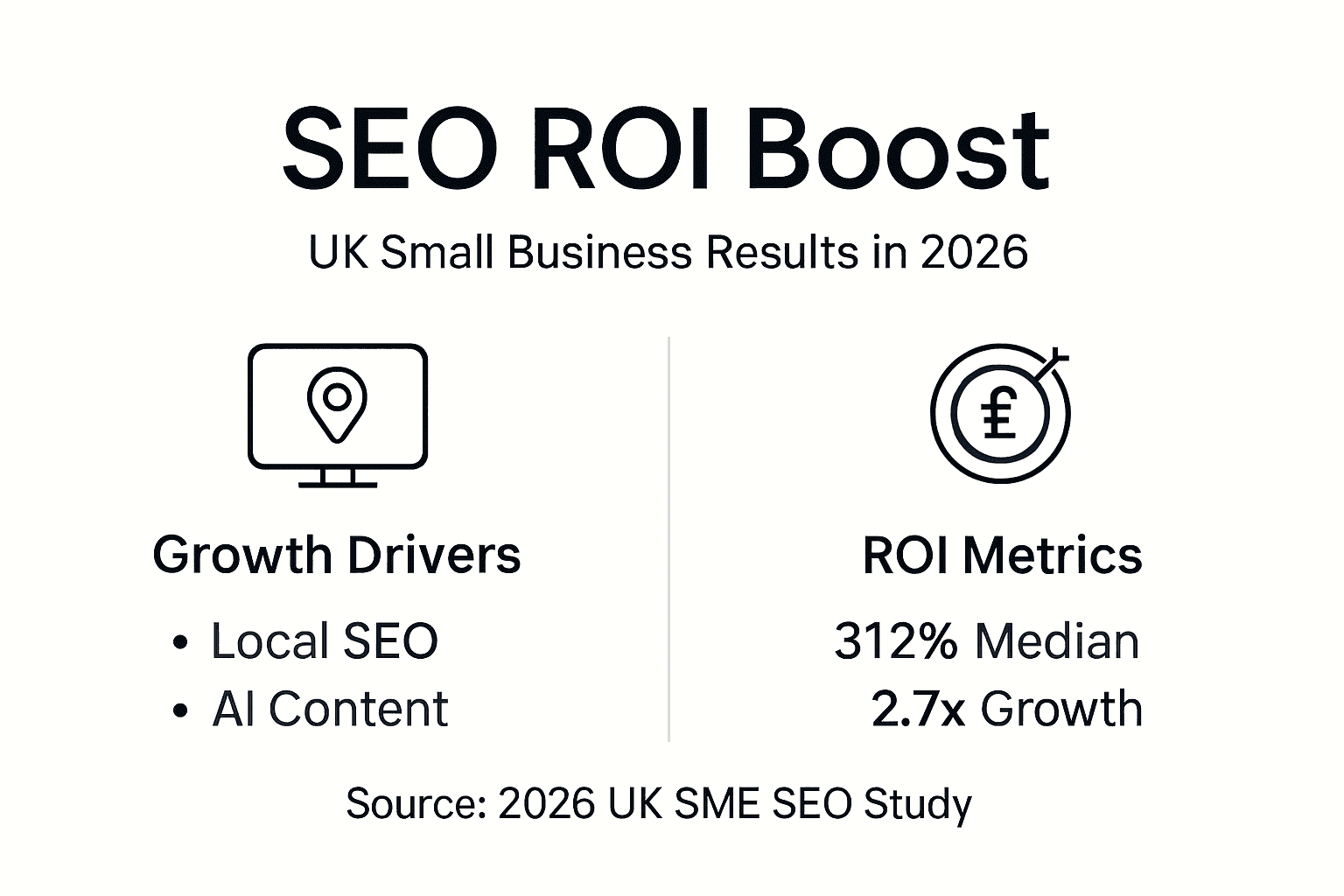
Data proves SEO’s value beyond anecdotal success stories. Small UK businesses investing in structured SEO strategies experienced a median 67% year-over-year increase in organic traffic. This growth compounds annually, creating exponential visibility gains over time.
Return on investment tells the real story. SEO provides a median ROI of 312% for UK small businesses, outperforming paid channels in sustained long-term growth and cost-effectiveness. For every pound invested in SEO, businesses see £3.12 returned through increased revenue and reduced customer acquisition costs.
Ethical, white-hat SEO practices deliver 2.7 times better growth for UK SMEs compared to shortcuts or black-hat tactics. Quick fixes might boost rankings temporarily, but algorithm updates penalize manipulative techniques, often resulting in permanent traffic loss. Patient, ethical optimization wins every time.
| SEO Metric | Median Result | Timeframe |
|---|---|---|
| Organic traffic increase | 67% year-over-year | 12 months |
| Return on investment | 312% | Ongoing |
| White-hat vs. shortcuts | 2.7x better growth | Long term |
| Traffic sustainability | Compounds annually | Multi-year |
SEO builds sustainable brand authority that paid advertising cannot replicate. High search rankings signal credibility and expertise to potential customers. This perceived authority translates into higher conversion rates and customer lifetime value, multiplying SEO’s financial impact.
Results compound over time rather than resetting monthly like ad campaigns. A well-optimized page continues attracting visitors for years, while paid ads stop delivering the moment budgets run out. This makes SEO the smartest long-term investment for marketing strategies for UK SMEs operating with finite resources.
Data supports making SEO a priority investment in your marketing budget. The question isn’t whether you can afford SEO; it’s whether you can afford to ignore it while competitors capture your potential customers.
Common Misconceptions and Knowledge Gaps
A critical disconnect exists between recognizing SEO’s importance and executing it effectively. 91% of UK SMEs consider SEO essential but only 28% feel confident in their SEO knowledge, highlighting a knowledge gap that prevents businesses from capturing available growth opportunities.
Many small business owners mistakenly view SEO as a one-time project rather than ongoing optimization. They expect to “finish” SEO and move on to other priorities. This mindset leads to declining rankings as competitors continuously improve and algorithms evolve. SEO requires regular attention, though not necessarily daily effort.
The belief that paid advertising delivers better results than SEO persists despite contradictory evidence. While ads provide immediate visibility, they cost more per customer and stop working when budgets end. SEO’s 312% ROI and compounding returns make it objectively superior for long-term growth, yet many businesses still prioritize ad spend.
Risk lurks in using black-hat or shortcut tactics promising quick results. Ethical practices deliver 2.7 times better growth than shortcuts, yet some businesses still fall for schemes that ultimately harm rankings. Algorithm updates specifically target manipulative techniques, often resulting in permanent traffic loss and recovery costs exceeding any short-term gains.
Educating your team and committing to continual SEO effort creates competitive advantage. Businesses that invest in learning current best practices outperform those relying on outdated knowledge or delegating SEO without understanding core principles. You don’t need to become an expert, but understanding fundamentals ensures effective strategy and vendor management.
Closing knowledge gaps through resources like this SEO learning guide for UK SMEs empowers you to make informed decisions and avoid costly mistakes that undermine your digital presence.
Practical SEO Strategies for UK Small Businesses in 2026
Start with a local SEO audit focused on Google Business Profile completeness. Verify your business information is accurate across all fields: address, phone number, business hours, website, categories. Add high-quality photos, create posts regularly, and ensure your profile exceeds 90% completeness to unlock maximum visibility.
Optimize your website’s technical foundation for speed, mobile friendliness, and crawlability. Use free tools to identify and fix broken links, improve page load times, and ensure mobile visitors can navigate easily. Technical issues silently sabotage rankings regardless of content quality.
Create high-quality, AI-friendly content targeting local and conversational search queries. Write for humans first, not search engines. Answer specific questions your customers ask. Use natural language and complete sentences that mirror how people speak when using voice search.
Pro Tip: Record common customer questions during sales calls or emails. These real queries make perfect content topics that rank well and convert visitors into customers.
- Complete your Google Business Profile to at least 90% with accurate information and regular updates.
- Fix technical SEO issues including site speed, mobile responsiveness, and navigation structure.
- Research and target local keywords specific to your service area and customer needs.
- Publish helpful content answering actual customer questions using conversational language.
- Build ethical backlinks through partnerships, directories, and genuine relationships with complementary businesses.
- Request reviews from satisfied customers and respond professionally to all feedback.
- Set up Google Analytics and Search Console to track traffic sources and search performance.
Build ethical backlinks and encourage genuine customer reviews simultaneously. Reach out to local business associations, suppliers, and complementary service providers for link opportunities. Focus on relevance and relationship quality over quantity. One relevant link from a trusted local source outweighs dozens of irrelevant directory listings.
Establish analytics tracking to measure organic traffic, local rankings, and conversions. You cannot improve what you don’t measure. Regular monitoring reveals which tactics work, which pages need improvement, and where opportunities exist for quick wins.
Implement essential SEO tips for small businesses and explore 7 ways to improve SEO for UK small businesses for additional tactical guidance. Remember that reducing business costs through efficient SEO frees budget for other growth initiatives.
Measuring and Maintaining SEO Success
Tracking organic traffic and conversion rates reveals SEO health and ROI. Monitor how many visitors arrive through search, which pages they view, and what actions they take. Increased traffic means nothing if visitors don’t convert into customers or leads.
Monitor Google Business Profile insights and local search rankings regularly. Check where you rank for target keywords monthly. Track profile views, clicks, and direction requests. These metrics directly indicate local SEO effectiveness and highlight improvement opportunities.
Adjust SEO tactics proactively with algorithm updates and evolving AI trends. Search engines announce major updates; stay informed and adapt quickly. What worked last year might hurt rankings this year. Flexibility and continuous learning separate winners from losers in SEO.
Prioritize content updates to maintain relevance and ranking positions. Refresh statistics, add new sections, and update outdated information on existing pages. Search engines reward fresh, current content over stale pages that haven’t changed in years.
Use insights to refine keyword targeting and user experience improvements. Analytics reveal which keywords drive traffic and which pages lose visitors quickly. Double down on what works. Fix or remove what doesn’t. Let data guide your optimization priorities.
Regular measurement using a structured growth roadmap for UK SMEs ensures SEO efforts align with broader business objectives and deliver measurable results that justify continued investment.
Summary: Future-Proofing Your SEO for Sustainable Growth
SEO remains essential for visibility and sustained growth in 2026 and beyond. The digital landscape continues evolving, but search engines remain the primary gateway customers use to discover businesses. Investing in SEO now positions your business to capture increasing online traffic as digital adoption accelerates.
Local SEO delivers the highest impact and most cost-effective results for UK SMEs. Focus your initial efforts here for quick wins and measurable ROI. A well-optimized Google Business Profile and targeted local content create immediate visibility improvements without requiring massive budgets or technical expertise.
Adapting to AI-driven changes and prioritizing quality content improves rankings and customer experience simultaneously. The same factors that please search algorithms also satisfy human visitors. Focus on genuinely helpful content and excellent user experience; rankings follow naturally.
Continuous SEO effort and ethical practices yield the best long-term results. Patience and consistency beat shortcuts every time. Small, regular improvements compound into significant competitive advantages over months and years.
UK small businesses equipped with these strategies compete successfully in the evolving digital landscape. You now understand why SEO matters, how to adapt to current realities, and which tactics deliver the highest returns. The knowledge gap that holds back 72% of UK SMEs no longer limits your growth potential.
Empower Your Business Growth with Kefihub Solutions
Transforming SEO knowledge into sustained business growth requires ongoing insights and strategic support. Kefihub offers tailored business intelligence for UK small businesses, helping you optimize SEO and marketing efforts with data-driven precision.
Discover effective marketing strategies for SMEs designed specifically for UK market realities. Track progress, reduce costs, and stay ahead of competitors with expert guidance tailored to small business constraints and opportunities. Access our business growth roadmap for UK SMEs to map your journey from current performance to ambitious growth targets, with SEO as your foundation for sustainable digital visibility.
FAQ
What is the role of AI in SEO for 2026?
AI shapes search engine algorithms by prioritizing high-quality, trustworthy content and excellent user experience over keyword manipulation. Search engines now understand content meaning and user intent rather than just matching keywords. SEO must adapt by creating genuinely helpful, AI-friendly content and optimizing site performance to meet these elevated standards.
How can small UK businesses benefit most from local SEO?
Local SEO increases visibility in nearby searches, driving more relevant traffic from customers ready to buy locally. Optimizing your Google Business Profile and encouraging customer reviews enhances trust while improving rankings. This approach delivers 3.2 times more local visits than incomplete profiles, making it the highest-ROI tactic available to small businesses.
What are common SEO misconceptions UK small businesses should avoid?
SEO requires ongoing effort rather than one-time work; it’s affordable with smart tactics and delivers higher ROI than paid ads over time. Avoid shortcuts or black-hat methods that promise quick results but ultimately harm rankings and waste resources. Ethical, patient optimization consistently outperforms manipulative techniques by 2.7 times in long-term growth.
Recommended
- 7 Practical Ways to Improve SEO for UK Small Businesses – Kefihub
- 7 Essential SEO Tips for Small Businesses in the UK – Kefihub
- Why Build a Website: Boosting UK Small Businesses – Kefihub
- How to Optimise Professional Website for UK SMEs – Kefihub
- SEO Trends in 2025: Growth Strategies for Founders
- Ecommerce Growth Strategies: Elevate Your Online Sales – ORNER