


Struggling to keep your business website both compliant and appealing? Legal regulations in the United Kingdom can change quickly, and digital expectations keep rising. Keeping up means more than ticking boxes—it requires ongoing review to maintain accuracy and trust. This guide brings together practical steps backed by digital competitiveness insights and official guidance to help you refine your site, reduce legal risks, and improve customer satisfaction.
Table of Contents
- Step 1: Assess Current Website Performance And Compliance
- Step 2: Update Content For Legal Accuracy And Clarity
- Step 3: Enhance Design For User Engagement
- Step 4: Improve Loading Speed And Mobile Responsiveness
- Step 5: Verify Optimisation With User Testing And Analytics
Quick Summary
| Key Point | Explanation |
|---|---|
| 1. Conduct Regular Website Audits | Assess website performance and compliance quarterly to identify and resolve issues affecting user experience and legal adherence. |
| 2. Ensure Legal Content Accuracy | Regularly review website content for compliance with UK data protection laws to maintain credibility and avoid penalties. |
| 3. Focus on User-Friendly Design | Enhance website design elements to create an intuitive experience that encourages user engagement across all devices. |
| 4. Optimise Loading Speed and Mobile Use | Implement strategies to improve loading times and mobile responsiveness to retain users and boost conversions. |
| 5. Leverage Analytics for Continuous Improvement | Use web analytics and user testing to gain insights and make iterative improvements to your website’s performance. |
Step 1: Assess current website performance and compliance
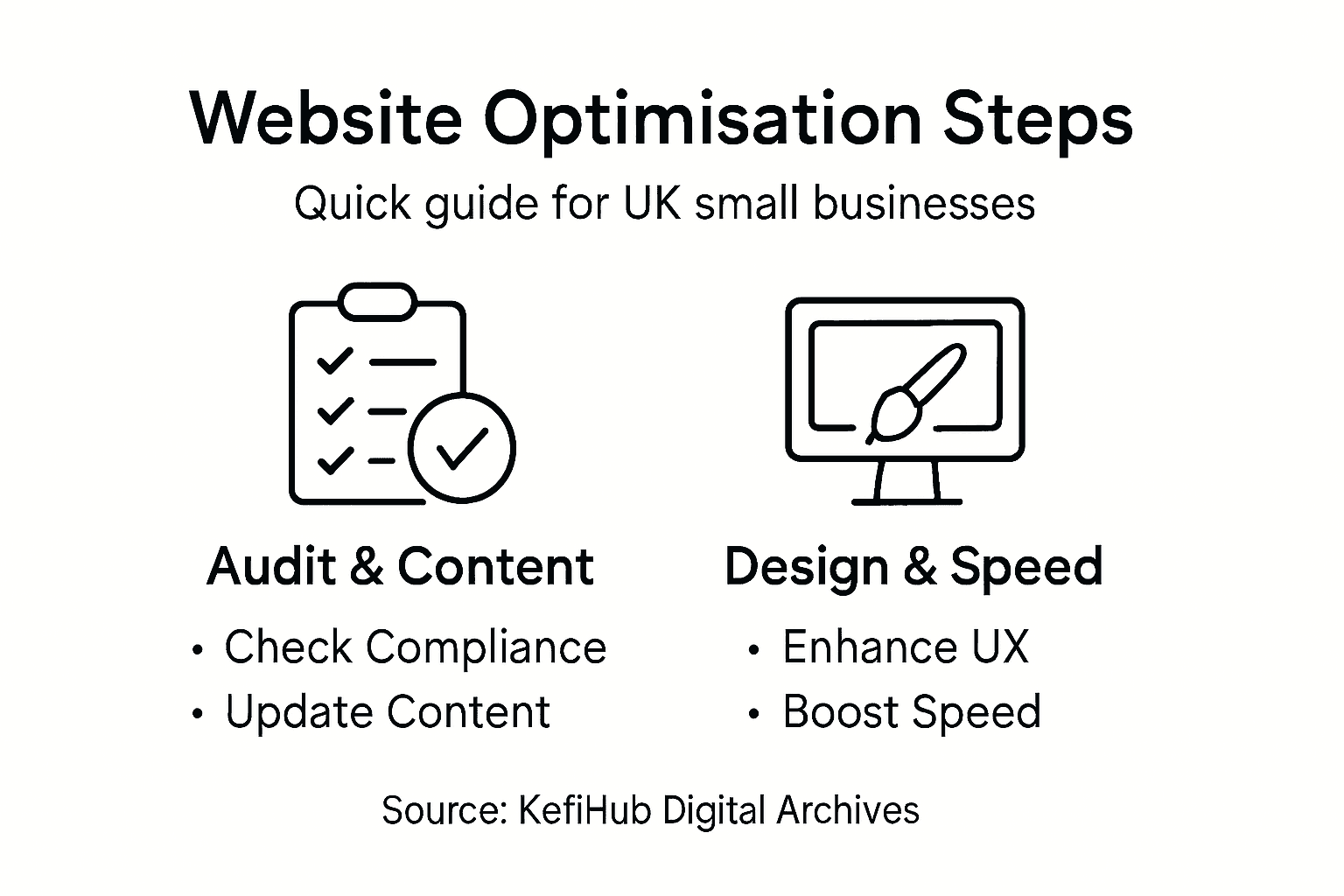
Understanding your website’s current performance and compliance status is crucial for UK small businesses wanting to maintain a professional digital presence. This assessment will help you identify potential issues, improve user experience, and ensure legal adherence.
To begin your comprehensive website audit, you’ll need to examine several critical areas. Start by gathering data about your website’s technical performance and legal compliance using these key strategies:
- Website Speed – Measure loading times using tools like Google PageSpeed Insights
- Mobile Responsiveness – Check how your site displays across different devices
- Security Features – Verify SSL certificate and data protection measures
- Accessibility Compliance – Ensure your site meets WCAG accessibility guidelines
Professional digital performance isn’t just about technical metrics – it’s about creating a trustworthy online environment. The OECD SME Digital Maturity Survey highlights that digital competitiveness requires ongoing assessment and strategic improvements.
Your website is often the first interaction potential customers have with your business. Make it count.
Critical areas to evaluate include content accuracy, copyright compliance, and transparent business representation. Document any discrepancies or potential improvement areas during your audit, creating a clear roadmap for enhancement.

The table below summarises the impact of key website audit areas on a small business’s digital presence:
| Audit Area | Common Issue | Potential Impact on Business |
|---|---|---|
| Website Speed | Slow loading times | Higher bounce rates |
| Mobile Responsiveness | Poor display on mobiles | Loss of mobile users |
| Security Features | Outdated SSL certificate | Loss of customer trust |
| Accessibility | Insufficient contrast | Legal risks, lost audiences |
Expert Tip: Schedule quarterly website performance reviews to stay ahead of potential compliance and technical issues.
Step 2: Update content for legal accuracy and clarity
Ensuring your website content meets legal requirements is a critical step for UK small businesses seeking to maintain professional credibility and avoid potential regulatory challenges. This process involves carefully reviewing and refining your website’s text to align with current data protection and disclosure standards.
Begin by conducting a comprehensive content audit focusing on these key areas:
- Privacy Policy – Review and update to reflect current UK data protection guidelines
- Terms of Service – Verify language meets legal transparency requirements
- Corporate Information – Ensure accuracy of business representations
- Customer Communication Sections – Check for clear, unambiguous language
The sustainability reporting standards for SMEs highlight the importance of precise, transparent corporate communications. This means going beyond mere compliance to create content that builds trust with your audience.
Legal accuracy is not just about avoiding penalties – it’s about demonstrating professionalism and respect for your customers.
Pay special attention to areas involving personal data, financial claims, and service descriptions. Each statement should be verifiable, clear, and aligned with current regulatory expectations. Consider engaging a legal professional to review complex sections if needed.
Expert Tip: Create a content review checklist and schedule biannual comprehensive audits to maintain ongoing legal compliance.
Step 3: Enhance design for user engagement
Transforming your website’s design is about creating an intuitive, welcoming digital environment that encourages visitors to explore and interact with your business. The visual and functional aspects of your site play a crucial role in capturing and maintaining user attention.
Focus on implementing design strategies that support digital adoption for SMEs and create a compelling user experience:
- Colour Palette – Choose a consistent, professional colour scheme
- Navigation – Develop clear, logical menu structures
- Responsive Layout – Ensure seamless display across devices
- Visual Hierarchy – Guide users’ attention to key information
Pay special attention to form design best practices, which are critical for reducing user friction. Well-designed forms can significantly improve engagement by making interactions smooth and intuitive.
Good design is invisible – it should guide users effortlessly without drawing unnecessary attention to itself.
Consider the psychological impact of your design choices. Every element – from typography to whitespace – communicates something about your brand’s professionalism and approach to customer experience.
Expert Tip: Conduct user testing with at least five participants to gain genuine insights into your website’s design effectiveness.
Step 4: Improve loading speed and mobile responsiveness
Optimising your website’s performance across different devices is no longer optional – it’s a critical requirement for UK small businesses wanting to attract and retain online visitors. Your site’s loading speed and mobile responsiveness directly impact user experience and can significantly influence potential customer interactions.
Implement these key strategies for responsive web design techniques:
- Image Compression – Reduce file sizes without sacrificing quality
- Browser Caching – Store static resources locally to speed up repeat visits
- Minimise Plugins – Remove unnecessary website add-ons
- Mobile-First Design – Prioritise mobile user experience
Consider lazy loading strategies to enhance your website’s performance by deferring non-critical resource loading. This approach can dramatically improve initial page load times and create a smoother user experience.
Speed is a silent ambassador of your brand’s professionalism and commitment to user experience.
Regularly test your website’s performance using tools like Google PageSpeed Insights to identify and address potential bottlenecks. Remember that every second of loading time can significantly impact user retention and conversion rates.
Expert Tip: Aim to achieve a loading time under 3 seconds by systematically optimising your website’s technical elements.
Step 5: Verify optimisation with user testing and analytics
Validating your website’s performance isn’t just about numbers – it’s about understanding how real users interact with your digital platform. By leveraging data-driven insights, you’ll transform guesswork into strategic improvements that directly enhance user experience.
Utilise web analytics reports to gain comprehensive insights into your website’s performance:
- User Behaviour – Track navigation patterns and interaction points
- Conversion Metrics – Monitor visitor engagement and goal completions
- Traffic Sources – Understand where your visitors originate
- Page Performance – Identify slow-loading or high-exit pages
The research on data-driven decision making highlights the critical importance of continuous measurement for UK small businesses. Understanding these analytics allows you to make informed, strategic website improvements.
Data transforms assumptions into actionable intelligence.
Consider combining quantitative analytics with qualitative user testing. This approach provides a holistic view of your website’s effectiveness, revealing nuanced insights that pure metrics might miss.
Here is a quick reference for website analytics and testing approaches:
| Method | Insights Provided | How to Use |
|---|---|---|
| Web Analytics | Track user behaviour and traffic | Review monthly for trends |
| User Testing Sessions | Identify navigation challenges | Conduct semi-annually with users |
| Conversion Analysis | Measure goal completions | Adjust marketing based on results |
| Page Performance Tools | Detect slow or problematic pages | Optimise after each assessment |
Expert Tip: Schedule monthly analytics reviews and conduct user testing sessions at least twice a year to maintain continuous improvement.
Take Your SME Website From Good to Outstanding Today
Struggling to keep your website compliant, fast, and engaging is a common challenge for UK SMEs. This article highlights crucial steps like technical audits, legal content updates, and improving mobile responsiveness that can feel overwhelming yet are vital for success. You want a professional online presence that not only meets regulations but also captivates visitors and converts them into loyal customers.
Discover how KefiHub’s expert insights on Digital Archives – Kefihub provide easy-to-follow, practical solutions that empower you to optimise your website confidently.
Don’t leave your digital future to chance. Visit KefiHub now for comprehensive guidance tailored specifically for UK small businesses. Explore our Featured Archives – Kefihub to unlock strategies that transform technical jargon into clear actions. Make the move today to boost your website’s performance, compliance, and user engagement with trusted advice from professionals dedicated to your growth.
Frequently Asked Questions
How can I assess the performance of my website?
To assess your website’s performance, use tools to measure loading times, check mobile responsiveness, and review security features. Start by conducting a comprehensive website audit, focusing on these key areas to identify any potential issues.
What should I include in my website’s privacy policy?
Your website’s privacy policy should reflect current data protection guidelines, clearly outlining how you collect, use, and protect personal data. Review and update this document regularly to ensure compliance and maintain customer trust.
How can I improve my website’s loading speed?
To improve your website’s loading speed, focus on optimising images, enabling browser caching, and minimising unnecessary plugins. Aim to achieve a loading time under 3 seconds by systematically implementing these technical enhancements.
Why is mobile responsiveness important for my website?
Mobile responsiveness is crucial because an increasing number of users access websites from mobile devices. Ensure your site is designed with a mobile-first approach to enhance user experience and retain visitors across all devices.
How often should I conduct website audits?
You should conduct website audits at least quarterly to ensure ongoing performance and compliance. Regular assessments will help you stay ahead of potential technical issues and regulatory challenges.
What strategies can I use for engaging website design?
To create an engaging website design, implement a consistent colour palette, clear navigation, and responsive layout. Focus on crafting a user-friendly interface that guides visitors naturally to the information they seek.
Recommended
- 7 Effective Marketing Strategies for SMEs to Drive Growth – Kefihub
- Why Build a Website: Boosting UK Small Businesses – Kefihub
- 7 Practical Ways to Improve SEO for UK Small Businesses – Kefihub
- Networking for SMEs Guide: Build Connections for Growth – Kefihub