


TL;DR:
- Proper due diligence is essential for all significant business or personal transactions in the UK.
- It involves thorough research, document review, legal checks, site visits, and ongoing monitoring.
- Adapting due diligence to regulated or complex deals strengthens business resilience and competitiveness.
Many UK professionals assume due diligence is reserved for corporate giants completing multi-million pound acquisitions. It is not. Whether you are a small business owner buying a competitor’s firm, a first-time home buyer reviewing a property, or a sole trader signing a major contract, skipping proper checks can cost you dearly. Due diligence failures have triggered some of the most damaging business losses in recent history. This guide breaks down what due diligence actually means, why it matters in 2026, and the practical steps you need to carry it out with confidence.
Table of Contents
- What is due diligence and why does it matter?
- The core steps of due diligence for UK professionals
- Common due diligence pitfalls (and how to avoid them)
- Adapting due diligence for complex or regulated situations
- Our perspective: why rigorous due diligence is a business superpower in 2026
- Connect with the right support for smarter due diligence
- Frequently asked questions
Key Takeaways
| Point | Details |
|---|---|
| Critical risk reduction | Careful due diligence prevents costly mistakes for businesses and individuals alike. |
| Tailored UK approach | Effective due diligence follows UK-specific frameworks, regulations, and checklists. |
| Avoid common pitfalls | Rushing the process or skipping steps risks substantial financial loss or deal failure. |
| Expert help is vital | Engaging solicitors and accountants early ensures thoroughness and compliance. |
| Ongoing value | Continuous due diligence offers a strategic advantage in business growth and risk management. |
What is due diligence and why does it matter?
Due diligence is the process of thoroughly investigating and verifying information before making a significant decision. Think of it as doing your homework before committing. It applies across a wide range of situations: buying or selling a business, purchasing property, entering a major contract, hiring senior staff, or ensuring your company meets its regulatory obligations.
For UK professionals, the stakes are real. Failing to carry out proper checks can expose you to hidden liabilities, legal disputes, financial losses, and reputational damage. The good news is that a structured approach makes the process manageable, even for smaller transactions.
Due diligence is relevant in many common scenarios:
- Buying a business or acquiring a competitor
- Purchasing residential or commercial property
- Entering joint ventures or partnerships
- Signing high-value supplier or client contracts
- Investing in a new product, technology, or market
- Onboarding regulated or high-risk clients
The consequences of skipping this step can be severe. One of the most cited examples is the HP-Autonomy deal, where inadequate due diligence contributed to an £8 billion writedown. On the other side of the coin, a rigorous technical review once saved an investor £500,000 by identifying critical flaws before a deal closed.
“Proper due diligence is not a formality. It is the single most effective way to protect your investment and avoid inheriting someone else’s problems.”
For UK small businesses, understanding your compliance obligations is equally important. Our SME compliance guide is a practical starting point for understanding what checks apply to your sector. You can also use the due diligence checklist from the British Business Bank to structure your approach when buying a business.
The core steps of due diligence for UK professionals
Now you understand its importance, here is how the process actually unfolds in practice. A thorough due diligence process follows a logical sequence, and skipping any stage increases your exposure to risk.
-
Initial research. Start by gathering publicly available information. Companies House records, court judgements, credit reports, and news searches all provide early signals about the party you are dealing with.
-
Document review. Request and review key documents: financial statements, tax records, contracts, leases, intellectual property registrations, and any pending litigation. For property transactions, this includes title deeds and planning permissions.
-
Financial and legal checks. Scrutinise the numbers carefully. Look for unusual cash flow patterns, undisclosed liabilities, or inflated valuations. Engage a solicitor to review legal documents and flag any clauses that carry risk.
-
Site visits and interviews. Where possible, visit premises and speak directly with key personnel. This helps you verify what is on paper and assess the culture and operational reality of the business.
-
Risk assessment. Compile your findings into a structured risk register. Categorise risks by severity and likelihood. Decide which risks are acceptable, which require mitigation, and which are deal-breakers.
-
Ongoing monitoring. Due diligence does not end at signing. Build in regular reviews, especially for regulated sectors or long-term partnerships.
The British Business Bank’s due diligence checklist is particularly useful for small business owners navigating a purchase. Our company setup checklist and legal compliance steps also provide structured guidance for UK-specific requirements.

Pro Tip: Engage a solicitor and accountant at the very start of your due diligence process, not at the end. In regulated sectors such as financial services or healthcare, early professional advice can prevent costly compliance failures.
Common due diligence pitfalls (and how to avoid them)
Even with a process in place, people still slip up. The most common mistake is treating due diligence as a tick-box exercise rather than a genuine investigation. Rushing through a checklist without critically evaluating the findings gives you a false sense of security.
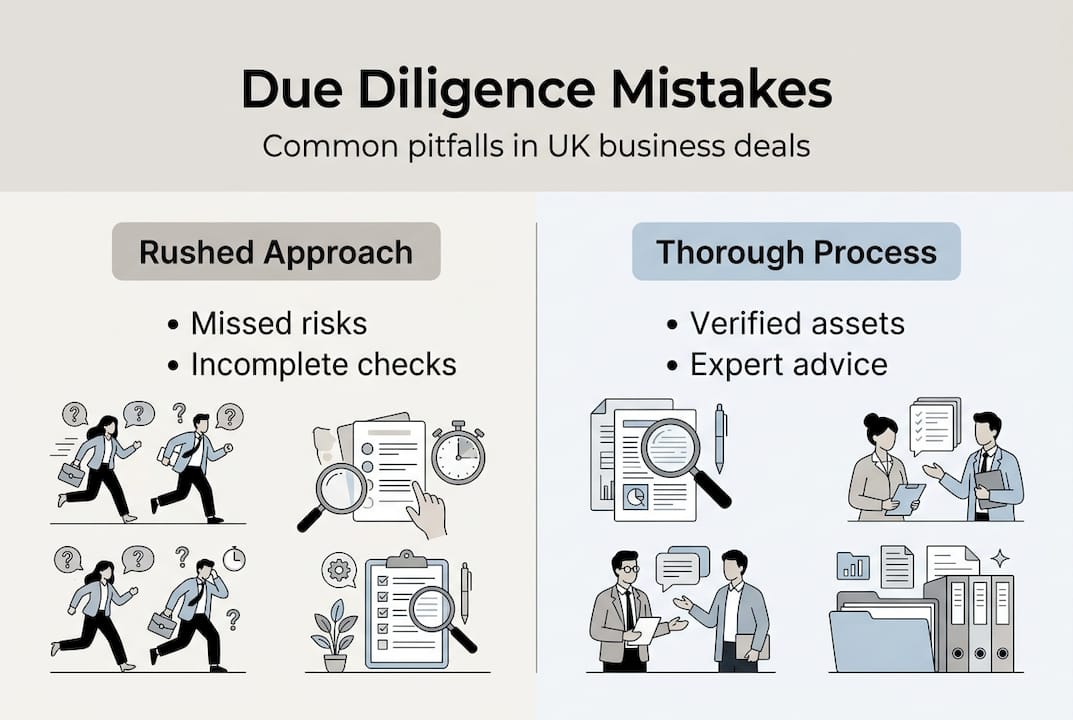
The HP-Autonomy case remains one of the starkest warnings. Inadequate scrutiny of financials and technology assets led to a catastrophic writedown. Contrast this with a case where technical due diligence identified serious flaws in a target company’s IT infrastructure, saving the investor £500,000 before any money changed hands.
Statistics reinforce the pattern. According to deal failure research, up to 70% of cross-border deals fail when integration planning and thoroughness are neglected during the due diligence phase.
| Factor | Rushed due diligence | Thorough due diligence |
|---|---|---|
| Hidden liabilities | Often missed | Identified and priced in |
| Legal risk | High | Managed and mitigated |
| Deal outcome | Higher failure rate | Better long-term performance |
| Cost of errors | Potentially catastrophic | Contained and controlled |
| Regulatory exposure | Significant | Minimised |
Technology tools, including AI-powered document review platforms, can accelerate the process. However, they work best when paired with experienced human judgement. Automated tools can miss context, cultural signals, and integration risks that only a skilled professional will spot.
Pro Tip: Do not rely solely on documents provided by the other party. Commission independent searches, verify references directly, and always cross-check financial claims against third-party sources.
For broader guidance on avoiding costly errors in your business, our article on avoiding common business mistakes covers practical strategies that complement a strong due diligence process.
Adapting due diligence for complex or regulated situations
But what if your situation is more complicated than a standard purchase? Here is how to adapt. When you are operating in a regulated industry, completing a cross-border transaction, or dealing with significant technology or intellectual property assets, your due diligence requirements expand considerably.
In the UK, regulated sectors such as financial services, legal, healthcare, and property are subject to strict anti-money laundering (AML) obligations. The Financial Conduct Authority (FCA) expects firms to apply enhanced due diligence to higher-risk clients and transactions. This is not optional. Ongoing AML due diligence is a legal requirement in these fields, and failures can result in significant fines.
For cross-border or regulated deals, consider these additional measures:
- Enhanced background checks on individuals and entities in higher-risk jurisdictions
- Data privacy compliance review under UK GDPR and any applicable international frameworks
- Cultural and operational assessments to identify integration risks post-deal
- Intellectual property audits to confirm ownership, licensing, and any disputes
- IT and cybersecurity reviews to assess vulnerabilities in technology assets
| Area | UK requirement | International best practice |
|---|---|---|
| AML checks | Legally mandated for regulated sectors | Risk-based approach across all deals |
| Data privacy | UK GDPR compliance | Local law plus cross-border frameworks |
| Cultural assessment | Recommended for acquisitions | Standard in major cross-border deals |
| IT diligence | Increasingly expected | Embedded in most technology transactions |
Ongoing monitoring is just as important as the initial review. Circumstances change, and a party that passed checks at the outset may present new risks six months later. Building regular review cycles into your compliance programme protects you over the long term. Our guide on AML checks in the UK provides a detailed breakdown of what is required and how to stay compliant.
Our perspective: why rigorous due diligence is a business superpower in 2026
Most organisations treat due diligence as a one-off hurdle to clear before a deal closes. We think that is the wrong frame entirely. The professionals and businesses that consistently outperform their peers treat due diligence as a continuous discipline, not a single event.
In 2026, the regulatory landscape is more complex, technology moves faster, and the cost of integration failures is higher than ever. Shortcuts that might have gone unnoticed a decade ago now carry real consequences. Cultural misalignment, overlooked IT vulnerabilities, and gaps in compliance programmes are not minor oversights. They are the reasons deals fail and businesses stall.
The real competitive edge comes from using due diligence as a growth filter. When you apply rigorous checks consistently, you make better decisions, build stronger partnerships, and avoid the kind of costly surprises that derail progress. Explore how ongoing compliance strategies can support this approach in your business.
“The goal is not perfection. It is catching the critical issues early enough to act on them.”
That mindset shift, from compliance burden to strategic advantage, is what separates cautious businesses from confident ones.
Connect with the right support for smarter due diligence
Ready to take the next step on your due diligence journey? Navigating these processes alone can feel overwhelming, but you do not have to figure it out from scratch.

At KefiHub, we bring together practical guidance, expert commentary, and curated resources to help UK professionals make informed decisions at every stage. Whether you need a structured business growth roadmap to plan your next move, or want to understand the role of solicitors in business transactions, we have the insights to support you. Explore our resource library and connect with the professional guidance that fits your situation.
Frequently asked questions
What are the key documents needed for due diligence in the UK?
Essential documents include financial statements, contracts, legal filings, compliance certificates, and proof of ownership or title depending on the transaction. The British Business Bank checklist provides a detailed breakdown for business purchases.
How long should due diligence take for a small business deal?
Most small business due diligence processes last from a few weeks to two months, but timelines vary based on the complexity of the transaction and the quality of documentation provided.
Is due diligence legally required in the UK?
For certain regulated sectors, due diligence is a legal requirement, particularly in relation to anti-money laundering obligations under FCA and HMRC frameworks.
What can happen if I skip due diligence?
You may face unexpected legal liabilities, financial losses, or regulatory penalties. The HP-Autonomy writedown is a well-documented example of how inadequate checks can lead to catastrophic outcomes.
Recommended
- Property Searches Explained – What UK Buyers Need to Know – Kefihub
- 7 Steps to a Robust Legal Compliance Checklist for UK SMEs – Kefihub
- How to Find Reliable Legal Advice for UK Homebuyers – Kefihub
- Legal Compliance: Why It Matters for UK Professionals – Kefihub