


TL;DR:
- Recent legal reforms have made exercising the right to manage more accessible and less costly for leaseholders.
- RTM allows leaseholders to control building management without purchasing the freehold or proving mismanagement.
- Success depends on clear communication, proper documentation, and ongoing collaborative community effort.
Many UK leaseholders assume they have little or no say in how their building is managed. That assumption is wrong, and recent legal changes make it more wrong than ever. The right to manage (RTM) is a legal mechanism that allows leaseholders to take control of property management away from the freeholder, without needing to prove fault or pay compensation. The Leasehold and Freehold Reform Act 2024 (LAFRA 2024) has since made the process more accessible, less costly, and less intimidating. This guide explains exactly what RTM is, how the new rules affect your eligibility, and the practical steps you need to take to exercise your rights with confidence.
Table of Contents
- What is the right to manage?
- Recent legal reforms and their impact
- How to start the right to manage process
- Common challenges and practical solutions
- A fresh perspective: What most guides miss about right to manage
- Connect with expert support for your next steps
- Frequently asked questions
Key Takeaways
| Point | Details |
|---|---|
| RTM gives leaseholders control | The right to manage lets you and your neighbours take charge of property decisions and costs. |
| Legal reforms make it easier | Recent changes reduce procedural barriers and financial risks, broadening access for more leaseholders. |
| No liability for freeholder’s costs | Leaseholders now avoid paying freeholder’s legal fees when exercising RTM following LAFRA 2024. |
| Step-by-step guidance | Following clear processes and expert tips helps you avoid common pitfalls and succeed with RTM. |
| Expert help is available | Specialised support and legal resources can smooth out challenges and ensure compliance. |
What is the right to manage?
The right to manage is a statutory right that allows leaseholders in qualifying residential buildings to take over the management functions previously held by the freeholder or their appointed managing agent. It does not require you to buy the freehold, prove mismanagement, or go to a tribunal. You simply need to meet the qualifying criteria, follow the correct procedure, and form an RTM company.
Once you exercise RTM, the RTM company takes responsibility for key management functions. These include:
- Collecting and administering service charges
- Arranging repairs, maintenance, and building insurance
- Managing contractors and building staff
- Handling day-to-day administration of the building
The legal foundation for RTM lies in the Commonhold and Leasehold Reform Act 2002, which first introduced the right as a way to give leaseholders genuine influence over their homes. LAFRA 2024 has since built on that framework, and LAFRA 2024 changes make access to RTM easier for leaseholders by removing several longstanding procedural barriers.
To understand why RTM matters, it helps to understand the wider context of types of property ownership in the UK. Leaseholders own their flat for a fixed term but not the land or structure. The freeholder retains that ownership and, traditionally, the power to decide who manages the building and at what cost. RTM shifts that power balance meaningfully.
“RTM does not transfer ownership of the building. It transfers the right to manage it. That distinction matters because leaseholders can benefit from direct control without the financial burden of purchasing the freehold.”
The qualifying criteria under current rules state that the building must be at least two-thirds residential, and at least two-thirds of flats must be held on long leases. At least half of those qualifying leaseholders must participate in the RTM application. These thresholds are important, and the 2024 reforms have adjusted some of them in favour of leaseholders, as the next section explains.
RTM applies in England and Wales. Scottish and Northern Irish leaseholders operate under different legislation and should seek jurisdiction-specific advice.
Recent legal reforms and their impact
With RTM defined, it is crucial to understand how recent legal changes shift the playing field. LAFRA 2024 introduced several significant amendments that make RTM both more achievable and less financially risky for leaseholders.
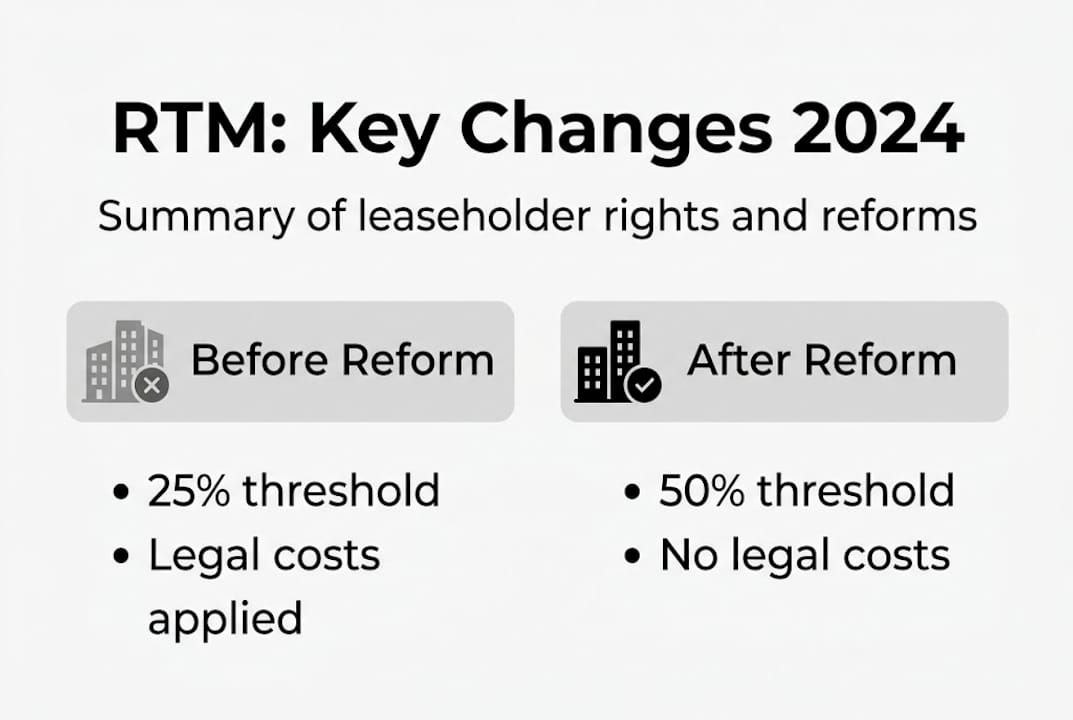
The most notable change concerns the non-residential threshold. Previously, buildings where more than 25% of the floor area was used for non-residential purposes (such as commercial units on the ground floor) were excluded from RTM. The non-residential threshold is now set to 50%, meaning many more mixed-use buildings now qualify. This is a substantial shift that brings thousands of additional leaseholders within reach of RTM.
The second major change concerns legal costs. Under the old rules, leaseholders could be held liable for the freeholder’s legal expenses if an RTM claim was pursued and contested. That risk alone deterred many from even starting the process. Under LAFRA 2024, leaseholders are no longer liable for the freeholder’s legal costs in RTM claims, removing a significant financial barrier.
Here is a comparison of key rules before and after LAFRA 2024:
| Area | Before LAFRA 2024 | After LAFRA 2024 |
|---|---|---|
| Non-residential threshold | 25% maximum | 50% maximum |
| Leaseholder liability for freeholder costs | Yes, if claim contested | No liability |
| Procedural complexity | Higher, more tribunal involvement | Streamlined process |
| Participation requirement | 50% of qualifying leaseholders | 50% of qualifying leaseholders |
These reforms reflect a wider legislative trend, which you can follow by reading about the leasehold vs freehold comparison in the UK property landscape. Much like how LLP setup legal reforms have simplified business structures for professionals, leasehold reform is gradually reducing friction for those navigating complex legal structures.
The streamlined process also means that disputes are less likely to end up in costly tribunal proceedings. Freeholders still retain the right to contest an RTM application, but the grounds for doing so are limited, and the financial consequences of contesting are now borne by the freeholder alone.
Key statistic: Following the threshold change, it is estimated that tens of thousands of additional properties across England and Wales now qualify for RTM, many of which were previously excluded purely due to ground-floor commercial space.
How to start the right to manage process
Now you know the rules, here is how to practically begin the RTM process. The steps are clearly defined in law, and following them correctly from the outset avoids delays and legal challenges.
-
Check eligibility. Confirm that your building meets the residency threshold, that enough qualifying leaseholders exist, and that the building does not fall under one of the limited exemptions (such as a resident landlord in a small building).
-
Form the RTM company. You must incorporate a limited company with the correct articles of association prescribed by statute. Every participating leaseholder becomes a member. The company must be registered at Companies House before any notice is served.
-
Invite all qualifying leaseholders. Before serving formal notice, you must give all qualifying leaseholders the opportunity to join the RTM company. This invitation notice must meet specific legal requirements in terms of content and timing.
-
Serve the claim notice. The RTM company then serves a formal claim notice on the freeholder and any other relevant parties. The notice must state the date on which RTM will be acquired, which must be at least three months from the date of the notice.
-
Wait for the counter-notice. The freeholder has one month to respond with a counter-notice. If they do not contest, RTM is acquired on the specified date. If they do contest, you may need to apply to the First-tier Tribunal.
-
Transition management. Once RTM is acquired, the RTM company takes over all management functions. Existing contracts with managing agents must be reviewed and either adopted or terminated.
The new RTM rules remove key procedural barriers, but getting the paperwork right still matters enormously. Reviewing property management solutions can help your RTM company hit the ground running once you acquire management. You should also familiarise yourself with your obligations under a legal compliance overview to avoid inadvertent breaches once your company is managing the building.
Pro Tip: The single most common error in RTM claims is a defective invitation notice. If the invitation does not comply with prescribed requirements, the entire claim can be invalidated. Use a solicitor experienced in RTM to draft or review this document before it is sent.
Common challenges and practical solutions
Even with clearer rules, leaseholders can run into issues. Here is how to overcome the most common hurdles.
One of the biggest obstacles is legal jargon. Terms like “qualifying tenant,” “claim notice,” “counter-notice,” and “acquisition date” carry precise legal meanings that differ from everyday usage. Misunderstanding even one term can cause you to miss a deadline or serve a defective document. If you encounter unfamiliar language, do not guess. Consult a specialist or use a trusted resource to clarify meaning before acting.
Internal disagreements among leaseholders are another frequent problem. RTM requires collective action, and not every leaseholder will be equally motivated or informed. Some may worry about cost, liability, or disruption. Open, transparent communication from the outset is essential. Hold informal meetings, share written summaries of the process, and address concerns directly. Documenting every decision and conversation protects everyone involved.

Freeholder objections are a reality you should prepare for. Common grounds include disputes about whether the building qualifies or whether the notice was served correctly. Under LAFRA 2024, leaseholder legal liability for freeholder costs has been abolished, so a contested claim is now far less financially threatening than it once was. If challenged, your RTM company has the right to apply to the First-tier Tribunal for a determination.
Practical steps to strengthen your position include:
- Keep detailed written records of all correspondence with the freeholder and between leaseholders
- Seek professional legal advice before serving any formal notice
- Review the shared ownership guide if any of your building’s flats are held on shared ownership terms, as different rules may apply
- Explore legal aid options if cost is a concern, particularly for leaseholders on lower incomes
“The most successful RTM applications are not necessarily the ones with the best legal team. They are the ones where leaseholders communicated clearly, documented everything, and moved as a united group.”
Financial planning is also important. While RTM does not require paying the freeholder’s costs post-reform, you will still need to fund your own legal advice, company registration, and potential tribunal costs if contested.
A fresh perspective: What most guides miss about right to manage
Most RTM guides focus almost entirely on procedure. That is useful, but it misses something important. When you take on RTM, you are not just signing legal documents. You are taking on a shared responsibility with your neighbours to run a building. That requires trust, communication, and ongoing commitment, none of which any statute can create for you.
The reforms introduced by LAFRA 2024 are genuinely meaningful. They reduce financial risk and open the door to more buildings. But legal reform does not resolve the interpersonal dynamics that often determine whether an RTM company thrives or stalls.
We see RTM as a community-building opportunity as much as a legal one. Buildings where leaseholders actively manage their environment tend to be better maintained, with lower service charges and fewer disputes over time. The role of solicitors in guiding leaseholders through this process is also frequently underestimated. An experienced solicitor does not just get the paperwork right; they also help manage expectations and prevent costly miscommunications.
Approach RTM not just as a legal right to exercise, but as an ongoing commitment to your building and your community. That mindset is what separates successful RTM companies from those that struggle.
Connect with expert support for your next steps
Navigating RTM can feel straightforward once you have the right information, but the practical and legal details still require care and expertise. Whether you are at the very beginning of the process or facing a contested claim, having reliable support makes all the difference.
KefiHub offers a range of guides and resources designed to help UK leaseholders move forward with confidence. Start by accessing reliable legal advice tailored to property matters, or explore our section on property investment advice to understand the broader financial context of your decisions. If you are ready to work with a professional, our guide on solicitor advantages will help you choose the right expert for your situation. You do not have to figure this out alone.
Frequently asked questions
Who can apply for the right to manage?
Leaseholders of qualifying buildings can apply for RTM if the property meets the residency and threshold rules set by current legislation. Following LAFRA 2024, the non-residential threshold is now set to 50%, expanding eligibility considerably.
Are leaseholders liable for the freeholder’s legal costs under RTM?
Under LAFRA 2024, leaseholders are no longer required to cover the freeholder’s legal expenses related to RTM claims. This change, removing leaseholder liability for costs, was one of the most significant improvements introduced by the legislation.
How long does the RTM process typically take?
The RTM process usually takes several months from company formation to acquisition date. Recent post-2024 reforms have streamlined timelines, though contested claims can extend the process further.
What are the biggest challenges in exercising RTM?
Common challenges include misunderstanding legal jargon, managing disagreements between leaseholders, and responding to freeholder objections. Recent reforms reduce financial risk and simplify parts of the process, but thorough preparation and clear communication remain essential.
Recommended
- Leasehold vs freehold: make smarter UK property choices – Kefihub
- Types of property ownership UK: 20% leasehold complexity – Kefihub
- Shared ownership meaning: clear guide for UK homebuyers 2026 – Kefihub
- Buy to let explained: clear guidance for UK investors – Kefihub