


Many prospective landlords underestimate the complexity of buy-to-let investing, often focusing on rental income while overlooking regulatory demands, tax implications and financial stress tests. This guide demystifies the entire process, explaining buy-to-let strategies, 2026 regulations and realistic returns. You’ll gain step-by-step clarity on mortgage requirements, ownership structures, compliance obligations and expert strategies to make informed investment decisions with confidence. Whether you’re a first-time landlord or expanding your portfolio, this article delivers the practical knowledge UK property investors need to succeed.
Table of Contents
- Key takeaways
- What is buy to let and how does it work?
- Step-by-step guide to setting up a buy-to-let investment
- Understanding key 2026 regulations and tax considerations
- Risks, returns and expert strategies for successful buy to let investing
- Explore Kefihub’s resources to support your buy-to-let journey
- Frequently asked questions
Key Takeaways
| Point | Details |
|---|---|
| Mortgage requirements | Buy-to-let typically requires a specialist mortgage with at least a 25 per cent deposit and rental coverage of 125 to 145 per cent of mortgage payments at stressed rates. |
| Regulatory changes 2026 | Rent increases are capped, no fault evictions are banned, and landlords must meet EPC and safety compliance requirements. |
| Ownership structure | Choosing between limited company and personal ownership affects tax obligations and mortgage costs. |
| Key risks | Void periods, ongoing maintenance costs and potential regulatory fines can erode returns. |
| Stress testing yields | Expert strategies include stress testing yields and balancing personal and company ownership to optimise cash flow. |
What is buy to let and how does it work?
Buy-to-let (BTL) involves purchasing a property to rent out for income and capital growth, typically requiring a specialist BTL mortgage with 25%+ deposit and rental coverage of 125-145% of mortgage payments at stressed rates. Unlike standard residential mortgages, lenders assess affordability based on projected rental income rather than your personal salary. This means the property must generate sufficient rent to cover mortgage payments even if interest rates rise.
Most BTL mortgages require a minimum 25% deposit, though some lenders demand 30-40% for first-time landlords or higher-risk properties. Mortgage rates typically range between 5-7% for buy-to-let products, significantly higher than owner-occupier rates. Lenders stress test rental income at rates of 125-145% of the mortgage payment, calculated at a notional interest rate of 5.5-6.5%. This ensures you can afford repayments during void periods or rate increases.
Rental income provides your primary return, while capital appreciation builds equity over time. Successful investors target properties in areas with strong rental demand, good transport links and employment growth. You’ll need to factor in additional costs beyond the mortgage:
- Stamp duty land tax, including the 5% surcharge on additional properties
- Legal fees, surveys and valuation costs during purchase
- Landlord insurance covering buildings, contents and liability
- Ongoing maintenance, repairs and safety certifications
- Letting agent fees if you use professional management
Pro Tip: Prioritise income coverage and stress testing rental yields to avoid cash flow shortages. Calculate your net yield after all expenses, not just the gross rent figure. Many new landlords focus on purchase price without adequately planning for void periods, maintenance and regulatory costs that erode returns.
Understanding property investment fundamentals helps you evaluate whether buy-to-let aligns with your financial goals and risk tolerance before committing capital.
Step-by-step guide to setting up a buy-to-let investment
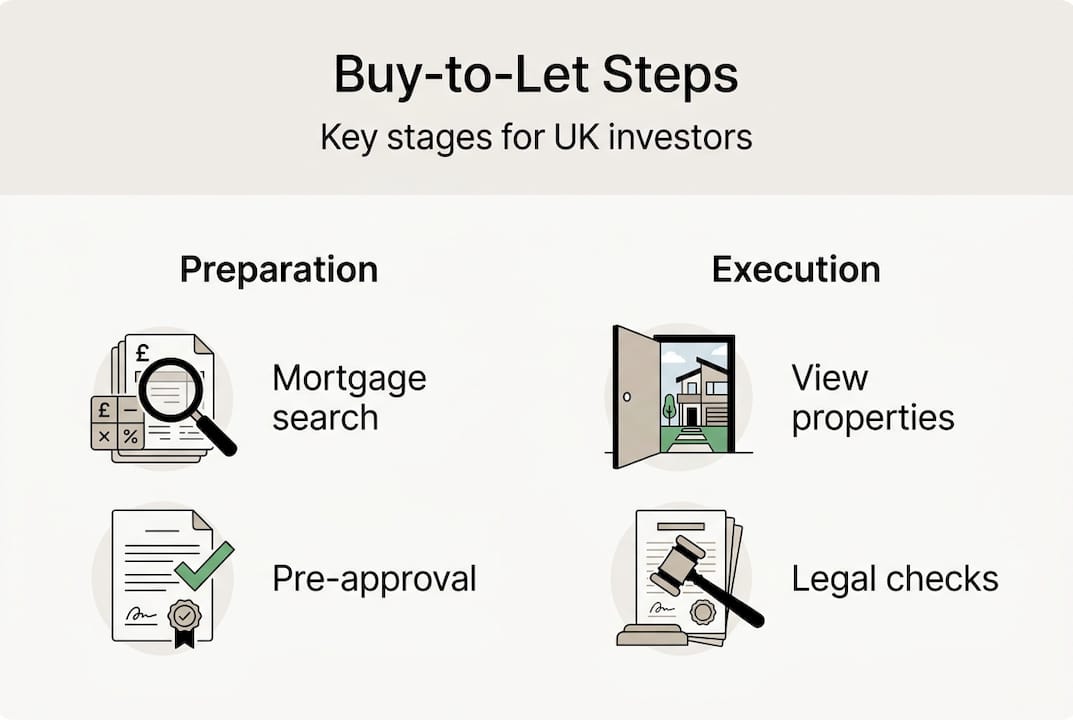
The step-by-step process involves assessing finances, researching locations, purchasing property, preparing it for tenants and managing ongoing compliance. Each stage requires careful planning and realistic timelines. Expect approximately six months from initial mortgage enquiry to tenant occupancy, though this varies based on property condition and local market dynamics.
-
Assess your finances and obtain a mortgage agreement in principle. Calculate your available deposit, review credit history and determine maximum borrowing capacity. Speak with specialist BTL mortgage brokers who understand rental coverage requirements and can recommend suitable lenders.
-
Research promising locations focusing on rental yield and capital growth potential. Analyse local employment sectors, transport infrastructure and rental demand indicators. Target areas with strong tenant pools, such as university towns, commuter belts or regeneration zones.
-
View properties, make offers and arrange surveys. Budget for the additional 5% stamp duty surcharge on second properties. Instruct solicitors early and prepare for conveyancing timelines of 8-12 weeks. Factor in survey costs and potential negotiation based on findings.
-
Prepare the property to meet all legal requirements. Obtain an Energy Performance Certificate with minimum rating E, arrange gas and electrical safety certificates, and install smoke and carbon monoxide alarms. Budget £1,000-3,000 for compliance work depending on property condition.
-
Find reliable tenants through thorough referencing and right-to-rent checks. Protect deposits in a government-approved scheme within 30 days. Provide tenants with all required documentation, including How to Rent guide, gas safety certificate and EPC.
-
Manage the tenancy through rent collection, maintenance requests and ongoing legal compliance. Conduct periodic property inspections and maintain detailed records of all communications and expenditure.
Pro Tip: Early mortgage pre-approval speeds up property purchase and strengthens bids. Sellers and agents take you more seriously when you can demonstrate funding is secured. This competitive advantage matters in hot markets where properties receive multiple offers.
Follow a detailed property investment checklist to ensure you complete every critical task and maintain compliance throughout the purchase process. Understanding the step-by-step investment process helps you anticipate challenges and plan realistic timelines.
Understanding key 2026 regulations and tax considerations
Key 2026 regulations include the Renters’ Rights Act 2025 (from May 1, 2026) which abolishes Section 21 no-fault evictions, introduces periodic tenancies, limits rent increases to once per year, bans bidding and rent-in-advance over one month, and prohibits discrimination based on children or benefits. Properties must maintain EPC minimum rating E, with rating C proposed for 2028. Gas and electrical safety certificates remain mandatory, alongside HMO licensing where applicable. Fines reach up to £40,000 for non-compliance.

The regulatory landscape fundamentally changes landlord-tenant dynamics. You can no longer evict tenants without specific grounds, such as rent arrears or antisocial behaviour. Periodic tenancies replace fixed terms, giving tenants greater flexibility but requiring landlords to adapt management approaches. Rent increases face stricter controls, limiting your ability to adjust to market rates quickly.
Safety compliance demands ongoing attention and expense:
- Annual gas safety checks by Gas Safe registered engineers
- Electrical installation condition reports every five years
- Smoke alarms on every storey, carbon monoxide alarms near appliances
- HMO licensing for properties with five or more occupants from two or more households
Ownership structure significantly impacts tax efficiency and mortgage availability. Limited companies offer advantages for higher-rate taxpayers and portfolio growth (corporation tax 19-25% versus 40-45% income tax, with full interest deductibility), while personal ownership suits basic-rate taxpayers or single properties. Transferring existing properties from personal to company ownership triggers capital gains tax and stamp duty costs.
| Ownership type | Tax rate | Mortgage interest | Mortgage rates | Best for |
|---|---|---|---|---|
| Personal | Income tax 20-45% | 20% tax credit only | Standard BTL rates | Basic-rate taxpayers, single properties |
| Limited company | Corporation tax 19-25% | Fully deductible | 0.5-1% higher | Higher-rate taxpayers, portfolios |
Pro Tip: Consult tax experts to align ownership structure with investment goals and tax status. The optimal structure depends on your income level, portfolio size and long-term strategy. Switching structures later incurs significant costs, so plan carefully from the start.
Regulatory compliance protects tenants and preserves your investment. Non-compliance risks substantial fines, legal action and reputational damage that undermines profitability and restricts future lending.
Stay informed about UK property tax changes and seek reliable legal advice to navigate complex requirements confidently. The Renters’ Rights Act 2025 guidance provides detailed information on compliance obligations.
Risks, returns and expert strategies for successful buy to let investing
Key risks include void periods typically lasting 4-6 weeks and maintenance costs consuming 10-15% of rental income, which significantly reduce net yields. Successful investors stress test rental yields to model worst-case scenarios, including interest rate rises, extended voids and unexpected repairs. This conservative approach prevents cash flow crises and ensures sustainable returns.
Below market value purchases and auction properties offer opportunities to build instant equity, but carry increased risks. Properties sold at discount often require substantial refurbishment, and auction purchases demand immediate completion funding. Houses in multiple occupation generate higher yields but involve complex licensing, enhanced safety requirements and intensive management.
Limited company ownership typically incurs mortgage rates 0.5-1% higher than personal ownership, offsetting some tax advantages for smaller portfolios. Calculate the break-even point where tax savings exceed additional borrowing costs before committing to company structure.
| Scenario | Gross yield | Expenses | Net yield | Key risks |
|---|---|---|---|---|
| Standard BTL | 6% | Mortgage, maintenance, voids | 2-3% | Rate rises, voids |
| HMO | 8-10% | Higher management, licensing | 4-6% | Regulation, turnover |
| Below market value | 7% + equity gain | Refurbishment costs | Variable | Hidden defects, delays |
Expert strategies focus on sustainable, stress-tested returns:
- Target minimum 5-6% gross yield in your chosen location
- Diversify across property types and locations to spread risk
- Use professional letting agents for compliance and tenant management
- Maintain cash reserves covering six months of mortgage payments and typical repairs
- Review insurance coverage annually to ensure adequate protection
Pro Tip: Always prepare for worst-case financial scenarios and don’t rely solely on optimistic projections. Model your returns assuming higher interest rates, longer void periods and unexpected maintenance costs. Properties that remain profitable under stress testing deliver reliable long-term returns.
Explore comprehensive property investment guidance and practical property viewing tips to refine your investment approach and identify promising opportunities.
Explore Kefihub’s resources to support your buy-to-let journey
Navigating buy-to-let investing demands reliable guidance across property strategy, legal compliance and business growth. Kefihub offers comprehensive resources tailored for UK investors and SMEs, delivering clear frameworks to execute successful property investments while managing complex regulations.

Our detailed property investment guide covers everything from initial research through to portfolio management, helping you make informed decisions at every stage. Whether you’re structuring ownership, understanding tax implications or ensuring regulatory compliance, Kefihub provides practical tools and expert commentary.
UK property investors benefit from understanding broader business compliance principles. Our small business compliance guide and business growth roadmap support landlords operating as businesses, offering step-by-step frameworks for sustainable growth and legal adherence. Visit Kefihub today to access the professional resources that complement your buy-to-let success.
Frequently asked questions
Is buy to let still profitable after the 2026 regulations?
Yes, but profitability requires careful planning and realistic expectations. Focus on net yields over 4% after all expenses, including increased compliance costs. Properties in strong rental markets with good tenant demand remain viable investments. Stress test your returns to ensure sustainability during regulatory changes and economic fluctuations.
Should I use a limited company or personal ownership for buy to let?
Limited companies suit higher-rate taxpayers and larger portfolios, offering corporation tax rates of 19-25% and full mortgage interest deductibility. Personal ownership works better for basic-rate taxpayers or single properties, avoiding company administration costs and slightly lower mortgage rates. Consult a tax adviser to determine the optimal structure for your circumstances.
What are the key steps to comply with 2026 buy-to-let regulations?
Understand tenant rights under the Renters’ Rights Act, including the ban on Section 21 evictions and rent increase restrictions. Obtain all required safety certifications: gas safety annually, electrical checks every five years, and proper alarm installations. Maintain EPC rating E minimum and prepare for potential rating C requirements. Keep detailed records of all compliance activities and tenant communications.
How do I protect my buy-to-let investment from financial risks?
Stress test rental returns by modelling higher interest rates, void periods of 4-6 weeks and maintenance costs at 10-15% of rent. Maintain cash reserves covering six months of mortgage payments. Use professional letting agents to manage compliance and reduce legal risks. Review insurance coverage annually and keep properties well maintained to minimise unexpected repair costs.
What professional support helps manage increased buy-to-let legal obligations?
Professional letting agents handle tenant referencing, compliance documentation, rent collection and maintenance coordination. They stay current with regulatory changes and reduce your legal exposure. Specialist BTL mortgage brokers identify suitable lenders and structure financing efficiently. Tax advisers optimise ownership structures and ensure accurate reporting. These professionals cost money but protect your investment and save time managing complex obligations effectively.
Recommended
- Property Investment Explained: A Complete UK Guide – Kefihub
- Property Investment Guide UK: Secure Your First Buy – Kefihub