


Most people assume buying a home in the UK means owning it outright, land and all. The reality is quite different. There are around 5 million leasehold properties in England and Wales alone, each carrying obligations, restrictions, and costs that freehold buyers never face. Whether you are buying your first flat or weighing up a house purchase, understanding the difference between leasehold and freehold is not optional. It is the foundation of every smart property decision you will make.
Table of Contents
- What is the difference between leasehold and freehold?
- Ownership patterns: houses and flats in the UK
- Costs, charges, and responsibilities: what to expect
- Mortgages, lease extensions and resale: what buyers must know
- Pros and cons: which is right for you?
- Rare alternatives and ongoing reforms
- Explore further with expert guides and tools
- Frequently asked questions
Key Takeaways
| Point | Details |
|---|---|
| Freehold means full ownership | You own both property and land, with no ground rent or service charges. |
| Leasehold comes with ongoing costs | Ground rent and service charges, plus lease expiry, affect value and resale. |
| Reforms make leasehold fairer | 2024-2026 changes cap ground rent, ease lease extension, and ban new leasehold houses. |
| Check lease length for mortgages | Lenders prefer leases with at least 80-90 years remaining. |
| Know the rare alternatives | Commonhold and share of freehold offer different control and management options. |
What is the difference between leasehold and freehold?
The distinction sounds simple but the implications run deep. Freehold ownership means owning the property and the land it stands on indefinitely; leasehold means owning the right to occupy a property for a fixed term, while the freeholder retains ownership of the land beneath it. Think of it this way: a freehold is permanent, a leasehold is a very long tenancy.
Leases typically run for 99, 125, or even 999 years when first granted. The catch is that as years pass, the remaining term shrinks, and so does the property’s value and mortgageability. You can explore the full range of types of property ownership to see how these models fit into the broader UK landscape.
Here is a quick comparison to make the differences concrete:
| Feature | Freehold | Leasehold |
|---|---|---|
| Ownership of land | Yes | No |
| Ownership duration | Indefinite | Fixed term (e.g. 99 to 999 years) |
| Ground rent | None | Yes (subject to reforms) |
| Service charges | None | Yes |
| Maintenance responsibility | Owner | Shared or freeholder managed |
| Restrictions on alterations | Minimal | Often significant |
| Resale complexity | Lower | Higher (lease length matters) |
In summary, the key distinctions are:
- Freehold: you own the building and land outright, with no time limit and no ground rent
- Leasehold: you own the right to use the property for a set period, paying ground rent and service charges to the freeholder
- Lease length: a lease below 80 years starts to cause serious problems with mortgages and resale
- Alterations: leaseholders often need written permission from the freeholder for renovations
- Management: leaseholders in blocks of flats share costs but have limited control over how the building is run
For a more detailed breakdown, the leasehold explained guide from Homeward Legal is a solid starting point.
Ownership patterns: houses and flats in the UK
Now that we have defined the terms, let us explore how they show up across UK property types and the legal shifts shaping your choices.
Most houses in the UK are freehold, whereas most flats are leasehold. This is not coincidence. Flats share a building, so one entity (the freeholder) typically owns the structure and land, while individual flat owners hold leases. Houses, by contrast, sit on their own plot, making freehold the natural arrangement.
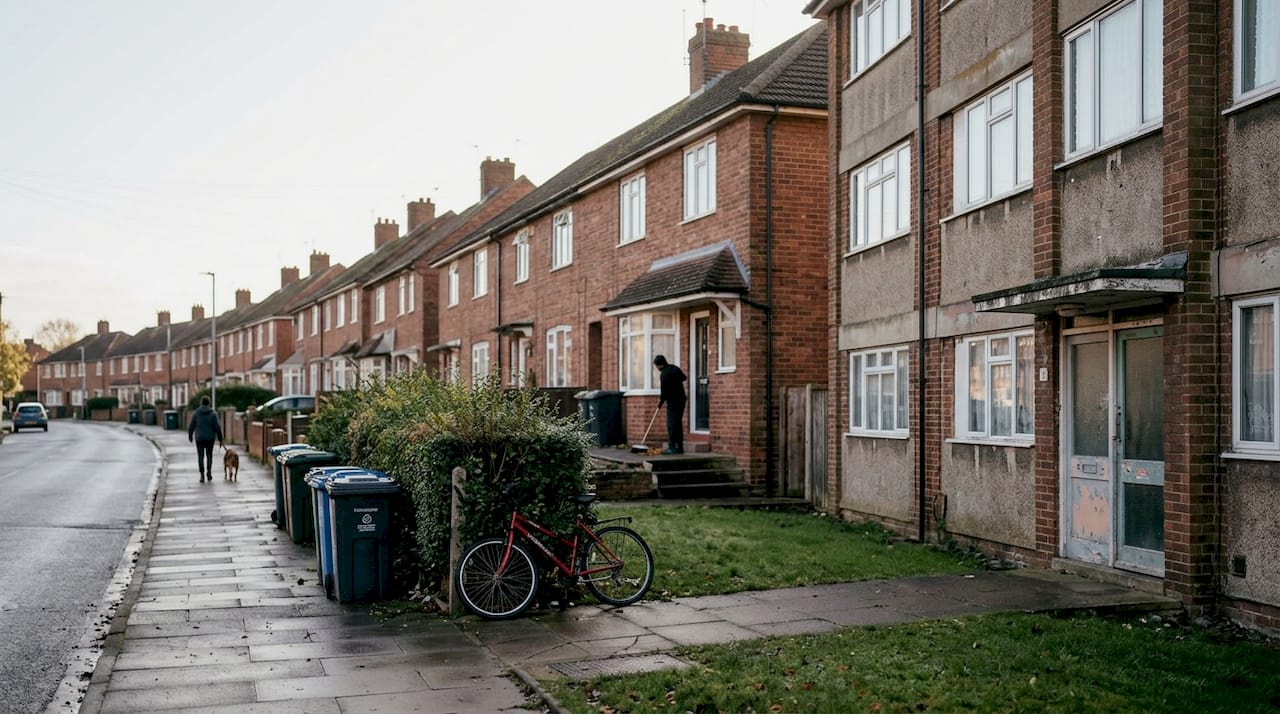
Here is how the split broadly looks across property types:
| Property type | Typical tenure | Notes |
|---|---|---|
| Detached house | Freehold | Rare exceptions exist |
| Semi-detached house | Freehold | Some older estates are leasehold |
| Terraced house | Freehold | Leasehold houses being phased out |
| Purpose-built flat | Leasehold | Most common arrangement |
| Converted flat | Leasehold or share of freehold | Varies by building |
| New-build house (post-2024) | Freehold only | Leasehold houses now banned |
The reforms addressing historical imbalances in England and Wales have already changed the landscape significantly. New leasehold houses have been banned since 2024 under the Leasehold and Freehold Reform Act, meaning developers can no longer sell houses on a leasehold basis. This is a major win for buyers who previously found themselves trapped in leasehold houses with escalating ground rents.
What these changes mean for you as a buyer:
- New-build houses must now be sold as freehold
- Existing leasehold houses are still in circulation and carry legacy risks
- Flat buyers remain in leasehold arrangements for now, though commonhold reform is progressing
- Transparency around service charges and management fees is improving
- Leaseholders have stronger rights to challenge unfair charges
If you are considering property as an investment as well as a home, our property investment guide covers how tenure affects long-term returns.
Costs, charges, and responsibilities: what to expect
With an understanding of who owns what, let us look at the money side and the day-to-day realities.
Leasehold properties involve ongoing ground rent and service charges; freehold properties do not. Ground rent is a periodic payment to the freeholder simply for occupying the land. Service charges cover maintenance of communal areas, building insurance, and repairs. Both can rise over time, and historically some have risen dramatically.
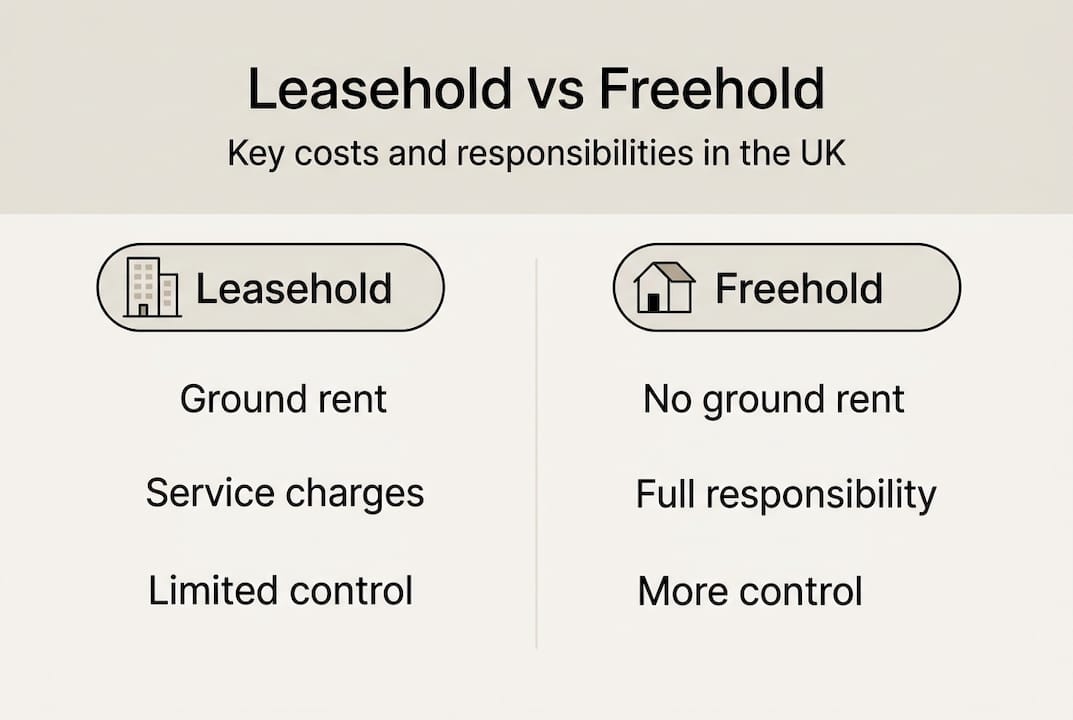
The term fleecehold emerged to describe new-build estates where freehold homeowners are still charged estate management fees for communal green spaces and roads. It is a growing concern that blurs the traditional freehold advantage. Freehold has no ongoing fees but full maintenance responsibility; leasehold offers shared upkeep but with the risk of escalating charges and limited control.
Typical costs and responsibilities at a glance:
- Ground rent (leasehold): historically up to hundreds of pounds per year; new leases now capped or set at a peppercorn rate
- Service charges (leasehold): can range from £500 to over £5,000 per year depending on the building
- Buildings insurance (leasehold): usually arranged by the freeholder and charged back via service charges
- Maintenance (freehold): entirely your responsibility, from roof repairs to garden upkeep
- Estate management fees: increasingly common on new-build freehold estates
Pro Tip: Always ask for at least three years of service charge accounts before exchanging contracts on a leasehold property. Sudden spikes in charges or large reserve fund deficits are red flags that could cost you thousands after completion.
If you are unsure about your rights or obligations, getting proper legal advice for homebuyers early in the process can save you from costly surprises.
Mortgages, lease extensions and resale: what buyers must know
Let us move from ongoing costs to the critical issues that affect getting a mortgage, keeping value, and resale.
Mortgages require leasehold properties to have at least 80 to 90 years remaining, and lease extensions are now easier under the 2024 reforms. Most lenders will not touch a property with fewer than 70 years on the lease, and many insist on 85 years or more. Once a lease drops below 80 years, the cost of extending it rises sharply because of a calculation called marriage value, which previously gave freeholders a share of the uplift in property value.
The Leasehold and Freehold Reform Act 2024 changed this significantly. Leaseholders can now extend their lease to up to 990 years and no longer need to wait two years after purchase before applying. Marriage value has been abolished for most cases, making extensions considerably cheaper.
“The 2024 reforms represent the most significant shift in leasehold law in a generation. Buyers should still check lease length and extension costs upfront, but the process is now far more transparent and fair.”
Steps to extend your lease or buy the freehold:
- Check the lease length on the title register via HM Land Registry
- Commission a lease extension valuation from a specialist surveyor
- Serve a Section 42 notice (for lease extension) or Section 13 notice (for collective enfranchisement to buy the freehold)
- Negotiate the premium with the freeholder, using your valuation as the basis
- Instruct a specialist solicitor to handle the legal transfer
- Register the new lease or freehold at HM Land Registry once complete
Pro Tip: If you are buying a leasehold flat with fewer than 85 years on the lease, factor the cost of a lease extension into your offer price. Your solicitor can help you estimate this during residential conveyancing, and our conveyancing tips guide walks you through the full process.
Pros and cons: which is right for you?
Now, with the facts about tenure and finances established, you can weigh up which path fits best.
Leasehold may suit flat buyers seeking affordability, while freehold offers long-term control and stability. Neither is universally better. It depends on your circumstances, budget, and how long you plan to stay.
Freehold: pros
- Complete ownership with no time limit
- No ground rent or service charges
- Freedom to alter and extend (subject to planning permission)
- Simpler resale process
- No dependence on a freeholder’s management decisions
Freehold: cons
- All maintenance costs fall to you
- Potentially higher purchase price
- Estate management fees on some new-build developments
Leasehold: pros
- Often more affordable, particularly for flats in city centres
- Shared maintenance costs for communal areas
- Building insurance typically arranged collectively
- Easier entry point for first-time buyers
Leasehold: cons
- Ground rent and service charges add ongoing costs
- Restrictions on alterations, pets, or subletting
- Lease length erodes over time, affecting value and mortgageability
- Dependence on freeholder or managing agent quality
- Risk of escalating charges with limited recourse
Pro Tip: As a first-time buyer considering a leasehold flat, focus on three numbers: the remaining lease length, the annual service charge, and the reserve fund balance. These three figures tell you more about the true cost of ownership than the asking price alone.
For a broader view of how tenure fits into long-term planning, our property investment advice covers what to prioritise at each stage.
Rare alternatives and ongoing reforms
With the main options covered, let us round out with less common alternatives, new reforms, and future prospects.
Beyond standard leasehold and freehold, there are a few other arrangements worth knowing:
- Share of freehold: leaseholders collectively own the freehold of their building, giving them more control over management and costs
- Flying freehold: a freehold property where part of it extends over or under another property, common in older terraced houses
- Commonhold: a form of ownership where flat owners hold their unit as freehold and collectively manage the building through a commonhold association
Reforms promote commonhold as an alternative to the traditional leasehold model for flats, and the government has signalled its intention to make commonhold the default for new flats in England and Wales. This would eliminate the landlord-tenant dynamic entirely and give flat owners the same rights as house owners.
“Commonhold has the potential to transform flat ownership in England and Wales, removing the power imbalance that has disadvantaged leaseholders for decades.”
What new buyers should watch for in the coming years:
- Commonhold legislation progressing through Parliament
- Further ground rent caps and transparency requirements
- Stronger rights to challenge managing agents
- Potential ban on new leasehold flats following the ban on leasehold houses
- Improved access to the First-tier Tribunal for service charge disputes
The direction of travel is clearly towards greater fairness and transparency for buyers. Staying informed about these changes will help you make decisions that hold their value over time.
Explore further with expert guides and tools
Understanding leasehold and freehold is just the beginning of making confident property decisions in the UK. Whether you are weighing up your first purchase or planning a longer-term investment strategy, having the right information at each step makes all the difference.

At KefiHub, we have built a library of practical, jargon-free resources specifically for UK buyers and property professionals. From our property investment explained guide to a clear breakdown of types of property ownership, you will find the context you need to move forward with confidence. Browse all our property tools and resources to find guides, checklists, and expert commentary tailored to where you are in your property journey.
Frequently asked questions
Can you buy the freehold of a leasehold property?
Yes; leaseholders can buy the freehold, but costs rise below 80 years remaining on the lease. The 2024 reforms have made the process cheaper and more straightforward for most leaseholders.
Are ground rents still charged on new leasehold flats?
Ground rents on new leases are now largely set at a peppercorn rate under 2024 reforms, meaning effectively zero. New leasehold houses are banned entirely.
Does freehold mean no restrictions or fees?
Freehold has no ground rent or service charges, but planning restrictions still apply and all maintenance costs fall to the owner. Some new-build freehold estates also carry estate management fees.
What is ‘share of freehold’ and how does it work?
Share of freehold means leaseholders jointly own the freehold of their building, giving them collective control over management decisions and costs. It is generally considered a more favourable arrangement than a standard leasehold.
If my lease is short, is it harder to get a mortgage?
Yes; lenders require at least 80 to 90 years remaining on a lease, and short leases reduce both property value and the pool of willing buyers when you come to sell.
Recommended
- Types of property ownership UK: 20% leasehold complexity – Kefihub
- Shared ownership meaning: clear guide for UK homebuyers 2026 – Kefihub
- How to Find Reliable Legal Advice for UK Homebuyers – Kefihub
- Property Investment Guide UK: Secure Your First Buy – Kefihub