


Tackling divorce or property problems in the United Kingdom often comes with confusion about where to turn for legal help and how much it might cost. Many people feel lost when faced with forms, financial questions, and talk of eligibility, especially when time is short and stress is high. This guide breaks down financial assistance through legal aid, clears up common myths, and explains practical steps so you can seek clear support during one of life’s most stressful moments.
Table of Contents
- Legal Aid UK: Core Purpose And Misconceptions
- Types Of Legal Aid For Property And Divorce
- Eligibility Requirements And Application Process
- Financial Responsibilities And Statutory Charge
- Alternatives To Legal Aid And Common Mistakes
Key Takeaways
| Point | Details |
|---|---|
| Core Purpose of Legal Aid | Legal aid serves as a vital resource in the UK justice system, providing financial assistance to ensure vulnerable individuals can access legal support. |
| Eligibility Criteria | Access to legal aid is not unlimited; eligibility is assessed based on income, financial resources, and the merits of the case. |
| Types of Support Available | Legal aid primarily focuses on critical areas like housing disputes and domestic violence, prioritising cases with the most serious legal needs. |
| Alternative Options | When legal aid is not available, individuals can seek alternative support through pro bono services, community clinics, and fixed-fee arrangements. |
Legal aid UK: Core purpose and misconceptions
Legal aid represents a critical safety net in the United Kingdom’s justice system, ensuring vulnerable individuals can access legal support regardless of their financial circumstances. The fundamental purpose of legal aid is to provide financial assistance for legal advice, mediation, and court representation to those who might otherwise be unable to defend their rights.
The core objectives of legal aid in the UK include:
- Protecting individuals at risk of abuse
- Preventing potential homelessness
- Supporting family mediation proceedings
- Ensuring fair access to legal representation
- Providing guidance for complex legal matters
Contrary to popular belief, legal aid is not an unlimited resource available for every legal scenario. Eligibility depends on specific criteria related to the nature of the legal issue and an individual’s financial status. The system carefully assesses each application to determine whether support can be provided, considering factors such as income, savings, and the potential merits of the case.
Misconceptions about legal aid often stem from a lack of understanding about its scope and limitations. Many people assume it covers all legal expenses, when in reality, certain types of cases are prioritised. Family law, housing disputes, and cases involving domestic violence typically receive more comprehensive support compared to less critical legal matters.
To clarify the distinctions, here is a comparison of legal aid support for different case types:
| Legal Matter Type | Typical Legal Aid Support | Common Eligibility Focus |
|---|---|---|
| Housing Disputes | Comprehensive advice, defence | Risk of homelessness, low income |
| Divorce Proceedings | Full or partial representation | Child safety, domestic abuse |
| General Civil Cases | Limited, means-tested support | Merits of case, financial need |
| Minor Legal Issues | Rare, minimal assistance | Exceptional vulnerability required |
Legal aid’s primary goal is not to provide free legal services for everyone, but to ensure fair access to justice for those most vulnerable in society.
Financial considerations play a significant role in legal aid eligibility. Applicants must typically demonstrate:
- Low household income
- Limited savings
- A compelling legal need
- Potential for a successful legal outcome
Pro tip: Before applying for legal aid, gather all relevant financial documentation and be prepared to provide comprehensive details about your specific legal situation.
Types of legal aid for property and divorce
Legal aid offers crucial support for individuals facing complex property and divorce challenges in the United Kingdom. Civil legal matters receive targeted assistance to help vulnerable people navigate difficult legal terrain, particularly in cases involving housing, family disputes, and financial settlements.
The primary types of legal aid for property and divorce proceedings include:
- Assistance with homelessness prevention
- Support for housing dispute resolution
- Family law consultation and representation
- Divorce process navigation
- Financial relief proceedings
- Mediation services
In property-related legal matters, legal aid can cover scenarios such as potential eviction, housing disrepair, and mortgage repossession challenges. These interventions aim to protect individuals from losing their homes and provide critical legal guidance during complex residential disputes.
For divorce proceedings, legal support extends beyond basic representation. The system prioritises cases involving:
- Domestic abuse situations
- Child safeguarding concerns
- Complex financial settlements
- Disputes involving child arrangements
Legal aid’s scope in family law is carefully designed to protect the most vulnerable individuals during challenging personal transitions.
Eligibility for legal aid in property and divorce cases depends on several crucial factors, including household income, the specific nature of the legal issue, and the potential for a successful outcome. Applicants must typically demonstrate financial need and the substantive merit of their legal case.

Pro tip: Collect comprehensive financial documentation and detailed information about your specific legal circumstances before applying for legal aid to improve your chances of successful support.
Eligibility requirements and application process
Navigating the legal aid application process requires careful preparation and understanding of the specific requirements. Applicants must work with legal advisers who will guide them through the complex submission process and help verify their eligibility for support.
The key eligibility criteria for legal aid typically involve:
- Household income assessment
- Current financial resources
- Nature of the legal problem
- Potential case merit
- Specific circumstances of the legal issue
- Residency and immigration status
Applicants must provide comprehensive documentation to demonstrate their financial need. This includes detailed evidence such as:
- Recent bank statements
- Proof of income
- Information about savings and assets
- Details of household expenditure
- Employment documentation
Financial thresholds play a crucial role in determining legal aid eligibility. The means test evaluates an individual’s capacity to fund legal representation, considering factors like gross monthly income, savings, and specific financial circumstances.
Legal aid is designed to support those who genuinely cannot afford legal representation, not to provide free services to everyone.
The application process involves several critical steps:
- Initial consultation with a legal adviser
- Completion of detailed application forms
- Submission of financial evidence
- Case merit assessment
- Verification by the Legal Aid Agency
- Potential request for additional information
Special provisions exist for urgent situations, particularly those involving domestic abuse or child protection. These cases may receive expedited processing and reduced documentation requirements to ensure swift support for vulnerable individuals.
Pro tip: Prepare a comprehensive file with all financial and personal documentation before your initial legal aid consultation to streamline the application process and improve your chances of approval.
Financial responsibilities and statutory charge
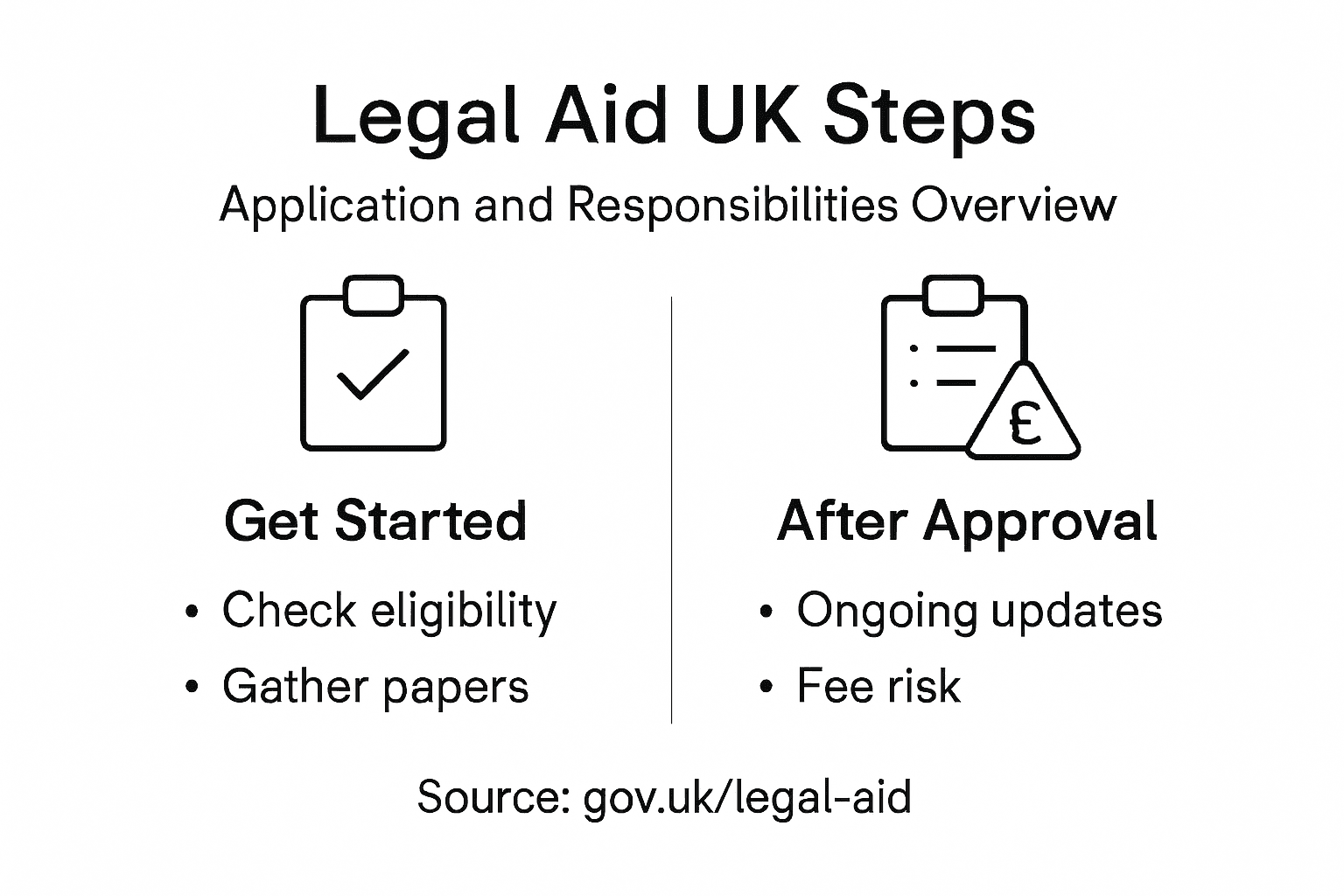
Legal aid recipients must understand their financial obligations under the statutory charge, which can significantly impact their case outcomes and potential financial recovery. This mechanism ensures that individuals who receive public funding contribute to their legal costs when possible.
The key aspects of financial responsibilities in legal aid include:
- Potential upfront cost contributions
- Possible repayment requirements
- Charges against recovered property or money
- Means-tested financial assessments
- Flexible payment arrangements
- Exceptions for vulnerable individuals
Statutory charge is a legal mechanism designed to recover legal aid expenses when a client gains financial benefit from their case. This can occur through various scenarios, such as:
- Property settlements in divorce proceedings
- Compensation awards in civil cases
- Financial settlements from legal disputes
- Inheritance or asset recoveries
The statutory charge aims to balance access to justice with responsible use of public funds, ensuring that those who can afford to contribute do so.
The financial assessment process involves carefully evaluating an individual’s:
- Current income levels
- Total accessible assets
- Potential case outcomes
- Ability to make retrospective contributions
- Specific legal aid category
Some critical considerations for legal aid recipients include understanding that the statutory charge may be applied flexibly. In some instances, payments can be structured like a mortgage, allowing gradual repayment without immediate financial strain.
The table below summarises key financial responsibilities and statutory charge implications for legal aid recipients:
| Financial Aspect | Description | Impact on Recipient |
|---|---|---|
| Upfront Contributions | Initial payment based on monthly means test | May reduce aid awarded |
| Statutory Charge | Charge on recovered property/money post-case | Repayment from winnings |
| Flexible Repayment | Structured instalments akin to a mortgage format | Eases immediate burden |
| Exemptions | May apply for highly vulnerable individuals | No repayment required |
Pro tip: Discuss potential financial responsibilities with your legal adviser before proceeding, and request a detailed breakdown of possible statutory charges to avoid unexpected financial obligations.
Alternatives to legal aid and common mistakes
When legal aid is unavailable, individuals facing legal challenges must explore alternative strategies for obtaining legal support. Expert legal advice platforms offer comprehensive resources for those navigating complex legal landscapes without traditional legal aid funding.
Alternative approaches to securing legal support include:
- Pro bono legal services
- Community legal clinics
- Law school legal assistance programmes
- Online legal consultation platforms
- Fixed-fee legal services
- Conditional fee arrangements
- Trade union legal support
Common mistakes individuals make when seeking legal assistance involve:
- Waiting too long to seek help
- Misunderstanding eligibility criteria
- Failing to gather comprehensive documentation
- Overlooking alternative funding mechanisms
- Assuming all legal services are equally accessible
Funding alternatives can provide critical support for those unable to secure traditional legal aid. These options range from conditional fee agreements to specialised community legal services that offer reduced-cost or free assistance.
Not all legal challenges require expensive representation; creative solutions can often provide meaningful support.
The most effective strategies for navigating legal challenges without standard legal aid involve:
- Researching multiple support channels
- Understanding specific legal service offerings
- Comparing cost structures
- Exploring sliding-scale fee options
- Considering alternative dispute resolution methods
Financial constraints should never prevent individuals from accessing fundamental legal support. Many organisations offer flexible approaches to legal assistance, ensuring that vulnerable people can still protect their rights.
Pro tip: Contact local law centres and university legal clinics, as they often provide free or low-cost legal consultations for individuals facing financial challenges.
Unlock Fair Access to Justice with Expert Guidance
Navigating the complexities of legal aid in the United Kingdom can be overwhelming, especially when financial constraints and strict eligibility requirements stand in your way. If you are concerned about understanding your rights around property disputes, divorce proceedings or the statutory charge, you are not alone. This article highlights key challenges such as proving financial need, meeting means tests and avoiding common application mistakes — all vital to securing the fair legal support you deserve.
At KefiHub, we provide practical and reliable insights tailored for professionals and individuals facing these exact hurdles. Our platform offers clear explanations on legal aid eligibility, financial responsibilities, and valuable alternatives when traditional routes seem out of reach.
Explore helpful resources and step-by-step advice on Legal Aid in the UK to empower your next move. Let us help you remove the barriers to justice so you can protect your rights with confidence.

Discover actionable guidance today with KefiHub. Don’t wait — access expert commentary and real-world solutions now to navigate the legal aid process successfully and safeguard your future.
Frequently Asked Questions
What is the purpose of legal aid in the UK?
Legal aid provides financial assistance for legal advice, mediation, and court representation to vulnerable individuals, ensuring fair access to justice regardless of their financial situations.
Who is eligible for legal aid?
Eligibility for legal aid depends on specific criteria including household income, savings, the nature of the legal issue, and the potential merits of the case. Individuals typically need to demonstrate financial need and a compelling legal requirement.
What types of cases receive comprehensive legal aid support?
Cases involving family law, housing disputes, and domestic violence often receive more extensive legal aid support. Other legal matters, such as general civil cases, may have limited assistance available.
What should I prepare before applying for legal aid?
Before applying for legal aid, gather all relevant financial documentation, such as recent bank statements, proof of income, and details about savings and household expenditure to streamline the application process.
Recommended
- DARVO in UK Family Law – Spotting and Countering Manipulation – Kefihub
- Role of a Solicitor: Navigating Legal Matters in the UK – Kefihub
- Why the Right Technology is the Secret Weapon for UK Law Firms’ Marketing Success – Kefihub
- Best Legal Advice Platforms 2025 – Expert Comparison 2026 – Kefihub
- AI-Powered Phone Systems: Boosting Law Firm Efficiency – Voipcom