


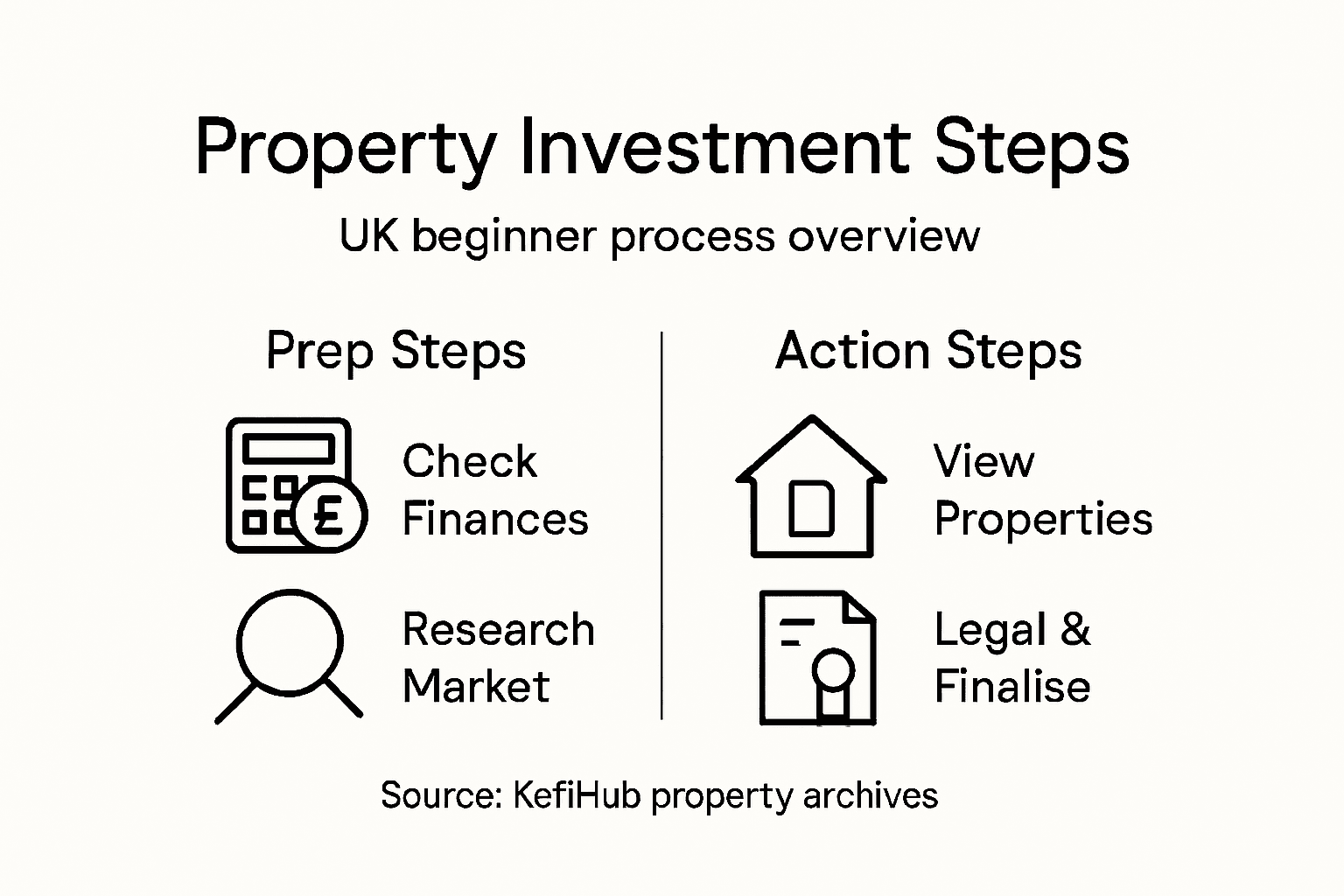
Taking your first step into property investment can feel like stepping into a world full of options and important decisions. For many in the UK, building wealth through property starts with understanding your own finances, the latest market trends, and the legal side of buying. This guide breaks down the key steps every first-time investor should follow so you can approach each stage with confidence and clarity.
Table of Contents
- Step 1: Assess Your Financial Position
- Step 2: Research The Property Market
- Step 3: Select The Right Investment Property
- Step 4: Secure Legal And Financial Arrangements
- Step 5: Complete Checks And Finalise The Purchase
Quick Summary
| Key Insight | Explanation |
|---|---|
| 1. Assess financial health closely | Conduct a thorough review of income, debts, expenses, savings, and credit score to understand your readiness for property investment. |
| 2. Research the property market | Analyse current market trends and regional data to identify promising investment opportunities based on price stability and growth potential. |
| 3. Choose the right investment property | Evaluate different properties based on location, condition, rental yield, and long-term capital appreciation to ensure maximum returns. |
| 4. Secure legal and financial arrangements | Engage a property solicitor, verify documentation, and prepare necessary financial approvals to protect your investment legally and financially. |
| 5. Finalise the purchase meticulously | Complete essential checks, contract exchanges, and registrations, ensuring every detail is attended to for a successful property transaction. |
Step 1: Assess your financial position
Understanding your current financial landscape is crucial before diving into property investment. This step helps you determine whether you’re financially prepared to embark on this significant journey and identify potential funding strategies.
Begin by conducting a comprehensive financial health check. Review your current income, existing debts, monthly expenses, and savings. The government’s affordable home ownership guidance emphasises the importance of ensuring you can manage mortgage costs comfortably.
Key aspects to evaluate include:
- Your monthly disposable income
- Total existing debt levels
- Current savings and emergency fund
- Credit score strength
- Potential mortgage affordability
Calculate your debt-to-income ratio by dividing your total monthly debt payments by your gross monthly income. Most lenders prefer this ratio to be below 40%. If you’re above this threshold, focus on reducing debts before proceeding.
The Financial Conduct Authority recommends ensuring your day-to-day finances are stable before considering property investment. This means having an emergency fund covering 3-6 months of expenses and a clear understanding of your financial resilience.
Your financial position isn’t just about current income, but your ability to sustain investment through potential market fluctuations.
Get professional insight by scheduling a meeting with a financial advisor who can provide personalised guidance tailored to your specific circumstances. They can help you understand your investment capacity and potential mortgage options.
Here’s a quick comparison of key methods to assess your investment readiness:
| Assessment Method | What It Evaluates | Typical Benefit |
|---|---|---|
| Debt-to-income ratio | Financial liabilities vs income | Determines mortgage eligibility |
| Credit score analysis | Borrowing and payment history | Unlocks best loan rates |
| Emergency fund status | Savings buffer for risk | Boosts resilience against setbacks |
| Financial advisor review | Tailored professional advice | Clarifies investment capacity |
Pro tip: Use online mortgage calculators and financial planning tools to get a preliminary assessment of your investment readiness before consulting professionals.
Step 2: Research the property market
Researching the UK property market is a critical step in your investment journey. This stage helps you understand current market trends, identify potential investment opportunities, and make informed decisions about where and when to invest.
Begin by examining comprehensive market data. The UK government’s housebuilding market study provides an analytical overview of property market dynamics across England, Scotland, and Wales. Look into key metrics such as:
- House price trends
- Regional market variations
- Supply and demand dynamics
- Economic indicators affecting property values
- Potential growth areas
Focus on specific regions that show promise. London housing market reports offer detailed insights into market conditions, providing quarterly data on house prices, rental yields, and sales volumes. Pay special attention to:
- Average property prices
- Rental income potential
- Local infrastructure developments
- Population growth trends
- Employment market strength
Market research isn’t just about numbers – it’s about understanding the story behind the statistics.
Diversify your research sources by combining official government data, local market reports, property investment websites, and conversations with local real estate professionals. Each source offers unique perspectives that can help you build a comprehensive market understanding.
Use this summary table to compare UK property market factors for investment:
| Factor | Impact on Investment | How to Research |
|---|---|---|
| Price trend stability | Predicts future returns | Analyse official reports |
| Regional growth outlook | Reveals area potential | Study employment data |
| Rental yield rates | Influences cash flow | Review local statistics |
| Infrastructure projects | Affects long-term value | Check council plans |
Pro tip: Create a spreadsheet to track and compare market data from different sources, helping you spot trends and make more informed investment decisions.
Step 3: Select the right investment property
Choosing the right property is a pivotal moment in your investment journey, where careful analysis meets strategic decision-making. This step requires a comprehensive approach to identifying properties that align with your financial goals and investment strategy.
Begin by understanding the different property types and their potential returns. Guidance on buying property highlights critical considerations such as leasehold versus freehold ownership, which can significantly impact your investment potential. Evaluate potential properties across these key dimensions:
- Location and neighbourhood potential
- Property condition and renovation requirements
- Potential rental yields
- Long-term capital appreciation prospects
- Local infrastructure and development plans
The Office for National Statistics provides detailed market data that can help you understand regional variations in property performance. Consider these strategic factors when selecting your investment property:
- Research local employment trends
- Analyse population growth indicators
- Investigate planned infrastructure projects
- Assess proximity to transport links
- Evaluate school district quality
Not all properties are created equal – your success depends on selecting the right asset at the right time.
Conduct thorough due diligence by visiting properties, speaking with local real estate professionals, and comparing multiple options. Look beyond surface-level attractions and dig into the fundamental investment potential of each property.

Pro tip: Create a comprehensive scoring system that objectively rates potential properties across multiple investment criteria, helping you make more rational and data-driven selection decisions.
Step 4: Secure legal and financial arrangements
Securing robust legal and financial arrangements is a critical phase in your property investment journey. This step ensures you’re protected legally and financially, minimising potential risks and establishing a solid foundation for your investment strategy.
UK government guidance highlights the importance of understanding legal responsibilities and investment protocols. Consider these essential legal and financial preparations:
- Engage a qualified property solicitor
- Obtain comprehensive property searches
- Verify all legal documentation
- Arrange mortgage pre-approval
- Understand tax implications
Prepare a comprehensive checklist of financial and legal requirements. The key documentation you’ll need includes:
- Proof of funds
- Mortgage agreement in principle
- Property valuation reports
- Legal contracts
- Insurance documents
Thorough preparation separates successful investors from amateur speculators.
Understand regulatory compliance by reviewing financial regulation requirements from the Financial Conduct Authority. This ensures you’re operating within legal frameworks and protecting your investment.
Pro tip: Create a dedicated investment folder containing all critical documents, organised chronologically to streamline your legal and financial record-keeping.
Step 5: Complete checks and finalise the purchase
The final stage of your property investment journey involves meticulously completing legal checks and finalising your purchase. This crucial phase transforms your investment strategy from planning to reality, requiring careful attention to detail and precise execution.
Official UK government guidance for home buying recommends thorough property purchase verification steps before completion. Key actions include:
- Conduct comprehensive property surveys
- Verify legal title documentation
- Confirm all financial arrangements
- Arrange final property valuation
- Prepare for Stamp Duty payment
The purchase completion process typically involves these sequential steps:
- Exchange formal contracts
- Pay completion deposit
- Transfer remaining funds
- Conduct final property walkthrough
- Receive property keys
The details in property transactions can make or break your investment success.
Understand the final stages of property purchase by working closely with your solicitor. Register your property with the Land Registry to ensure legal ownership is properly documented and protected.
Pro tip: Create a comprehensive digital and physical file containing all transaction documents, keeping copies in multiple secure locations to safeguard your investment records.
Navigate Your UK Property Investment Journey with Confidence
Embarking on property investment in the UK can feel overwhelming from assessing your finances to finalising the purchase. Whether you are worried about understanding mortgage affordability, researching vibrant markets, or navigating complex legalities, you are not alone. This article highlights common challenges like managing debt-to-income ratios, pinpointing promising locations, and securing the right legal and financial frameworks. At KefiHub, we understand these pain points and offer clear, practical guidance designed to empower UK beginners with expert insights and actionable advice.

Discover more in our Property Archives – KefiHub where you can deepen your understanding of each step towards successful property investment. Start turning uncertainty into informed decision-making today on KefiHub. The right knowledge at the right time can transform your investment goals into lasting financial growth. Take the first step now and explore resources tailored for UK property investors.
Frequently Asked Questions
How do I assess my financial position before starting property investment?
Start by conducting a comprehensive financial health check that includes reviewing your income, debts, expenses, and savings. Ensure you calculate your debt-to-income ratio and keep it below 40% to improve your mortgage eligibility.
What are the key factors to research in the property market?
Focus on house price trends, regional market variations, and supply and demand dynamics. Investigate local economic indicators and potential growth areas to identify the best investment opportunities.
How do I select the right investment property?
Evaluate properties based on location, condition, rental yield potential, and long-term capital appreciation. Conduct thorough due diligence by visiting properties and comparing multiple options to make informed decisions.
What legal and financial arrangements should I secure before purchasing?
Engage a qualified property solicitor and verify all legal documentation while arranging mortgage pre-approval. Prepare essential documents such as proof of funds and insurance documentation to streamline your purchase process.
What checks should I complete before finalising the property purchase?
Conduct comprehensive property surveys and verify legal title documentation before exchanging contracts. Ensure all financial arrangements are confirmed and prepare for Stamp Duty payment prior to completion.
How can I keep track of my property investment documents?
Create a dedicated folder, both digital and physical, to store all critical documents in chronological order. Regularly update this folder with transaction documents to streamline record-keeping.
Recommended
- Property Investment Guide UK: Secure Your First Buy – Kefihub
- Property Investment Guide UK: Secure Your First Buy – Kefihub
- Property Investment Explained: A Complete UK Guide – Kefihub
- 7-Step Property Investment Checklist for UK Professionals – Kefihub
- 7 Steps to a Profitable B2B Real Estate Marketing Checklist – Kadima