


TL;DR:
- Only 14.6% of UK SMEs achieve sustained four-year growth, often due to lack of market research.
- Market research helps SMEs reduce risks, validate ideas, and make informed decisions affordably.
- Continual research habits enable businesses to adapt, avoid costly mistakes, and build market resilience.
Only 14.6% of UK SMEs achieve sustained growth over four years. That is a sobering figure, and it raises a critical question: what separates the businesses that thrive from those that stall? In many cases, the answer is not passion, funding, or even hard work. It is the consistent use of market research. Many small business owners assume research is reserved for large corporations with dedicated teams and big budgets. This guide challenges that assumption directly. Market research is one of the most practical and affordable tools available to you, and it can make the difference between a decision that costs you money and one that builds your business.
Table of Contents
- What is market research and why does it matter?
- How market research drives better decisions for UK SMEs
- Common pitfalls: What happens if you skip market research
- Practical guide: Getting started with market research on a small business budget
- Our perspective: What most small businesses overlook about market research
- Grow your business with expert support
- Frequently asked questions
Key Takeaways
| Point | Details |
|---|---|
| Market research is vital | Understanding your customers and competitors is the simplest way to fuel SME growth in the UK. |
| Avoid costly mistakes | Skipping market research leads to wasted effort and higher failure rates. |
| Affordable methods exist | Even on a small budget, UK SMEs can access useful market data and tools. |
| Better decisions, better odds | Businesses using research respond faster to market changes and outperform their peers. |
| It’s an ongoing discipline | Continually researching your market makes your SME more resilient and agile. |
What is market research and why does it matter?
Market research is the process of gathering and analysing information about your customers, competitors, and the wider business environment. It does not require expensive consultants or complex software. At its core, it means asking the right questions and listening carefully to the answers.
For UK small businesses, market research covers five essential areas:
- Customer needs and behaviour: Who your buyers are, what they want, and what frustrates them
- Competitor activity: What others in your sector are offering and at what price
- Market trends: How your industry is shifting and where demand is heading
- Pricing signals: What customers are willing to pay and how your rates compare
- Business risks: Regulatory changes, economic pressures, or emerging threats
A common myth is that only large companies need formal research. In reality, the opposite is true. Small businesses have less margin for error, which makes research even more critical. One poorly timed product launch or misjudged pricing decision can drain months of profit.
“Market research is not a luxury for big brands. It is a safety net and a blueprint for every business that wants to grow with confidence rather than guesswork.”
The UK market research sector was valued at £9 billion in 2023, reflecting just how seriously businesses of all sizes invest in understanding their markets. Yet many SMEs still skip this step entirely, relying on instinct alone.
Research also supports building market resilience by helping you anticipate change rather than react to it. When you understand your market deeply, you make decisions with greater confidence and far less financial risk.
How market research drives better decisions for UK SMEs
With a clearer understanding of what market research is, let us explore how it actually powers smarter decision-making in your business.
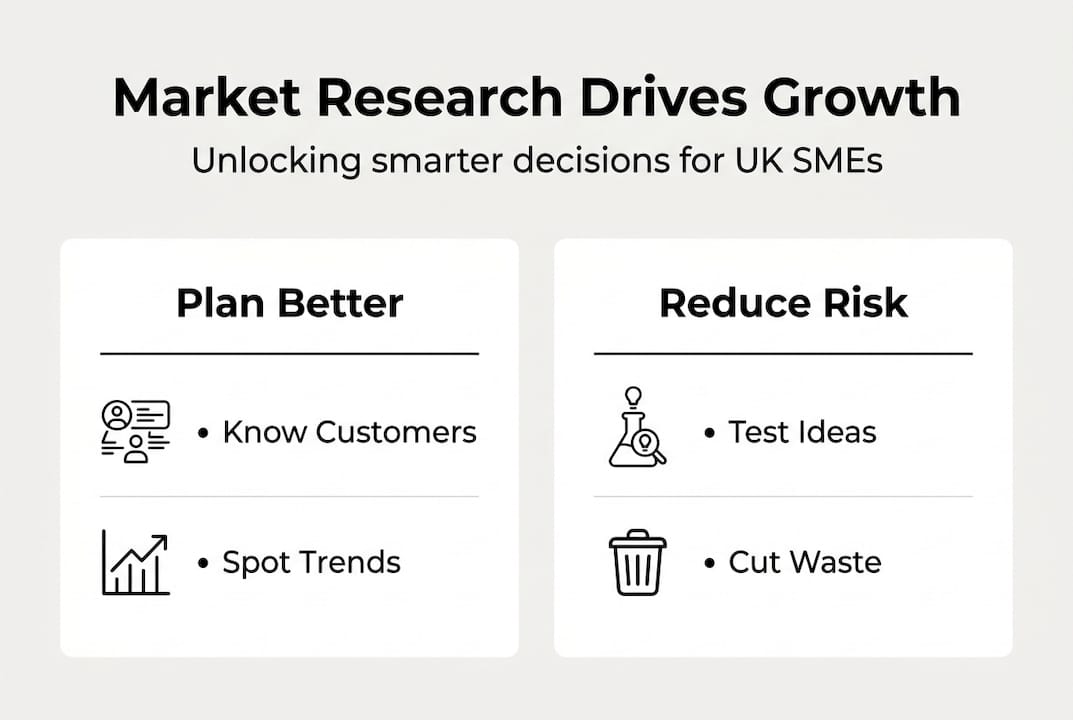
Research reduces wasted spending. Before you invest in a new product, service, or marketing campaign, research tells you whether there is genuine demand. Without it, you are spending money on assumptions. 53% of UK startups from 2020 had failed by 2023, and a significant factor was launching without validating their ideas in the market first.
Here is a comparison of decisions made with and without research:
| Decision type | With market research | Without market research |
|---|---|---|
| New product launch | Validated demand, lower risk | Assumption-based, high risk |
| Pricing strategy | Benchmarked and competitive | Guesswork, may undercut profit |
| Target audience | Defined and segmented | Broad and unfocused |
| Customer satisfaction | Measured and improved | Unknown until complaints arrive |
Using business intelligence for SMEs does not need to be complex. Here is a simple five-step process to put research into action:
- Identify the decision you need to make (e.g. should I launch a new service?)
- Gather desk research using existing data, competitor websites, and industry reports
- Survey or interview customers to validate your assumptions
- Analyse the feedback and look for patterns, not just confirmation
- Refine your offer based on what the data actually tells you, then position accordingly
Pro Tip: When creating a customer survey, keep it to five or six focused questions. Ask one open-ended question such as “What is the biggest challenge you face with X?” The answers often reveal opportunities you had not considered.
For growth strategies for SMEs, research is not a one-time event. It feeds into pricing, positioning, and product development on an ongoing basis.
Common pitfalls: What happens if you skip market research
Understanding the value market research can bring, it is critical to also see what can go wrong if you ignore it.
The most common pitfalls for UK SMEs who skip research include:
- Wasted marketing budgets on campaigns targeting the wrong audience
- Failed product launches due to unvalidated assumptions about demand
- Pricing errors that either undervalue your offer or push customers away
- Missed competitive threats from new entrants you did not see coming
- Poor customer retention because you never understood what they actually valued
“Market research acts as a safety net. Without it, you are making expensive decisions in the dark, hoping the floor is where you think it is.”
The data reinforces this clearly. Only 14.6% of UK SMEs achieved sustained growth over four years. Many of those who struggled had one thing in common: they acted on intuition rather than evidence.
Pro Tip: Watch out for confirmation bias. This is the tendency to seek out information that supports what you already believe and dismiss what does not. To counter it, actively ask customers what they dislike about your product or service. Their honest answers are more valuable than praise.
Consider a brief example. A UK-based independent retailer spent £8,000 on a new product range based on what the owner personally liked. Without checking whether local customers wanted it, the stock sat unsold for months. A simple survey of 20 existing customers beforehand would have revealed the gap. Contrast this with a service business that ran a short competitor audit before adjusting its pricing, which led to a 22% increase in enquiries within three months.

Avoiding common growth mistakes often comes down to one thing: checking your assumptions before committing your budget. And when it comes to service pricing strategies, research gives you the confidence to charge what your offer is genuinely worth.
Practical guide: Getting started with market research on a small business budget
To make research manageable and affordable, here are the essential steps and tools any SME can adopt immediately.
Follow this starter blueprint:
- Define your goal: What specific decision does this research need to support?
- Desk research first: Search competitor websites, read trade association reports, and review customer reviews on platforms like Trustpilot or Google
- Survey your customers: Use free tools such as Google Forms or SurveyMonkey to gather structured feedback
- Run a competitor check: Note their pricing, messaging, and customer reviews to identify gaps
- Iterate: Research is not a one-off task. Review findings regularly and adjust your strategy accordingly
Here is a comparison of free versus paid research methods:
| Method | Free or paid | Pros | Cons | Best for |
|---|---|---|---|---|
| Customer surveys | Free | Direct insight, fast | Low response rates | Validating ideas |
| ONS data | Free | Reliable, UK-specific | Can be complex | Market sizing |
| Focus groups | Paid | Deep qualitative data | Time-consuming | New product testing |
| Trade reports | Often paid | Sector-specific depth | Costly | Strategic planning |
| Online reviews | Free | Real customer voice | Unstructured | Competitor analysis |
Useful free resources for UK SMEs include:
- Office for National Statistics (ONS): Sector data, economic trends, and consumer behaviour
- Trade associations: Sector-specific insight and benchmarking data
- Google Trends: Real-time search demand signals
- Companies House: Competitor financial data
- Online reviews: Trustpilot, Google, and social media comments
Pro Tip: Ten honest customer conversations can be more revealing than a 200-person survey. Ask open questions, listen without interrupting, and note the exact words customers use to describe their problems. That language becomes your most effective marketing copy.
In an uncertain UK economy, research supports better decision-making for both survival and scaling. If your research needs grow beyond what free tools can provide, consider a freelance market researcher or a specialist agency for a defined project. Understanding the role of analytics for SMEs and tracking key business metrics will also sharpen how you interpret the data you collect.
Our perspective: What most small businesses overlook about market research
Now that you have actionable steps, here is our candid take on what separates SMEs who thrive from those who simply survive.
Most small business owners treat market research as a box to tick before launch, then never return to it. That is the real problem. Markets shift, customer expectations evolve, and competitors move fast. Research carried out once in 2022 does not protect you in 2026.
Relying on gut feel is riskier than ever in the current UK market. Economic pressures, changing consumer priorities, and increased competition mean that even experienced business owners can misread the room. The businesses we see building genuine traction are those that treat research as a regular habit, not a one-off task.
The uncomfortable truth is that most SME failures are not caused by a lack of passion or effort. They come from ignoring negative signals. A customer who stops buying, a product that gets returned repeatedly, a service that generates lukewarm reviews. These are all data points. If you dismiss them, you miss the chance to course-correct before the damage is done.
Simple research habits, done consistently, are your most affordable form of business insurance. Start small. Stay curious. And commit to building real resilience through evidence rather than assumption.
Grow your business with expert support
If you want to put these insights to work in your business, the right resources can make all the difference.
At KefiHub, we have built a growing library of practical guides designed specifically for UK small business owners. Follow our business growth roadmap for a step-by-step framework that takes you from early-stage research through to scaling with confidence. Explore our guide on networking for SMEs to build the connections that support informed decision-making. And if you are looking for a broader business support network, KefiHub is your go-to platform for reliable, UK-focused guidance across every stage of your business journey.
Frequently asked questions
How often should small businesses do market research?
You should review your market, competitors, and customer feedback at least every 6 to 12 months, or before launching any new product or service.
Can market research be done cheaply or for free?
Yes. Many UK SMEs rely on free research options such as the ONS, trade associations, and free online survey tools to gather meaningful market data.
What is the biggest mistake in market research?
The most common error is confirmation bias. Many SMEs only seek data that supports their existing idea and ignore negative signals, which significantly increases the risk of failure.
Where can I find reliable market data for the UK?
Start with the Office for National Statistics, your relevant trade association, and sector-specific reports. These sources provide credible, UK-focused data that is regularly updated.
Does market research guarantee success?
No, but it improves your growth odds considerably by helping you make informed decisions and avoid the most common and costly mistakes.
Recommended
- Key Business Metrics Explained: Driving UK Growth – Kefihub
- 7 Smart Business Growth Strategies for UK Professionals – Kefihub
- Why branding matters: 81% trust boost for UK SMEs – Kefihub
- Role of Analytics in Growth: UK SME Impact – Kefihub
- How to Conduct Market Research for B2B Revenue Growth – Kadima