


Only a small portion of British small business owners regularly track their key metrics, yet those who do report up to 20 percent higher growth. Busy managers across the United Kingdom face tough decisions every day, and understanding performance data can mean the difference between steady progress and missed opportunities. This guide simplifies essential business metrics, giving you practical tools to measure success, make better choices, and confidently grow your company.
Table of Contents
- What Are Key Business Metrics?
- Types Of Metrics For Small Businesses
- How Metrics Improve Business Decision-Making
- Financial, Customer And Operational Metrics
- Common Mistakes When Tracking Metrics
- Interpreting Metrics For Sustainable Growth
Key Takeaways
| Point | Details |
|---|---|
| Importance of Metrics | Key business metrics provide crucial insights into performance, guiding strategic decision-making and identifying growth opportunities. |
| Diverse Metric Categories | Tracking financial, customer, operational, and marketing metrics ensures a comprehensive understanding of business health. |
| Common Pitfalls | Avoid metric fixation and vanity metrics; focus on actionable insights that align with overarching business goals. |
| Dynamic Approach | Implement a quarterly review process to adapt metrics to changing conditions and maintain alignment with strategic objectives. |
What Are Key Business Metrics?
Key business metrics represent quantifiable measurements that help small businesses track performance, understand progress, and make informed strategic decisions. These vital indicators go beyond simple financial data, providing a comprehensive view of organisational health and potential growth opportunities. Key performance indicators (KPIs) are essential tools that enable entrepreneurs to monitor their company’s trajectory with precision and clarity.
At their core, business metrics function like a dashboard for your organisation, displaying critical information about different aspects of performance. They might track areas such as financial performance, customer satisfaction, operational efficiency, marketing effectiveness, and team productivity. The most powerful metrics adhere to the SMART framework, which ensures each indicator is Specific, Measurable, Achievable, Relevant, and Time-Bound. This approach transforms abstract goals into concrete, trackable objectives that provide meaningful insights.
Small business owners should focus on metrics most relevant to their specific industry and strategic goals. Common examples include revenue growth rate, customer acquisition cost, profit margins, employee retention rates, and conversion rates. By selecting and consistently monitoring the right metrics, you can identify trends, recognise potential issues early, and make data-driven decisions that propel your business forward. Tracking these indicators helps create a culture of continuous improvement and strategic planning.
Top tip: Select 3-5 key metrics that directly align with your most critical business objectives and review them monthly to maintain consistent strategic focus.
Types Of Metrics For Small Businesses
Small businesses must strategically track different types of metrics to gain comprehensive insights into their organisational performance. Effective business metrics encompass multiple dimensions, helping entrepreneurs understand their company’s health from various critical perspectives. These metrics are typically categorised into distinct yet interconnected groups that collectively paint a holistic picture of business performance.

The primary categories of business metrics include financial metrics, which measure monetary performance and stability. These typically cover areas such as revenue growth rate, gross profit margins, net profit, cash flow, and return on investment. Customer metrics represent another crucial category, tracking indicators like customer acquisition cost, customer satisfaction scores, retention rates, and lifetime value. These metrics help businesses understand their relationship with customers and the effectiveness of their engagement strategies.
Operational metrics focus on internal efficiency and productivity, measuring aspects like employee performance, production speed, resource utilisation, and process effectiveness. Marketing metrics evaluate the success of promotional efforts, including website traffic, conversion rates, social media engagement, and campaign return on investment. Sales metrics track performance indicators such as lead generation, sales volume, average transaction value, and sales cycle length. By monitoring these diverse metric categories, small business owners can develop a nuanced understanding of their organisational strengths and potential areas for improvement.
Here’s how core business metrics differ in their strategic focus and benefits:
| Metric Category | Strategic Focus | Typical Metrics | Key Benefit |
|---|---|---|---|
| Financial | Profitability and financial health | Revenue, profit margin, ROI | Informs resource allocation |
| Customer | Client relationships and satisfaction | Satisfaction, retention, acquisition | Drives loyalty and growth |
| Operational | Efficiency and internal processes | Productivity, cycle time, defect rate | Boosts productivity |
| Marketing/Sales | Growth through promotion and sales effectiveness | Conversion rate, lead volume, traffic | Enhances market reach |
Top tip: Create a dashboard that consolidates metrics from different categories, allowing you to quickly assess your business performance and identify interconnected trends.
How Metrics Improve Business Decision-Making
Business metrics serve as a powerful navigational tool, transforming raw data into actionable strategic insights. Systematic measurement frameworks enable organisations to articulate clear strategic objectives and make informed decisions based on quantitative evidence. By establishing meaningful key performance indicators (KPIs), businesses can track progress, assess performance, and adapt their strategies with precision and confidence.
Data-driven decision-making fundamentally shifts how small businesses approach challenges and opportunities. Rather than relying on intuition or gut feelings, entrepreneurs can now use concrete metrics to validate their strategic choices. Outcome-based measurement approaches help leaders allocate resources more effectively, demonstrating tangible project value and reducing uncertainty. This approach enables businesses to identify potential issues early, recognise emerging trends, and make proactive adjustments before minor challenges escalate into significant problems.
The transformative power of metrics lies in their ability to provide a holistic view of organisational performance. By tracking indicators across financial, operational, customer, and marketing domains, business owners gain a multidimensional understanding of their company’s health. These metrics create a feedback loop that supports continuous improvement, allowing organisations to benchmark their performance, set realistic goals, and develop targeted strategies for growth. The ongoing process of measuring, analysing, and adapting ensures that decision-making remains agile, responsive, and aligned with overall business objectives.
Top tip: Establish a quarterly review process where you analyse your key metrics, identifying trends and making strategic adjustments to maintain consistent business momentum.
Financial, Customer And Operational Metrics
Small businesses must develop a comprehensive understanding of three critical metric categories to drive sustainable growth and performance. Integrated metric frameworks enable organisations to gain holistic insights into their business health by tracking financial, customer, and operational indicators simultaneously. These interconnected metrics provide a nuanced view of organisational effectiveness beyond traditional single-dimensional measurement approaches.
Financial metrics represent the monetary backbone of business performance, offering critical insights into economic sustainability. Key indicators include return on investment, profit margins, revenue growth rates, cash flow stability, and earnings per share. These metrics help entrepreneurs assess their financial stewardship, understand profitability trends, and make informed resource allocation decisions. Customer metrics complement financial data by measuring relationship quality, tracking indicators such as customer satisfaction scores, retention rates, acquisition costs, and lifetime value. These measurements reveal the strength of client connections and the effectiveness of engagement strategies.
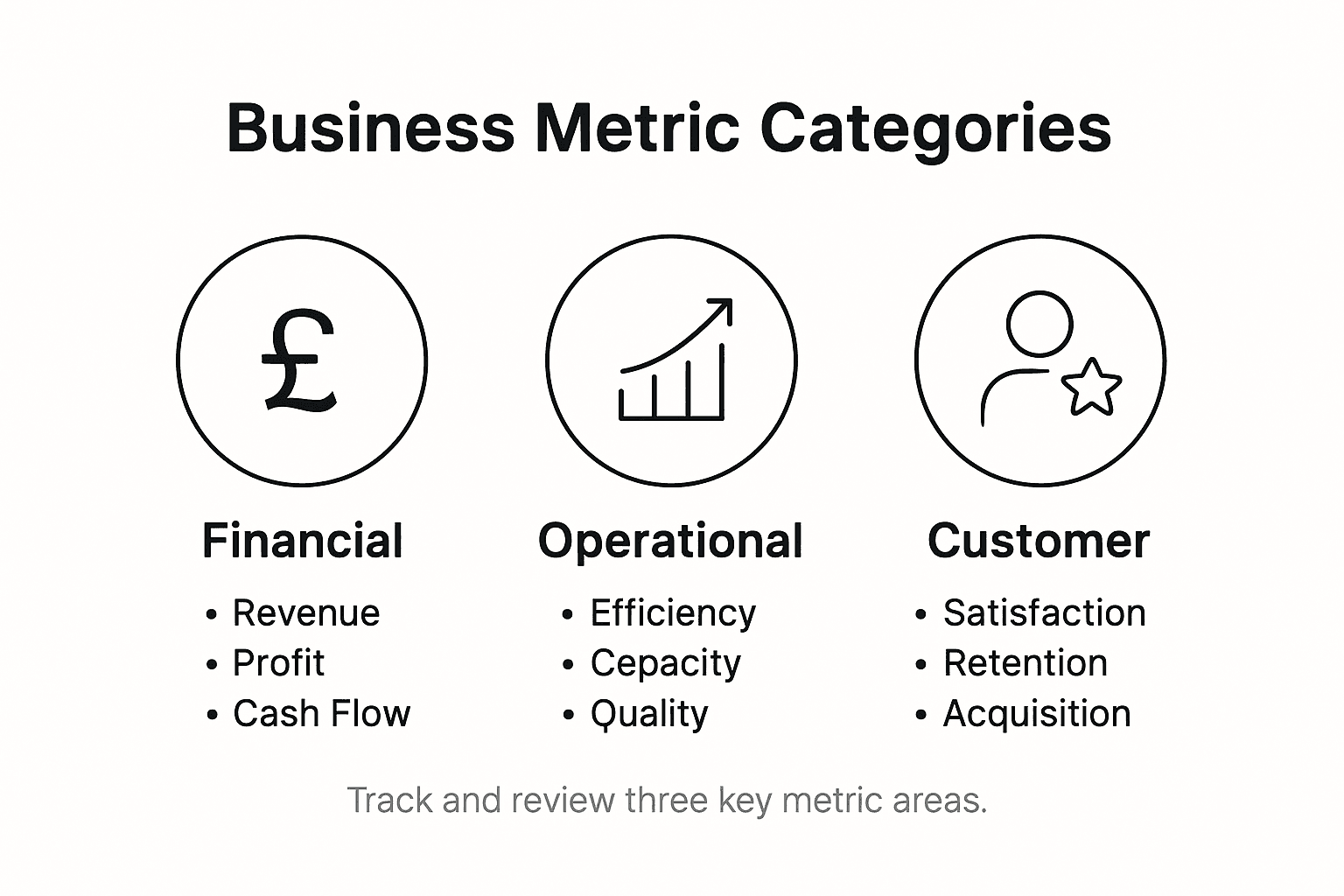
Operational metrics focus on internal process efficiency and productivity, providing insights into organisational performance beyond monetary measurements. These indicators assess aspects like production cycle times, defect rates, employee productivity, resource utilisation, and process quality. By monitoring operational metrics, businesses can identify bottlenecks, streamline workflows, and continuously improve internal systems. The power of these metric categories lies in their ability to work together, creating a comprehensive dashboard that enables small business owners to make strategic, data-driven decisions across multiple organisational dimensions.
Top tip: Create a monthly dashboard that synthesises financial, customer, and operational metrics to gain a holistic view of your business performance and identify interconnected improvement opportunities.
Common Mistakes When Tracking Metrics
Small businesses often encounter significant challenges when implementing performance measurement strategies. Metric selection mistakes can undermine an organisation’s ability to gain meaningful insights, leading to misguided decision-making and wasted resources. Understanding these common pitfalls is crucial for developing a robust and effective measurement approach that genuinely supports business growth.
One of the most prevalent errors is metric fixation, where businesses become overly focused on numerical targets rather than understanding the underlying strategic implications. Organisations frequently prioritise hitting specific numbers without considering the broader context or potential unintended consequences. This approach can create perverse incentives, where employees manipulate metrics to appear successful instead of driving genuine business value. Common manifestations include selecting vanity metrics that look impressive but provide little actionable insight, tracking indicators that are easy to measure but irrelevant to core business objectives, and failing to establish clear ownership and review processes for metric tracking.
Additional critical mistakes include implementing metrics in isolation without considering their interconnected nature, neglecting to regularly review and update measurement frameworks, and becoming overly reliant on historical data without accounting for changing business environments. Successful metric tracking requires a dynamic approach that balances quantitative measurement with qualitative understanding. Businesses must develop a holistic view that considers not just the numbers themselves, but the strategic context, potential limitations, and broader organisational goals that these metrics are designed to support. This means creating flexible measurement systems that can adapt to changing business conditions and provide meaningful, actionable insights.
Common metric tracking mistakes and how to avoid them:
| Mistake | Description | Recommended Solution |
|---|---|---|
| Metric fixation | Obsessing over numbers, missing strategic context | Link measures to broader objectives |
| Vanity metrics | Tracking impressive but meaningless numbers | Prioritise actionable, business-relevant |
| Neglecting reviews | Failing to update or assess metrics regularly | Schedule periodic audits and adjustments |
| Isolated measurement | Ignoring metric interconnections | Use integrated dashboards for context |
Top tip: Conduct a quarterly audit of your metrics, critically assessing each indicator’s relevance, accuracy, and alignment with your current business strategy.
Interpreting Metrics For Sustainable Growth
Sustainable business growth requires more than tracking traditional financial indicators. Comprehensive metric frameworks challenge entrepreneurs to view performance through a multidimensional lens that balances economic success with broader societal and environmental considerations. This holistic approach transforms metrics from simple numerical records into strategic navigation tools that guide long-term organisational development.
Contextual interpretation is crucial when evaluating business metrics for sustainable growth. Rather than viewing individual indicators in isolation, successful organisations understand the interconnected nature of different performance measurements. Financial metrics like revenue and profit margins must be considered alongside customer satisfaction scores, employee engagement rates, environmental impact indicators, and social responsibility metrics. This integrated approach ensures that growth is not achieved at the expense of long-term stability, ethical practices, or resource sustainability.
Effective metric interpretation demands a forward-looking perspective that anticipates future challenges and opportunities. Small businesses should develop a dynamic assessment framework that goes beyond historical performance, using metrics to identify emerging trends, potential risks, and strategic pivot points. This means creating feedback loops that continuously validate and refine measurement approaches, ensuring that the metrics themselves remain relevant and aligned with evolving business objectives. By treating metrics as living, adaptable tools rather than static benchmarks, organisations can build resilience, maintain competitive agility, and drive meaningful, responsible growth.
Top tip: Develop a balanced scorecard that integrates financial, customer, operational, and sustainability metrics to create a comprehensive view of your business performance.
Unlock the Power of Key Business Metrics to Drive Growth in the UK
Understanding and tracking the right key business metrics is essential for UK small businesses striving to overcome challenges like metric fixation and disconnected data points. This article reveals how metrics such as customer retention rates, profit margins, and operational efficiency can transform decision-making from guesswork into confident, data-driven action. If you want to avoid common pitfalls and embrace a holistic, sustainable growth strategy, timely insight and clear guidance are critical.
Explore practical strategies and expert advice tailored to UK professionals in our Business Archives – Kefihub. Don’t miss the chance to stay ahead by visiting KefiHub now for reliable, actionable guidance that connects key metrics with your business goals. Ready to make smarter decisions today? Start transforming your approach with the resources waiting for you at KefiHub and empower your business growth journey.
Frequently Asked Questions
What are key business metrics?
Key business metrics are quantifiable measurements used by organisations to track performance, evaluate progress, and guide strategic decisions. They provide insights into various aspects of business health beyond financial data, enabling a comprehensive understanding of growth opportunities.
Why are metrics important for small businesses?
Metrics are crucial for small businesses as they help identify trends, recognise potential issues early, and facilitate data-driven decision-making. By consistently monitoring the right metrics, businesses can create a culture of continuous improvement and strategically plan for future growth.
What types of metrics should small businesses focus on?
Small businesses should focus on financial metrics (such as profit margins and cash flow), customer metrics (like acquisition costs and satisfaction scores), operational metrics (covering productivity and efficiency), and marketing/sales metrics (including conversion rates and traffic). Choosing 3-5 key metrics directly aligned with business objectives is recommended.
How can business metrics improve decision-making?
Business metrics improve decision-making by providing quantitative evidence that supports strategic choices. By using data instead of intuition, small businesses can allocate resources effectively, identify emerging trends, and make proactive adjustments to enhance performance and achieve objectives.
Recommended
- Business Growth Roadmap: Step-by-Step Path for UK SMEs – Kefihub
- What Is Business Succession and Why It Matters – Kefihub
- How to Avoid Common Business Mistakes for UK Professionals – Kefihub
- Role of Social Media for Business Success – Kefihub