


Pricing your services correctly is one of the hardest challenges you will face as a UK provider. Set rates too low and you erode profit margins, attract the wrong clients, and build a business that cannot sustain itself. Set them too high without justification and you risk losing work to competitors. Many providers fall into a cycle of guessing, copying others, or simply charging what feels comfortable. This guide cuts through that uncertainty. You will find practical pricing models, current benchmarks, regional adjustments, and communication strategies to help you set rates that are both profitable and competitive in today’s UK market.
Table of Contents
- Understanding service pricing fundamentals in the UK
- Benchmarking and analysing competitor prices
- Adapting prices for client value and changing market conditions
- Legal, regional, and ethical factors in UK service pricing
- Communicating your prices and justifying your value
- Why following your competitors isn’t enough: smarter pricing for lasting success
- Take the next step: tools and support for setting smarter prices
- Frequently asked questions
Key Takeaways
| Point | Details |
|---|---|
| Use evidence-based models | Combine cost-plus, value-based, and competitive pricing to find the best fit for your services. |
| Benchmark and update regularly | Monitor market rates and review pricing at least annually or when costs shift significantly. |
| Communicate confidently | Frame price changes around client value, not just cost, to increase understanding and reduce churn. |
| Comply and build trust | Always notify clients clearly about changes and adjust for regional nuances and regulations. |
Understanding service pricing fundamentals in the UK
Before you can price confidently, you need to understand the main approaches available to you. Key pricing methodologies for UK service providers include cost-plus pricing, value-based pricing, competitive pricing, hourly or project rates, and dynamic pricing. Each has a specific use case, and the best providers often blend two or more.
| Pricing model | Best for | Key advantage | Main risk |
|---|---|---|---|
| Cost-plus | Tradespeople, manufacturers | Guarantees margin | Ignores perceived value |
| Value-based | Consultants, agencies | Higher profit potential | Harder to quantify |
| Competitive | Crowded markets | Market alignment | Price wars, margin erosion |
| Hourly/project | Freelancers, IT | Flexibility | Scope creep |
| Dynamic | Demand-driven services | Revenue optimisation | Client trust issues |
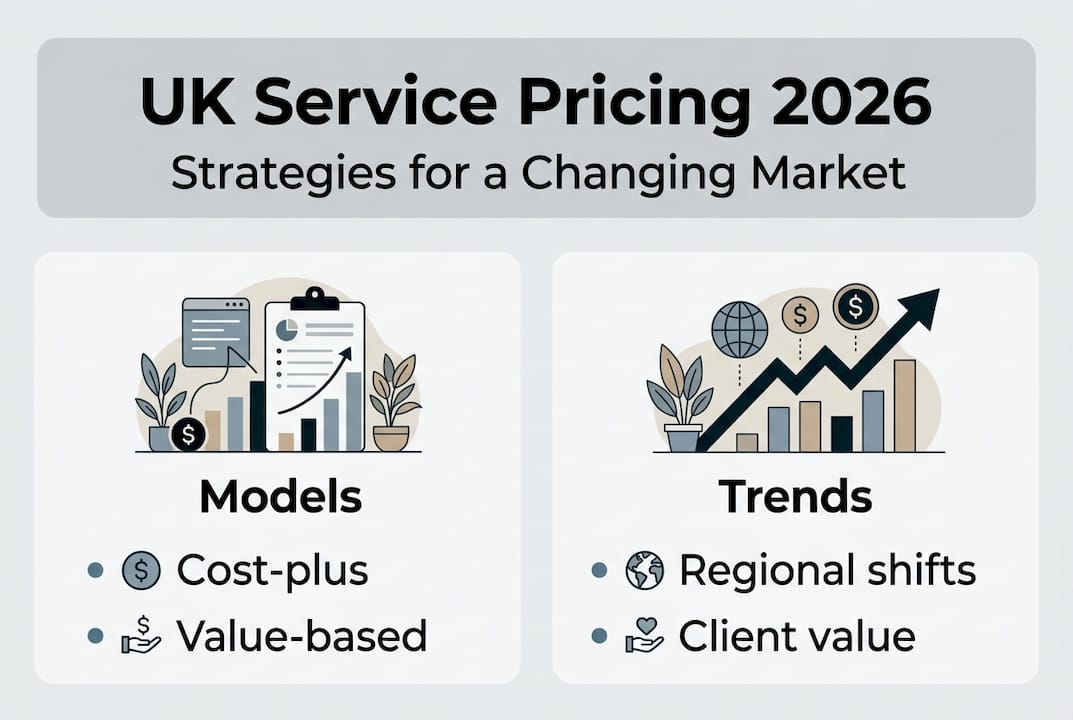
Cost-plus guarantees margins but may overlook value, while value-based pricing can increase profits by focusing on outcomes rather than inputs. Many providers default to cost-plus because it feels safe, but it often leaves money on the table.
Here are the most common pricing mistakes to avoid:
- Relying solely on cost-plus without considering what clients actually value
- Copying competitor rates without understanding your own cost base
- Failing to review prices annually as costs rise
- Underpricing to win work, then struggling to raise rates later
- Ignoring how different service business models affect the right pricing approach
Pro Tip: Start with your desired annual income, add business costs, divide by billable hours, and you have a baseline rate. From there, adjust upward based on the value you deliver, not just the time you spend. You can also explore a sample price table to see how structured pricing looks in practice.
With this foundation in mind, you can build a customised, competitive approach to pricing.
Benchmarking and analysing competitor prices
With your pricing model chosen, aligning it with the market ensures you remain attractive and competitive. Competitive pricing requires monitoring market rates to avoid price wars, as competing purely on price may boost sales volume but can erode margins significantly.
Here is a step-by-step approach to conducting a competitor analysis:
- Identify five to ten direct competitors in your sector and region.
- Gather publicly available pricing from websites, directories, and trade bodies.
- Cross-reference with ONS service sector data for empirical benchmarks.
- Adjust for regional differences (see below).
- Assess what each competitor offers at their price point, not just the number itself.
Current 2026 benchmarks across common UK service sectors:
| Sector | Typical hourly rate (UK average) | London/SE premium | Wales/North adjustment |
|---|---|---|---|
| IT support | £65 to £95 | +35 to 50% | -10 to 20% |
| Car mechanic labour | £55 to £80 | +40% | -15% |
| Marketing consultancy | £75 to £120 | +50% | -20% |
| Accountancy | £80 to £130 | +45% | -10% |
Regional adjustments matter more than many providers realise. London and the South East typically command rates 35 to 50% above the national average, while Wales and northern regions often sit 10 to 20% below. The Midlands tends to serve as a useful baseline for national comparisons.

The goal is not to undercut everyone. Interpret benchmark data by asking where you sit on the value spectrum, not just the price spectrum. Providers who cut costs to win work often find themselves serving more clients for less reward. If you are looking to protect margins while staying lean, reviewing ways to reduce business costs alongside pricing is a smart parallel step.
Pro Tip: Use automated price monitoring tools or set calendar reminders to review competitor rates every quarter. Markets shift quickly, and a rate that was competitive in January may be out of step by autumn.
Adapting prices for client value and changing market conditions
Now you understand the competitive landscape, adjust your tactics for long-term resilience. Value-based pricing means tying your rate to the outcome you deliver, not just the hours you work or the costs you incur. If your accountancy service saves a client £10,000 in tax, charging £1,500 for that work is entirely justifiable, even if your cost base is only £400.
Key drivers that should prompt a pricing review include:
- Significant increases in your own costs (materials, software, insurance, staff)
- New qualifications, certifications, or specialist expertise you have gained
- Investment in technology that improves client outcomes
- Shifts in demand, either seasonal or structural
- Changes in the regulatory environment affecting your sector
Language matters when you communicate changes. Framing a rate increase as an investment in better outcomes rather than a cost increase changes how clients receive it. Words like “enhanced service,” “improved response times,” and “expanded support” all shift the conversation from price to value.
UK service sector cost growth reached 46 to 81% in some categories, while price rises averaged only 9 to 39% above baseline, meaning many providers are absorbing costs rather than passing them on sustainably.
The UK service sector faces rising cost pressures with profitability falling despite price increases in several categories. This makes proactive pricing reviews essential, not optional. Meanwhile, dynamic pricing needs transparency and clear communication, especially when serving vulnerable clients. Understanding service-based business facts for the UK market can help you contextualise these pressures within your specific sector.
Pro Tip: When testing a price increase, apply it to new clients first. Monitor conversion rates and feedback before rolling it out to your existing base. This gives you real data without risking established relationships.
Legal, regional, and ethical factors in UK service pricing
Careful strategy is only effective when it is trusted. Compliance and transparency matter, and they directly affect client retention.
Key legal and ethical considerations for UK service providers:
- Transparency: Clients must be able to understand what they are paying for and why.
- Fair notice: Give adequate advance notice before implementing price changes, particularly for ongoing contracts.
- Vulnerability considerations: If you serve individuals on fixed incomes or in vulnerable circumstances, pricing changes require extra care.
- Regional rate differences: Charging different rates in different regions is legal, but must be applied consistently and not discriminatorily.
- SPA structures: Certain professional services and non-wholly owned investments involve special pricing mechanics that require legal review.
GOV.UK advises businesses against making snap decisions on dynamic price changes. Clients should receive clear, advance communication and have reasonable time to respond or seek alternatives.
Dynamic pricing requires transparency, notice to clients, and consideration for vulnerable customers. This is not just good practice. It is increasingly an expectation regulators and consumers hold providers to. Understanding how business rates affect small businesses in your region also helps you factor in overhead costs accurately when setting compliant, sustainable prices.
Honesty and clear explanation build client trust far more effectively than a low price. Clients who understand why your rates are what they are tend to stay longer and refer more.
Communicating your prices and justifying your value
Building trust through clear, value-driven communication can make rate changes a growth opportunity rather than a risk. The way you present a price increase is often more important than the increase itself.
Follow these steps when communicating a pricing update:
- Give advance notice. Inform clients at least four to six weeks before the change takes effect.
- Explain the reason. Reference specific cost increases, new capabilities, or service improvements.
- Highlight the value. Use concrete examples: faster turnaround, better tools, expanded support.
- Share testimonials. UK clients respond best to price increases framed as value enhancements, and testimonials from satisfied clients reinforce that framing.
- Offer a transition. For long-standing clients, consider a phased increase or a loyalty rate for a defined period.
- Follow up. Check in after the change to address concerns and reinforce the relationship.
Psychological framing is genuinely effective. Presenting a new rate alongside a bundled benefit, such as a free monthly review or priority response, makes the increase feel like a gain rather than a loss.
Data supports the trust argument. Mechanics with high trust scores sustain higher average prices even in competitive local markets, demonstrating that perceived reliability commands a premium across service sectors.
Pro Tip: Reframe increases as investments. For example: “Our new rate reflects the addition of same-day support and a dedicated account manager, saving you an average of three hours per month.” Specific figures make the case far more convincingly than general statements.
Strong client onboarding practices and clear growth strategies both support your ability to hold and justify higher rates over time.
Why following your competitors isn’t enough: smarter pricing for lasting success
There is a persistent belief among UK service providers that matching the market rate is a safe, sensible strategy. We would argue it is one of the most limiting decisions you can make. When you price by imitation, you anchor your value to someone else’s decisions, someone whose cost base, client profile, and service quality may be entirely different from yours.
Competitive pricing can increase volume but erode margins by up to 5%, and that erosion compounds over time. The providers who achieve genuine, sustainable growth are those who invest in client experience, specialisation, and communication rather than simply adjusting a number on a website.
Competing only on price is a race to the bottom for UK services. The winners are those who make clients feel the rate is irrelevant compared to the outcome.
Consider the IT support firm that raised its rates by 20% after introducing a proactive monitoring service. Client churn was under 3% because the value was obvious and well communicated. Or the independent accountant who stopped competing on hourly rates entirely and moved to fixed-fee packages tied to measurable client savings. Revenue grew by 35% in twelve months.
The lesson is straightforward. Use competitive analysis as a reference point, not a ceiling. Blend it with a clear understanding of your own value proposition, and you will build a pricing strategy that competitors cannot easily replicate. Explore business growth strategies that support this kind of value-led positioning.
Take the next step: tools and support for setting smarter prices
If you want tailored tools or advice for your next pricing move, here is where to start.
KefiHub brings together practical resources, expert commentary, and sector-specific guidance to help UK service providers price with confidence. Whether you are reviewing your rates for the first time or preparing for a significant increase, the right support makes the process far less daunting. Start by working through the business growth roadmap to see where pricing fits within your broader strategy. You can also connect with peers and advisers through networking for growth to benchmark your approach against real-world experience. For a full overview of what KefiHub offers, visit the platform and explore the resources available to you today.
Frequently asked questions
What is the best pricing strategy for UK service providers?
Value-based pricing raises profits while competitive pricing aligns to market realities. For most UK providers, a blend of both, anchored in a clear understanding of your cost base, delivers the strongest results.
How do I adjust my service prices for inflation and cost increases in 2026?
Factor in your actual cost rises, consult the ONS service sector index for sector-specific data, and frame changes to clients as improvements in the service they receive rather than a straightforward price rise.
Are there legal requirements for notifying clients of price changes in the UK?
Yes. Transparency is legally advised for UK dynamic pricing models, and GOV.UK recommends clear advance notice and consideration for vulnerable customers in all pricing change communications.
How do regional differences affect UK service pricing?
London and South East rates typically run 35 to 50% above the national average, while Wales and northern regions sit 10 to 20% below. Always benchmark against local competitors, not just national averages.
What is the risk of losing clients when raising prices?
When communicated clearly with value framing, most moderate price increases result in low client loss. Trust, transparency, and a clear explanation of what clients gain are the most effective retention tools you have.
Recommended
- 7 Smart Business Growth Strategies for UK Professionals – Kefihub
- 7 UK Business Growth Strategy Mistakes (How to Fix Before 2026)
- 7 Smart Ways to Reduce Business Costs for UK Owners – Kefihub
- 7 Types of Business Models for UK Service Providers – Kefihub
- Coffee contracts: clarity for Southwest UK hospitality