


TL;DR:
- % of UK SME digital initiatives fail due to poor leadership, staff buy-in, and misaligned goals.
- Successful strategies require strong leadership, clear goals, ongoing review, and staff training.
- People and culture, not technology, are the key factors in digital transformation success.
Seven out of ten digital transformation initiatives fail, and for UK small businesses, that failure carries a real financial and reputational cost. The reasons are rarely about choosing the wrong software. They run deeper, touching leadership, culture, and how clearly a business understands its own goals. If you have invested time and money into a digital strategy that has not delivered, you are far from alone. This guide breaks down why digital strategies fail, what the UK business landscape makes uniquely difficult, and what you can do right now to build an approach that actually works.
Table of Contents
- Understanding why digital strategies fail
- Root causes: where digital strategy falls apart
- External barriers: costs, resources and the UK digital landscape
- What actually works: how UK SMEs can build digital strategies that succeed
- A new perspective: why digital strategy isn’t about technology
- Supporting your business digital journey
- Frequently asked questions
Key Takeaways
| Point | Details |
|---|---|
| Strategy alignment | Tailor your digital strategy to support specific business goals, not what’s trendy or cheapest. |
| Staff involvement | Engage your team early and prioritise change management to boost adoption and minimise resistance. |
| Overcoming barriers | Plan for external constraints such as funding and resources, making use of grants and scalable technology. |
| Practical frameworks | Adopt frameworks that emphasise clear ownership and continuous review for sustained digital success. |
Understanding why digital strategies fail
Digital strategy failure does not always look dramatic. Sometimes it is a new CRM system that nobody uses. Sometimes it is a website redesign that drives no additional conversions. For UK SMEs, failure often means wasted budget, frustrated staff, and a growing reluctance to try again.
A common misconception is that buying the right technology solves the problem. It does not. Technology is a tool. Without a clear plan for how it supports your business goals, it sits idle or creates more complexity than it resolves. Understanding digital transformation for UK SMEs means recognising that the platform is never the strategy itself.
“The technology is rarely the problem. The problem is almost always the people, the processes, and the plan around it.”
The numbers are stark. 70% of digital transformation initiatives fail due to poor alignment with business goals, skills gaps, and resistance to change. For SMEs operating with lean teams and tight margins, even a partial failure can set a business back by months.
Here is how digital failure compares to traditional business challenges:
| Challenge area | Traditional business | Digital strategy failure |
|---|---|---|
| Primary cause | Market shifts, cash flow | Misalignment, poor adoption |
| Visibility | Often clear and immediate | Gradual, harder to detect |
| Recovery cost | Variable | High, especially post-implementation |
| Staff impact | Redundancy, restructure | Disengagement, tool fatigue |
The most common misconceptions UK SME owners hold include:
- Believing that a new tool will automatically improve productivity
- Assuming staff will adapt without structured training or support
- Treating digital strategy as a one-time project rather than an ongoing process
- Underestimating the time required to see measurable results
Recognising these patterns is the first step. The next is understanding precisely where things go wrong.
Root causes: where digital strategy falls apart
Having established the what, it is time to look at the why. What truly causes digital strategies to unravel, even when the intentions are sound?
Leadership is the single biggest variable. When senior decision-makers are not actively championing a digital initiative, it signals to the rest of the team that it is optional. Without clear ownership, accountability disappears and momentum stalls.
Aligning digital strategy with business goals is not a one-off exercise. It requires regular review as your business evolves. A strategy built around goals from two years ago may be pulling your team in entirely the wrong direction today.
The four primary root causes, in order of impact, are:
- Lack of leadership buy-in: No senior champion means no organisational weight behind the change.
- Poor change management: Staff are told what is changing but not why, or how it benefits them.
- Skills gaps within the team: New tools require new competencies. Without training, adoption stalls.
- Misaligned goals: The digital initiative solves a problem that is not the business’s actual priority.
User adoption issues account for 70% of software implementation failures, a figure that should give every UK SME owner pause before signing a new software contract.

Consider a comparison between two approaches to rolling out a new project management tool:
| Approach | Without change management | With change management |
|---|---|---|
| Staff training | Minimal or none | Structured, role-specific |
| Adoption rate at 3 months | Below 40% | Above 75% |
| Leadership involvement | Passive | Active champion assigned |
| Outcome | Tool abandoned | Embedded in daily workflow |
Pro Tip: Before committing to any new digital tool, run a short internal survey. Ask your team what problem they most want solved. If the tool does not address that problem, reconsider the investment.
The pattern across failing UK SME digital projects is consistent. The technology was often fine. The human side of the change was not managed with the same care.
External barriers: costs, resources and the UK digital landscape
Aside from internal challenges, UK SMEs also face significant hurdles from the wider business landscape. Even with the best internal intentions, external factors can derail a digital strategy before it gains traction.
The most common external barriers include:
- High switching costs: Moving from one platform to another involves data migration, retraining, and downtime, all of which carry direct and indirect costs.
- Vendor lock-in: Some technology providers make it deliberately difficult to export your data or integrate with other tools, limiting your flexibility.
- Limited internal resource: Smaller teams cannot always dedicate the time needed to implement and manage new systems effectively.
- Funding access: Many SMEs are unaware of available grants or find the application process too complex to pursue.
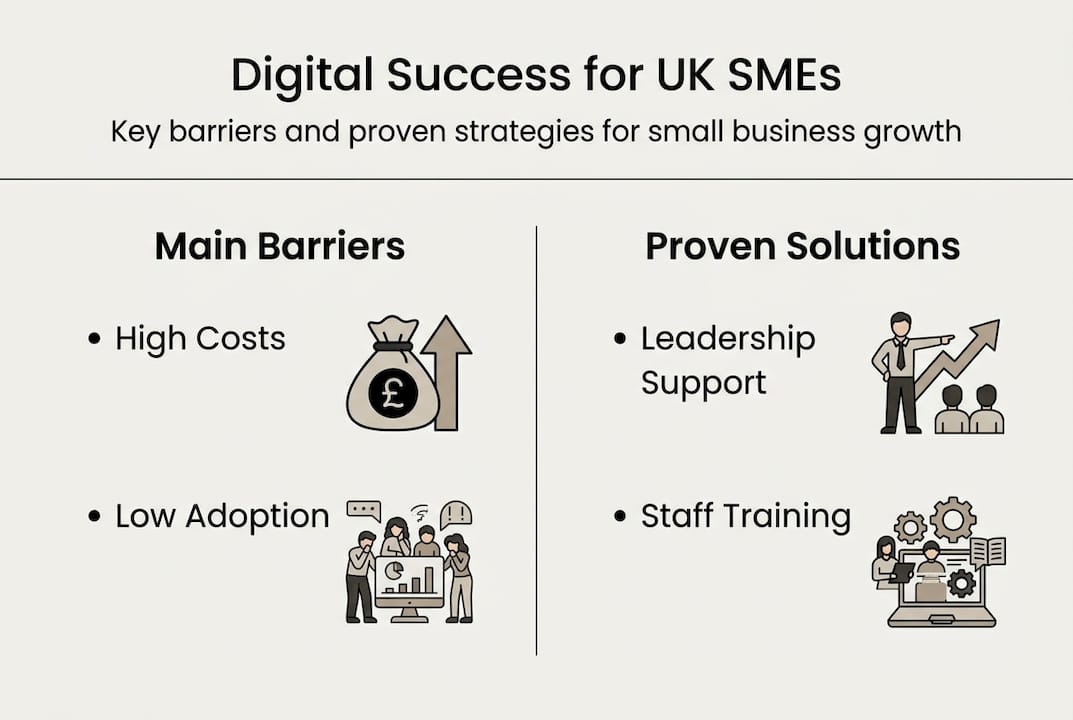
The UK government report on SME digital adoption highlights that high switching costs remain a significant barrier for small businesses attempting to modernise their technology stack. The report recommends prioritising scalable cloud tools that grow with your business rather than locking you into rigid, expensive contracts.
Cloud adoption is particularly relevant here. Cloud-based tools typically offer lower upfront costs, automatic updates, and the ability to scale usage up or down as your needs change. For a small business managing cash flow carefully, this flexibility matters.
On the funding side, SME business grants are available through various UK government schemes and regional growth funds. Many business owners overlook these because they assume the process is too bureaucratic. In practice, smaller grants for digital adoption are often more accessible than people expect.
Pro Tip: When evaluating any new digital tool, ask the provider directly: “How do I export all my data if I decide to leave?” If the answer is vague or the process is costly, treat that as a red flag.
Avoiding common pitfalls is also about knowing where others have stumbled. Resources on avoiding common business mistakes can help you stress-test your plans before committing budget.
What actually works: how UK SMEs can build digital strategies that succeed
Now that the main barriers are clear, what does success look like for a UK SME determined to get digital right?
The answer lies in structure, ownership, and iteration. Successful digital strategies are not built once and left alone. They are living plans that adapt as your business learns.
Here are the five steps that consistently separate successful digital strategies from failed ones:
- Assign a digital champion: Identify one person, ideally at a senior level, who owns the strategy and is accountable for its progress.
- Set measurable goals: Define what success looks like before you start. Vague goals produce vague results.
- Build in review points: Schedule quarterly reviews to assess what is working and what needs adjustment.
- Invest in training: Allocate budget for staff upskilling alongside any new tool or platform investment.
- Start small and scale: Pilot new approaches with one team or process before rolling out business-wide.
Expert insights on digital strategy consistently point to leadership buy-in as the most predictive factor in digital strategy success, more so than the technology chosen.
Consider a practical example. A UK-based professional services firm with twelve staff members introduced a client portal to replace email-based document sharing. Rather than rolling it out immediately, they piloted it with two account managers for six weeks, gathered feedback, adjusted the workflow, and then trained the full team. Adoption reached 90% within three months. The difference was not the tool. It was the process.
| Common pitfall | Successful alternative |
|---|---|
| No clear owner | Designated digital champion |
| No training plan | Role-specific onboarding sessions |
| Rigid, fixed strategy | Quarterly review and adjustment cycle |
| Technology-first thinking | Goals-first, then tool selection |
For ongoing improvement, optimising SME websites and revisiting your business growth strategies regularly will keep your digital approach aligned with where your business is heading.
A new perspective: why digital strategy isn’t about technology
In light of these practical steps, it is worth challenging the usual narrative around digital strategy. Most conversations about digital transformation focus on tools, platforms, and software. The assumption is that getting the technology right is the hard part.
It is not. The hard part is people.
When a digital strategy fails, the post-mortem almost always reveals the same story: leadership was not fully committed, staff were not brought along, and the goals were never clearly defined. The software worked fine.
This matters because it changes where you should invest your attention. Spending three months evaluating CRM platforms is far less valuable than spending three weeks building internal alignment and clarity around what you actually need.
Leadership buy-in is not a soft factor. It is the single most reliable predictor of whether a digital initiative succeeds. Culture and ownership determine outcomes more consistently than any feature list.
If you want to understand overcoming adoption challenges at a deeper level, the lesson is always the same: fix the people side first, then choose the tools.
Supporting your business digital journey
If you are ready to act on what you have read, KefiHub has the resources to help you move forward with confidence.
Our practical guides cover everything from building a business growth roadmap to developing your professional network through our SME networking guide. Whether you are starting your digital journey or reassessing a strategy that has not delivered, you will find step-by-step guidance tailored to the realities of running a UK small business. Explore the full library of insights at KefiHub and take your next step with a clear plan behind you.
Frequently asked questions
What is the most common reason digital strategies fail for UK small businesses?
Poor alignment with business goals and lack of staff adoption are the leading causes, with 70% of initiatives failing due to these issues rather than technology problems.
How important is leadership buy-in for digital transformation?
Leadership buy-in is critical. Without it, strategies lack clear ownership and fail to gain the team support needed to sustain momentum.
What external challenges do UK SMEs face in digital adoption?
High switching costs and limited funding are major barriers, but scalable cloud tools and government grants can significantly reduce these obstacles.
Can digital strategy work for all types of small businesses?
Yes. With clear goals, strong leadership, and the right support, digital strategies can be effective for virtually any UK SME regardless of sector or size.
Recommended
- Digital Transformation Explained: Boosting UK SME Success – Kefihub
- 7 UK Business Growth Strategy Mistakes (How to Fix Before 2026)
- 7 Smart Business Growth Strategies for UK Professionals – Kefihub
- Business Growth Roadmap: Step-by-Step Path for UK SMEs – Kefihub