


{
“@type”: “Article”,
“image”: {
“url”: “https://csuxjmfbwmkxiegfpljm.supabase.co/storage/v1/object/public/blog-images/organization-8865/1770998366188_image.png”,
“@type”: “ImageObject”,
“caption”: “Consultants reviewing scaling strategy roadmap”
},
“author”: {
“url”: “https://kefihub.co.uk”,
“name”: “Kefihub”,
“@type”: “Organization”
},
“@context”: “https://schema.org”,
“headline”: “How to Scale Professional Services for Sustainable Success”,
“publisher”: {
“url”: “https://kefihub.co.uk”,
“name”: “Kefihub”,
“@type”: “Organization”
},
“inLanguage”: “en-US”,
“articleBody”: “Learn how to scale professional services with our step-by-step guide for UK businesses. Get practical advice to expand, optimise, and future-proof your services.”,
“description”: “Learn how to scale professional services with our step-by-step guide for UK businesses. Get practical advice to expand, optimise, and future-proof your services.”,
“datePublished”: “2026-02-13T16:00:50.514Z”
}
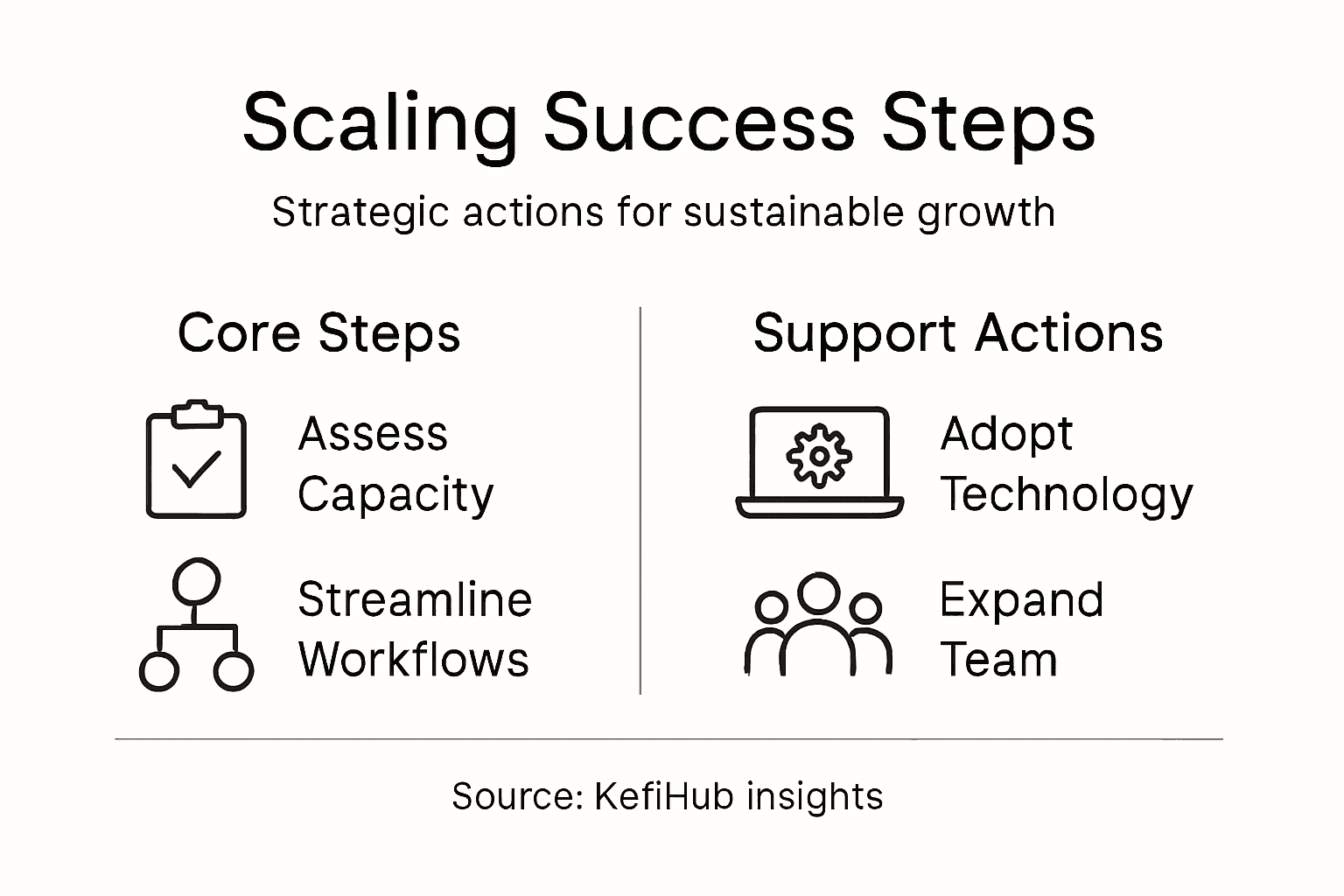
Expanding a professional service business in the United Kingdom can feel daunting when regulatory demands and resource limits collide. Small team leaders often wrestle with unpredictable workloads, unclear capacity, and bottlenecks holding back growth. By mastering professional service capacity assessment, you will gain practical insight into your operations, find hidden opportunities to scale, and design a strategy that matches your capabilities to market needs with confidence.
Table of Contents
- Step 1: Assess Your Current Service Capacity
- Step 2: Streamline Systems And Workflows
- Step 3: Implement Scalable Technology Solutions
- Step 4: Expand Your Team Strategically
- Step 5: Monitor Performance And Maintain Quality
Quick Summary
| Key Point | Explanation |
|---|---|
| 1. Assess Service Capacity Methodically | Conduct a thorough audit of skills, workloads, and performance metrics to identify resource capacity for new projects. |
| 2. Streamline Workflows for Efficiency | Map and digitise routine tasks to create clear, automated workflows that enhance productivity and reduce complexity. |
| 3. Invest in Scalable Technology | Select technology solutions that offer flexibility and integration capabilities to support current operations and future growth. |
| 4. Focus on Strategic Team Expansion | Identify skill gaps in your team and target recruitment efforts to develop deep expertise without merely increasing headcount. |
| 5. Implement Robust Performance Monitoring | Establish comprehensive evaluation frameworks and feedback mechanisms to ensure consistent service quality and continuous improvement. |
Step 1: Assess your current service capacity
Mastering professional service capacity assessment is crucial for sustainable business growth. You’ll create a comprehensive snapshot of your team’s current capabilities, identifying strengths, potential resource gaps, and strategic opportunities for scaling your services.
To effectively evaluate your service capacity, begin by conducting a detailed audit of your existing resources. This involves systematically mapping team capabilities across several critical dimensions:
- Skills inventory: Document each team member’s specific expertise, certifications, and professional capabilities
- Current workload: Track ongoing project commitments and individual utilisation rates
- Availability windows: Identify potential bandwidth for additional project work
- Performance metrics: Review historical productivity and project completion rates
Break down your assessment into structured components. Start by calculating your team’s total available working hours, then subtract existing project commitments to determine remaining capacity. This process helps you understand whether you can take on new work without risking overcommitment.
Resource capacity planning isn’t just about numbers—it’s about strategic alignment between your team’s capabilities and market demands.
Consider both short-term and long-term perspectives when evaluating capacity. Forecasting project needs allows you to proactively address potential resource constraints before they become critical bottlenecks.
Top tip: Create a dynamic spreadsheet that automatically updates resource allocation and highlights potential capacity constraints in real-time.
Step 2: Streamline systems and workflows
Streamlining your professional service systems is about creating more efficient, responsive operational processes that save time and reduce unnecessary complexity. Your goal is to transform fragmented workflows into smooth, interconnected operations that enhance productivity and service delivery.
Start by mapping and digitising routine tasks across your organisation. This involves identifying repetitive administrative processes that consume significant time and energy. Look for opportunities to automate and standardise workflows through strategic interventions:
- Workflow mapping: Visualise current processes and identify bottlenecks
- Task automation: Implement digital tools that handle repetitive administrative functions
- Communication channels: Establish clear, standardised communication protocols
- Performance tracking: Create metrics to monitor workflow efficiency
Prioritise creating transparent, predictable workflows that reduce manual intervention. By defining precise task routing mechanisms, you can ensure each process moves swiftly between responsible team members with minimal friction.
Effective workflow streamlining isn’t about eliminating human touch—it’s about empowering your team to focus on high-value strategic work.
Consider investing in workflow management software that offers customisable automation, real-time tracking, and seamless integration with your existing systems. Such tools can dramatically reduce administrative overhead and improve overall operational responsiveness.

Expert advice: Conduct a quarterly workflow audit to continuously identify and eliminate emerging inefficiencies in your operational processes.
To clarify the distinct advantages of system and workflow streamlining, see the comparison below:
| Approach | Primary Benefit | Typical Implementation | Business Impact |
|---|---|---|---|
| Workflow Mapping | Identifies process bottlenecks | Visual process diagrams | Enhanced efficiency |
| Task Automation | Reduces manual tasks | Software automation tools | Increased productivity |
| Communication Standardisation | Minimises misunderstandings | Clear protocols and channels | Improved teamwork |
| Performance Tracking | Monitors operational progress | Custom metrics dashboards | Continuous improvement |
Step 3: Implement scalable technology solutions
Scalable technology solutions are the backbone of modern professional services, enabling your business to grow efficiently and adapt to changing market demands. Your objective is to select and integrate technological infrastructure that supports your current operations while providing flexibility for future expansion.
Begin by exploring adaptive digital infrastructure that can seamlessly grow with your organisation’s needs. This involves carefully evaluating technology solutions that offer robust, flexible capabilities:
- Cloud computing: Select platforms with elastic resource allocation
- Software integration: Choose systems with open APIs and compatibility
- Modular design: Prioritise technologies that allow incremental upgrades
- Performance metrics: Implement tools for continuous technology assessment
Focus on technological ecosystems that support growth. By leveraging cloud and AI technologies, you can create a responsive infrastructure that scales intelligently with your business requirements.
Technology scalability isn’t just about adding more resources—it’s about creating a dynamic system that evolves with your strategic vision.
Prioritise solutions that offer seamless data migration, robust security protocols, and intuitive user interfaces. The right technological foundation will transform your operational capabilities, reducing manual overhead and creating pathways for innovative service delivery.
Expert strategy: Conduct annual technology audits to ensure your digital infrastructure remains aligned with emerging industry standards and your organisation’s evolving objectives.
Here’s a summary of essential features in scalable technology solutions for professional services:
| Feature | Business Benefit | Example Solution |
|---|---|---|
| Cloud Computing | Flexible resource scaling | Microsoft Azure |
| Software Integration | Improved data flow | Zapier connectors |
| Modular Design | Easy incremental upgrades | Salesforce modules |
| Real-Time Performance Tools | Continuous assessment | Datadog analytics |
Step 4: Expand your team strategically
Strategic team expansion is a delicate balance of growing capabilities while maintaining service quality and organisational cohesion. Your goal is to build a robust, specialised workforce that can elevate your professional services without compromising your core operational excellence.
Begin by designing targeted talent acquisition strategies that align precisely with your organisational strengths and growth objectives. This involves carefully mapping your current team’s capabilities and identifying critical skill gaps:
- Skill mapping: Conduct comprehensive talent assessments
- Strategic recruitment: Target professionals with specialised expertise
- Cultural alignment: Prioritise candidates who match your organisational values
- Growth potential: Look for adaptable team members with learning capabilities
Focus on developing deep expertise rather than simply increasing headcount. By implementing thoughtful organisational development approaches, you can create a dynamic team structure that responds effectively to evolving business challenges.
Strategic team expansion isn’t about adding more people—it’s about curating a high-performance ecosystem of specialised talent.
Consider implementing mentorship programmes, cross-training initiatives, and continuous professional development to nurture your team’s capabilities. The right approach transforms recruitment from a transactional process into a strategic growth lever for your organisation.
Expert strategy: Develop a talent pipeline that focuses on long-term potential, creating comprehensive professional development pathways that attract and retain top-tier professionals.
Step 5: Monitor performance and maintain quality
Ensuring consistent, high-quality service delivery requires a systematic approach to performance monitoring and continuous improvement. Your objective is to create a robust evaluation framework that captures meaningful insights, drives strategic enhancements, and maintains exceptional professional standards.
Begin by implementing comprehensive performance evaluation strategies that go beyond surface-level metrics. This involves developing a nuanced approach to tracking and analysing organisational performance:
- Key performance indicators: Establish clear, measurable benchmarks
- Feedback mechanisms: Create multiple channels for client and team input
- Regular performance reviews: Schedule systematic assessment intervals
- Data-driven improvement: Use analytical insights to drive strategic changes
Focus on creating a culture of continuous improvement. By developing reflective monitoring processes, you can transform performance evaluation from a bureaucratic exercise into a dynamic strategic tool.
Quality maintenance isn’t about perfection—it’s about consistent, incremental enhancement and responsive adaptation.
Prioritise transparent reporting, actionable feedback loops, and proactive problem-solving. The most effective quality monitoring systems create a shared understanding of excellence across your entire organisation, empowering team members to take ownership of service quality.
Expert strategy: Develop a quarterly performance review cycle that combines quantitative metrics with qualitative feedback, ensuring a holistic approach to continuous improvement.
Unlock Sustainable Growth for Your Professional Services Today
Scaling professional services can feel overwhelming when facing challenges like accurately assessing service capacity, streamlining workflows, adopting scalable technology and strategically expanding your team. These critical steps require clear insights and practical guidance to avoid costly missteps and ensure your efforts lead to lasting success.
At KefiHub, we understand the pressures that come with mastering terms such as capacity planning, workflow automation and performance monitoring. Our UK-based platform provides trusted, real-world advice to help professionals like you confidently navigate these complex areas and turn obstacles into opportunities.
Elevate your strategy by visiting KefiHub for tools and expert commentary specifically tailored for professional service providers. Explore our resources to learn how to implement scalable technology, streamline your operations and build a resilient team that drives sustained growth.
Start transforming your service delivery today with actionable insights from KefiHub. Don’t wait for bottlenecks or quality issues to slow you down take the next step now and build the professional service business you envision.
Frequently Asked Questions
How can I assess my current service capacity effectively?
To assess your current service capacity, start by conducting a detailed audit of your existing resources. Create a comprehensive snapshot of your team’s skills, current workload, and availability to ensure you understand your capacity for new work within the next few weeks.
What steps should I take to streamline my professional service workflows?
Begin by mapping out current processes to identify bottlenecks and inefficiencies. Implement task automation and establish clear communication protocols to create more efficient workflows, aiming for visible improvements within the next month.
How do I choose scalable technology solutions for my professional services?
Evaluate technology solutions by focusing on features such as cloud computing, software integration, and modular design. Prioritise systems that can expand with your needs and conduct annual technology audits to ensure ongoing alignment with your goals.
What strategies can I use to expand my team effectively?
Develop targeted recruitment strategies that focus on filling specific skill gaps within your team. Aim to hire professionals who align with your organisational values and seek to enhance your team’s capabilities within the next quarter.
How can I monitor performance and maintain service quality?
Implement a performance evaluation framework that includes key performance indicators and regular feedback mechanisms. Schedule systematic reviews and use these insights to drive improvements, creating a culture of continuous enhancement over time.
What are the best practices for creating a skills inventory?
To create a skills inventory, document each team member’s capabilities, certifications, and area of expertise. Regularly update this inventory to reflect changes and ensure you can leverage your team’s strengths effectively in upcoming projects.
Recommended
- Best 8 crm tools for small business – Expert Comparison 2025 – Kefihub
- Best 8 crm tools for small business – Expert Comparison 2025 – Kefihub
- Why Sustainable Business: Complete Guide for UK Professionals – Kefihub
- Why Sustainable Business: Complete Guide for UK Professionals – Kefihub
- Business Setup in Dubai | New Company Formation in Dubai