


Sorting through the maze of funding choices can leave small business owners feeling unsure about the best way forward. Accessing business grants offers a powerful route to growth without the burden of repayment, but common myths often cloud what is truly available. This article helps UK service-based firms cut through confusion by highlighting how grants work, busting key misconceptions, and revealing steps to boost funding success.
Table of Contents
- Business Grants Defined And Common Myths
- Types Of UK Business Grants Available
- Eligibility And Essential Application Criteria
- How Grants Work And Practical Use Cases
- Tax, Compliance, And Financial Obligations
- Risks, Pitfalls, And Alternatives To Grants
Key Takeaways
| Point | Details |
|---|---|
| Understanding Grants | Business grants are non-repayable financial awards supporting SMEs, aimed at fostering innovation and economic growth. |
| Misconceptions | Many believe grants are easy to obtain; however, they entail strict eligibility criteria and competitive application processes. |
| Types of Grants | Various grants are available, including R&D grants and sector-specific funding, targeted at specific business needs and objectives. |
| Financial Compliance | Businesses must comply with detailed financial reporting requirements to maintain transparency and avoid penalties from HMRC. |
Business grants defined and common myths
Business grants are financial awards provided by government agencies, local authorities, and specific organisations to support small and medium enterprises (SMEs) in the United Kingdom. Unlike loans, business grants do not require repayment, making them an attractive funding option for entrepreneurs seeking to grow their ventures without accumulating debt.
Many small business owners misunderstand the nature and accessibility of grants. Government grant services clarify that these funds are not simply free money handed out indiscriminately. Instead, they are strategic investments designed to achieve specific economic or social objectives. Grants typically target businesses that demonstrate potential for innovation, job creation, technological advancement, or contributions to regional economic development.
Common misconceptions about business grants include believing they are easy to obtain or universally available. In reality, grants have strict eligibility criteria that vary significantly across different programmes. Successful applications require detailed business plans, clear project outcomes, and alignment with the funding body’s specific goals. Competitive grant programmes often receive numerous applications, meaning businesses must present compelling cases that distinguish themselves from other candidates.
Pro Tip: Before applying for any business grant, thoroughly research the specific requirements, prepare a comprehensive business case, and ensure your project directly addresses the grant’s stated objectives.
Types of UK business grants available
The United Kingdom offers a diverse range of business grants designed to support small and medium enterprises across various sectors and stages of growth. Government grant services provide an extensive selection of funding opportunities that cater to different business needs, objectives, and developmental stages.
Key categories of business grants in the UK include research and development grants, which support innovative projects and technological advancements. These grants are particularly crucial for technology startups, engineering firms, and businesses pursuing cutting-edge solutions. Sector-specific funding streams also exist for industries such as agriculture, manufacturing, digital technologies, and green energy, enabling targeted economic development and sector-specific growth.
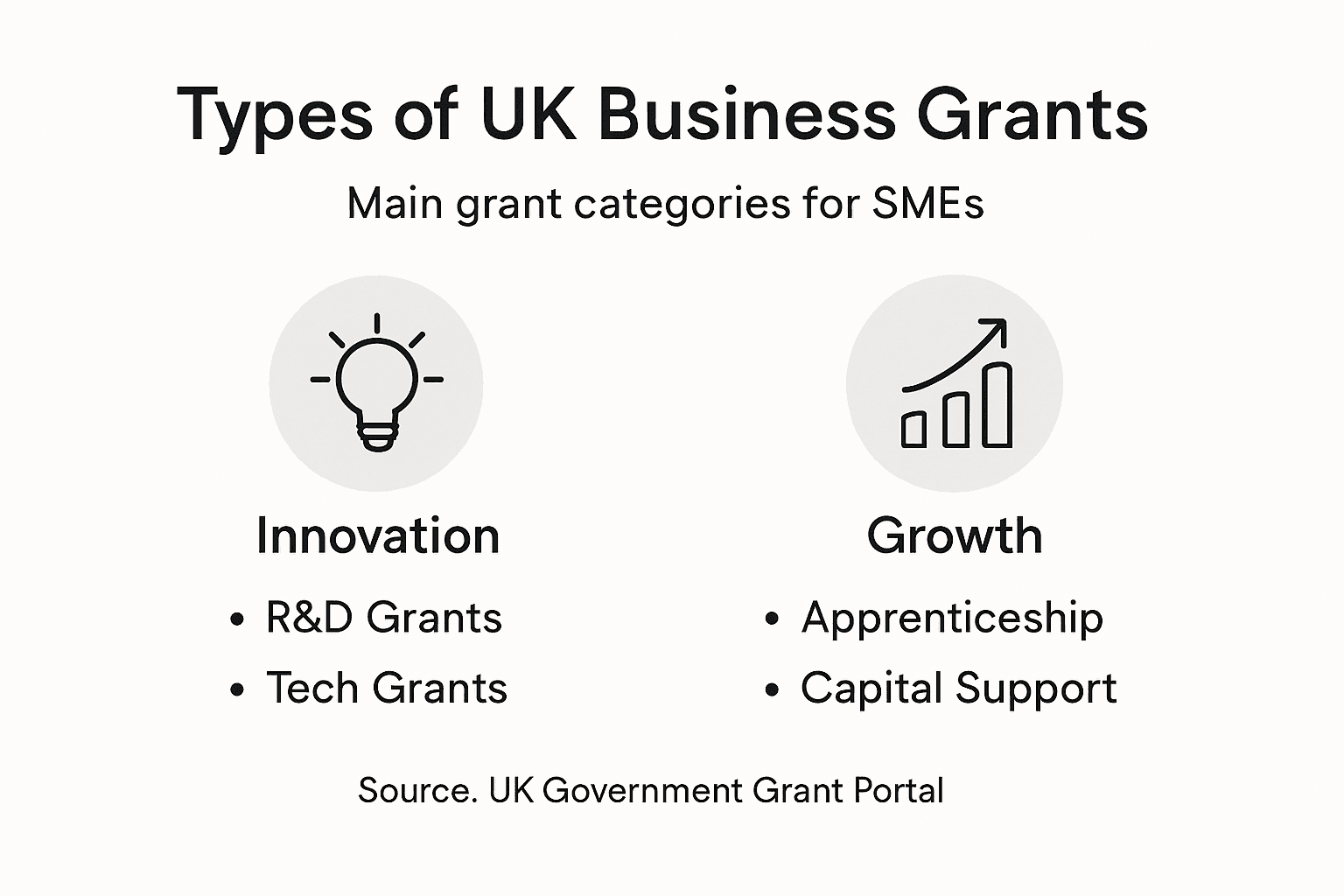
Additionally, business grants are available for specific purposes like apprenticeship funding, capital investment support, environmental initiatives, and regional economic development. Local councils and regional development agencies often provide grants aimed at job creation, skills enhancement, and supporting businesses that contribute to local economic strategies. These grants typically have specific eligibility criteria, focusing on businesses that demonstrate potential for job creation, innovation, and sustainable economic impact.
Here is a concise summary of common business grant types and their main objectives:
| Grant Type | Typical Beneficiaries | Primary Objective |
|---|---|---|
| R&D Grants | Technology startups | Foster innovation and research |
| Sector-Specific | Agriculture, manufacturing | Boost key industry growth |
| Apprenticeship Funding | SMEs hiring apprentices | Skill development and jobs |
| Capital Investment | Expanding businesses | Support equipment purchase |
| Environmental Grants | Firms adopting green methods | Promote sustainability |
Pro Tip: Create a comprehensive spreadsheet tracking grant application deadlines, requirements, and potential funding sources to systematically approach your grant search and maximise your chances of successful applications.
Eligibility and essential application criteria
Understanding grant eligibility requires careful examination of multiple factors that vary across different funding programmes. Government grant services typically assess applicants based on several critical criteria, including business size, sector, geographical location, and the specific nature of the proposed project.
Key eligibility requirements often encompass detailed documentation and compliance checks. Businesses must typically demonstrate financial stability, provide comprehensive business plans, and show clear alignment with the grant’s specific objectives. Application criteria frequently include requirements such as precise financial statements, evidence of business viability, and a detailed explanation of how the grant will be utilised to achieve specific, measurable outcomes.

Most grant programmes have strict parameters regarding business size, with many targeting small and medium enterprises (SMEs) operating within specific regions or industries. Applicants must typically be registered businesses with a clear trading history, demonstrating potential for growth, innovation, or economic contribution. Some grants have additional requirements, such as minimum employee numbers, annual turnover thresholds, or specific sector focus areas that can significantly impact an organisation’s eligibility.
Pro Tip: Create a comprehensive checklist matching your business’s characteristics against each grant’s specific eligibility requirements to quickly identify the most suitable funding opportunities.
How grants work and practical use cases
Business grants function as strategic financial tools designed to support specific organisational objectives and drive economic growth. UK government support programmes provide targeted funding that helps small businesses overcome financial barriers and achieve critical developmental milestones.
Practical use cases for business grants demonstrate their versatility across different business needs. Companies might leverage grants for research and development, enabling technological innovation, purchasing essential equipment, or expanding into new markets. Startup funding strategies reveal how grants can support critical business functions such as hiring specialised talent, developing prototype technologies, or investing in skills training programmes that enhance overall organisational capabilities.
The application of grants varies significantly across industries, with each sector experiencing unique benefits. Technology startups might use grants to fund initial product development, agricultural businesses could secure funding for sustainable farming innovations, and manufacturing firms might obtain grants for upgrading production infrastructure. These targeted investments not only support individual businesses but contribute to broader economic development by encouraging innovation, creating jobs, and promoting sector-specific growth.
Pro Tip: Develop a comprehensive grant tracking system that categorises potential funding opportunities by industry, project type, and application deadlines to maximise your chances of successful grant acquisition.
Tax, compliance, and financial obligations
Business grants come with complex financial reporting requirements that demand meticulous attention to tax and compliance regulations. International accounting standards provide comprehensive guidelines for recognising and documenting grant income, ensuring businesses maintain transparent and accurate financial records.
HM Revenue and Customs (HMRC) enforces strict compliance and reporting requirements for businesses receiving grant funding. These obligations typically include detailed documentation of how grant funds are utilised, precise income reporting, and potential tax implications. Businesses must carefully track grant expenditures, ensuring they align with the specified project objectives and maintaining comprehensive documentation to demonstrate proper use of funds.
The financial obligations associated with business grants extend beyond simple record-keeping. Companies must navigate complex reporting frameworks, potentially impacting their tax liabilities, financial statements, and overall fiscal strategy. This involves systematic recognition of grant income, potential adjustments to asset valuations, and ensuring full transparency with regulatory bodies. Failure to comply with these requirements can result in significant penalties, including potential repayment of grant funds and legal consequences.
Pro Tip: Establish a dedicated financial tracking system specifically for grant funds, maintaining separate documentation and consulting with a qualified accountant to ensure full compliance with HMRC reporting requirements.
Risks, pitfalls, and alternatives to grants
Business grants present both opportunities and significant strategic challenges that entrepreneurs must carefully navigate. Entrepreneurship research highlights the potential risks of over-reliance on grant funding, emphasising the importance of developing diverse financial strategies beyond single funding sources.
The primary pitfalls associated with grant funding include complex application processes, stringent compliance requirements, and potential limitations on fund usage. Businesses often encounter significant administrative burdens, including extensive documentation, strict reporting mechanisms, and potential clawback provisions if project objectives are not precisely met. Risk assessment strategies suggest that entrepreneurs should develop comprehensive contingency plans and maintain financial flexibility to mitigate these potential challenges.
Alternative funding approaches offer valuable alternatives to traditional grant models. These options include equity investment, bank loans, peer-to-peer lending, angel investors, and reinvested earnings. Each alternative presents unique advantages, such as greater financial flexibility, less restrictive reporting requirements, and potentially faster access to capital. Successful businesses often employ a mixed funding strategy, combining grants with other financial instruments to create a more robust and adaptable financial foundation.
Below is a comparison of grants versus alternative funding options for UK SMEs:
| Funding Option | Repayment Required | Typical Flexibility | Compliance Burden |
|---|---|---|---|
| Business Grants | No | Often restrictive usage | High documentation needed |
| Bank Loans | Yes | Business-defined spending | Standard financial checks |
| Equity Investment | No (but gives equity) | Strategic flexibility | Investor reporting needed |
| Angel Investors | No (but gives equity) | Strategic support and advice | Moderate reporting |
| Peer-to-Peer Loan | Yes | Quick capital access | Basic business disclosure |
Pro Tip: Develop a comprehensive financial strategy that includes grants as one component, maintaining multiple funding streams to ensure organisational resilience and financial flexibility.
Unlock Your SME’s Potential with Expert Guidance on Business Grants
Navigating the complexities of business grants can be daunting. From understanding strict eligibility criteria to managing intricate financial and compliance obligations, UK small businesses face real challenges when seeking grant funding. If you are striving to secure grants that truly support innovation, growth, and sustainability, addressing these pain points with expert advice is essential for success.
At KefiHub, we specialise in providing clear, practical guidance tailored for UK SMEs and entrepreneurs. Whether you are preparing detailed business plans or aiming to maximise funding opportunities, our platform offers reliable insights to empower your journey. Explore expert commentary, real-world stories, and actionable advice focused on making business grants work for you.

Begin your path to confident grant applications today by visiting KefiHub. Discover essential resources that clarify government grant services, application tips, and financial compliance. Take control of your business growth with trusted support from KefiHub, your dedicated UK insights platform for business success.
Frequently Asked Questions
What are business grants?
Business grants are financial awards given to support small and medium enterprises (SMEs) that do not require repayment, distinguishing them from loans.
How can I apply for a business grant?
To apply for a business grant, you typically need to prepare a detailed business plan, demonstrate financial stability, and align your project with the specific objectives of the grant programme.
What are the common types of business grants available?
Common types of business grants include research and development grants, sector-specific funding, apprenticeship funding, capital investment support, and environmental grants aimed at various industries.
What are the risks associated with relying on business grants?
The risks of relying on business grants include complex application processes, stringent compliance requirements, and potential limitations on how the funds can be used, which may create administrative burdens for businesses.
Recommended
- Growth Hacking Explained: Driving UK Business Success – Kefihub
- Growth Hacking Explained: Driving UK Business Success – Kefihub
- 7 Effective Marketing Strategies for SMEs to Drive Growth – Kefihub
- Networking for SMEs Guide: Build Connections for Growth – Kefihub
- Website Design for Small Businesses in the UK | Firefly Digital