


{
“@type”: “Article”,
“image”: {
“url”: “https://csuxjmfbwmkxiegfpljm.supabase.co/storage/v1/object/public/blog-images/organization-8865/1773560923990_Consultant-planning-UK-lead-generation-workflow.png”,
“@type”: “ImageObject”,
“caption”: “Consultant planning UK lead generation workflow”
},
“author”: {
“url”: “https://kefihub.co.uk”,
“name”: “Bal’s Organization”,
“@type”: “Organization”
},
“@context”: “https://schema.org”,
“headline”: “Lead generation workflow UK: step-by-step guide 2026”,
“publisher”: {
“url”: “https://kefihub.co.uk”,
“name”: “Bal’s Organization”,
“@type”: “Organization”
},
“inLanguage”: “en-US”,
“articleBody”: “Discover a proven lead generation workflow for UK small businesses. Learn step-by-step methods to capture, nurture and convert quality leads effectively in 2026.”,
“description”: “Discover a proven lead generation workflow for UK small businesses. Learn step-by-step methods to capture, nurture and convert quality leads effectively in 2026.”,
“datePublished”: “2026-03-15T07:49:00.756Z”
}
Attracting quality leads consistently remains one of the toughest challenges for UK small businesses in 2026. Without a structured approach, you risk wasting time on prospects who never convert whilst missing genuine opportunities. This guide delivers a clear, actionable workflow that transforms how you capture, nurture and convert leads, helping you build stronger client relationships and drive sustainable growth for your business.
Table of Contents
- Prepare Your Lead Generation Workflow: Essential Tools And Prerequisites
- Execute Your Lead Generation Workflow: Step-By-Step Process For UK Small Businesses
- Verify And Refine Your Lead Generation Workflow: Tracking Performance And Avoiding Mistakes
- Enhance Your UK Business Growth With Kefihub’s Expert Resources
- Frequently Asked Questions
Key takeaways
| Point | Details |
|---|---|
| Systematic approach | A structured lead generation workflow creates predictable sales pipelines and reduces customer acquisition costs for UK small businesses |
| Multi-channel strategy | Successful workflows integrate various contact methods and nurturing techniques to maximise conversion rates |
| Data-driven refinement | Regular tracking of conversion rates and engagement metrics enables continuous improvement of your lead generation process |
| GDPR compliance | UK businesses must collect and organise lead data whilst maintaining full compliance with current data protection regulations |
Prepare your lead generation workflow: essential tools and prerequisites
Before launching your lead generation efforts, you need the right foundation. Start by defining your ideal client profiles with precision. Consider demographics, business size, industry sector and specific pain points your services address. This clarity prevents wasted effort on prospects who will never convert.
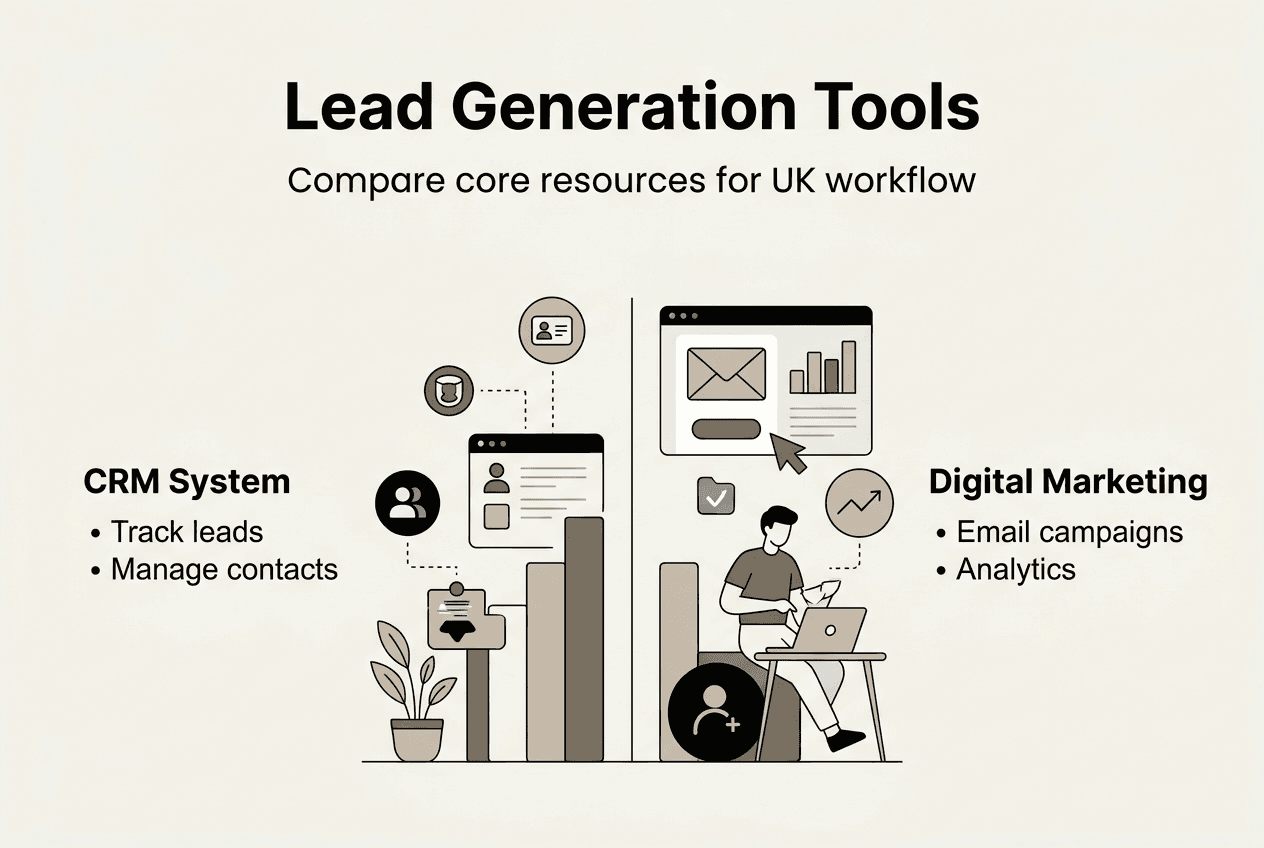
Your CRM system forms the backbone of effective lead management. Whether you choose HubSpot, Salesforce or a simpler solution like Pipedrive, ensure it tracks every interaction and stores relevant prospect data. Lead generation is crucial for B2B lead gen strategy and increasing sales funnel conversion rates. A robust CRM lets you monitor where each lead sits in your pipeline and automate follow-up reminders.
Digital marketing tools amplify your reach significantly. Email marketing platforms like Mailchimp or ActiveCampaign enable personalised communication at scale. Landing page builders such as Unbounce or Leadpages capture prospect information efficiently. Analytics tools including Google Analytics reveal which channels deliver your best leads. Combining these elements creates a powerful ecosystem for digital marketing UK SMEs can leverage immediately.
Data collection must respect GDPR requirements rigorously. Obtain explicit consent before adding contacts to your database. Store information securely and provide clear opt-out mechanisms. Document your data processing activities and appoint a data protection officer if your business meets the threshold requirements. Compliance protects your reputation whilst building trust with prospects.
| Tool Category | Purpose | Example Options |
|---|---|---|
| CRM System | Track leads and manage interactions | HubSpot, Salesforce, Pipedrive |
| Email Marketing | Nurture leads with automated sequences | Mailchimp, ActiveCampaign, ConvertKit |
| Landing Pages | Capture prospect information | Unbounce, Leadpages, Instapage |
| Analytics | Measure campaign performance | Google Analytics, Mixpanel, Hotjar |
| Social Media | Engage prospects and build awareness | LinkedIn Sales Navigator, Hootsuite |
Pro Tip: Create detailed buyer personas documenting your ideal clients’ challenges, goals and decision-making processes. This clarity ensures every element of your workflow speaks directly to their needs and increases conversion rates substantially.
Organising your lead data systematically prevents chaos as your pipeline grows. Tag leads by source, industry and engagement level. This segmentation enables targeted messaging that resonates with specific prospect groups. Understanding improving SEO for UK small businesses also helps drive organic traffic that feeds your lead generation machine consistently.
Execute your lead generation workflow: step-by-step process for UK small businesses
Capturing leads begins with compelling offers that solve specific problems. Create valuable content such as industry reports, templates or webinars that prospects exchange their contact details to access. Your calls to action must be crystal clear, telling visitors exactly what they receive and why it matters. Place these prominently on your website, social media and email signatures.

Qualifying leads separates serious prospects from casual browsers. Design a brief qualification form asking key questions about budget, timeline and decision-making authority. Score leads based on their responses and engagement behaviour. High-scoring prospects receive immediate attention whilst lower-scoring contacts enter nurturing sequences. This prioritisation ensures your sales team focuses energy where it generates maximum return.
Nurturing transforms cold leads into warm prospects ready for conversation. Develop email sequences delivering relevant content over several weeks. Share case studies demonstrating results you have achieved for similar businesses. Offer insights addressing common challenges your ideal clients face. Personalise messages using prospect data from your CRM, referencing their industry or specific interests. This approach builds trust gradually without aggressive selling.
Successful suppliers use sophisticated methods to initiate and nurture initial customer contacts. Your workflow should mirror this sophistication by employing multiple contact methods. Some prospects prefer email whilst others respond better to LinkedIn messages or phone calls. Test different channels and track response rates. Adapt your approach based on what works for your specific audience.
Converting qualified leads requires tailored offers and direct conversation. Once a prospect demonstrates genuine interest through repeated engagement, schedule a discovery call or meeting. Prepare thoroughly by reviewing their interaction history and identifying how your services address their specific situation. Present solutions focusing on outcomes rather than features. Address objections confidently and provide clear next steps for moving forward.
Pro Tip: Automate follow-up sequences but maintain a personal touch. Use merge tags to include prospect names and company details. Schedule messages to send during business hours. Monitor responses closely and have your team step in for personalised outreach when prospects show buying signals.
Implementing business growth strategies UK professionals recommend means testing different approaches systematically. Run A/B tests on email subject lines, landing page headlines and call-to-action copy. Small improvements compound over time, significantly boosting your overall conversion rates. Additionally, ensure your optimising website for UK SMEs supports lead capture with fast loading times, mobile responsiveness and clear navigation.
Verify and refine your lead generation workflow: tracking performance and avoiding mistakes
Measuring workflow effectiveness requires tracking specific metrics consistently. Monitor your lead conversion rate, calculating the percentage of prospects who become paying clients. Track cost per lead across different channels to identify your most efficient sources. Measure engagement metrics including email open rates, click-through rates and content downloads. These numbers reveal which elements of your workflow perform strongly and which need adjustment.
Comparing lead generation methods side by side illuminates where to invest resources. Create a spreadsheet tracking leads generated, costs incurred and revenue produced by each channel monthly. Calculate return on investment for paid advertising, content marketing, social media and networking events. This analysis might reveal that LinkedIn outperforms Facebook for your business, or that webinars generate higher-quality leads than downloadable guides.
| Lead Source | Monthly Leads | Cost Per Lead | Conversion Rate | ROI |
| — | — | — | — |
| LinkedIn Ads | 45 | £28 | 12% | 340% |
| Content Marketing | 67 | £15 | 8% | 280% |
| Networking Events | 23 | £52 | 18% | 420% |
| Email Campaigns | 89 | £8 | 6% | 210% |
| Referral Programme | 34 | £12 | 22% | 580% |
Common mistakes undermine even well-designed workflows. Overreliance on a single lead source creates vulnerability when that channel’s performance declines. Diversify your approach to maintain consistent lead flow. Neglecting follow-up represents another critical error. Successful companies employ multiple methods, recognising that no single approach works universally. Research shows prospects need multiple touchpoints before converting, yet many businesses give up after one or two attempts.
Failing to segment your audience leads to generic messaging that resonates with nobody. Tailor communications based on prospect characteristics and behaviour. Someone who downloaded a beginner’s guide needs different content than a prospect who attended an advanced webinar. Ignoring this distinction wastes opportunities and damages your credibility.
Data-driven optimisation transforms good workflows into exceptional ones. Review your metrics monthly and identify underperforming elements. If email open rates drop, test new subject line approaches. When landing page conversion rates plateau, experiment with different layouts or offers. Small tweaks based on actual performance data generate substantial improvements over time.
Pro Tip: Schedule quarterly workflow reviews examining broader trends and market shifts. Customer needs evolve, competitors adjust their strategies and new channels emerge. Staying adaptable ensures your lead generation remains effective as conditions change throughout 2026 and beyond.
Avoiding UK business growth mistakes 2026 requires honest assessment of your current performance. Many businesses collect leads effectively but struggle with nurturing and conversion. Others excel at closing deals but fail to generate sufficient top-of-funnel activity. Identify your specific weaknesses and prioritise improvements addressing those gaps first.
Enhance your UK business growth with Kefihub’s expert resources
Building an effective lead generation workflow represents just one element of sustainable business growth. Kefihub provides comprehensive guidance helping UK small businesses navigate every stage of their development journey. Our business growth roadmap for UK SMEs offers practical frameworks you can implement immediately, addressing common challenges from client acquisition through to scaling operations.
Understanding digital marketing benefits UK SMEs can unlock new opportunities for reaching your ideal clients efficiently. Our platform delivers actionable insights tailored specifically for UK professionals seeking reliable, practical guidance. Whether you need support with marketing strategy, operational efficiency or avoiding business mistakes UK professionals commonly encounter, Kefihub provides the expert commentary and real-world examples that drive meaningful results.
Frequently asked questions
What is a lead generation workflow and why does my UK business need one?
A lead generation workflow is a systematic process for attracting, qualifying and converting potential clients into paying customers. UK businesses need structured workflows because they create predictable sales pipelines, reduce customer acquisition costs and ensure no opportunities slip through gaps. Without this structure, you waste time chasing unqualified prospects whilst missing genuine buyers ready to purchase.
How can I measure the success of my lead generation workflow?
Track key metrics including conversion rates, cost per lead, engagement levels and revenue generated from each source. Use your CRM software and analytics tools to gather this data automatically. Compare performance across different channels monthly to identify which methods deliver the best return on investment. Regular measurement enables data-driven decisions that continuously improve your results.
What are common mistakes to avoid in lead generation for UK SMEs?
Relying too heavily on a single lead source creates dangerous vulnerability when that channel’s performance declines. Neglecting timely follow-up dramatically reduces conversion rates, as prospects lose interest or choose competitors. Failing to regularly review and adjust your workflow leads to inefficiencies that compound over time. Many businesses also ignore GDPR compliance requirements, risking substantial fines and reputation damage.
How can I nurture leads effectively in my workflow?
Use personalised email sequences delivering relevant content that addresses specific challenges your prospects face. Share case studies, industry insights and practical tips demonstrating your expertise without aggressive selling. Follow a consistent communication schedule, typically one email every five to seven days, avoiding over-contacting that irritates prospects. Monitor engagement signals like opens and clicks to identify when leads are ready for direct sales conversation.
Recommended
- How to Create Invoices UK: Step-by-Step for Small Businesses – Kefihub
- Business Registration Step by Step for UK Owners – Kefihub
- Top 6 Email Marketing Platforms UK for 2026 Buyers – Kefihub
- Starting a Small Business UK: Step-by-Step Legal Guide – Kefihub