


You’ve spent hours crafting what you thought was the perfect pitch, only to hear nothing back from potential clients. Many UK small business owners struggle to write proposals that actually convert prospects into paying customers. The difference between winning and losing often comes down to how well you structure your proposal and demonstrate genuine understanding of client needs. This guide walks you through proven strategies to create compelling business proposals that secure contracts and grow your business in 2026.
Table of Contents
- Why Well-Structured Business Proposals Matter
- Preparing To Write Your Business Proposal: Research And Client Understanding
- How To Write And Structure Your Business Proposal Step By Step
- Leveraging Technology And AI To Improve Proposal Writing
- Explore Kefihub’s Resources To Grow Your Business In 2026
Key takeaways
| Point | Details |
|---|---|
| Structure drives success | Structured proposals achieve 30% higher contract success rates compared to unorganised pitches. |
| Customisation is essential | Tailored proposals that address specific client priorities deliver 40% better conversion rates. |
| Preparation matters most | Thorough research into client needs and decision-maker priorities forms the foundation of winning proposals. |
| Technology accelerates results | AI-powered tools can increase proposal win rates by over 200% whilst reducing drafting time significantly. |
| Clear value presentation | Proposals must demonstrate tangible benefits and solutions rather than just listing features or credentials. |
Why well-structured business proposals matter
Think of your business proposal as a roadmap that guides potential clients from uncertainty to commitment. A well-structured business proposal significantly increases your chances of securing contracts by presenting information in a logical, professional manner that builds confidence. When clients can easily understand what you’re offering, how it solves their problems, and what it costs, they’re far more likely to say yes.
Structure isn’t just about looking professional. It demonstrates that you’ve thought through every aspect of the project and can deliver on your promises. Your proposal should flow naturally from identifying the client’s challenge through to your proposed solution, pricing, and terms. Each section builds on the previous one, creating a compelling narrative that addresses concerns before they arise.
Businesses that use structured proposal formats see significantly better results. Research shows that organised, well-formatted proposals achieve contract success rates roughly 30% higher than generic or poorly structured alternatives. This isn’t surprising when you consider that decision-makers often review multiple proposals under time pressure. A clear structure helps them find the information they need quickly and compare offerings effectively.
Your proposal structure should include distinct sections:
- Executive summary highlighting key benefits
- Client needs analysis showing you understand their situation
- Proposed solution with clear deliverables
- Pricing breakdown with transparent costs
- Timeline and milestones
- Terms and conditions
“The most successful proposals don’t just describe what you do, they paint a picture of the client’s improved future state after working with you.”
Avoid the temptation to recycle generic proposals across different opportunities. Unorganised or template-heavy submissions signal that you haven’t invested time in understanding the specific client’s needs. This immediately reduces your chances of conversion, regardless of how competitive your pricing might be. Just as you’d develop a comprehensive strategy when considering why to write a business plan, your proposal deserves the same strategic attention.
Preparing to write your business proposal: research and client understanding
Successful proposals begin long before you type the first word. The preparation phase determines whether your proposal resonates with decision-makers or gets filed away with dozens of other forgettable submissions. Customisation is crucial, with tailored proposals achieving 40% higher conversion rates than generic alternatives.
Start by identifying who will actually read and approve your proposal. Different stakeholders care about different things. A CEO focuses on strategic value and return on investment. A procurement manager scrutinises costs and contract terms. An IT director examines technical feasibility and integration requirements. Your proposal needs to address each perspective without becoming unfocused or contradictory.
Follow these research steps systematically:
- Study the client’s website, annual reports, and recent news to understand their business model and current priorities
- Review their industry landscape to identify common challenges and opportunities they likely face
- Connect with contacts at the company or in their network to gain insider perspective on decision-making culture
- Analyse their existing solutions or vendors to understand what’s working and what gaps exist
- Document specific pain points mentioned in conversations or RFP documents
- Gather quantitative data that supports your proposed approach and demonstrates measurable benefits
Thorough research and planning enable you to tailor proposals effectively and provide factual support for your claims. This preparation shows respect for the client’s time and demonstrates your commitment to understanding their unique situation. It also helps you anticipate objections and address them proactively within your proposal.

Create a simple priority matrix listing what matters most to each stakeholder. Match your solution’s benefits directly to these priorities. If cost reduction ranks highest, lead with financial impact. If speed to market is critical, emphasise your efficient delivery process. This alignment makes your proposal feel like it was written specifically for them, because it was.
Pro Tip: Schedule a pre-proposal conversation with the client whenever possible. A 30-minute call can reveal insights that hours of desk research might miss, and it builds rapport that strengthens your proposal’s reception.
Gather supporting evidence before you start writing. Collect case studies, testimonials, performance data, and relevant certifications. Having this material ready ensures your proposal includes credible proof points rather than unsupported claims. Just as solicitors play a vital role in business transactions, proper documentation plays a vital role in proposal credibility. Similarly, understanding branding principles helps you present your proposal in a way that aligns with client expectations and values.
How to write and structure your business proposal step by step
Now that you’ve completed your research, it’s time to transform those insights into a compelling document. A business proposal is a formal document designed to persuade clients by demonstrating how your offerings meet their specific needs. Think of it as a conversation in written form, where you acknowledge their challenges and present your solution as the logical answer.
Follow this proven structure for maximum impact:
- Cover letter: A brief, personalised introduction that references your previous conversations and expresses enthusiasm for the opportunity
- Executive summary: A one-page overview highlighting the client’s main challenge, your proposed solution, key benefits, and total investment required
- Client needs analysis: Demonstrate your understanding by describing their situation, challenges, and goals in their own language
- Proposed solution: Detail exactly what you’ll deliver, how you’ll deliver it, and why your approach works best for their situation
- Deliverables and timeline: Break down the project into clear phases with specific milestones and completion dates
- Pricing and payment terms: Present costs transparently with options when appropriate, explaining what’s included at each level
- About your company: Establish credibility through relevant experience, qualifications, and success stories
- Terms and conditions: Cover legal requirements, warranties, and mutual responsibilities clearly
Write with clarity and focus on benefits rather than features. Instead of saying “We use advanced project management software”, explain “You’ll receive weekly progress updates through our client portal, ensuring complete visibility and no surprises”. Every sentence should answer the client’s unspoken question: “What’s in this for me?”
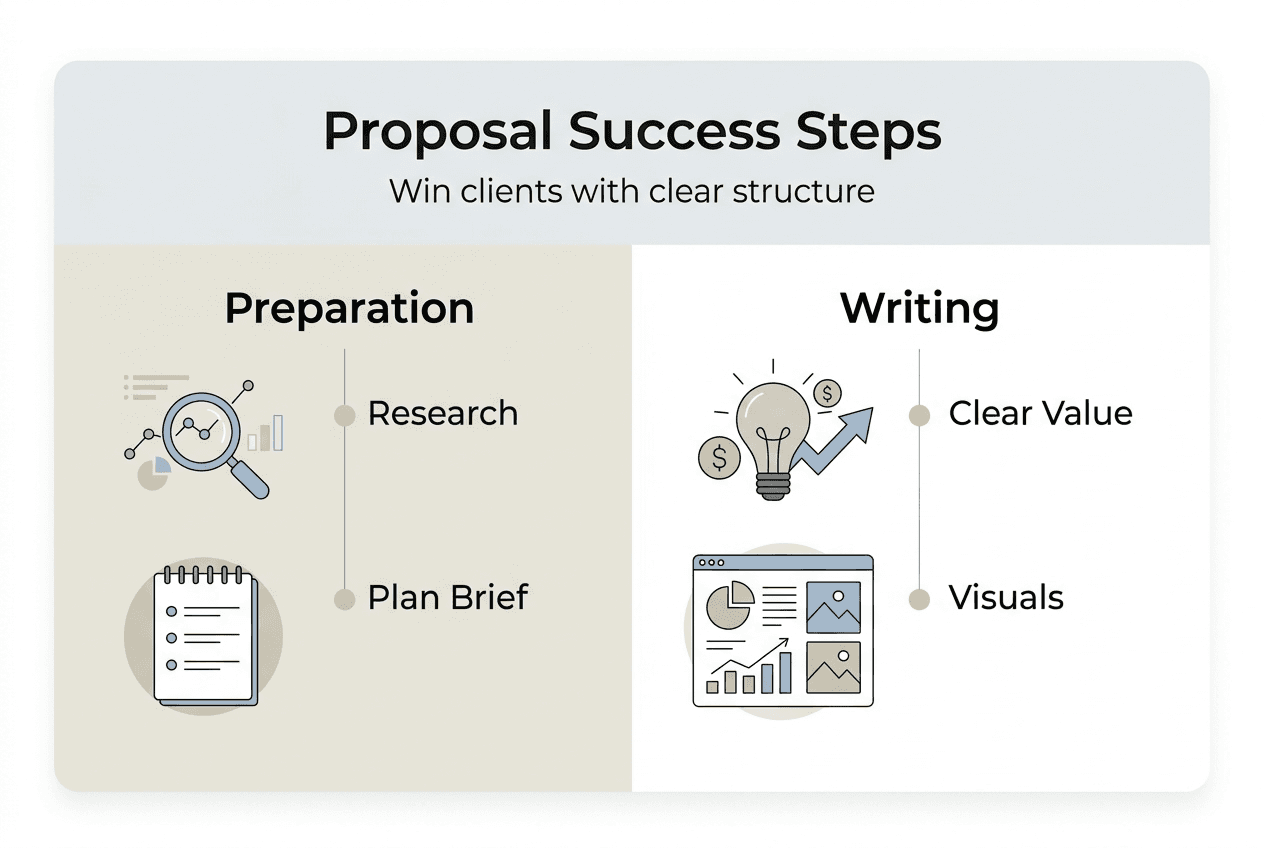
Use visual elements strategically to break up text and make complex information digestible. Bullet points work brilliantly for listing deliverables or benefits. Tables help clients compare options quickly. Charts can illustrate projected ROI or timeline phases. These elements also make your proposal easier to skim, which busy decision-makers appreciate.
When presenting pricing options, a comparison table provides clarity:
| Package | Core deliverables | Timeline | Investment |
| — | — | — |
| Essential | Basic implementation, standard support | 8 weeks | £15,000 |
| Professional | Full implementation, priority support, training | 10 weeks | £25,000 |
| Premium | Complete solution, dedicated support, ongoing optimisation | 12 weeks | £40,000 |
Pro Tip: Mirror the client’s communication style and industry language. If they use formal, technical terminology, match that tone. If they prefer straightforward, plain English, write accordingly. This subtle alignment makes your proposal feel more compatible with their culture.
Tailor every section to the specific client. Generic statements like “We provide excellent service” mean nothing. Specific commitments like “We’ll assign Sarah Thompson as your dedicated account manager, available by phone within two hours during business hours” demonstrate real value. The same attention to detail you’d apply when considering what makes a strong business plan applies equally to proposal writing.
Leveraging technology and AI to improve proposal writing
Technology has transformed how quickly and effectively small businesses can create winning proposals. You don’t need a large team or unlimited resources to compete with bigger firms anymore. The right tools level the playing field by amplifying your capabilities and helping you work smarter.
Artificial intelligence has emerged as a game changer for proposal writing. Recent data shows remarkable results: AI increases productivity by 85%, drafting speed by 75%, and enables businesses to handle 100% more proposal volume. Perhaps most impressively, AI-powered proposal writing engines can increase win rates by over 200%. Firms implementing these tools have seen a 241% increase in win rates within just one year.
These aren’t just incremental improvements. They represent a fundamental shift in how small businesses can compete for contracts. AI assists with several critical tasks:
- Analysing RFP requirements and highlighting key client priorities
- Suggesting relevant case studies and proof points from your library
- Ensuring consistency in messaging and formatting across sections
- Checking factual accuracy and identifying gaps in your argument
- Optimising language for clarity and persuasiveness
- Generating first drafts that you refine with your expertise
The key word is “assists”. AI doesn’t replace human creativity, strategic thinking, or genuine client understanding. It handles time-consuming tasks like formatting, research synthesis, and initial drafting, freeing you to focus on strategy and customisation. Think of AI as a highly efficient assistant that never gets tired but still needs your direction and judgement.
“The businesses winning more contracts aren’t necessarily those with the best solutions, they’re often those who can articulate their value most clearly and quickly. AI helps bridge that communication gap.”
Technology also supports collaboration and version control. Cloud-based proposal software lets team members contribute simultaneously, tracks changes, and maintains a library of reusable content blocks. This means your best case studies, testimonials, and service descriptions are always at your fingertips, ready to be customised for each new opportunity.
For small businesses with limited resources, these tools provide outsized advantages. You can respond to more opportunities without hiring additional staff. You can maintain quality even when juggling multiple proposals simultaneously. You can compete effectively against larger competitors who once had an edge simply through having more people to throw at proposals. Understanding broader AI trends shaping UK business helps you select tools that integrate well with your overall operations. Similarly, exploring business process automation can reveal additional efficiency opportunities beyond just proposal writing.
Explore Kefihub’s resources to grow your business in 2026
Writing effective proposals is just one piece of building a successful small business. You need a comprehensive approach that addresses growth strategy, networking, compliance, and operational excellence. That’s where Kefihub comes in.
Our platform offers step-by-step growth roadmaps specifically designed for UK SMEs, helping you move from where you are now to where you want to be. Whether you’re just starting out or ready to scale, you’ll find practical frameworks that work in the real world.
Building the right connections accelerates everything. Our networking guide for SMEs shows you how to build valuable relationships that lead to referrals, partnerships, and new opportunities. Strong networks often matter more than perfect proposals.
Staying compliant doesn’t have to be complicated. Our small business compliance guide breaks down UK regulations into manageable steps, ensuring you meet requirements confidently without getting overwhelmed by legal complexity. Explore these resources to complement your proposal writing skills and support your overall business growth in 2026.
FAQ
What is the main difference between a business proposal and a business plan?
A business proposal is an outward-facing document designed to win specific clients or contracts by showing how you’ll solve their particular problem. A business plan is an internal roadmap that outlines your overall business strategy, market analysis, and financial projections. Proposals focus on individual deals whilst plans guide your entire operation. Both documents are essential but serve completely different purposes in your business toolkit.
How can I tailor my proposal to different client decision-makers?
Research each stakeholder’s role and priorities carefully before writing. CEOs care about strategic value and ROI, procurement managers scrutinise costs and terms, whilst technical directors examine feasibility and integration. Address each perspective in relevant sections without making your proposal feel disjointed. A well-structured executive summary can highlight benefits for all stakeholders, then detailed sections can dive deeper into specific concerns. This approach, similar to tailoring business proposals effectively, ensures everyone finds the information most relevant to their decision criteria.
What are common mistakes to avoid in business proposals?
Submitting generic, unstructured proposals that don’t address specific client needs is the biggest mistake. Avoid using complex jargon or unclear language that confuses rather than clarifies. Never ignore stated client priorities or fail to provide credible data supporting your claims. Other pitfalls include unrealistic timelines, vague deliverables, hidden costs, and focusing on your company’s greatness rather than the client’s benefits. Every sentence should add value from the client’s perspective, not just showcase your capabilities.
How long should a business proposal be?
Length depends entirely on project complexity and client requirements. Simple projects might need just 5 to 10 pages, whilst complex implementations could require 30 or more. Focus on completeness rather than hitting a specific page count. Include enough detail to address all client concerns and questions without padding with unnecessary information. Decision-makers appreciate conciseness, so edit ruthlessly to keep only what adds genuine value. If the RFP specifies page limits, respect them precisely.
Should I include pricing in my initial proposal?
Yes, in most cases transparency builds trust and moves the sales process forward efficiently. Clients want to know whether your solution fits their budget before investing time in detailed discussions. Present pricing clearly with options when appropriate, explaining what’s included at each level. The exception might be highly complex projects where pricing depends on detailed discovery work, but even then provide a range or starting point. Avoiding price discussions rarely helps and often creates suspicion about hidden costs or lack of confidence in your value.
Recommended
- Why Write a Business Plan – Unlocking UK Success – Kefihub
- 7 UK Business Growth Strategy Mistakes (How to Fix Before 2026)
- Why Update Your Business Plan – Staying Relevant in 2025 – Kefihub
- Role of SEO in 2026: 312% ROI Boost for UK Small Businesses – Kefihub
- 7 Key 2025 Business Trends in Switzerland for Growth