


Repetitive manual tasks drain UK small business resources, consuming valuable time that could fuel growth. Business process automation (BPA) transforms how you operate by eliminating these bottlenecks, cutting costs by up to 30%, and freeing your team for strategic work. This guide delivers a clear, practical roadmap for implementing BPA in your UK SME during 2026, from initial preparation through measurable results.
Table of Contents
- Understanding Business Process Automation
- Prerequisites And Preparation For Automation
- Core Steps For Successful Bpa Implementation
- Common Mistakes And Troubleshooting In Bpa Projects
- Expected Results And Outcomes From Business Process Automation
- Explore Expert Business Growth Support At Kefihub
- Frequently Asked Questions
Key takeaways
| Point | Details |
|---|---|
| Cost savings potential | BPA reduces operational costs by up to 30% for UK SMEs through reduced manual work and fewer errors. |
| Implementation approach | Start by automating one high-impact manual workflow, then expand incrementally based on measurable results. |
| Employee engagement | Thorough change management and staff training ensure successful adoption and sustained automation benefits. |
| Accessible technology | No-code and low-code tools enable affordable, rapid BPA implementation without large IT budgets. |
| Rapid ROI | Most UK SMEs achieve positive return on investment within 3 to 6 months of implementation. |
Understanding business process automation
Business process automation means using technology to complete repetitive manual tasks without human intervention. You eliminate data entry, approval routing, report generation, and similar workflows that consume staff hours daily. BPA transforms these processes into automated systems that run consistently, accurately, and faster than manual methods.
The benefits extend beyond simple time savings. BPA reduces operational costs by up to 30% for small to mid-sized UK businesses by minimising manual work and cutting error rates. Your team shifts focus from administrative tasks to activities that directly support growth and customer satisfaction. Accuracy improves dramatically because automated systems follow defined rules without variation or fatigue.
UK SMEs gain competitive advantages through BPA that were previously exclusive to larger enterprises. Modern automation platforms offer two primary approaches: no-code solutions with visual interfaces that business users configure directly, and custom automation built by developers for complex requirements. The no-code route suits most SME needs, delivering results in weeks rather than months.
Business automation explained shows how these systems integrate with existing software:
- Invoice processing: Automatically extract data, validate against purchase orders, route for approval, and update accounting systems
- Customer onboarding: Collect information, verify documents, create accounts, and trigger welcome sequences without manual coordination
- Inventory management: Monitor stock levels, generate purchase orders, notify suppliers, and update records in real time
- HR workflows: Process leave requests, track approvals, update calendars, and maintain compliance documentation
- Marketing campaigns: Segment audiences, personalise content, schedule delivery, and track engagement metrics
Your business automation guide for small and mid-sized businesses demonstrates how accessible BPA has become. Cloud platforms, subscription pricing, and pre-built templates mean you no longer need substantial upfront investment or technical expertise to start automating core processes.
Prerequisites and preparation for automation
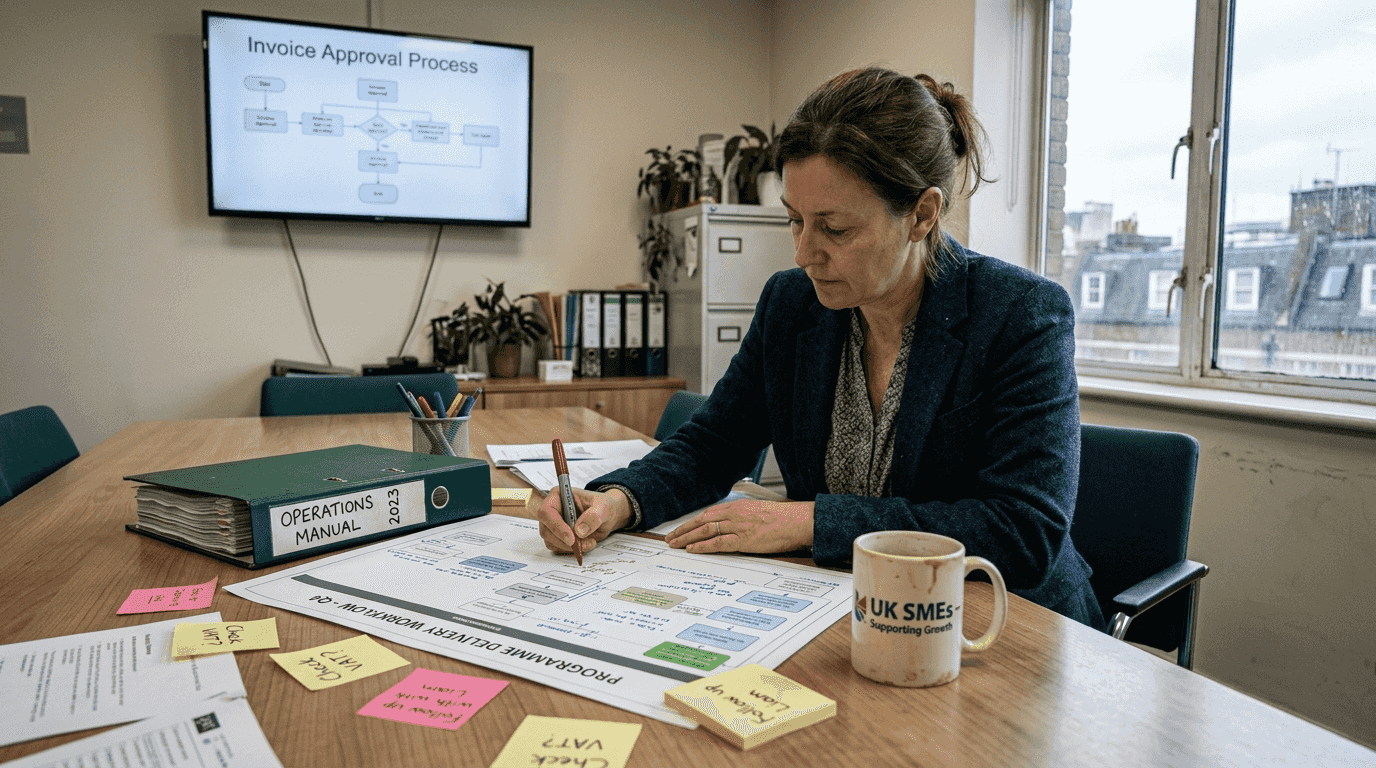
Successful BPA requires thorough groundwork before you implement any technology. Start by documenting your current manual workflows in detail. Map each step, identify who performs it, measure time consumption, and note pain points where delays or errors occur regularly. This assessment reveals which processes offer the highest automation value.
Calculate the hourly cost of staff performing manual tasks to quantify potential savings. Multiply employee hourly rates by time spent on repetitive work, then factor in error correction costs and opportunity costs from diverted attention. This calculation justifies BPA investments and helps prioritise which workflows to automate first.
Look for processes with these characteristics for initial automation:
- High volume: Tasks performed daily or multiple times per week
- Rule-based: Clear decision logic without requiring human judgement
- Time-consuming: Workflows taking 30 minutes or more per instance
- Error-prone: Processes where mistakes occur frequently despite careful attention
- Multi-step: Tasks involving handoffs between people or systems
UK government support programmes can offset BPA costs substantially. The Made Smarter initiative provides grants and expertise to manufacturing SMEs adopting digital technologies, including automation. Research regional enterprise partnerships and industry-specific schemes that may fund portions of your automation projects.
Employee engagement determines BPA success or failure. Communicate automation plans early, emphasising how technology eliminates tedious work rather than replacing people. Involve staff who currently perform manual tasks in process mapping and tool selection. Their insights identify practical obstacles that technical specifications might miss, and their buy-in ensures adoption.
Pro Tip: Create a change management plan addressing training needs, communication schedules, and support resources before purchasing automation tools. Staff prepared for transition adapt faster and report higher satisfaction with automated workflows.
Assess your digital infrastructure readiness. BPA tools integrate with existing software like accounting platforms, CRM systems, and communication tools. Verify that your current systems support API connections or native integrations with automation platforms. Poor data quality undermines automation, so clean up customer records, product catalogues, and transactional data before implementation.
Business intelligence for UK small businesses explains how quality data powers effective automation. Establish data governance practices ensuring accuracy, consistency, and security. Consider whether staff need digital literacy training to work effectively with automated systems.
Budget realistically for both technology costs and implementation time. No-code platforms typically charge monthly subscriptions based on automation volume and features required. Factor in staff hours for setup, testing, training, and ongoing optimisation. Starting small with one pilot process keeps initial investment manageable whilst building internal expertise.
Starting a small business legal guide covers compliance considerations when automating processes involving personal data, financial transactions, or regulated activities. Ensure your chosen BPA approach maintains audit trails and meets relevant UK regulatory requirements for your industry.
Partnering with ERP solutions and integration specialists can accelerate implementation if your processes span multiple complex systems requiring sophisticated coordination.
Core steps for successful BPA implementation
Start BPA by identifying one labour-intensive manual workflow, then expand incrementally for better adoption and measurable efficiency gains. This phased approach minimises risk whilst building confidence and expertise within your organisation.
Follow this structured implementation roadmap:
-
Select your pilot process: Choose a workflow with clear boundaries, measurable inputs and outputs, and immediate value if automated. Invoice approval, new customer onboarding, or inventory reorder processes make excellent pilots.
-
Map the current state: Document every step in detail, including decision points, data sources, approvals required, and handoffs between people or systems. Identify bottlenecks, error sources, and unnecessary steps that automation could eliminate.
-
Define target outcomes: Set specific, measurable KPIs for your pilot. Examples include time saved per instance, error rate reduction, cycle time improvement, or cost per transaction decrease.
-
Evaluate automation tools: Research no-code platforms like Zapier, Make, or Microsoft Power Automate for simple workflows. Consider low-code options for more complex requirements. Request demonstrations using your actual process as the test case.
-
Build and test thoroughly: Configure your automation in a test environment using real data samples. Run parallel operations where automated and manual processes execute simultaneously, comparing results for accuracy and completeness.
-
Train users comprehensively: Provide hands-on training for everyone interacting with the automated process. Create quick reference guides, video tutorials, and easy access to support resources.
-
Launch with monitoring: Deploy your automation whilst closely tracking the defined KPIs. Monitor error rates, completion times, and user feedback daily during the first fortnight.
-
Optimise iteratively: Gather feedback from users and analyse performance data to refine the automation. Most implementations benefit from adjustments after observing real-world usage patterns.
Pro Tip: Establish a cross-functional project team including process owners, technology staff, and end users. Regular check-ins throughout implementation catch issues early and maintain momentum.
This table shows typical implementation timelines for common SME automation projects:
| Process Type | Complexity | Setup Time | Testing Period | Total to Production |
|---|---|---|---|---|
| Email automation | Low | 1-2 weeks | 1 week | 2-3 weeks |
| Invoice processing | Medium | 3-4 weeks | 2 weeks | 5-6 weeks |
| Customer onboarding | Medium | 4-6 weeks | 2-3 weeks | 6-9 weeks |
| Inventory management | High | 8-12 weeks | 4 weeks | 12-16 weeks |
Expand automation scope gradually based on pilot results. After your first process runs smoothly for 60 to 90 days, select a second workflow applying lessons learnt. This measured approach builds organisational capability whilst delivering continuous improvements.
Business growth roadmap for UK SMEs shows how BPA fits within broader strategic planning. Automation supports scaling by ensuring operational capacity grows without proportional staff increases.
Document your automated processes thoroughly, including logic flows, integration points, error handling, and maintenance requirements. This documentation enables knowledge transfer and simplifies troubleshooting when staff changes occur.
Common mistakes and troubleshooting in BPA projects
Common automation project failures stem from automating poorly defined processes, lack of user buy-in, and underestimating change management needs. Recognising these pitfalls helps you avoid them or respond quickly when issues emerge.
Automating broken processes simply creates faster dysfunction. If your manual workflow contains unnecessary steps, unclear decision criteria, or workarounds for system limitations, address these inefficiencies before automation. Process optimisation should precede technology implementation, not follow it.
Neglecting employee engagement creates resistance that undermines automation benefits. Staff who feel threatened or excluded from planning resist using new systems, find workarounds, or actively sabotage implementations. Invest time explaining how automation helps rather than replaces them. Involve process owners in designing automated workflows so they take ownership of success.
Underestimating resource requirements causes project delays and budget overruns. Many UK SMEs assume automation delivers instant results with minimal effort. Reality involves significant setup time, testing cycles, training periods, and ongoing optimisation. Budget 30% more time and money than initial estimates suggest to accommodate unexpected complexity.
These troubleshooting strategies address frequent BPA challenges:
-
Integration failures: APIs change, systems update, or credentials expire, breaking automated connections. Implement monitoring that alerts you immediately when workflows stop functioning. Maintain documentation of all integration settings and credentials.
-
Data quality issues: Automation exposes inconsistent data formats, missing fields, or duplicate records that manual processes accommodated. Clean your data systematically before automating, then implement validation rules preventing poor quality information from entering systems.
-
Scope creep: Initial pilots expand to include additional features, integrations, or processes before the core automation proves successful. Firmly maintain project boundaries, deferring enhancements until the primary workflow operates reliably.
-
Inadequate testing: Rushing to production without thorough testing creates errors that damage user confidence. Test edge cases, error conditions, and high-volume scenarios, not just happy path workflows.
-
Poor documentation: Insufficient documentation of automated processes makes troubleshooting difficult and knowledge transfer impossible. Document logic, dependencies, error handling, and maintenance procedures as you build.
How to avoid common business mistakes emphasises realistic planning and stakeholder communication. Apply these principles to BPA projects by setting achievable timelines, maintaining transparent progress reporting, and adjusting plans based on feedback rather than rigidly pursuing original specifications.
Iterate based on real usage rather than theoretical requirements. Your first automation version rarely performs perfectly. Plan for refinement cycles after launch, gathering user feedback and performance data to guide improvements. Agile adaptation produces better long-term outcomes than perfectionism during initial development.
The Workday UK BPA guide provides additional troubleshooting insights for complex enterprise scenarios that may apply as your automation programme matures.
Expected results and outcomes from business process automation
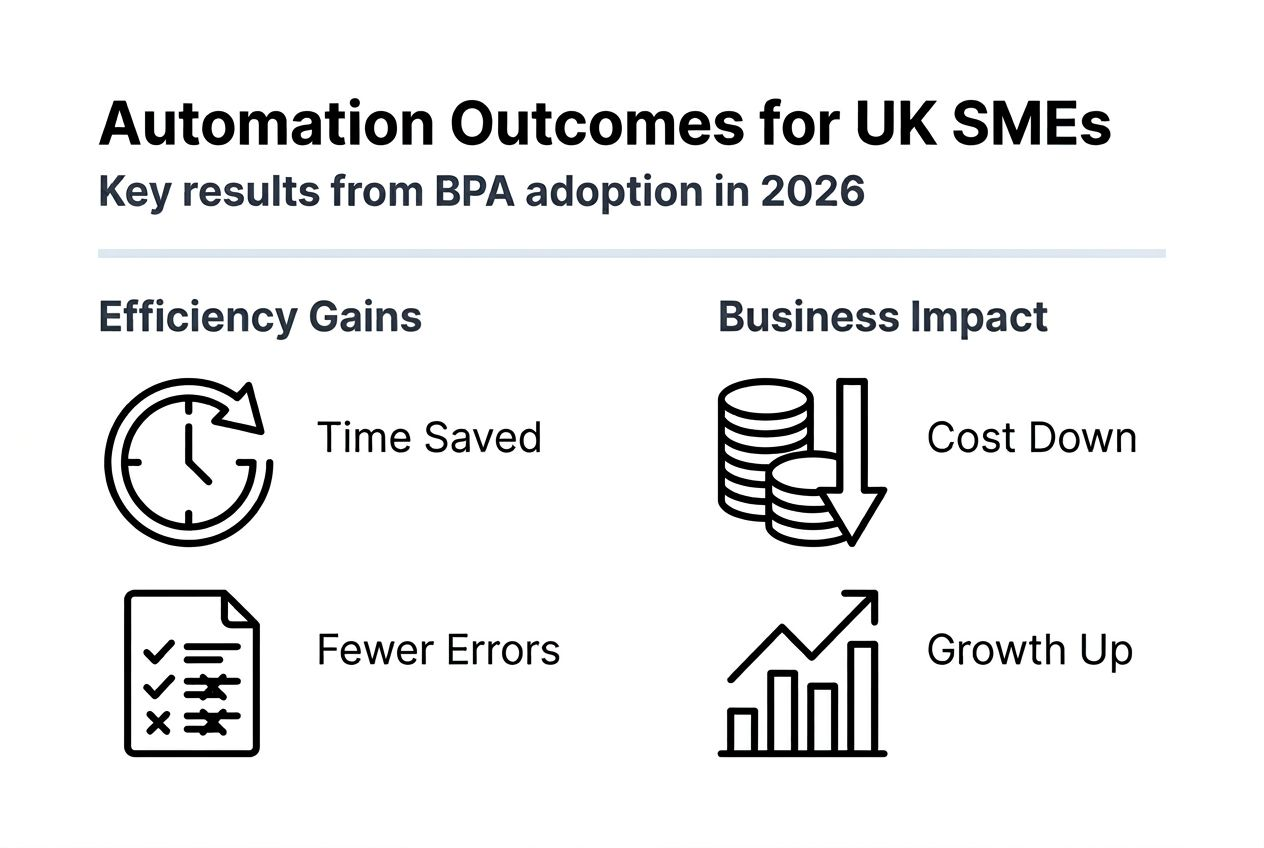
Small to mid-sized UK businesses save up to 30% of operational costs implementing BPA that reduces manual work and errors. These savings accumulate across multiple dimensions: direct labour costs, error correction expenses, faster revenue realisation, and opportunity costs from staff redeployed to higher value activities.
Time savings prove immediately visible and measurable. Managers typically save more than 20 hours weekly previously spent on administrative tasks after implementing comprehensive BPA. Your team completes tasks 30% to 40% faster when automation handles data entry, routing, notifications, and status tracking.
Accuracy improvements reduce costly mistakes that manual processes inevitably produce. Automated data transfer eliminates transcription errors. Rule-based routing ensures appropriate approvals without oversights. Consistent execution prevents the variations that occur when different people interpret instructions differently or fatigue affects attention.
Automation improves staff engagement by freeing employees from mundane repetitive tasks, leading to higher job satisfaction and retention. Your team tackles more interesting, strategic work requiring human creativity and judgement. Morale improves when people spend days solving problems rather than copying data between systems.
This comparison shows typical before and after metrics for common SME automation projects:
| Metric | Before Automation | After Automation | Improvement |
|---|---|---|---|
| Invoice processing time | 15 minutes | 3 minutes | 80% faster |
| Approval cycle duration | 3-5 days | 4-8 hours | 85% faster |
| Data entry errors | 5-8% | 0.5-1% | 90% reduction |
| Monthly admin hours | 80 hours | 25 hours | 69% savings |
| Customer onboarding | 2 weeks | 3 days | 79% faster |
Most UK SMEs achieve positive ROI within 3 to 6 months after implementing BPA solutions. Initial investments in platform subscriptions, implementation time, and training pay back quickly through reduced labour costs and increased operational capacity. Ongoing benefits compound as you automate additional processes and optimise existing automations.
Scalability improves dramatically because automated processes handle volume increases without proportional cost growth. Your business processes twice the transactions without doubling administrative staff. This operational leverage enables sustainable growth without constantly expanding overhead.
Business growth strategies for UK professionals explains how operational efficiency through automation supports broader growth initiatives. Resources freed from manual tasks fund marketing, product development, or customer service improvements that drive revenue.
Customer experience benefits when automation delivers faster response times, consistent service quality, and fewer errors. Orders process immediately rather than waiting for manual intervention. Customers receive proactive notifications about status changes. Service quality remains consistent regardless of workload or staff availability.
The business automation guide for SMEs and SME’s guide to process automation provide detailed case studies showing these outcomes across different industries and company sizes.
Explore expert business growth support at Kefihub
Automating your business processes represents just one component of sustainable growth for UK SMEs. Kefihub delivers comprehensive guidance helping you build a thriving business through proven strategies, regulatory compliance, and strategic networking.
Our business growth roadmap for UK SMEs provides a structured framework for planning your next expansion phase. You will discover how to align automation investments with broader strategic objectives, ensuring technology supports rather than drives your business direction.
Building valuable professional relationships accelerates growth beyond what internal improvements alone achieve. Our networking guide for SMEs shows you how to identify, approach, and cultivate connections that open doors to partnerships, referrals, and opportunities.
Compliance protects your business as you scale through automation and growth. The small business compliance guide for UK SMEs ensures you understand and meet regulatory obligations across data protection, employment law, and industry-specific requirements that automation must respect.
Frequently asked questions
What is the first step UK SMEs should take to begin business process automation?
Identify a single high-impact, labour-intensive manual process suitable for automation. Look for workflows performed frequently, following clear rules, and consuming significant staff time. Document this process thoroughly before evaluating automation tools.
Can small UK businesses afford business process automation without large IT budgets?
Yes, no-code and low-code platforms make BPA cost-effective and accessible for SMEs with limited IT resources. Cloud-based subscription pricing eliminates large upfront investments. Many tools offer free tiers or trials letting you validate value before committing budgets.
How long does it typically take to see a return on investment from BPA?
Most UK SMEs observe positive ROI within 3 to 6 months after implementing BPA solutions. Simple automations like email workflows deliver returns within weeks. Complex multi-system integrations may require 6 to 12 months to fully realise benefits.
Does business process automation require technical expertise or programming skills?
Modern no-code platforms enable business users to build automations using visual interfaces without programming knowledge. Drag-and-drop builders, pre-built templates, and guided setup wizards make automation accessible to non-technical staff. Complex integrations may benefit from technical support.
What happens to employees when their manual tasks get automated?
Automation frees staff from repetitive administrative work, allowing them to focus on strategic activities requiring human judgement, creativity, and relationship building. Properly managed BPA improves job satisfaction rather than eliminating positions, as employees tackle more meaningful, engaging responsibilities.
Recommended
- Business Automation Explained: Practical Gains for SMEs – Kefihub
- Digital Transformation Explained: Boosting UK SME Success – Kefihub
- Business Growth Roadmap: Step-by-Step Path for UK SMEs – Kefihub
- 7 Smart Business Growth Strategies for UK Professionals – Kefihub
- ERP Solutions, Integrations and Odoo Partners