


TL;DR:
- UK SMEs need a clear marketing strategy to guide focused growth and resource allocation.
- A strategy defines long-term goals, target audiences, USP, and key channels for effective marketing.
- Regular review and adaptation are essential to avoid common pitfalls and ensure sustained success.
Most UK small business owners know they need to market their services, but far fewer have a clear, documented strategy guiding those efforts. Without one, you end up spending money on tactics that feel right but deliver little. Research consistently shows that SMEs with a structured marketing approach grow faster and waste less budget than those reacting to trends. This guide gives you a practical, step-by-step framework to build a strategy that actually works, whether you are running a local service business, a consultancy, or an e-commerce operation across the UK.
Table of Contents
- Understanding what a marketing strategy is
- Key elements every SME marketing strategy needs
- Step-by-step process: Building your marketing strategy
- Common mistakes and how to avoid them
- Why small business marketing strategies often fail—and how to beat the odds
- Take your SME growth further with expert guidance
- Frequently asked questions
Key Takeaways
| Point | Details |
|---|---|
| Strategy beats tactics | A clear, long-term marketing strategy drives better results than isolated activities. |
| Focus on your audience | Understanding and targeting your ideal customers is key to efficient, high-impact marketing. |
| Measure and adapt | Track your outcomes and adjust regularly to maximise every pound you invest. |
| Avoid common pitfalls | Steer clear of unfocused campaigns and learn from small setbacks for lasting growth. |
Understanding what a marketing strategy is
A marketing strategy is not the same as a marketing plan, and it is definitely not the same as a tactic. Getting this distinction right from the start saves you from a lot of confusion later.
Your marketing strategy defines your long-term direction. It answers the big questions: who are you selling to, why should they choose you, and what position do you want to hold in your market? A marketing plan then translates that direction into specific actions, timelines, and budgets. Tactics are the individual activities you use, such as running a Google Ads campaign or posting on Instagram.
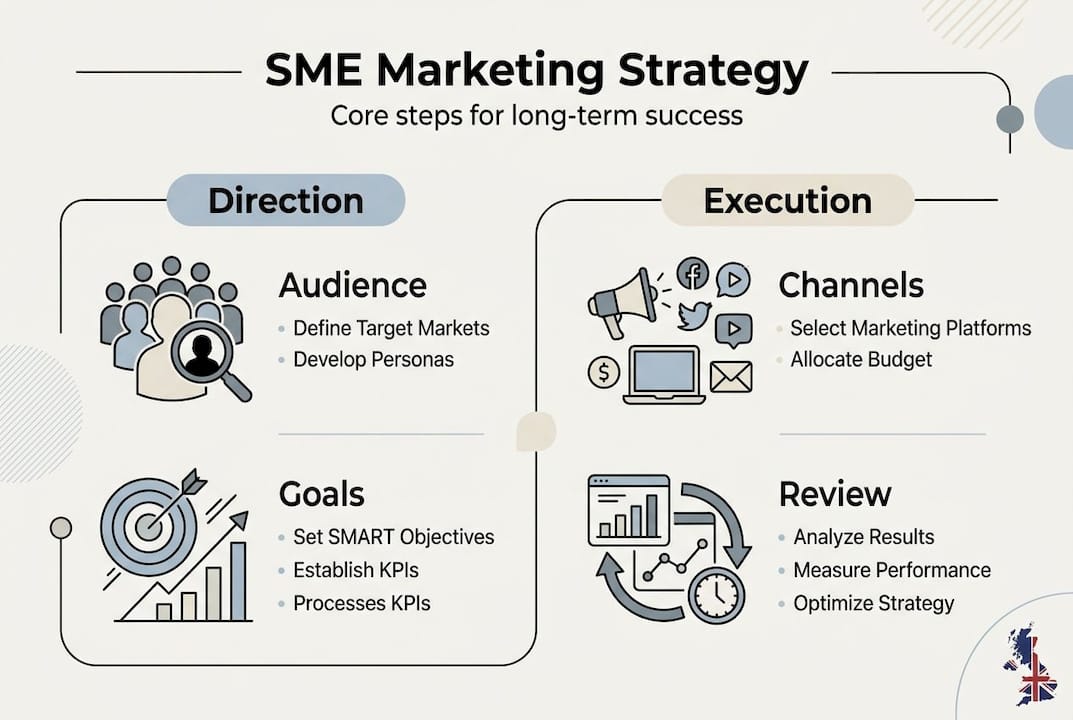
Think of it this way. Strategy is the destination. The plan is the route. Tactics are the individual turns you take along the way.
For UK SMEs, having a clear strategy matters enormously. Without it, you end up doing a bit of everything and excelling at nothing. A strong marketing strategy streamlines business growth by focusing on critical goals and activities rather than scattering your limited resources. Exploring business growth strategies used by UK professionals can also reveal approaches you may not have considered.
Here are the core benefits a well-formed strategy delivers:
- Clarity on who you are targeting and why
- Efficiency by directing budget to what works
- Consistency in how your brand is presented
- Measurable growth tied to real business goals
- Confidence when making day-to-day marketing decisions
The table below clarifies some common misconceptions:
| Common misconception | Reality |
|---|---|
| Strategy and plan are the same thing | Strategy sets direction; the plan details actions |
| More tactics means better results | Focused, fewer tactics outperform scattered efforts |
| A strategy is only for large businesses | SMEs benefit most from strategic clarity |
| Once written, a strategy is fixed | Good strategies evolve with your market and results |
The CIM’s guide to marketing strategy is a solid starting point if you want to read further on the formal definitions. The key takeaway for UK SMEs is simple: strategy first, tactics second.
Key elements every SME marketing strategy needs
With marketing strategy clearly defined, let’s look at the essential ingredients every plan needs for real, sustainable growth.
A strategy without the right building blocks is just a document. These are the components that give your strategy genuine traction:
- Clear objectives: Every strategy needs measurable goals. Instead of “grow the business,” aim for “increase monthly enquiries by 30% within six months.” Specific targets keep your efforts focused.
- Customer targeting: Knowing exactly who your ideal customer is shapes every decision. Consider their age, location, challenges, and buying habits. The more specific you are, the more relevant your marketing becomes.
- Unique selling proposition (USP): Your USP is the one thing that makes your business the better choice. It could be speed, expertise, price, or a combination. Identifying your target audience and unique value makes your strategy more effective and ROI-driven.
- Brand positioning and voice: How do you want customers to perceive you? Friendly and approachable, or expert and authoritative? Your tone should be consistent across every touchpoint. For practical guidance, the branding step-by-step guide covers this in detail.
- Essential channels: Digital options include SEO (search engine optimisation), email marketing, social media, and paid advertising. In-person options include networking events, trade shows, and local partnerships. The GOV.UK business growth resource also outlines support available for SMEs looking to expand their reach.
Many SME owners make the mistake of trying every channel at once. That spreads effort thin and makes it nearly impossible to measure what is actually working.

Pro Tip: Focus your limited resources on the two or three channels your target audience uses most. Master those before adding anything new. Depth beats breadth every time when budgets are tight.
You can also look at branding strategies examples from real UK businesses to see how others have applied these principles effectively.
Step-by-step process: Building your marketing strategy
Knowing the must-have components, it’s time to walk through exactly how to build a strategy that gets results, step by step.
Structuring your marketing strategy into clear, repeatable steps leads to more consistent outcomes. Here is a proven sequence you can follow:
- Define your goals. Start with what you want to achieve in the next 6 to 12 months. Use measurable targets tied to revenue, leads, or brand awareness.
- Research your market. Understand your competitors, industry trends, and where demand is growing. Even basic desk research gives you a significant advantage.
- Identify your audience. Build a simple customer profile. Name them, describe their problem, and explain why your business solves it better than anyone else.
- Choose your tactics. Based on your audience and goals, select the channels and activities most likely to reach them. Keep the list short and manageable.
- Set your budget. Allocate spending across your chosen channels. Be realistic. Most UK SMEs should expect to invest at least 5 to 10 per cent of revenue in marketing.
- Implement and track. Launch your activities and record results from day one. Use free tools like Google Analytics or Meta Business Suite to monitor performance.
- Review and adjust. Look at your data monthly. Drop what is not working, double down on what is.
The table below summarises each step with common pitfalls and quick fixes:
| Step | Common pitfall | Quick fix |
|---|---|---|
| Define goals | Goals too vague | Add a number and a deadline |
| Research market | Skipping this step entirely | Spend just two hours on competitor review |
| Identify audience | Being too broad | Narrow to one primary customer type |
| Choose tactics | Picking too many channels | Limit to three channels maximum |
| Set budget | Underestimating costs | Add a 15% contingency buffer |
| Implement | No tracking in place | Set up analytics before launching |
| Review | Reviewing too infrequently | Schedule a monthly 30-minute check-in |
For further guidance on sustainable growth, the FSB’s steps to growth resource offers practical advice tailored to UK small businesses. You can also explore scaling professional services for sector-specific insight.
Pro Tip: Use simple, free analytics tools to measure what is working each month. Google Analytics 4 and Google Search Console are both free and provide enough data for most SMEs to make informed decisions.
Common mistakes and how to avoid them
Now, even with a solid framework, mistakes can happen. Here is how to spot and avoid the most damaging ones.
The most common errors UK SMEs make with their marketing strategies are not dramatic failures. They are quiet, gradual missteps that compound over time.
- Lack of clarity: Vague goals produce vague results. If your whole team cannot explain your strategy in two sentences, it needs simplifying.
- Confusing campaigns with strategy: Running a one-off promotion is not a strategy. Sustained, consistent activity over time is what builds brand recognition and customer trust.
- Ignoring measurement: Ignoring measurement often leads to wasted marketing spend and missed opportunities for growth. If you are not tracking results, you are guessing.
- Overcomplicating tactics: Trying to be on every platform, produce every content type, and run every campaign simultaneously is exhausting and ineffective. Simplicity wins.
- Not reviewing and adjusting: A strategy written once and never revisited quickly becomes irrelevant. Markets shift, customer behaviour changes, and your strategy must keep pace.
- Ignoring your website: Your website is often the first impression a potential customer gets. Optimising SME websites for speed, clarity, and conversion is one of the highest-return investments you can make.
The Marketing Society’s guide to common marketing mistakes highlights that many small business owners repeat the same errors because they never stop to assess what went wrong.
“The businesses that grow fastest are not those that never make mistakes. They are the ones that learn from small failures quickly and adjust before those failures become expensive.”
Protect your budget by setting a clear spending limit per channel each month. If a channel is not delivering results after 60 to 90 days, reallocate that budget rather than continuing to hope for improvement.
Why small business marketing strategies often fail—and how to beat the odds
Having covered concrete steps and pitfalls, let us dig into what really separates lasting SME marketing strategies from the forgettable.
Here is an uncomfortable truth: most SME marketing strategies fail not because the tactics were wrong, but because the strategy was never truly owned by the business. It was written, filed, and forgotten.
Over-reliance on trendy tactics is one of the biggest culprits. Chasing the latest social media platform or advertising format without a clear rationale wastes time and money. What works for a large consumer brand rarely translates directly to a local UK SME with a fraction of the budget.
Internal buy-in matters more than most owners admit. If your team does not understand or believe in the strategy, execution will always be inconsistent. Even a sole trader benefits from articulating the strategy clearly, because it sharpens their own decision-making.
Feedback loops are undervalued. Small, regular tweaks based on real data outperform big annual overhauls. The businesses we see growing steadily are those that treat their strategy as a living document, not a one-time exercise. Investing in branding for small businesses as part of that ongoing process also pays dividends over time.
Pro Tip: Set aside dedicated, protected time to review your strategy each quarter. Block it in your diary, treat it like a client meeting, and act on at least one learning each time.
Take your SME growth further with expert guidance
Building a marketing strategy is one of the most valuable things you can do for your business. But knowing where to start, and what to prioritise, is not always straightforward.
At KefiHub, we have built a library of practical, expert-led resources designed specifically for UK small business owners. From a clear business growth roadmap that walks you through each stage of scaling, to guidance on networking for SMEs that helps you build the right connections, our platform gives you the tools to move from strategy to real results. Explore our growing library of guides and take your next step with confidence.
Frequently asked questions
How do I start a marketing strategy for my small UK business?
Begin by setting clear goals, understanding your target audience, and identifying what makes your business unique before choosing your marketing channels. Identifying your goals and audience is the essential first step before any tactical decisions are made.
What’s the difference between a marketing plan and a marketing strategy?
A marketing strategy sets your long-term aims and direction, while a plan details the specific actions and timelines to achieve them. The CIM clarifies this distinction clearly for anyone wanting a formal definition.
Which marketing channels are best for UK SMEs?
The best channels are those your ideal customers actually use, which may include social media, email, local events, or professional networks. Channel selection must align with your audience’s habits rather than what is currently popular.
How often should I review my marketing strategy?
Review your strategy at least quarterly to track results and make necessary adjustments based on real data. Regular review is critical for maintaining relevance and lasting impact.
What are common mistakes to avoid when making a marketing strategy?
Avoid being too broad with your goals, neglecting measurement, and skipping regular reviews. Neglecting measurement is consistently one of the top mistakes that leads to wasted budget and missed growth opportunities.
Recommended
- Avoid digital strategy failure: proven solutions for UK SMEs – Kefihub
- Business Growth Roadmap: Step-by-Step Path for UK SMEs – Kefihub
- 7 Effective Marketing Strategies for SMEs to Drive Growth – Kefihub
- 7 Smart Business Growth Strategies for UK Professionals – Kefihub
- Social Media Marketing für Praxen: Mehr Sichtbarkeit 2026 | TheraComplete
- Master the multi-project management process: boost success