


TL;DR:
- Effective budgeting is crucial for cash flow stability and legal compliance in UK startups.
- Regularly reviewing and updating budgets helps early detection of financial issues and supports growth.
- Many UK SMEs falter by neglecting tax, VAT, and adapting budgets to business changes.
Cash flow pressure, unexpected VAT bills, and late payments from clients push thousands of UK small businesses into crisis every year. In fact, poor financial management is one of the most common reasons startups fail within their first three years. If you have ever felt blindsided by a tax demand or unsure whether you can cover next month’s payroll, you are not alone. This guide gives you a clear, practical, step-by-step budgeting process built specifically for UK startups and small businesses. We cover everything from preparation to monthly maintenance, with UK compliance requirements built in throughout.
Table of Contents
- Why budgeting matters for UK small businesses
- What you need before starting your business budget
- Step-by-step process: Building your business budget
- Checking, updating, and troubleshooting your budget
- The hard truths about budgeting UK owners rarely hear
- Take budgeting further with expert support
- Frequently asked questions
Key Takeaways
| Point | Details |
|---|---|
| Budget for compliance | Plan for VAT, tax, and legal obligations from the start to avoid costly surprises. |
| Update monthly | Regular budget reviews keep your business agile and prevent financial shocks. |
| Track cash and profit | Know the difference between cash flow and profit to make informed financial choices. |
| Prepare for late payments | Build a buffer for delayed revenue, a common risk for UK SMEs. |
Why budgeting matters for UK small businesses
A business budget is not a luxury reserved for large companies with finance departments. For small businesses and startups, it is the foundation that keeps cash flow stable, ensures you meet your legal obligations, and gives you the data to make confident decisions. Without one, you are essentially operating blind.
UK businesses face a set of financial pressures that make budgeting especially important. VAT registration becomes mandatory once your turnover reaches the £90,000 threshold, and many startups are caught off guard when they hit it mid-year. Corporation Tax, National Insurance contributions, and Making Tax Digital compliance all add layers of cost and administration that must be planned for in advance. The good news is that tracking business expenses consistently makes all of these obligations far easier to manage.
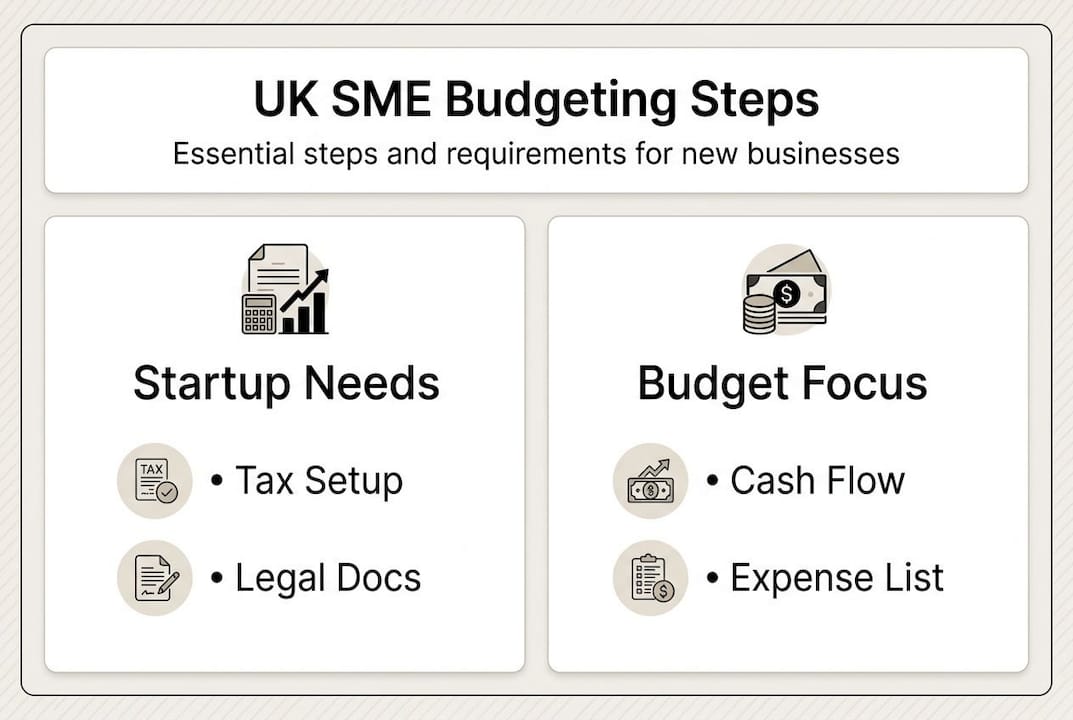
Late payments are another serious threat. Late payments cost £11bn per year to the UK economy, with 38 businesses closing every day partly as a result. The government is introducing stricter late payment legislation, but until that takes full effect, you need your budget to absorb these gaps.
Here is what a well-maintained budget actually gives you:
- Reduced financial stress because you can see what is coming
- Faster, more confident decisions about hiring, investment, and pricing
- A stronger case when applying for funding or business loans
- Early warning signals when costs are rising faster than income
- Clear evidence of profitability for HMRC and potential investors
“A budget is not about restricting your business. It is about understanding it well enough to grow it on your own terms.”
Familiarising yourself with examples of business expenses relevant to your sector is a practical first step before you build any budget framework.
Now that we have introduced why budgeting is crucial, let us get specific about what you will need to start.
What you need before starting your business budget
Before you open a spreadsheet or accounting app, gather the right information. Starting without it leads to guesswork, and guesswork leads to budgets that fall apart in month two.
Here is what you will need:
- Bank statements from the past 6 to 12 months
- Previous year’s accounts if your business has been trading
- Key contracts showing recurring income or committed expenditure
- Invoices and receipts for regular suppliers
- Payroll records including employer National Insurance contributions
- Any loan or finance agreements with repayment schedules
- Tax records including VAT returns and Corporation Tax payments
For startups without trading history, you will need to estimate. SEIS-eligible startup costs typically range from £15,000 to £70,000 for one-off setup expenses, covering items such as legal fees (£1,000 to £3,000) and a website (£2,000 to £10,000). First-year operational costs often fall between £50,000 and £150,000 depending on team size and sector.
Understanding your business model types also shapes your budget structure. A service-based business has very different cost patterns to a product-based one.

| Item | Example | Why needed |
|---|---|---|
| Bank statements | Last 6 months | Confirm actual cash flow |
| Invoices and receipts | Supplier bills | Identify fixed and variable costs |
| Tax records | VAT returns, CT payments | Forecast upcoming liabilities |
| Payroll data | Salary and NI records | Accurate staff cost projection |
| Contracts | Client or supplier agreements | Confirm committed income and spend |
| Accounting software | Xero, QuickBooks, FreeAgent | Automate tracking and reporting |
Pro Tip: Start a simple spreadsheet the moment you begin trading. Even rough estimates are more useful than nothing, and you can refine them as real figures come in. Exploring reducing business costs early can also help you build a leaner, more realistic starting budget.
With preparation in place, you are ready for the hands-on process.
Step-by-step process: Building your business budget
Building a budget does not need to be complicated. Follow these seven steps in order, and you will have a working budget that reflects your real business situation.
-
Estimate your income. Start with realistic revenue projections based on confirmed orders, average monthly sales, or sector benchmarks. Use conservative figures. Overestimating income is the most common early mistake. Review your service pricing strategies to ensure your rates support a profitable budget.
-
Identify fixed costs. These are costs that do not change month to month: rent, insurance, software subscriptions, loan repayments, and salaries. List every single one.
-
Identify variable costs. These change with your activity level: materials, freelance support, delivery costs, and marketing spend. Estimate a monthly average based on past data or industry norms. Reviewing business expense examples helps ensure you miss nothing.
-
Add tax and VAT estimates. Factor in Corporation Tax (currently 19% to 25% depending on profit), VAT if you are registered, and employer National Insurance. The VAT £90k threshold is a critical trigger point to plan around.
-
Include a contingency buffer. Set aside 10% to 15% of your monthly costs as a buffer for unexpected expenses, late payments, or slow months.
-
Build a cash flow projection. Map out income and outgoings week by week for the next three months, then month by month for the rest of the year. This reveals gaps before they become crises.
-
Align to business goals and review regularly. Your budget should support your growth targets, not just cover costs. Compare your invoicing software comparison options to automate this process.
| Method | Pros | Cons |
|---|---|---|
| Spreadsheet | Free, fully customisable | Manual, error-prone at scale |
| Accounting app (e.g., Xero) | Automated, MTD-compliant | Monthly cost, learning curve |
| Bookkeeper or accountant | Expert oversight | Higher cost, less hands-on control |
Pro Tip: Each quarter, compare your actual figures against your budget line by line. If a category is consistently over or under, adjust your projections rather than ignoring the gap.
You now have a functional budget, but it is vital to stress test and refine it.
Checking, updating, and troubleshooting your budget
A budget you never revisit is not a budget. It is a document. Real financial control comes from treating your budget as a live tool that reflects current reality.
Schedule a monthly review session. Compare your actual income and expenditure against your projections. Even 30 minutes a month can prevent serious problems.
Watch for these warning signs:
- Your cash buffer is shrinking month on month
- Invoices are going unpaid beyond 30 days
- Tax liabilities are building up without a clear payment plan
- Variable costs are consistently higher than estimated
- Revenue is below projection for two or more consecutive months
When you spot a warning sign, act quickly. Late payments cost businesses £11 billion per year in the UK, and many of those losses compound because owners wait too long to chase outstanding invoices or cut costs.
“Most UK small firms waste time and lose money by waiting too long to course correct. Early action saves businesses.”
Common correction tactics include:
- Renegotiating supplier contracts or payment terms
- Cutting discretionary spend temporarily
- Chasing late payers with a formal process and clear terms
- Revisiting your pricing to protect margins
- Applying for a short-term credit facility before you need it urgently
Your budget also needs to adapt when your business changes. A new hire, a large contract win, or a change in tax rates all affect your numbers. Explore business growth strategies to understand how growth phases affect your financial planning, and use resources on avoiding business mistakes to stay ahead of common errors.
Having mastered day-to-day control, what is the bigger picture others are missing about budgeting?
The hard truths about budgeting UK owners rarely hear
Most UK SME owners treat budgeting as a one-off admin task completed in January and forgotten by March. That approach is why so many businesses with solid revenue still run into cash flow crises. The owners who genuinely pull ahead financially are those who use their budget as a decision-making tool every single month.
Here is a myth worth busting: profit is not the same as cash flow. You can show a healthy profit on paper while having no cash in the bank, particularly if clients pay late or you have invested heavily in stock or equipment. Your budget must track both.
Another common error is building a budget so tight that there is no room for investment. Cutting costs to the bone feels responsible, but it often prevents the very spending (marketing, talent, tools) that drives growth. Buffers are not waste. They are strategy.
The competitive edge belongs to businesses that review, update, and act on their budget monthly. Block one hour each month, compare actuals to projections, and reset your forecasts based on facts. Use expense tracking discipline as the backbone of this habit. Businesses that do this consistently are faster to spot opportunities and quicker to avoid threats.
Take budgeting further with expert support
Building a solid budget is one of the most impactful things you can do for your business, but it rarely stops there. Tax changes, new compliance requirements, and growth decisions all create new financial questions that need reliable answers.

At KefiHub, we publish practical, expert-led guidance to help UK business owners stay informed and in control. Whether you are working through common business mistakes to protect your margins, navigating the legal side of starting a UK business, or following a clear business growth roadmap to scale with confidence, our resources are built for your reality. Explore our guides and take your next step with clarity.
Frequently asked questions
What documents do I need to start a business budget in the UK?
You will need recent bank statements, invoices, contracts, and estimates for one-off and monthly costs. For startups, SEIS-eligible startup costs provide a useful benchmark, with setup costs typically ranging from £15,000 to £70,000.
How often should I review my business budget?
Review your business budget every month to stay on top of cash flow and spot issues early. Given that late payments cost £11bn annually to UK businesses, monthly reviews help you act before gaps become serious.
What is the biggest budgeting mistake UK startups make?
Many underestimate tax and VAT liabilities or fail to adapt their budgets when income changes. Planning around the VAT £90k threshold and Corporation Tax from day one prevents the most common and costly surprises.
Recommended
- Starting a Small Business UK: Step-by-Step Legal Guide – Kefihub
- Business Growth Roadmap: Step-by-Step Path for UK SMEs – Kefihub
- 7 Essential Steps for Your Start-Up Checklist UK Success – Kefihub