


Many believe barristers spend all their time in wigs and gowns arguing cases before judges. Reality proves far richer. Barristers serve as specialist legal advisers across family disputes, property conflicts and civil matters, often working behind the scenes to craft winning legal strategies. This guide reveals when and why you might need their expertise, clearing confusion about how they fit within Britain’s legal landscape and how to access their services directly.
Table of Contents
- Understanding The Role Of Barristers In The UK Legal System
- Training And Qualification Of Barristers
- Barristers In Family, Property, And Civil Matters
- How Barristers Interact With Clients And Solicitors
- Common Misconceptions About Barristers
- Beyond Courtroom Advocacy: Expanded Roles Of Barristers
- Summary And Practical Advice For Engaging Barristers
Key takeaways
| Point | Details |
|---|---|
| Specialist advocates | Barristers provide expert courtroom representation and complex legal advice in family, property and civil law |
| Rigorous training | All barristers complete the Bar Professional Training Course and 12 months of supervised pupillage before practising |
| Flexible access | You can instruct barristers directly under Public Access rules or through solicitors depending on your case needs |
| Independence matters | Professional independence ensures barristers deliver unbiased legal opinions regardless of who instructs them |
| Beyond courts | Barristers contribute over 10,000 pro bono hours annually and engage in public legal education work |
Understanding the role of barristers in the UK legal system
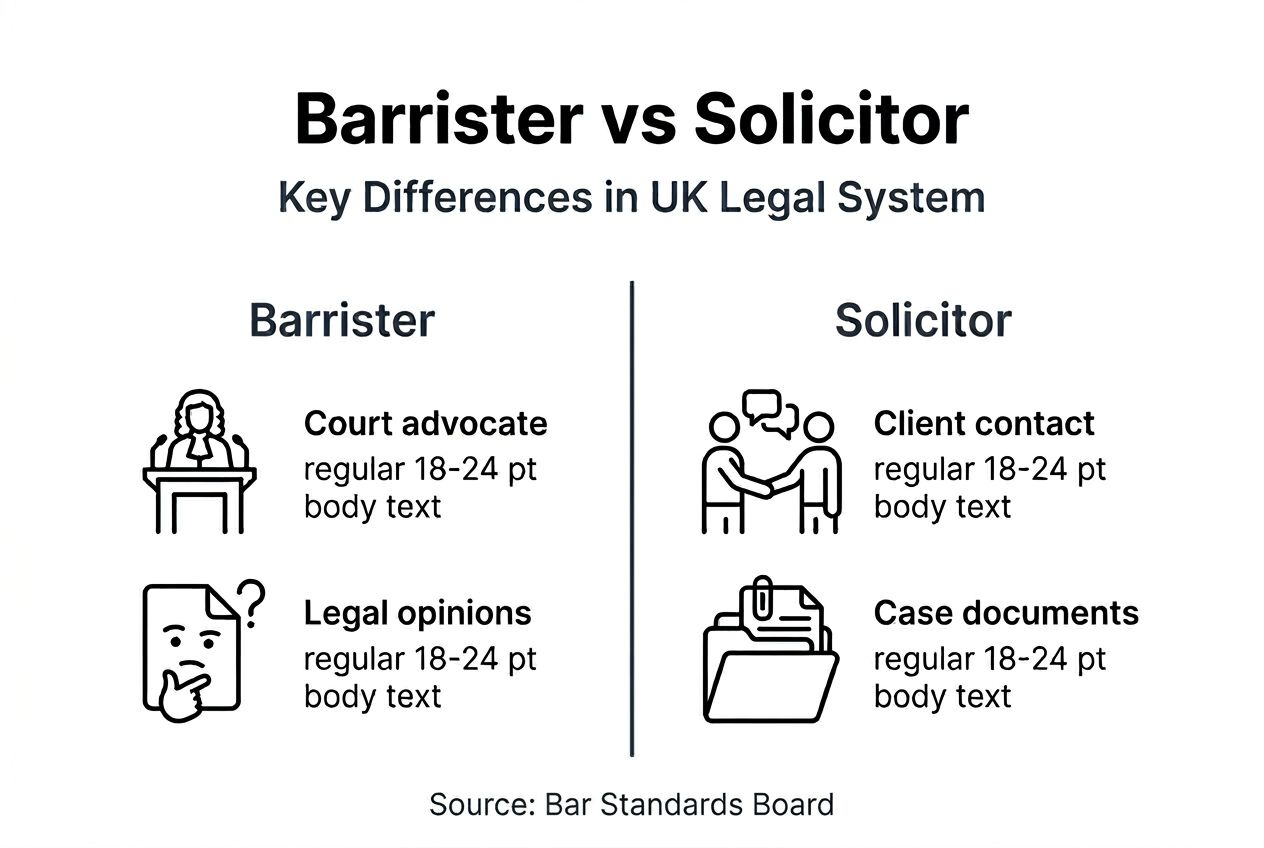
Barristers occupy a distinctive position within Britain’s legal framework. They specialise in advocacy and advising on complex legal matters in family, property, and civil law, bringing precision and specialist knowledge to cases requiring courtroom representation or expert legal opinions. Unlike the broader scope solicitors handle, barristers focus intensely on preparing legal arguments, analysing case law and presenting submissions before judges.
Their work centres on three core functions:
- Presenting cases in court with persuasive oral advocacy
- Providing specialist written legal opinions on complex matters
- Drafting legal documents including pleadings and case summaries
Most barristers operate as self-employed practitioners within chambers, maintaining professional independence whilst collaborating with solicitors who instruct them. This structure ensures clients receive impartial advice untainted by commercial pressures. For family disputes involving custody battles, property disagreements over boundaries or civil claims seeking damages, barristers translate intricate legal principles into compelling arguments judges can apply.
The distinction matters practically. Solicitors manage client relationships, gather evidence and handle administrative tasks. Barristers step in when cases demand specialist courtroom skills or nuanced legal interpretation. Understanding this division helps you recognise when engaging a barrister directly or through your solicitor serves your interests best.
Training and qualification of barristers
Becoming a barrister demands years of rigorous academic preparation and practical training. The pathway ensures only candidates meeting exacting standards enter the profession, protecting clients through quality assurance.
The qualification journey follows these stages:
- Complete a qualifying law degree or conversion course for graduates from other disciplines
- Pass the Bar Professional Training Course focusing on advocacy, ethics and legal skills
- Secure a 12-month pupillage placement providing supervised courtroom experience
- Gain rights of audience by demonstrating competence before the Bar Standards Board
Pupillage represents the profession’s apprenticeship phase. Trainees shadow experienced barristers, observing court proceedings, drafting legal documents and gradually taking on cases under supervision. This immersive learning develops practical judgment that academic study alone cannot provide.
Regulation by the Bar Standards Board maintains professional standards through ongoing monitoring and enforcement. The Board’s independence framework ensures barristers’ independence is upheld by 100% of practising barristers according to regulatory standards, creating structural safeguards against conflicts of interest.
“Independence enables barristers to provide fearless advice and representation, even when unpopular or commercially inconvenient, serving justice rather than personal gain.”
This independence proves crucial when barristers must challenge powerful institutions or advise clients against pursuing weak cases. Their duty to the court supersedes loyalty to whoever pays them, distinguishing barristers from other professional advisers. Clients benefit from honest assessments rooted in legal merit rather than what they want to hear.
Barristers in family, property, and civil matters
Barristers demonstrate their specialist value across diverse legal contexts. Understanding their typical involvement clarifies when their expertise proves essential.
Family law cases frequently require barristers for emotionally charged disputes where outcomes affect children’s welfare and financial security:
- Divorce proceedings involving substantial assets or pension division
- Child custody battles requiring detailed welfare arguments
- Domestic violence cases needing protective injunctions
- Financial remedy hearings determining spousal maintenance
Property disputes bring technical complexity demanding barristers who understand land law intricacies. Boundary disagreements between neighbours, landlord disputes with tenants over lease terms, and challenges to property ownership all benefit from specialist advocacy. Barristers analyse title deeds, interpret easement rights and present evidence about historical property use to resolve conflicts.
Civil litigation spans contract breaches, personal injury claims and professional negligence suits. These cases require barristers to construct detailed legal arguments supported by case law precedents and statutory interpretation. A barrister might argue whether a builder’s defective work constitutes breach of contract or negligence, determining available remedies and quantum of damages.
Consider a property boundary dispute where your neighbour erected a fence encroaching two metres onto your land. Your solicitor gathers surveyor reports and historical documents. The barrister then synthesises this evidence into legal arguments about adverse possession, trespass and equitable remedies, presenting them persuasively before a judge. Their specialist knowledge of property law nuances and courtroom advocacy skills increase your chances of a favourable judgment.
How barristers interact with clients and solicitors
Accessing barrister services follows established pathways shaped by professional rules and practical considerations. Most commonly, solicitors instruct barristers on behalf of clients, maintaining a traditional division of labour. Your solicitor identifies when specialist advocacy or legal opinion adds value, selects an appropriate barrister, and briefs them with case details and strategic objectives.

This three-party arrangement offers benefits. Solicitors provide continuity throughout your case, managing communications and coordinating multiple work streams. Barristers contribute targeted expertise at critical junctures like court hearings or when complex legal points need analysis.
However, Direct Public Access accounts for around 20% of barrister client engagements allowing clients to instruct barristers without solicitors. This route suits straightforward cases where you can gather evidence independently and need specialist advocacy without ongoing legal support. Direct access potentially reduces costs by eliminating the solicitor’s fees, though you assume greater responsibility for case preparation.
Key considerations for direct access include:
- Confirming your chosen barrister accepts Public Access instructions
- Understanding you must handle administrative tasks and evidence gathering
- Recognising barristers cannot conduct litigation like issuing court proceedings
- Ensuring your case suits the limited scope direct access provides
Pro tip: Before engaging a barrister directly, assess whether your case complexity requires ongoing solicitor support or if targeted advocacy alone meets your needs, potentially saving significant costs whilst securing specialist representation.
Barristers maintain professional independence regardless of instruction method. Whether solicitors or clients instruct them directly, barristers owe primary duties to the court and must provide unbiased advice. This structural independence prevents conflicts of interest and ensures legal arguments rest on merit rather than who pays the bill.
Common misconceptions about barristers
Several persistent myths obscure what barristers actually do, potentially deterring people from seeking appropriate legal help. Clearing these misunderstandings helps you make informed decisions about engaging their services.
Many assume barristers exclusively perform courtroom advocacy wearing wigs and gowns. Reality proves more nuanced. Barristers spend considerable time drafting legal opinions, advising on case strategy and preparing written submissions judges read before hearings. Much of their value emerges from analytical work behind the scenes rather than dramatic courtroom speeches.
Another misconception suggests barristers remain inaccessible to ordinary people, reserved for wealthy individuals or large corporations. Direct Public Access rules democratise access, enabling anyone to instruct barristers without solicitor intermediaries. Whilst costs vary based on case complexity and barrister seniority, many practitioners offer fixed fees for specific services, providing cost certainty.
| Misconception | Reality |
|---|---|
| Barristers only appear in court | They also provide written legal opinions, draft documents and advise on strategy |
| You must use a solicitor first | Direct Public Access allows instructing barristers without solicitors in suitable cases |
| Barristers are prohibitively expensive | Fixed fee arrangements and direct access can reduce overall legal costs |
| All barristers wear wigs | Wigs are only required in specific courts and many hearings proceed without traditional dress |
| Barristers cannot be approached directly | About 20% now accept direct instructions from clients under Public Access rules |
Some believe engaging a barrister signals desperation or escalates disputes unnecessarily. Actually, early barrister involvement often prevents expensive litigation. A well-crafted legal opinion from a barrister can persuade opponents to settle, avoiding court altogether. Their specialist perspective identifies strengths and weaknesses both parties might miss, facilitating realistic negotiations.
The perception that barristers operate in rarefied spheres disconnected from everyday legal problems also misleads. Many specialise in areas like housing disrepair, employment disputes and consumer rights, directly affecting ordinary people’s lives. Their expertise makes complex law accessible and actionable.
Beyond courtroom advocacy: expanded roles of barristers
Barristers increasingly contribute to public legal understanding and access to justice through activities extending beyond paid casework. This broader engagement demonstrates the profession’s evolving social responsibility.
Barristers across the UK contribute over 10,000 pro bono hours annually, providing free legal representation to individuals and organisations unable to afford fees. These efforts address justice gaps where legal aid proves unavailable, helping vulnerable people challenge unfair decisions, defend their rights and navigate legal systems.
Public legal education initiatives see barristers visiting schools, community centres and voluntary organisations to explain legal rights and court processes. These sessions demystify law for non-lawyers, empowering citizens to recognise when they need legal help and understand basic legal protections. Barristers might explain employment rights to workers, tenant protections to renters or consumer safeguards to shoppers.
Pro tip: When selecting a barrister, consider those actively involved in community legal education or pro bono work, signalling commitment to accessible justice beyond commercial interests.
Their expanded roles include:
- Mentoring law students and aspiring barristers from underrepresented backgrounds
- Contributing to law reform consultations based on practical courtroom experience
- Providing expert commentary helping media explain legal developments to the public
- Supporting charitable organisations with legal governance and compliance advice
This broader engagement benefits society by improving legal literacy and ensuring diverse perspectives shape legal system development. For clients, barristers engaged in these activities often demonstrate deeper understanding of how law affects real people beyond abstract legal principles.
The profession’s commitment to pro bono work reflects recognition that justice requires more than technical legal skill. It demands ensuring legal protections reach those most vulnerable to injustice but least able to afford representation.
Summary and practical advice for engaging barristers
Understanding barristers’ specialist roles empowers you to secure appropriate legal support when family disputes, property conflicts or civil claims arise. Their focused expertise in advocacy and legal analysis complements solicitors’ broader case management, creating powerful representation when both work together.
Recognising when you need a barrister proves crucial. Complex legal arguments, high-stakes court hearings and cases requiring specialist knowledge justify their involvement. For straightforward matters, solicitor-only representation may suffice. Assess your case complexity honestly.
Consider these practical steps:
- Evaluate whether direct Public Access suits your case or if solicitor referral provides better support
- Research barristers specialising in your specific legal area through chambers’ websites and legal directories
- Request initial consultations to assess rapport and confirm their experience matches your needs
- Clarify fee structures upfront, asking about fixed fees versus hourly rates and likely total costs
- Prepare thoroughly for meetings by organising documents and summarising key facts concisely
Direct access works best for defined tasks like drafting legal opinions or representing you at single hearings where ongoing legal support proves unnecessary. Complex litigation with multiple hearings, extensive disclosure and procedural complications generally benefits from solicitor involvement alongside barrister expertise.
When selecting barristers, prioritise relevant experience over general reputation. A barrister specialising in employment law may prove less effective in property disputes than someone immersed in land law daily. Review their case experience, professional memberships and published articles demonstrating subject matter expertise.
Utilise resources like top legal services UK comparison guides and specialist civil disputes directories to identify practitioners matching your requirements. These curated resources save time filtering countless options by highlighting qualified professionals with verified track records.
Early engagement often improves outcomes. Barristers consulted before disputes escalate can advise on strengthening your position, identifying evidence gaps and assessing realistic prospects. This foresight prevents costly mistakes and positions you advantageously if court proceedings become necessary.
Discover expert legal and business support with Kefihub
Navigating legal challenges and business growth requires reliable guidance tailored to UK professionals and SMEs. Kefihub delivers practical insights helping you make informed decisions about legal representation, business strategy and professional services.
Our comprehensive resources connect you with trusted experts across law, property and business development. Whether you need clarity on solicitors’ roles in business growth or seek a structured business growth roadmap for UK SMEs, Kefihub provides expert commentary and real-world advice.

Explore our top legal services UK comparison to find qualified barristers, solicitors and legal advisers matching your specific requirements. Our curated guides cut through complexity, delivering actionable insights that support better outcomes for your legal and business decisions.
Frequently asked questions
What is the main difference between a barrister and a solicitor?
Barristers specialise in courtroom advocacy and providing specialist legal opinions on complex matters. Solicitors handle broader client relationship management, paperwork and case administration. Solicitors often instruct barristers when cases require specialist advocacy or detailed legal analysis, creating a complementary professional relationship.
Can I hire a barrister without going through a solicitor?
Yes, approximately 20% of barristers accept direct instructions under Public Access rules. You must verify your chosen barrister offers this service before engagement. Direct access suits straightforward cases where you can manage evidence gathering independently, potentially reducing overall legal costs by eliminating solicitor fees.
What types of cases do barristers usually work on?
Barristers commonly handle family disputes including divorce and custody battles, property cases involving boundary disputes and lease conflicts, and civil litigation encompassing contract breaches and personal injury claims. Their specialist advocacy skills and deep legal knowledge prove particularly valuable in complex cases requiring persuasive courtroom arguments and detailed legal analysis.
How much does it cost to hire a barrister?
Costs vary significantly based on case complexity, barrister seniority and whether you instruct them directly or through a solicitor. Many barristers offer fixed fee arrangements for defined tasks like drafting opinions or single court appearances. Request detailed fee estimates upfront and clarify what services the quoted fee covers to avoid unexpected costs.
Do barristers only work in criminal cases?
No, barristers work extensively across civil law areas including family, property, employment and commercial disputes. Whilst criminal barristers gain media attention, the profession encompasses diverse specialisms. Many barristers never handle criminal cases, focusing entirely on civil matters affecting businesses and individuals in non-criminal legal disputes.
Recommended
- Complete Guide to the Role of Solicitors in Business – Kefihub
- Legal Aid UK: Removing Barriers to Justice – Kefihub
- Best 8 Top Legal Services UK – Expert Comparison 2025 – Kefihub
- Role of a Solicitor: Navigating Legal Matters in the UK – Kefihub