


Most british small business owners discover too late that business rates can fluctuate, often with little warning. These charges affect everything from your annual budget to day-to-day cash flow, and over 60 percent of United Kingdom small enterprises overpay due to confusion about exemptions and reliefs. If you want to avoid costly mistakes and make informed financial decisions, understanding the real rules and common myths about business rates is essential.
Table of Contents
- Business Rates Defined And Common Myths
- How Business Rates Are Calculated
- Key Types Of Business Rate Relief
- Legal Framework And Regional Differences
- Financial Impact And Planning For Costs
- Challenges, Mistakes And Compliance Risks
Key Takeaways
| Point | Details |
|---|---|
| Understanding Business Rates | Business rates are a local tax on non-domestic properties, calculated based on the property’s rateable value assessed by the Valuation Office Agency. |
| Relief Opportunities | Numerous relief schemes exist, particularly for small businesses, with varying applications across regions such as England, Scotland, Wales, and Northern Ireland. |
| Compliance and Risk Management | Small enterprises must be diligent in understanding eligibility and compliance to avoid significant financial penalties and ensure they do not miss out on potential relief. |
| Financial Planning Importance | Developing a proactive financial strategy to manage business rates can help anticipate fluctuations and mitigate the financial impact on operational budgets. |
Business Rates Defined And Common Myths
Business rates represent a mandatory local tax levied on non-domestic properties across the United Kingdom, requiring business owners to understand their financial obligations. These annual charges apply to commercial spaces like shops, offices, warehouses, and factories, calculated based on the property’s rateable value determined by the Valuation Office Agency.
Contrary to popular belief, business rates are not uniform across regions. Businesses can access significant relief measures depending on their specific circumstances. For instance, properties with a rateable value under £12,000 may qualify for complete exemption, which can dramatically reduce financial strain for small enterprises. The relief landscape varies between England, Scotland, Wales, and Northern Ireland, making regional research crucial.
Several common myths persist about business rates that can mislead entrepreneurs. Many believe rates are static, but they actually change periodically. Some small business owners incorrectly assume all properties are taxed equally, when in reality, relief programs specifically support smaller commercial entities. The government implements caps to prevent excessive increases, ensuring businesses are not suddenly overwhelmed by unexpected tax burdens.
Expert Tip Contact your local council annually to confirm your current business rates and potential relief options, as eligibility can change with property modifications or business status updates.
How Business Rates Are Calculated
Business rates calculations form a complex process involving multiple variables that directly impact a business’s financial obligations. The fundamental formula relies on multiplying a property’s rateable value by a government-determined multiplier, which varies depending on specific property characteristics and regional guidelines.
Precise calculations depend on the property’s official rateable value, as assessed by the Valuation Office Agency. This value represents the property’s hypothetical annual rental value, determined through comprehensive property assessments. From April 2026, significant changes will introduce different multipliers for various property types, particularly targeting small businesses with properties under £500,000 rateable value.
The calculation process involves several key components beyond simple multiplication. Different multipliers apply based on property size and type, with special considerations for specific sectors like retail, hospitality, and leisure. Small businesses may benefit from additional relief schemes that can substantially reduce their effective tax burden. The government implements transitional relief schemes to prevent sudden, dramatic increases in business rates, ensuring gradual and manageable changes for commercial property owners.
Expert Tip Request a detailed rateable value assessment from the Valuation Office Agency and review your property’s classification annually to ensure you’re not overpaying on business rates.
Key Types Of Business Rate Relief
Business rate relief in the United Kingdom represents a critical financial support mechanism for small enterprises, offering multiple avenues to reduce tax burdens. Different relief schemes address various business circumstances, helping companies manage their operational expenses more effectively across different regions and sectors.
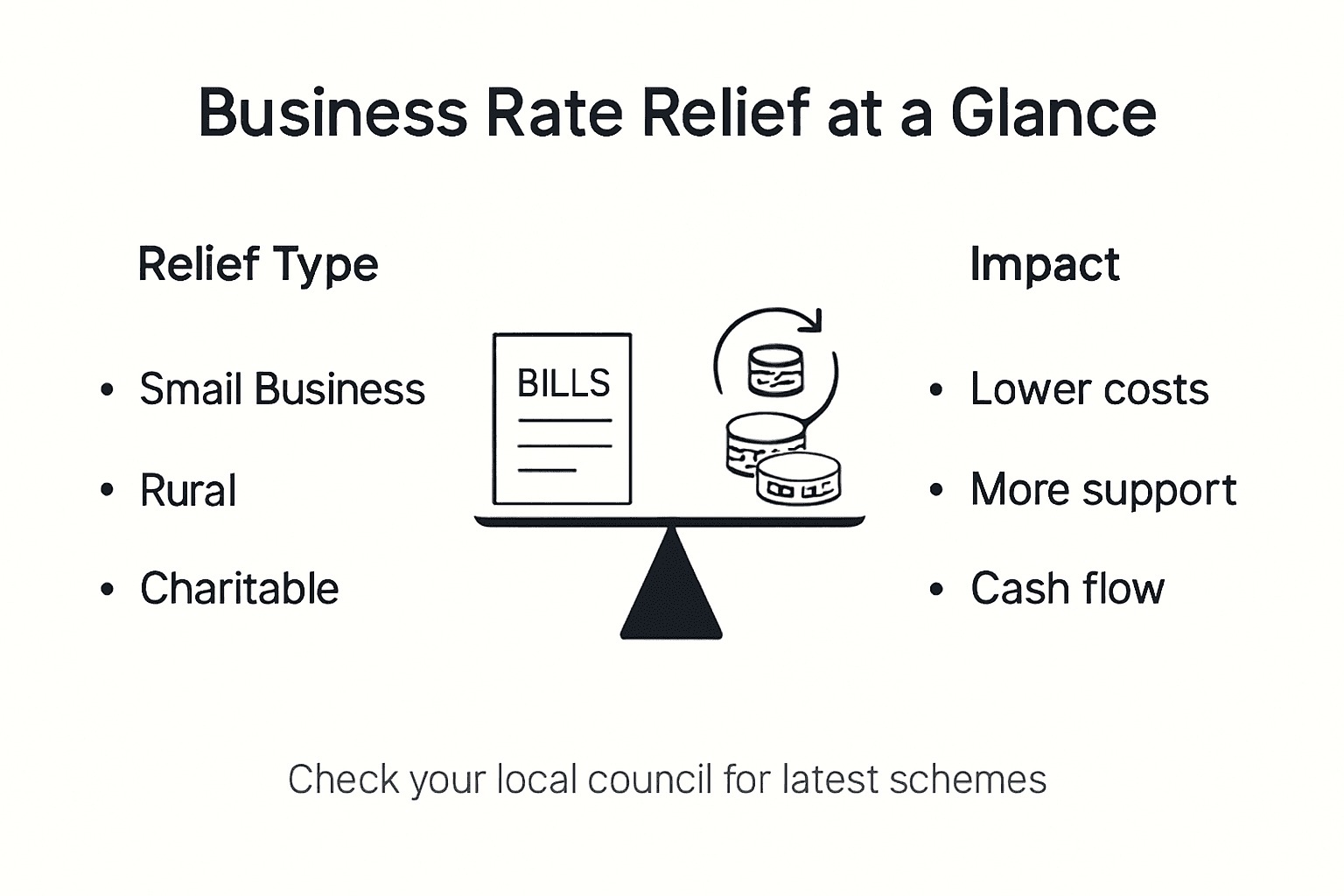
Small Business Rate Relief stands as the primary support mechanism, providing significant financial reprieve for businesses with lower rateable property values. Typically, properties with a rateable value under £12,000 qualify for complete exemption, while those between £12,000 and £15,000 receive tapered relief. This system ensures that smaller enterprises are not disproportionately burdened by local taxation.
Business rate relief varies substantially across different regions, reflecting unique legislative approaches in Scotland, Wales, and Northern Ireland. Key relief types include charitable relief for non-profit organisations, rural rate relief for businesses in designated countryside locations, and specific support for retail, hospitality, and leisure sectors. Additional targeted reliefs exist for specific circumstances such as hardship relief, which provides temporary support during challenging economic periods.
Expert Tip Consult your local council annually and review all potential business rate relief options, as eligibility can change with property modifications or shifts in business status.
To clarify the most frequent misconceptions about business rates, see the summary below:
| Myth | Reality | Business Impact |
|---|---|---|
| Rates stay the same | Rates can change with revaluations | Unexpected cost adjustments |
| All properties pay equal | Relief varies for small businesses | Small firms often pay much less |
| No protections exist | Government caps limit sharp increases | Reduces risk of sudden expense |
Understanding regional differences is crucial. Here’s a comparison of business rate relief across UK regions:
| Region | Key Relief Schemes | Distinctive Feature |
|---|---|---|
| England | Small Business, Retail Relief | Tapered exemption for low values |
| Scotland | Small Business Bonus Scheme | Unique local eligibility rules |
| Wales | Enhanced Retail Relief | Higher relief for retail premises |
| Northern Ireland | Rural Rate Relief, Hardship | Sector-specific and rural support |
Legal Framework And Regional Differences
Business rates in the United Kingdom operate within a complex legal landscape governed by national and regional legislative frameworks. The Non-Domestic Rating Act 2023 provides the primary legal foundation for establishing how local taxation applies to commercial properties, creating a structured approach to assessing and implementing business rate obligations.
Devolved administrations significantly complicate the legal framework, with Scotland, Wales, and Northern Ireland maintaining distinct regulatory approaches. While the core principles remain consistent, each region can implement unique relief schemes, multiplier calculations, and administrative processes. This regional variation means businesses must carefully navigate local council regulations and understand the specific legal nuances that apply to their geographical location.
Legislative provisions continue to evolve to support small businesses, with ongoing reforms addressing key challenges in the business rates system. The most recent legislative changes focus on more frequent property revaluations, streamlined relief processes, and mechanisms to reduce financial burdens on smaller enterprises. These reforms reflect a strategic approach to balancing local government revenue needs with the economic sustainability of small and medium-sized businesses.
Expert Tip Maintain a comprehensive file of your property’s documentation and seek local legal advice to understand the specific business rate regulations applicable in your specific regional jurisdiction.
Financial Impact And Planning For Costs
Business rates represent a significant financial challenge for small enterprises, often consuming a substantial portion of operational budgets. The government’s ongoing analysis highlights the complex economic pressures facing small businesses, revealing the critical need for strategic financial planning and proactive cost management approaches.

Small firms must develop robust strategies to anticipate and mitigate business rate expenses. This involves understanding potential rate fluctuations, implementing comprehensive budgeting techniques, and leveraging available relief schemes. Detailed financial modelling can help businesses predict potential rate increases and create contingency funds to absorb unexpected taxation changes.
Economic data indicates substantial challenges for small UK businesses in managing fixed costs alongside inflationary pressures. These financial constraints require sophisticated approaches to cash flow management, including regular financial reviews, strategic cost reduction initiatives, and proactive engagement with local taxation authorities to understand potential relief opportunities. Successful businesses view business rates not as a static expense, but as a dynamic financial component requiring ongoing strategic assessment.
Expert Tip Create a dedicated financial reserve specifically for business rate obligations, aiming to maintain at least three months of potential rate expenses to provide a robust buffer against unexpected taxation changes.
Challenges, Mistakes And Compliance Risks
Navigating the complex landscape of business rates presents numerous challenges for small enterprises, with potential pitfalls that can significantly impact financial stability. Compliance requirements demand meticulous attention to detail, as mistakes can result in substantial financial penalties and unexpected taxation burdens.
Common compliance risks include misunderstanding relief eligibility criteria, incorrectly assessing property rateable values, and failing to respond promptly to revaluation notices. Small businesses often struggle with the intricate rules surrounding business rates, which vary across different regions and can change rapidly. Misinterpretation of these regulations can lead to overpaying taxes or missing crucial relief opportunities that could substantially reduce financial strain.
Payment practices and financial compliance form critical aspects of business rate management, with potential consequences extending beyond immediate taxation issues. Late payments can trigger additional charges, damage business credit ratings, and potentially lead to enforcement actions by local authorities. Successful navigation requires proactive engagement, regular financial reviews, and a comprehensive understanding of both local and national regulatory requirements.
Expert Tip Maintain a dedicated compliance folder with all business rate correspondence, assessments, and communication records, and set up calendar reminders for key submission and payment deadlines to prevent inadvertent non-compliance.
Take Control of Your Business Rates with Expert Guidance
Understanding and managing business rates in the United Kingdom can feel overwhelming, especially with changing multipliers, relief schemes, and regional legal differences putting pressure on small firms. If you have struggled with navigating rateable values, misunderstood relief eligibility, or felt the impact of unexpected tax increases, you are not alone. Many small business owners face these challenges without clear, practical support.
At KefiHub, we specialise in delivering reliable insights and straightforward advice tailored for UK professionals tackling these exact issues. Whether you want to maximise your business rate relief or avoid costly compliance mistakes, our resources empower you to make informed decisions that protect your financial wellbeing.

Explore our expert commentary and actionable strategies at KefiHub today. Don’t leave your business rates to chance. Visit KefiHub now and take confident steps toward managing your local taxation with clarity and control.
Frequently Asked Questions
What are business rates and how are they calculated?
Business rates are a local tax on non-domestic properties, calculated by multiplying the property’s rateable value by a government-determined multiplier. The rateable value is assessed by the Valuation Office Agency based on the property’s hypothetical annual rental value.
How can small businesses reduce their business rates?
Small businesses can reduce their business rates through relief schemes like Small Business Rate Relief, which can exempt properties with low rateable values or provide tapered relief for those slightly above the threshold. It’s essential to consult with local councils to understand eligibility.
What are common misconceptions about business rates?
Common misconceptions include the belief that business rates remain fixed over time, and that all properties incur the same tax. In fact, rates change periodically, and relief options exist specifically for small businesses, helping lessen their tax burden.
What should small businesses do if they receive a revaluation notice?
Upon receiving a revaluation notice, businesses should review their property’s rateable value and ensure it’s accurate. They can appeal the valuation if they believe it is incorrect and should consult their local council for guidance on the appeals process.
Recommended
- 7 Smart Ways to Reduce Business Costs for UK Owners – Kefihub
- What Is Business Succession and Why It Matters – Kefihub
- Starting a Small Business UK: Step-by-Step Legal Guide – Kefihub
- Small Business Compliance Guide: Essential Steps for UK SMEs – Kefihub