

TL;DR:
- 79% of marketing leads fail to convert without a structured sales funnel.
- UK SMEs should build simple, connected stages focusing on awareness, interest, consideration, and conversion.
- Combining basic funnel models with follow-up and trust-building improves long-term growth and customer loyalty.
Without a structured system to guide prospects from first contact to purchase, 79% of marketing leads fail to convert into paying customers. For UK small business owners, that represents a significant and largely invisible loss of revenue. Many SMEs invest time and money attracting visitors through social media, SEO, or word of mouth, yet have no clear process for what happens next. The result is inconsistency, wasted effort, and stalled growth. This guide cuts through the confusion around marketing funnels, explains exactly how they work in a UK business context, and gives you practical steps to build one that genuinely improves your sales results.
Table of Contents
- What is a marketing funnel and why does it matter?
- How marketing funnels drive customer journeys
- Alternative funnel models: hourglass, flywheel, and tailored approaches
- Common mistakes and how to implement successful funnels in your business
- What most UK experts miss about marketing funnels
- Ready to build your own marketing funnel?
- Frequently asked questions
Key Takeaways
| Point | Details |
|---|---|
| Funnels stop lost sales | A clear funnel recovers abandoned leads and turns interest into conversions for UK SMEs. |
| Match your customer journey | Choosing the right funnel model matters—nonlinear buyers need flexible, tailored approaches. |
| Start simple, measure results | Effective funnels don’t need fancy software—focus on structured steps and basic data tracking first. |
| Compounding improvements | Optimising every stage of your customer journey compounds your sales and growth over time. |
What is a marketing funnel and why does it matter?
A marketing funnel is a structured framework that maps the journey a potential customer takes from first hearing about your business to making a purchase. The term “funnel” reflects the reality that many people enter at the top but fewer reach the bottom where the sale happens. Understanding this journey lets you identify where prospects drop off and what you can do to keep them moving forward.
For UK SMEs, this matters enormously. Without a funnel, selling becomes reactive and inconsistent. You might win clients through referrals one month and struggle the next, with no clear idea why. A funnel gives you a repeatable, measurable process.
The classic funnel has four core stages:
- Awareness: The prospect discovers your business through an advert, social post, search result, or recommendation.
- Interest: They engage further, perhaps reading your website, following you on social media, or downloading a resource.
- Consideration: They compare your offering against alternatives and assess whether you meet their needs.
- Conversion: They make a purchase, sign a contract, or take the desired action.
Each stage requires a different approach. At the awareness stage, your goal is visibility. At consideration, it is trust-building. At conversion, it is removing friction and making it easy to say yes.
| Funnel stage | Primary goal | Typical tactic |
|---|---|---|
| Awareness | Reach new audiences | SEO, social media, paid ads |
| Interest | Build engagement | Blog content, email sign-ups |
| Consideration | Establish trust | Case studies, testimonials |
| Conversion | Drive action | Clear offers, follow-up calls |
The evidence supports investing in each stage deliberately. Multi-stage optimisation yields compounding returns, meaning small improvements at every step add up to significantly higher overall conversion rates. Explore how this connects to your broader UK marketing strategy to see the full picture.
“A funnel does not create demand — it captures and nurtures the demand that already exists. Without it, most of that demand simply walks away.”
For UK small businesses operating with limited budgets and lean teams, this structured approach is not a luxury. It is the difference between sustainable growth and constant hustle.

How marketing funnels drive customer journeys
Understanding the funnel concept is crucial, but how do these stages actually work together to win and nurture customers? The answer lies in deliberate, connected touchpoints that guide your prospect forward at each step.
Consider a practical UK example. A sole-trader accountant in Manchester wants more clients. Here is how a funnel works in practice:
- Awareness: She publishes a helpful article on self-assessment tax tips, which ranks on Google and gets shared on LinkedIn.
- Interest: Visitors land on her website and sign up for a free tax deadline reminder via email.
- Consideration: Over two weeks, she sends three emails: one with a client success story, one explaining her process, and one answering common objections.
- Conversion: She invites subscribers to book a free 20-minute consultation, converting warm leads into paying clients.
This is not complicated. It is consistent. And consistency is precisely what most UK SMEs lack.
The benefits of running a structured funnel include:
- Predictability: You know roughly how many leads you need at the top to hit your revenue targets.
- Efficiency: You stop spending time on cold outreach and focus energy where it counts.
- Measurement: You can track where prospects drop off and fix the weak points.
- Scalability: Once the funnel works, you can invest more at the top to grow output.
Without this structure, 79% of leads are simply lost, never followed up, never nurtured, never converted. That is a sobering figure for any business owner. A well-designed lead generation workflow sits at the heart of this process.
Pro Tip: Avoid copying funnel templates designed for large US SaaS companies. They often include seven or eight stages with complex automation sequences that overwhelm small teams. Start with three or four clear steps and build from there. You can find SME marketing strategies that are specifically sized for UK businesses.
If you want to understand the broader landscape of marketing funnel models before committing to one approach, it is worth reviewing the options available before you build.
Alternative funnel models: hourglass, flywheel, and tailored approaches
While traditional funnels are helpful, some journeys do not follow a strict path. Here are smart alternatives for UK businesses that need something more flexible.
The classic funnel ends at conversion, but that is where many businesses leave significant value on the table. Two alternative models address this gap directly.
The hourglass model extends the funnel beyond the sale. After conversion, it adds stages for onboarding, retention, referral, and advocacy. The idea is that a happy customer does not just come back, they bring others with them. For service-based UK businesses where reputation and word of mouth drive growth, this model is particularly relevant.
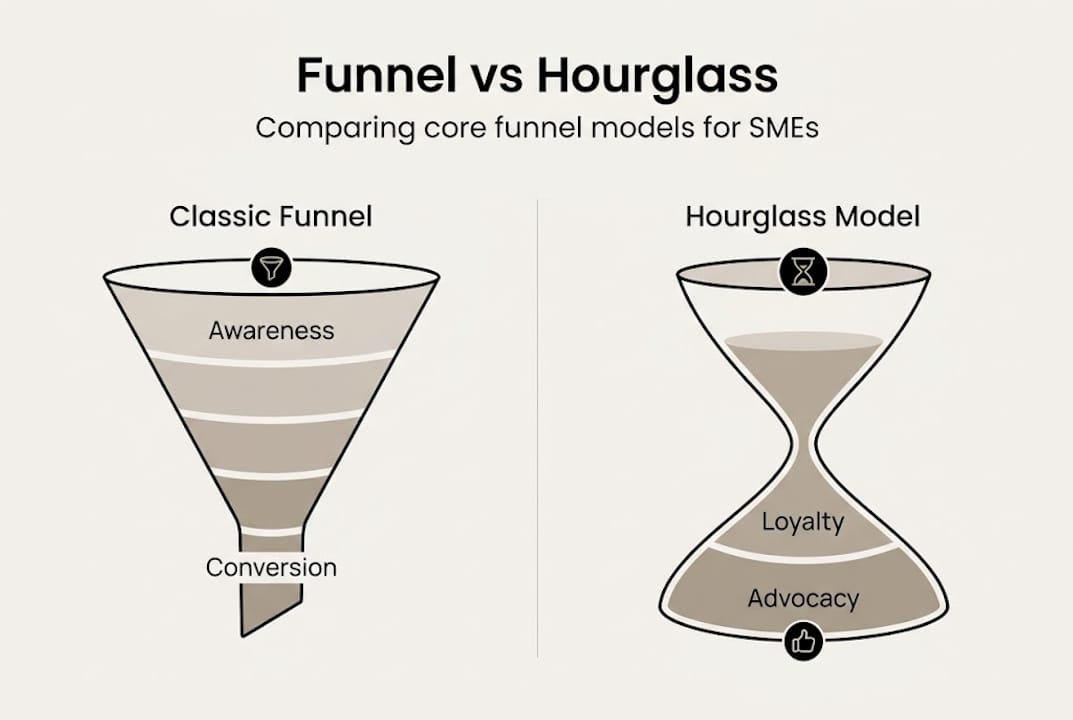
The flywheel model treats customers as the primary engine of growth. Rather than a linear path, it is a continuous cycle where delighted customers generate momentum that attracts new prospects. This suits subscription businesses, membership organisations, and any UK SME where repeat business is the norm.
| Model | Best suited for | Key advantage |
|---|---|---|
| Classic funnel | New businesses, simple offers | Easy to build and measure |
| Hourglass | Service firms, consultancies | Captures referral and loyalty value |
| Flywheel | Subscriptions, communities | Turns customers into growth drivers |
Linear models fail for nonlinear journeys. If your customers take time to decide, compare extensively, or return repeatedly, a rigid funnel will not capture their full value. Hourglass and flywheel approaches build post-purchase loyalty and advocacy into the system.
Pro Tip: You do not have to choose one model exclusively. Many UK SMEs benefit from combining a simple awareness-to-conversion funnel with a lightweight post-sale follow-up sequence that encourages referrals. This hybrid approach is low-cost and highly effective.
When selecting your model, consider:
- How long is your typical sales cycle?
- Do customers return or buy once?
- How important are referrals to your current revenue?
- How much time can you realistically invest in follow-up?
Your answers will point clearly to the right structure. Strong branding examples from UK businesses show how the right model, paired with consistent brand messaging, accelerates results at every stage.
Common mistakes and how to implement successful funnels in your business
Choosing the right model is only half the battle. Here is how to avoid costly missteps and get your funnel working from day one.
The most common errors UK SMEs make with funnels are:
- Copying US templates directly: American funnel tools are built for large audiences and high ad spend. They rarely translate well to UK SME budgets or buyer behaviour.
- Neglecting follow-up: Most conversions do not happen on the first touchpoint. If you have no follow-up sequence, you are leaving money behind.
- Overcomplicating the system: A funnel with too many stages, tools, and automations creates confusion and inertia. Simplicity wins.
- Not measuring anything: Without tracking, you cannot improve. Even a basic spreadsheet tracking lead sources and conversion rates is better than nothing.
Here is a straightforward process for building your funnel:
- Map your current journey: Write down every step a customer takes from first contact to purchase. Be honest about where the gaps are.
- Define one goal per stage: Awareness should drive traffic. Interest should capture contact details. Consideration should build trust. Conversion should remove obstacles.
- Create the content or process for each stage: This might be a blog post, an email sequence, a case study, or a simple phone call.
- Set up basic tracking: Use Google Analytics, a CRM, or even a spreadsheet to record how many leads enter each stage and how many progress.
- Review monthly and iterate: Look at where prospects drop off and test one change at a time to improve that stage.
Optimising multiple funnel stages produces compounding returns. A 10% improvement at three stages does not give you 30% more sales. It multiplies, giving you significantly more. This is why consistent iteration matters more than a perfect launch.
Quick implementation checklist for UK small business owners:
- [ ] Current customer journey mapped on paper
- [ ] Lead capture mechanism in place (form, call, email sign-up)
- [ ] At least one follow-up touchpoint after first contact
- [ ] Basic conversion tracking set up
- [ ] Monthly review scheduled
For broader context on scaling beyond the funnel, review business growth strategies and explore the digital marketing benefits that support each stage of your funnel.
What most UK experts miss about marketing funnels
Most funnel guides focus on the mechanics: stages, tools, and tactics. What they rarely address is the cultural mismatch between how funnels are taught and how UK buyers actually behave.
UK buyer journeys tend to be more relational and less transactional than American models assume. British customers often take longer to trust, value personal communication over automated sequences, and respond better to straightforward honesty than high-pressure urgency tactics. A funnel built on countdown timers and aggressive retargeting may generate short-term clicks but erodes the trust that drives long-term business in the UK.
The most effective funnels we see working for UK SMEs are simple, low-friction, and backed by genuine follow-up. Not seven-step automation sequences. Not complex CRM workflows. Just clear steps, real communication, and consistent measurement. That is what the real strategy insights consistently point to. The businesses that grow sustainably are not those with the most sophisticated funnels. They are the ones that actually follow up, keep their promises, and make it easy for the right people to say yes.
Ready to build your own marketing funnel?
If you are ready to act, the journey to better funnels does not end with theory. Putting these principles into practice requires clear planning, realistic budgeting, and the confidence to start simple and improve over time.
At KefiHub, we publish practical, UK-focused guidance to help small business owners take confident next steps. Whether you are working through your business budgeting guide to fund your funnel investment or looking to sidestep the pitfalls covered in our guide to avoiding business mistakes, our resources are built for your context. Explore the full library at KefiHub and find the practical support your business needs to grow with clarity and confidence.
Frequently asked questions
What is the biggest benefit of marketing funnels for UK small businesses?
They help turn more leads into paying customers by guiding people through a structured journey. Without one, 79% of leads are never captured or followed up.
Do I need expensive software to use a marketing funnel?
No. UK SMEs can use spreadsheets and free tools to map and track their funnel steps effectively. Complex US SaaS templates are rarely necessary and often create more confusion than value.
Which is better for UK firms: funnel, hourglass, or flywheel?
It depends on your business model. Funnels suit simple, single-purchase journeys, while hourglass and flywheel models work better for building loyal, repeat customers and referral-driven growth.
How can I measure if my marketing funnel is working?
Track how many leads move from one stage to the next and adjust your steps to boost conversions. Even a basic monthly review of lead-to-sale ratios will reveal where your funnel needs attention.
Recommended
- 7 Effective Marketing Strategies for SMEs to Drive Growth – Kefihub
- Create a winning marketing strategy: the essential UK SME guide – Kefihub
- Why Use Digital Marketing in UK SMEs: 50% More Customers – Kefihub
- Networking for SMEs Guide: Build Connections for Growth – Kefihub
- INUSUAL | Cómo impulsar equipos innovadores y transformar tu empresa