


TL;DR:
- AI adoption among UK SMEs is low but offers significant economic value and efficiency gains.
- Preparing with process mapping, data cleaning, and governance is essential before implementing AI tools.
- Small, measured pilots and ongoing measurement help ensure successful AI integration and return on investment.
Most UK small businesses know AI can improve how they operate, yet AI adoption rates range from 16% to 54%, depending on how broadly adoption is measured. That gap tells a clear story: awareness is high, but confident action remains rare. Cost concerns, skills gaps, and sheer confusion about where to begin keep many owners on the sidelines. This guide cuts through that uncertainty. You will find practical, sequenced steps to assess your readiness, choose the right tools, pilot them safely, and measure genuine results. The evidence for acting is strong, and the barriers are more manageable than most people assume.
Table of Contents
- Benchmarking AI adoption: Understanding the opportunity
- Preparing for AI: Critical foundations for success
- Step-by-step AI adoption: Practical guide for UK SMEs
- Verifying AI impact: How to measure, iterate, and avoid pitfalls
- A fresh perspective: Smarter AI adoption for UK SMEs
- Next steps: Explore business automation and analytics with Kefihub
- Frequently asked questions
Key Takeaways
| Point | Details |
|---|---|
| Clear ROI benchmarks | Small businesses adopting AI see measurable efficiency gains and cost savings; case studies confirm substantial impact. |
| Critical foundations first | Preparing with process audits, data cleanup and basic governance is essential to avoid costly mistakes. |
| Step-by-step adoption | A practical, phased approach—starting small, piloting, and iterating—delivers best results with low risk. |
| Real-world pitfalls | Automating without foundational readiness, or neglecting human oversight, can stall productivity and create compliance issues. |
| Ongoing measurement | Track metrics and adapt quickly to sustain improvements and maximise ROI from AI investments. |
Benchmarking AI adoption: Understanding the opportunity
Building on this widespread uncertainty, it helps to ground the opportunity with hard numbers. The business case for AI is not speculative. It is documented, measurable, and increasingly relevant to businesses of every size.
Government research reports a 16% strict adoption rate among UK SMEs, meaning businesses using AI in a meaningful, embedded way. Broader surveys push that figure to 54% when including any use of at least one AI tool, such as a chatbot or automated scheduling system. Either way, a large proportion of small businesses are not yet capturing the value on offer.
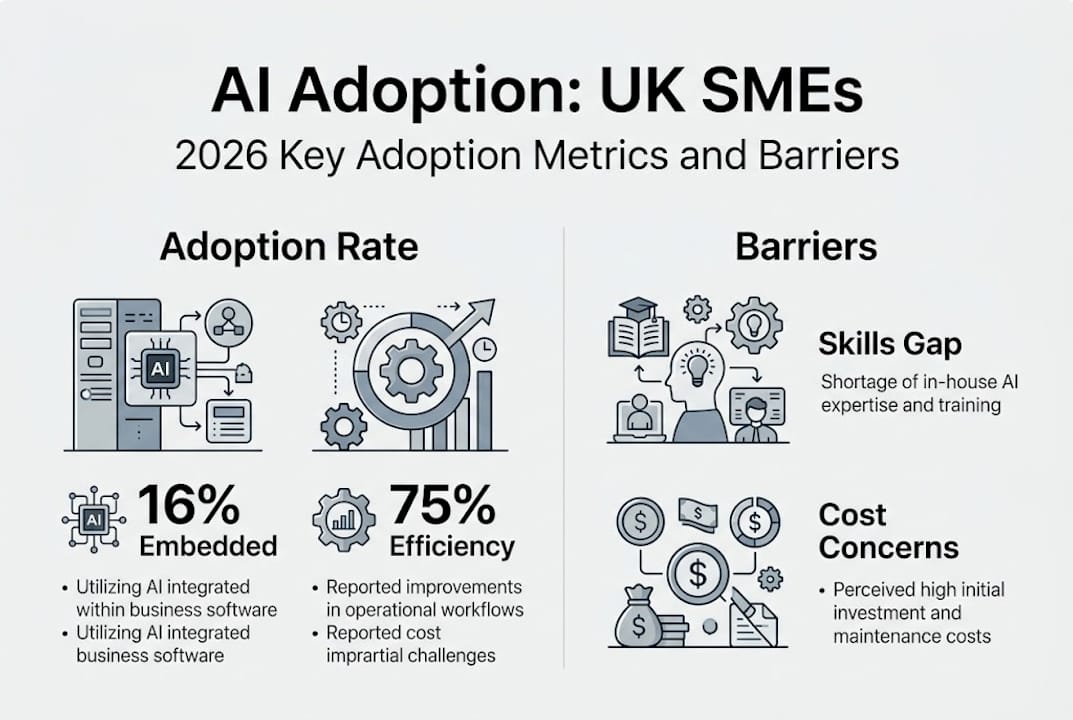
The scale of that value is significant. AI delivers £78B in potential economic value to UK SMEs, with individual case studies showing savings of £85,000 per year and reductions in manual processing time of up to 75%. Those are not outliers reserved for large corporations. UK law firms, recruitment agencies, and logistics providers with fewer than 50 staff have all reported similar results.
| Metric | Reported figure |
|---|---|
| Strict AI adoption (UK SMEs) | 16% |
| Broad AI tool usage | Up to 54% |
| SMEs reporting efficiency gains | 75% |
| Potential UK SME economic value | £78 billion |
| Typical annual savings (case studies) | Up to £85,000 |
The most common early wins come from:
- Automating repetitive admin tasks such as invoicing, data entry, and appointment booking
- Improving lead generation through AI-assisted outreach and follow-up sequencing
- Reducing processing time for client onboarding, compliance checks, and reporting
For a broader view of how business intelligence for UK SMEs supports these gains, the picture becomes even clearer. Understanding your data is the first step towards using AI to act on it. Businesses that invest in analytics in SME growth consistently outperform those that rely on instinct alone.
The opportunity is real. The question is whether your business is ready to capture it.
Preparing for AI: Critical foundations for success
Once the value is clear, attention turns to getting your business ready for genuine AI adoption. This stage is where most SMEs either set themselves up for success or create expensive problems they will need to unpick later.
The AI Opportunities Action Plan is direct on this point: prioritise process audits and data cleanup before introducing any AI tool. Automating a broken or unclear process does not fix it. It accelerates the damage.
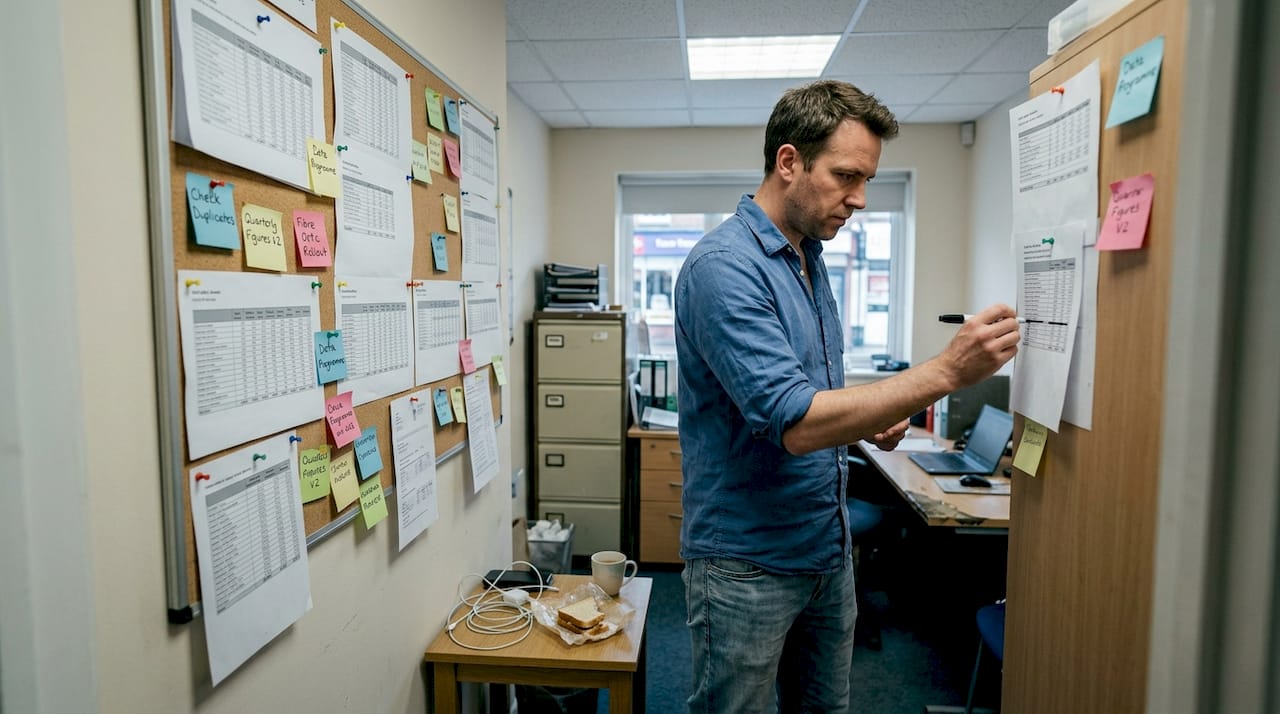
Start with a process audit. Map out the repetitive tasks in your business, the bottlenecks that slow your team down, and the points where data moves between systems. You are looking for tasks that are rule-based, time-consuming, and consistent. These are your best candidates for early AI adoption.
Next, address data readiness. AI tools are only as reliable as the data you feed them. Inconsistent records, duplicate entries, and outdated contact details will undermine any tool you introduce. Clean up your CRM, standardise your naming conventions, and consolidate data into as few systems as possible.
Finally, establish governance basics. You do not need a complex policy document. A lightweight internal guide covering how staff should use AI tools, when human review is required, and how you handle personal data under GDPR is enough to start. Skills gaps (39%), cost (21%), and confusion (39%) are the top barriers cited by UK SMEs, and a clear internal framework addresses all three.
| Readiness checklist | Common mistake |
|---|---|
| Map repetitive processes | Jumping straight to tool selection |
| Clean and standardise data | Feeding messy data into AI systems |
| Define human review points | Removing human oversight entirely |
| Create a lightweight AI policy | Ignoring GDPR obligations |
| Set measurable success criteria | Adopting AI without clear goals |
Pro Tip: The UK government’s AI action plan includes practical playbooks for SMEs at different stages of readiness. Use them as a starting framework rather than building your approach from scratch.
Understanding the advantages of business automation at this stage will also help you prioritise which processes deserve attention first. If you are scaling professional services, preparation is especially important before adding AI to client-facing workflows.
Step-by-step AI adoption: Practical guide for UK SMEs
Your business is prepared. Here is how to implement AI confidently and effectively, without overcomplicating the process.
- Complete your process audit. Identify three to five tasks that are repetitive, rule-based, and time-consuming. These are your starting points.
- Clean your data. Before selecting any tool, ensure the data it will rely on is accurate, consistent, and well-organised.
- Choose low-risk tools first. Start with established, widely-used AI tools in your sector. Look for clear pricing, good support, and GDPR-compliant data handling.
- Run a pilot. Introduce the tool in one area of your business for four to six weeks. Set a clear goal, such as reducing invoice processing time by 30%.
- Maintain human oversight. Assign a team member to review AI outputs during the pilot. This catches errors early and builds confidence in the tool.
- Measure and iterate. Compare your results against the baseline you set before the pilot. Adjust, expand, or replace based on what the data shows.
Actionable wins are possible even with modest budgets of £50 to £100 per month, but consolidating processes before automation is vital. Spending more on a sophisticated tool will not compensate for unclear workflows.
Pro Tip: Treat your first AI pilot like a small experiment. Define what success looks like before you start, measure it honestly, and do not expand until you have clear evidence it is working.
When selecting tools, check for:
- Transparent pricing with no hidden usage fees
- UK or EU data storage to simplify GDPR compliance
- Integration capability with your existing CRM or accounting software
- Trial periods so you can test before committing
Common mistakes to avoid include adopting too many tools at once, skipping the pilot phase, and failing to train staff on how to use and review AI outputs. For a practical overview of business automation for SMEs, and to understand how AI vs traditional design approaches affects your broader digital decisions, both resources offer useful context.
Verifying AI impact: How to measure, iterate, and avoid pitfalls
After following a practical adoption process, measuring results and learning from early mistakes is crucial. Many SMEs adopt AI tools with enthusiasm, then struggle to determine whether they are actually working.
75% of UK SMEs report efficiency gains from AI, with 56% seeing higher productivity. However, businesses with weak foundations often see flat results. The tool is rarely the problem. The process or data underneath it usually is.
Track both quantitative and qualitative metrics. Quantitative measures include time saved per task, error rates, cost per output, and revenue influenced by AI-assisted processes. Qualitative measures include staff confidence, customer satisfaction, and the ease of human review.
| ROI benchmark | Pitfall if foundation is weak |
|---|---|
| 75% reduction in manual processing time | No baseline means no comparison |
| £85,000 average annual savings | Savings offset by rework and errors |
| 56% productivity improvement | Staff distrust undermines adoption |
| Faster client onboarding | Poor data causes AI errors at scale |
Expert warning: Productivity gains stall when businesses automate bad processes or neglect human oversight. Governance is not optional.
Early signs of successful adoption include:
- Staff spending less time on admin and more on higher-value work
- Consistent, repeatable outputs from previously variable processes
- Clear cost or time savings visible within the first 60 days
Warning signs of trouble include:
- Frequent manual corrections to AI outputs
- Staff avoiding the tool or reverting to old methods
- No measurable improvement after eight weeks
Using analytics impact for SMEs to track these signals gives you an evidence base for decisions. If you are applying AI to client onboarding, measuring retention and satisfaction alongside efficiency will give you a fuller picture of impact. Use the AI management essentials tool to assess your governance posture at each stage.
A fresh perspective: Smarter AI adoption for UK SMEs
Most conversations about AI adoption focus on tools. Which platform is best? Which AI writes the best emails? Which chatbot handles customer queries most efficiently? These are the wrong questions to lead with.
Real-world experience consistently shows that the businesses achieving the strongest results are not those with the most sophisticated AI. They are the ones that did the unglamorous work first: mapping their processes, cleaning their data, and agreeing on how humans and AI would work together.
Government guidance advises consolidating and cleaning up processes before automation, and this matches nearly every SME success story we have seen. The businesses that struggle are those that bolt AI onto chaos and expect clarity in return.
Our view is straightforward. Prepare well, start small, and iterate fast. A simple pilot on one process, measured honestly, teaches you more than any vendor demonstration. Human oversight is not a weakness in your AI strategy. It is the thing that makes it work. Keep that in mind as you explore AI trends for SMEs and decide where to focus next.
Next steps: Explore business automation and analytics with Kefihub
Having mapped practical steps for AI adoption, the next move is finding ongoing support and deeper resources tailored to your business.
Kefihub brings together practical guides, real-world insights, and expert commentary to help UK small businesses move forward with confidence. Whether you are just starting to explore business intelligence for UK small businesses, looking to understand business automation explained in plain terms, or ready to see how analytics for SME growth can sharpen your decisions, you will find clear, actionable guidance across all of these areas. Explore the resources, identify your next step, and reach out if you need tailored support for your specific situation.
Frequently asked questions
How much does AI adoption cost for UK small businesses?
Entry-level AI tools start from as little as £50 to £100 per month, with costs scaling based on complexity, integrations, and the number of users. Many low-cost pilots deliver measurable results before any significant investment is required.
What are the main barriers stopping SMEs from adopting AI?
The top barriers are skills gaps (39%), cost concerns (21%), and general confusion about where to start (39%), alongside data quality issues and uncertainty around privacy obligations.
How can I ensure AI adoption complies with GDPR?
Establish a lightweight internal policy covering data use, human review requirements, and regular compliance checks. The AI management essentials tool provides structured guidance to help you assess and maintain your governance posture.
What return on investment can UK SMEs expect from AI?
Most businesses report 75% efficiency gains alongside meaningful cost savings, with case studies showing thousands of pounds and hundreds of hours recovered each year when the right foundations are in place.
Recommended
- 7 Key AI Trends in 2025 Every UK Professional Should Know – Kefihub
- Business Intelligence: Empowering UK Small Businesses – Kefihub
- Discover the top advantages of business automation in 2026 – Kefihub
- Role of Analytics in Growth: UK SME Impact – Kefihub
- Карьера в индустрии AI/ML (Career in AI/ML Industry)