


Most small business owners view LLPs as complex legal entities reserved for large professional firms, missing their practical advantages for everyday businesses. An LLP offers limited liability protection without corporation tax burdens, combining the best features of partnerships and companies. This guide clarifies exactly why LLPs benefit UK small businesses and walks you through formation, compliance and strategic considerations for 2026.
Table of Contents
- What Makes Llps A Smart Choice For Uk Small Businesses?
- How To Form An Llp In The Uk: Key Steps And Legal Requirements
- Comparing Llps With Other Business Structures: Pros And Cons
- Maintaining Compliance And Best Practices For Llp Members
- Explore Kefihub’s Resources To Grow Your Uk Business
Key takeaways
| Point | Details |
|---|---|
| Limited liability protection | LLPs shield members’ personal assets from business debts and other members’ actions. |
| Tax transparency | Profits pass directly to members, avoiding corporation tax whilst maintaining management flexibility. |
| Simple formation | Registration requires two members and Companies House form LL IN01, typically completed within 24 hours. |
| Enhanced credibility | LLP status signals professionalism to clients and suppliers compared to general partnerships. |
| LLP agreement essential | This document defines member roles, profit share and decision-making to prevent future disputes. |
What makes LLPs a smart choice for UK small businesses?
An LLP gives you limited liability protection, shielding your personal assets from business debts and obligations. Unlike general partnerships where one partner’s mistake can bankrupt all members, LLPs protect you from liabilities arising from other members’ actions.
The tax advantages prove equally compelling. Profits and losses pass directly to members, avoiding corporation tax at the entity level. You pay income tax and national insurance on your share, but the business itself faces no separate corporation tax bill. This transparent taxation structure delivers real savings compared to limited companies.
LLPs combine partnership flexibility with company benefits. You get separate legal entity status, enabling the LLP to enter contracts, own property and maintain continuity regardless of membership changes. This legal personality means the business continues smoothly when members join or leave.
Management stays flexible without rigid board structures or shareholder requirements. Members control decision-making through their LLP agreement rather than company articles. This suits professional practices like law firms, accountants and consultancies where partners want direct involvement without corporate formality.
Pro Tip: Compare different types of business structures before committing to an LLP. Consider your liability exposure, tax position and management preferences to choose the optimal structure for your specific situation.
How to form an LLP in the UK: key steps and legal requirements
Forming an LLP requires at least two members under the Limited Liability Partnerships Act 2000. Members can be individuals or corporate entities, with at least two designated for statutory responsibilities.
- Choose a unique name ending with ‘LLP’ or ‘Limited Liability Partnership’. Check availability through Companies House to avoid rejections or trademark conflicts.
- Prepare form LL IN01 with your LLP name, registered office address and members’ details including designated members.
- Submit your application to Companies House online or by post. Registration typically completes within 24 hours for electronic submissions.
- Draft an LLP agreement outlining member rights, profit distribution, management processes and exit procedures. Whilst not legally required, this prevents costly disputes.
- Register for tax obligations including VAT if turnover exceeds thresholds, PAYE for employees and self-assessment for members’ income tax.
Your registered office must be a UK physical address where official communications arrive. This appears on public records, so consider privacy implications before using your home address.
Pro Tip: Follow our business registration step by step guide alongside LLP formation to ensure you complete all registration requirements efficiently. Missing steps can delay trading or create compliance issues later.
Most LLPs complete registration within 24 hours electronically, receiving their certificate of incorporation swiftly. This speed lets you start trading quickly whilst maintaining proper legal standing.
Comparing LLPs with other business structures: pros and cons
LLPs occupy a middle ground between general partnerships and limited companies. LLPs suit professional firms like law and accounting practices, offering more flexibility than limited companies and greater protection than general partnerships.

| Structure | Liability | Taxation | Formation Complexity | Management Flexibility |
|---|---|---|---|---|
| LLP | Limited | Transparent (personal income) | Moderate (2+ members, registration) | High (flexible agreement) |
| General Partnership | Unlimited | Transparent (personal income) | Low (minimal formality) | High (partnership agreement) |
| Limited Company | Limited | Corporation tax + dividend tax | Moderate (registration required) | Lower (directors, shareholders) |
| Sole Trader | Unlimited | Transparent (personal income) | Very low (self-employed only) | Maximum (sole control) |
The liability difference matters most. LLP members enjoy limited liability whilst general partnership members face unlimited personal exposure. If your business carries significant risk, this protection justifies the extra formation complexity.
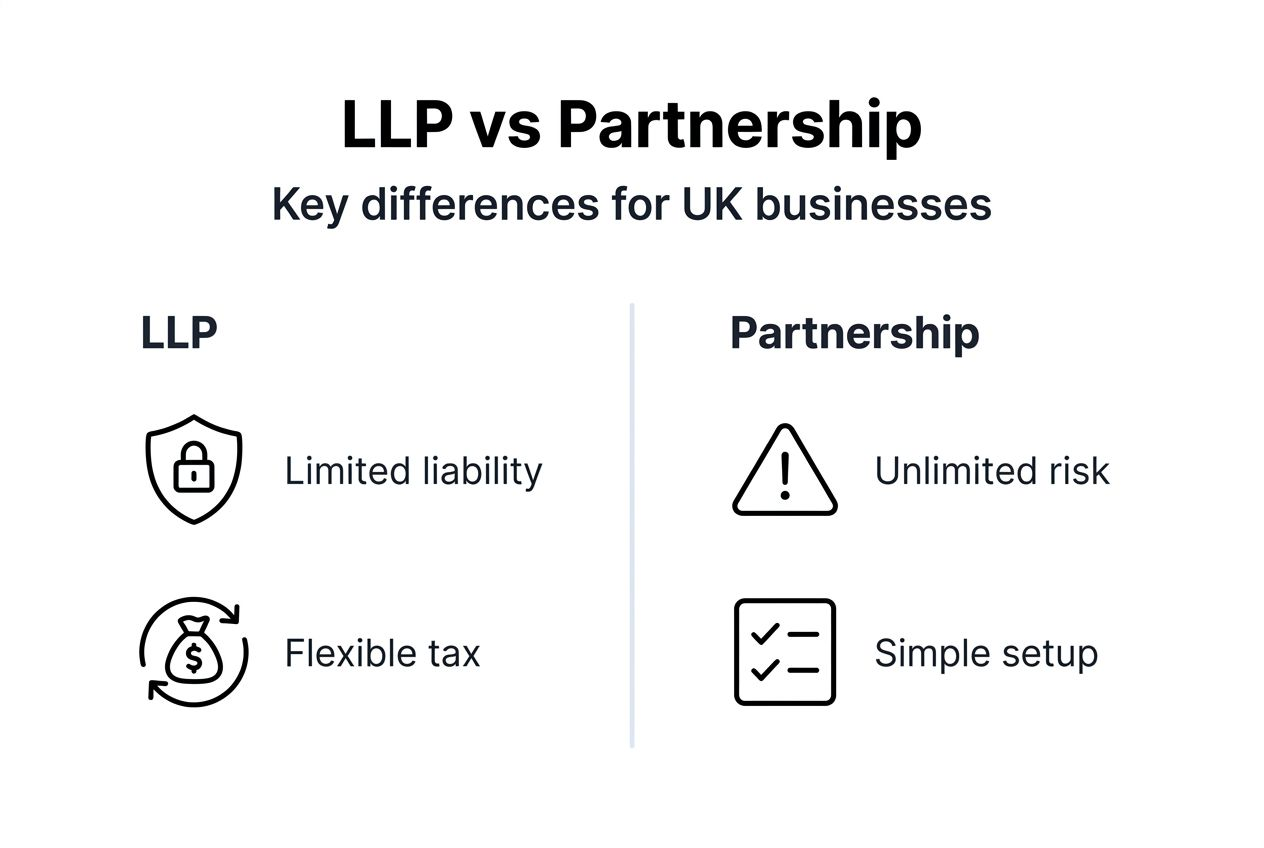
Tax treatment favours LLPs over limited companies for many scenarios. Limited companies face corporation tax on profits, then dividend tax or income tax when distributing to owners. LLPs avoid this double taxation through transparent treatment, though members lose certain corporate tax planning opportunities.
Management flexibility beats limited companies but requires more structure than sole trading. LLPs need formal agreements and designated members for compliance, whilst sole traders operate with complete autonomy. Consider whether you value protection and credibility over simplicity.
Credibility gains prove substantial. Clients and suppliers view LLP status as more professional than general partnerships, potentially opening doors to larger contracts. This perception boost matters in professional services where trust drives business development.
Pro Tip: Professional indemnity insurance remains vital even with LLP protection. Limited liability shields personal assets but doesn’t prevent claims against the business itself. Adequate insurance protects your LLP’s resources from professional negligence claims.
Review why to register a UK company alongside LLP considerations. Sometimes a limited company structure better suits your growth plans, funding needs or exit strategy despite LLP tax advantages.
Maintaining compliance and best practices for LLP members
Designated members carry specific statutory responsibilities. At least two designated members must handle filing annual returns and accounts with Companies House. These members face personal penalties for non-compliance, so clear designation and accountability matter.
Your LLP agreement should specify management and decision-making processes beyond statutory minimums. Define profit distribution formulas, voting rights for major decisions, admission procedures for new members and exit terms. Updating this agreement prevents disputes as your business evolves.
- Keep registered office details current with Companies House to receive official correspondence reliably
- Maintain professional indemnity insurance where your industry requires it, protecting against negligence claims
- File annual accounts within nine months of your financial year end to avoid penalties
- Submit confirmation statements annually, updating member details and registered office information
- Ensure designated members understand their legal duties including Anti-Money Laundering compliance for relevant sectors
Regular LLP agreement reviews keep terms aligned with reality. Membership changes, profit share adjustments and strategic pivots all warrant updates. Outdated agreements create confusion and potential legal challenges.
Compliance deadlines stack up quickly. Companies House penalties for late filing start at £150 and escalate with continued delays. HMRC penalties for tax obligations add further costs. Consider using compliance checklists to track deadlines systematically.
Pro Tip: Automate compliance reminders through calendar alerts or practice management software. Missing a filing deadline creates unnecessary costs and administrative burden that simple planning prevents. Designated members should review upcoming obligations quarterly.
Explore Kefihub’s resources to grow your UK business
Forming an LLP marks just the beginning of your business journey. Kefihub delivers comprehensive guidance tailored for UK SMEs navigating growth challenges, legal requirements and strategic decisions. Our business growth roadmap breaks down expansion into manageable stages with actionable steps for each phase.

Staying compliant becomes simpler with our small business compliance guide, covering tax obligations, regulatory requirements and best practices. Whether you’re establishing your LLP or managing an existing structure, our legal guide for starting a small business provides the clarity you need to operate confidently and avoid costly mistakes.
FAQ
What is an LLP agreement and why is it important?
An LLP agreement establishes the rules between members regarding management responsibilities, profit distribution and decision-making processes. Whilst not legally required, this document proves vital for avoiding disputes and ensuring smooth operation as your business evolves. Consider working with a solicitor to draft comprehensive terms covering admission, retirement and dispute resolution procedures. Review our business registration guide for additional formation considerations.
How are profits taxed in an LLP?
LLPs avoid corporation tax entirely, with profits taxed as personal income of individual members. Each member pays income tax and Class 2 and Class 4 national insurance contributions on their profit share. This transparent taxation prevents the double taxation limited companies face but requires members to manage their own tax affairs through self-assessment returns.
Can an LLP continue if a member leaves or joins?
An LLP maintains separate legal personality, continuing smoothly despite membership changes. This continuity supports business stability and client confidence, as contracts and relationships remain valid regardless of individual departures. Your LLP agreement should specify procedures for member admission and retirement to manage transitions efficiently whilst protecting existing members’ interests.
Do all LLP members have limited liability protection?
All LLP members enjoy limited liability for business debts and obligations, protecting personal assets from claims against the LLP. However, members remain personally liable for their own negligent acts or omissions. Professional indemnity insurance provides additional protection against claims arising from professional errors, complementing the structural liability shield the LLP provides.
What ongoing costs should I expect with an LLP?
LLPs face annual accounts filing fees, confirmation statement costs and potential accountancy expenses for preparing statutory accounts. Professional indemnity insurance adds recurring costs for many sectors. Budget for designated members’ time managing compliance obligations, plus legal fees for updating your LLP agreement when membership or terms change. These costs prove modest compared to the liability protection and tax efficiency gained.
Recommended
- Why Choose Limited Company? Key Benefits Explained – Kefihub
- 7 Key Types of Business Structures UK Professionals Must Know – Kefihub
- 7 Key Types of Business Structures for UK Small Firms – Kefihub
- Why Register a UK Company – Legal and Financial Impact – Kefihub