


Starting a UK company should be simple, yet 15-20% of first-time applications are delayed or rejected due to avoidable errors. Registration confusion costs you time and momentum when speed matters most. This guide breaks down each step clearly, covering prerequisites, naming rules, structures, documentation, costs, and common pitfalls to ensure you register confidently and quickly.
Table of Contents
- Prerequisites: What You Need Before You Start
- Step 1: Choose Your Company Name
- Step 2: Choose Your Company Structure
- Step 3: Prepare Necessary Documents
- Step 4: Submit Incorporation Application
- Step 5: Pay Registration Fees
- Common Mistakes to Avoid When Registering a Company
- Expected Timelines and Outcomes After Registration
- Simplify Your UK Company Registration With Kefihub Solutions
Key Takeaways
| Point | Details |
|---|---|
| Registration speed | Online applications approved within 24 hours in 90% of cases when submitted correctly. |
| Essential prerequisites | UK office address, unique company name, chosen legal structure, and accurate director details required before starting. |
| Common mistakes | Incomplete forms, incorrect director data, and restricted names cause most delays and rejections. |
| Cost difference | Online registration costs £12 versus £40 for postal applications, with significantly faster processing. |
| Post-registration duties | Annual confirmation statements are mandatory to maintain good standing and avoid being struck off. |
Prerequisites: What You Need Before You Start
Before submitting your application, gathering the right information prevents costly delays. A registered UK office address is mandatory, serving as your company’s official location for legal correspondence. This cannot be a PO box and must be a physical address where documents can be delivered during business hours.
Your company name must be unique and compliant with naming rules before you can proceed. Checking availability early saves time and avoids application rejection. Decide on your legal company structure now because changing it later involves significant cost and administrative burden.
Collect accurate personal information for all directors and shareholders, including full legal names, dates of birth, residential addresses, and nationality. You’ll also need details about share allocation and the nature of control each person holds. Starting with complete, verified information reduces the likelihood of delays dramatically.
Key items to prepare:
- Valid UK registered office address (not a PO box)
- Unique, compliant company name verified through official checker
- Chosen legal structure (limited by shares, limited by guarantee, etc.)
- Personal details and identification for all directors and shareholders
- Initial share capital allocation plan
- Contact information including email and phone numbers
Pro tip: Keep digital copies of all identification documents and proof of address ready. The online system requires uploads, and having everything prepared speeds up the process significantly.
Step 1: Choose Your Company Name
Your company name is a legal requirement, not just a branding exercise. Over 6 million companies are registered in the UK, making uniqueness checks essential. Use the official Companies House name availability checker before you invest time in applications or branding materials.
Certain words are restricted or sensitive, requiring special permission before use. Terms like “Royal,” “British,” “Authority,” or anything suggesting government connection need approval. Financial terms like “Bank,” “Insurance,” or “Trust” also face restrictions unless you hold appropriate licenses.
Your name must end with “Limited” or “Ltd” for private limited companies, clearly signaling your legal structure to customers and suppliers. Avoid names too similar to existing companies, as similarity can trigger rejection even if the exact name is available.
Consider how your chosen name fits your brand identity and long-term goals. Simple, memorable names work better for marketing while remaining professional and credible. Check domain availability alongside company name availability to ensure digital presence consistency.
Naming restrictions to avoid:
- Words suggesting government affiliation without permission
- Financial or regulated industry terms without proper licenses
- Offensive or misleading terminology
- Names identical or too similar to existing registered companies
- Special characters or unusual formatting that causes confusion
Pro tip: Have two or three backup names ready. Even if your first choice passes the checker, additional review during processing might reveal conflicts you didn’t anticipate.
Step 2: Choose Your Company Structure
Your legal structure determines liability, tax treatment, and administrative requirements. Over 95% of newly registered UK companies are limited by shares, making it the default choice for most small businesses. This structure separates personal and business finances, limiting your liability to the amount you invested in shares.
Limited by guarantee suits non-profit organisations, clubs, and charities better than commercial ventures. Members guarantee a nominal amount rather than holding shares, and profits must be reinvested rather than distributed. This structure makes sense when your primary goal is social impact rather than financial return.
Structure affects how you pay tax, file accounts, and distribute profits to owners. Limited companies pay corporation tax on profits, while directors can take salary and dividends. Changing structure after registration involves dissolving the old company and forming a new one, losing your original registration date and company number.
Weigh the types of business structures against your specific needs before committing. Consider future growth plans, investment requirements, and whether you’ll need to bring on partners or shareholders later.
Structure comparison:
| Structure | Best For | Liability | Profit Distribution |
|---|---|---|---|
| Limited by shares | Commercial businesses | Limited to share value | Dividends to shareholders |
| Limited by guarantee | Non-profits, clubs | Limited to guarantee amount | Reinvested, not distributed |
| Unlimited company | Specific tax situations | Unlimited personal liability | Flexible distribution |
Pro tip: Speak with an accountant about tax implications before finalising your structure choice. The right structure can save thousands in tax while the wrong one creates unnecessary complications.
Step 3: Prepare Necessary Documents
The Memorandum of Association is a legal statement signed by all initial shareholders agreeing to form the company. This document is mandatory and created automatically during online registration when you confirm shareholder details.

Articles of Association define your company’s rules, covering how decisions are made, how shares are issued and transferred, and what powers directors hold. You can use model articles provided by Companies House or create customised versions to suit specific needs. Model articles work perfectly for straightforward companies, while complex ownership or control arrangements need tailored articles.
Collect valid identification for all directors and shareholders, including passport or driving licence details and proof of current residential address dated within three months. Document initial share allocations carefully, specifying how many shares each person receives and what class of shares you’re issuing.
Organise everything digitally before starting your application. The online system requires document uploads in specific formats, typically PDF or JPG. Poor quality scans or missing pages cause delays, so verify readability before submission.
Required information checklist:
- Full legal names of all directors and shareholders
- Dates of birth and nationalities
- Current residential addresses with supporting documentation
- Service addresses if different from residential (for directors)
- Share allocation details including number and class of shares
- Nature of control declarations for persons with significant control
Pro tip: Review your company setup checklist thoroughly before starting the online application. Having everything prepared means you can complete the process in one session without interruption.
Step 4: Submit Incorporation Application
The Companies House Web Incorporation Service handles online submissions efficiently. Standard online processing takes around 24 hours if submitted without errors, compared to 8 to 10 days for postal applications. Create an account or sign in to begin your application.
Complete each section methodically, starting with company name and structure confirmation. Enter your registered office address exactly as it appears on official documents, ensuring postcode accuracy. Input director details carefully, as incorrect information is the leading cause of delays.
Add shareholder information including the number of shares each person holds and their percentage of control. Declare persons with significant control, typically anyone holding more than 25% of shares or voting rights. The system validates certain fields automatically, catching obvious errors before submission.
Upload all required documents in the correct format and verify file sizes meet system requirements. Review every field before final submission, as corrections after submission require contacting Companies House directly. Follow this step-by-step business registration guide to ensure nothing is missed.
Submission steps:
- Create Companies House account and log in
- Select company type and enter approved company name
- Input registered office address with exact postcode
- Add all director details including service addresses
- Enter shareholder information and share allocation
- Declare persons with significant control
- Upload required documents (Articles of Association if customised)
- Review all information thoroughly
- Proceed to payment
Step 5: Pay Registration Fees
Online registration costs £12 while postal applications cost £40, making online filing significantly more cost effective. Payment is required at submission time, processed securely through the Companies House portal. Accepted payment methods include debit cards, credit cards, and some business payment cards.
Formation agents offer registration services for additional fees, typically ranging from £30 to £100 or more depending on included extras. These services may reduce errors for complex situations but add cost without speeding up processing. For straightforward registrations, direct online filing is both faster and cheaper.
Your payment confirms submission and triggers processing by Companies House. Keep your payment receipt and application reference number for tracking purposes. No refunds are issued if your application is rejected, so accuracy matters financially as well as administratively.
Choosing online registration saves £28 immediately while cutting processing time by more than 75%. The cost savings alone justify using the online system unless you have specific reasons requiring postal submission.
Payment considerations:
- Online: £12, paid by card during submission
- Postal: £40, paid by cheque with application
- Same day service: £100, guaranteed same day processing if submitted before 3pm
- Formation agents: £30-£100+ additional fees depending on service level
Check available company registration fees and payment methods before starting to ensure you have appropriate payment ready.
Common Mistakes to Avoid When Registering a Company
Incorrect or incomplete forms cause 15-20% of registration delays, with director data errors topping the list. Double check spelling of names, accuracy of dates of birth, and correctness of addresses before submission. Small errors like transposed numbers or misspelled street names trigger rejections.
Using restricted or sensitive words without obtaining prior permission guarantees rejection. Even if a name passes the initial checker, additional review during processing catches restricted terms you shouldn’t use. Apply for permission before incorporating if your desired name includes potentially restricted words.
Missing mandatory documents delays processing while Companies House contacts you for additional information. Ensure your Articles of Association are included if you’re using customised versions rather than model articles. Upload clear, readable copies of all identification and address proof.
Incomplete shareholder information or unclear share allocation creates confusion requiring clarification. Specify exact share numbers, not just percentages, and ensure total shares match your stated share capital. Declare all persons with significant control accurately to comply with transparency requirements.
Top errors causing delays:
- Director names spelled incorrectly or inconsistent with ID documents
- Birth dates entered wrong or incomplete
- Addresses missing postcodes or using incorrect formatting
- Restricted company names without permission
- Missing or illegible uploaded documents
- Incomplete share allocation details
- Undeclared persons with significant control
Pro tip: Use online validation tools built into the Companies House system to catch errors before final submission. These tools flag obvious problems, giving you a chance to correct them immediately rather than facing rejection later. Learn more about avoiding common registration mistakes through proper preparation.
Expected Timelines and Outcomes After Registration
Ninety percent of online applications are processed within one day, typically within 24 hours of submission. Postal applications take 8 to 10 days on average, though this can extend if errors require correspondence. Same day service guarantees processing on the day of submission for applications received before 3pm.
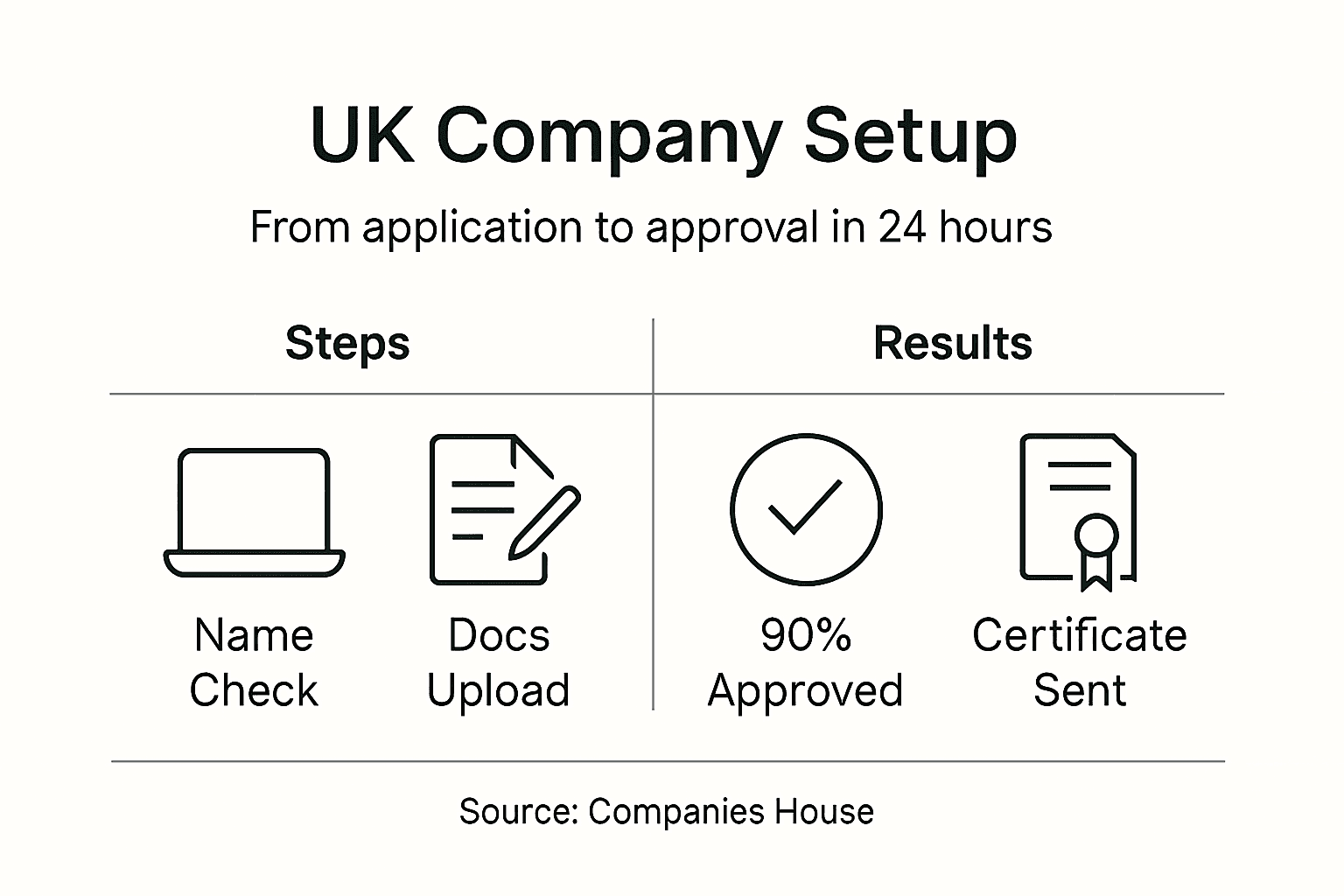
Once approved, you receive your Certificate of Incorporation by email or post depending on application method. This certificate includes your company registration number, date of incorporation, and confirms your company legally exists. You can begin trading immediately upon receiving this certificate.
Annual confirmation statements are mandatory, due every 12 months from your incorporation date. These statements confirm your company details remain accurate and up to date. Failure to file confirmation statements results in penalties and can lead to your company being struck off the register.
Maintain good standing by tracking filing deadlines carefully. Set reminders well before due dates to ensure you have time to gather information and submit accurately. Check company registration timelines and confirmation requirements to understand ongoing obligations.
Processing timeline comparison:
| Method | Typical Processing | Cost | Best For |
|---|---|---|---|
| Online standard | 24 hours | £12 | Most registrations |
| Same day | Same day if before 3pm | £100 | Urgent situations |
| Postal | 8-10 days | £40 | No online access |
Post-incorporation duties:
- File annual confirmation statement every 12 months
- Submit annual accounts within 9 months of year end
- Report changes to company details within 14 days
- Maintain statutory registers at registered office
- Keep accounting records for at least 6 years
Simplify Your UK Company Registration With Kefihub Solutions
Navigating company formation becomes straightforward when you have expert support guiding each decision. Kefihub delivers tailored business intelligence solutions for UK SMEs, helping you understand requirements, avoid pitfalls, and maintain compliance confidently.

Access comprehensive company formation guidance covering every aspect of starting and running your UK business, from initial registration through ongoing legal obligations. Whether you need clarity on structures, documentation, or post-incorporation duties, Kefihub provides reliable, actionable advice you can trust. Explore our top legal advice platforms for UK entrepreneurs to find the right support for your specific situation and ensure your company starts strong.
FAQ
How long does it typically take to register a company online in the UK?
Online registration usually processes within 24 hours if all information is accurate and complete. Same day service is available for £100 if you need guaranteed processing on submission day. Postal applications take significantly longer, averaging 8 to 10 days.
What documents are mandatory when registering a company?
The Memorandum of Association is mandatory and generated automatically during online registration. Articles of Association must be included, either model articles or customised versions. Valid identification and proof of address for all directors and shareholders are required.
Can I change my company structure after registration?
Yes, but changing structure requires dissolving your existing company and forming a new one with different structure. This process involves costs, administrative burden, and loss of your original incorporation date. Choose the right structure initially to avoid these complications.
What are common reasons for registration delays or rejection?
Incomplete or incorrect director information causes most delays and rejections. Restricted or duplicate company names without proper permission trigger automatic rejection. Missing mandatory documents or unclear share allocation also create processing delays requiring clarification.
Recommended
- Why Register a UK Company – Legal and Financial Impact – Kefihub
- Business Registration Step by Step for UK Owners – Kefihub
- Company Setup Checklist for UK Business Success – Kefihub
- Local SEO Step by Step: Boost Your UK Business Fast – Paul Baguley