


{
“@type”: “Article”,
“image”: {
“url”: “https://csuxjmfbwmkxiegfpljm.supabase.co/storage/v1/object/public/blog-images/organization-8865/1769575948939_image.png”,
“@type”: “ImageObject”,
“caption”: “Directors in corner office reviewing company paperwork”
},
“author”: {
“url”: “https://kefihub.co.uk”,
“name”: “Kefihub”,
“@type”: “Organization”
},
“@context”: “https://schema.org”,
“headline”: “Why Choose Limited Company? Key Benefits Explained”,
“publisher”: {
“url”: “https://kefihub.co.uk”,
“name”: “Kefihub”,
“@type”: “Organization”
},
“inLanguage”: “en-US”,
“articleBody”: “Why choose limited company for UK businesses: shows limited liability, tax efficiency, professional image, and funding access. Covers costs, risks, and legal basics.”,
“description”: “Why choose limited company for UK businesses: shows limited liability, tax efficiency, professional image, and funding access. Covers costs, risks, and legal basics.”,
“datePublished”: “2026-01-28T04:54:10.310Z”
}
Choosing the right business structure can seem confusing, especially when financial protection and tax savings are top priorities. For small business owners in the United Kingdom, understanding the limited company model is key to safeguarding personal assets while gaining more control over tax liabilities. This introduction clears up common myths and outlines how adopting this structure can help you grow your business with greater confidence and security.
Table of Contents
- Limited Company Meaning And Misconceptions
- Types Of Limited Company In The UK
- Core Features And Legal Structure
- Tax Benefits And Financial Efficiency
- Personal Liability And Asset Protection
- Comparisons: Sole Trader Vs Limited Company
Key Takeaways
| Point | Details |
|---|---|
| Limited Company Structure | A limited company offers shareholders protection from personal financial liability, confining their risk to the capital they invest. |
| Types of Limited Companies | The UK has two primary types: Private Limited Companies (Ltd), which are more suitable for small businesses, and Public Limited Companies (PLC), designed for larger entities able to trade shares publicly. |
| Tax Efficiency | Limited companies can benefit from lower corporate tax rates and favourable dividend taxation, allowing for strategic financial planning and potential cost savings. |
| Comparative Safety | Unlike sole traders, limited company owners experience limited liability, reducing personal exposure to business debts and enhancing overall financial security. |
Limited company meaning and misconceptions
A limited company represents a specific legal business structure where the financial liability of shareholders is restricted to their invested capital. Understanding this structure is crucial for entrepreneurs seeking protection and clarity in their business ventures. In the United Kingdom, companies can be structured as either companies limited by shares or companies limited by guarantee, each offering distinct advantages for business owners.
The fundamental misconception many business owners harbour is that a limited company provides complete immunity from financial risk. While it does offer significant protection, it does not eliminate all potential liabilities. Shareholders are typically only responsible for the amount of capital they have invested, which means personal assets remain somewhat insulated from business debts. This legal separation between personal and business finances represents one of the most attractive features of the limited company structure.
Two primary types of limited companies exist in the UK: private limited companies and public limited companies. Private limited companies cannot offer shares to the general public and have restrictions on transferring shares, making them ideal for smaller businesses and startups. Public limited companies, conversely, can trade shares on stock exchanges and have more complex regulatory requirements. The choice between these structures depends on the specific goals, scale, and strategic vision of the business.
Pro tip: Before registering a limited company, consult with a qualified accountant or legal professional to understand the specific tax implications and regulatory requirements that apply to your unique business circumstances.
Types of limited company in the UK
In the United Kingdom, businesses can choose between two primary types of limited companies: Private Limited Companies (Ltd) and Public Limited Companies (PLC). These structures offer distinct advantages and are designed to accommodate different business scales and objectives. Business structures in the UK present unique opportunities for entrepreneurs to protect their personal assets and establish credible business entities.
Private limited companies represent the most common structure for small and medium enterprises. These companies cannot offer shares to the general public and have restrictions on share transferability. According to research, private limited company regulations ensure that shareholders’ liability is limited to their invested capital, providing a crucial layer of financial protection. Typically, these companies require at least one director and one shareholder, making them highly accessible for small business owners.
Public limited companies (PLCs) offer a more complex corporate structure designed for larger businesses with significant growth potential. These companies can trade shares on stock exchanges and are subject to more rigorous regulatory requirements. They must have a minimum share capital and comply with extensive disclosure rules, which means more transparency and potentially greater investor confidence. The decision between a private limited company and a public limited company depends on factors such as business size, growth strategy, funding requirements, and long-term corporate objectives.
Pro tip: Consult with a corporate lawyer or chartered accountant to carefully evaluate which limited company structure best aligns with your specific business goals, financial capacity, and growth aspirations.
Here is a comparison of key elements distinguishing private and public limited companies:
| Aspect | Private Limited Company (Ltd) | Public Limited Company (PLC) |
|---|---|---|
| Share Trading | Shares not available to public | Shares traded on stock exchanges |
| Ownership Flexibility | Ideal for small, closely held firms | Suitable for larger, growing enterprises |
| Regulatory Requirements | Fewer disclosure obligations | Strict reporting and governance standards |
| Minimum Share Capital | No minimum set by law | Must maintain at least £50,000 share capital |
Core features and legal structure
A limited company possesses several distinctive legal characteristics that set it apart from other business structures. Limited company legal framework establishes a robust mechanism for business operations with clear governance and accountability. The primary hallmark of this structure is its separate legal personality, which means the company exists as an independent entity distinct from its shareholders and directors.

The core legal features include limited liability protection, which shields shareholders’ personal assets from business debts and legal claims. Directors have specific management responsibilities and must adhere to formal governance requirements. The company must register with Companies House, maintain accurate financial records, and submit annual returns, ensuring transparency and regulatory compliance. This structured approach provides a professional framework that instils confidence among investors, partners, and potential clients.
Perpetual succession represents another critical feature of limited companies. Unlike sole proprietorships, these entities can continue operating indefinitely, regardless of changes in ownership or management. This continuity offers significant strategic advantages, enabling long-term planning and investment. Corporate legal structures create a predictable environment where business relationships, contracts, and operational processes remain stable even as individual participants change.
Pro tip: Engage a qualified corporate accountant to help you navigate the complex legal and financial requirements of maintaining a limited company, ensuring full compliance and optimal financial management.
Tax benefits and financial efficiency
Limited companies offer substantial tax advantages that can significantly improve a business’s financial strategy. Corporate tax efficiency enables entrepreneurs to optimise their financial structures in ways sole traders cannot. By strategically managing income through a combination of salary and dividends, business owners can potentially reduce their overall tax liability and retain more of their hard-earned revenue.
The United Kingdom’s corporate tax framework provides several key financial incentives for limited companies. Corporate tax rates are typically lower than personal income tax rates, creating an opportunity for more efficient financial management. Shareholders can receive dividends, which are taxed more favourably compared to standard income, allowing for more flexible compensation strategies. Additionally, limited companies can claim a broader range of business expenses as tax deductions, including operational costs, professional development, and equipment investments, which can substantially reduce the company’s taxable income.
One of the most compelling financial benefits is the ability to retain earnings within the company. Unlike sole traders, limited companies can reinvest profits back into the business at a lower tax rate, facilitating faster growth and more strategic financial planning. This approach allows business owners to build capital, invest in expansion, and create a more robust financial foundation. The ability to split income between salary and dividends provides an additional layer of tax efficiency, enabling more sophisticated financial management that can adapt to changing business circumstances.
Pro tip: Consult with a chartered accountant specialising in corporate taxation to develop a personalised tax strategy that maximises your limited company’s financial potential while ensuring full compliance with HMRC regulations.
Personal liability and asset protection
Limited liability represents one of the most crucial protections offered by incorporating a company, creating a robust legal barrier between personal and business finances. Personal asset protection fundamentally shields business owners from comprehensive financial risks that could otherwise devastate personal wealth. Unlike sole traders who bear unlimited personal responsibility, limited company shareholders have their potential losses strictly confined to their initial capital investment.
The legal mechanism of limited liability ensures that if a company encounters significant debt, legal challenges, or bankruptcy, shareholders’ personal assets remain protected. This means your home, personal savings, and other individual investments cannot be directly seized to settle business liabilities. The separation creates a critical financial firewall, enabling entrepreneurs to take calculated business risks without jeopardising their entire personal financial ecosystem. Professional investors and banks often view this protection as a sign of financial prudence and reduced risk.
Beyond financial protection, limited liability status provides psychological comfort and strategic flexibility for business owners. Entrepreneurs can pursue innovative projects, enter competitive markets, and make bold strategic decisions knowing their personal financial exposure is carefully contained. This protection extends to legal claims as well, where the company itself becomes the primary defendant rather than individual shareholders. The structure encourages entrepreneurial courage by creating a controlled environment where business risks can be managed more systematically and with greater predictability.
Pro tip: Maintain rigorous separation between personal and company finances, keeping detailed records and avoiding any actions that could pierce the corporate liability shield, such as personal guarantees or commingling of funds.
Comparisons: sole trader vs limited company
The fundamental differences between sole traders and limited companies extend far beyond legal paperwork, representing critical strategic choices for business owners. Business structure comparisons reveal nuanced implications for financial risk, taxation, and operational complexity. While sole traders enjoy simplicity, limited companies provide robust legal and financial protections that can significantly impact long-term business sustainability.
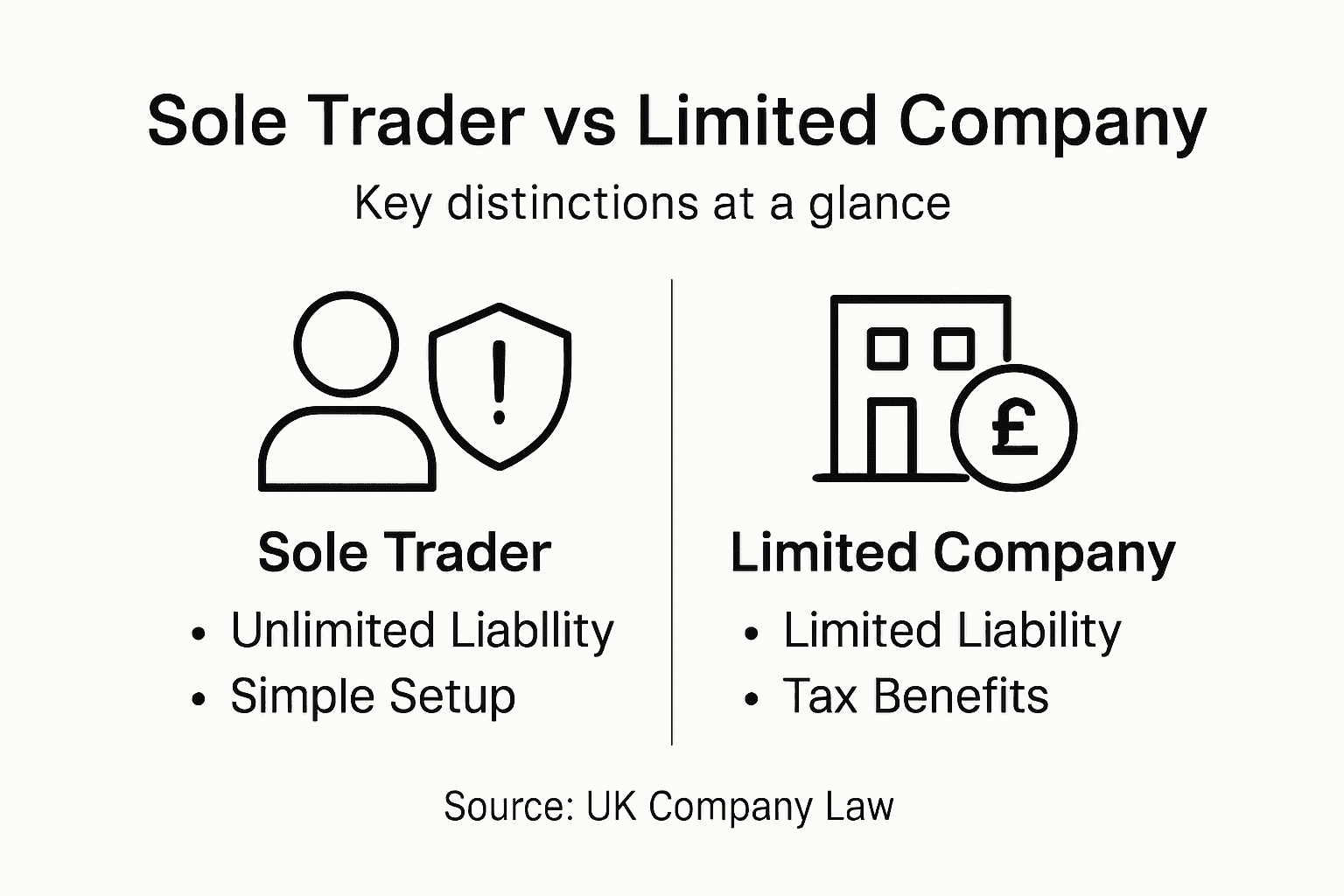
From a financial perspective, sole traders face unlimited personal liability, meaning business debts and legal claims can directly threaten personal assets. Limited companies, by contrast, create a legal separation between personal and business finances. Taxation represents another crucial distinction: sole traders report business income on personal tax returns and are subject to higher personal tax rates, whereas limited companies benefit from lower corporate tax rates and more flexible dividend distribution strategies. This difference can result in substantial financial savings for growing businesses.
Administrative requirements also differ significantly between these structures. Sole traders experience minimal regulatory oversight and have straightforward reporting obligations. Limited companies must comply with more rigorous statutory requirements, including annual financial statements, corporation tax returns, and detailed record-keeping. Company structure advantages become particularly apparent for businesses anticipating growth, seeking external investment, or operating in sectors with higher potential legal risks.
For easy reference, here are the main differences between sole traders and limited companies in the UK:
| Factor | Sole Trader | Limited Company |
|---|---|---|
| Legal Status | Owner and business are one | Separate legal entity from owners |
| Liability | Unlimited personal responsibility | Liability limited to invested capital |
| Taxation | Profits assessed as personal income | Subject to corporation tax rates |
| Administrative Burden | Minimal record-keeping | Detailed filings and annual accounts required |
Pro tip: Consult a professional accountant to perform a comprehensive financial analysis comparing sole trader and limited company structures specific to your unique business circumstances and projected growth trajectory.
Unlock the Benefits of Choosing a Limited Company with KefiHub
Deciding to set up a limited company is a strategic move that offers crucial advantages like limited liability, tax efficiency and a professional legal structure. Yet navigating the complexities can feel overwhelming. From understanding the difference between private and public limited companies to mastering compliance and asset protection, many UK business owners seek clear, practical guidance to truly maximise these benefits. This is where KefiHub’s expertly curated resources become invaluable.
Explore our Digital Archives – Kefihub for detailed insights into limited company structures and financial strategies. Whether you are just starting out or looking to optimise an existing business, our platform delivers actionable advice and expert commentary tailored for UK professionals. Take control of your business journey today by visiting KefiHub and discover how the right business structure can protect your personal assets and unlock tax advantages. Make an informed decision now and secure your company’s future with confidence.
Frequently Asked Questions
What is a limited company?
A limited company is a legal business structure where the financial liability of shareholders is limited to their investment in the company, protecting personal assets from business debts.
What are the key benefits of choosing a limited company structure?
Key benefits include limited liability protection for personal assets, potential tax advantages, a separate legal personality for the business, and the ability to attract investment and grow more strategically.
How do private limited companies differ from public limited companies?
Private limited companies cannot offer shares to the public and have restrictions on share transferability, making them suitable for smaller businesses. Public limited companies can trade shares on stock exchanges and face stricter regulatory requirements.
What tax advantages do limited companies offer compared to sole traders?
Limited companies often benefit from lower corporate tax rates, flexible dividend distributions, and the ability to claim a wider range of business expenses, leading to potential savings compared to sole traders who face higher personal income tax rates.
Recommended
- Why Form a Limited Company in the UK? – Kefihub
- 7 Key Types of Business Structures for UK Small Firms – Kefihub
- 7 Key Benefits of Registering a Business in the UK – Kefihub
- Why Register a UK Company – Legal and Financial Impact – Kefihub
- IT Support Benefits Explained: Value for Brisbane SMEs – IT Start