

Starting your own business in the United Kingdom means facing important decisions about structure and responsibility. Many entrepreneurs find the simplicity and flexibility of sole trader status appealing, but taking full personal responsibility for legal and financial matters adds significant weight to every choice. This guide breaks down what it really means to act as a sole trader, highlighting the practical steps and key risks so you can start your enterprise with confidence.
Table of Contents
- Sole Trader Status Defined And Explained
- Core Requirements And Legal Obligations
- Key Benefits: Simplicity, Control, Flexibility
- Risks: Liability, Tax, Funding And Growth Limits
- Sole Trader Versus Limited Company Or Partnership
- Who Sole Trader Suits Best And When To Reconsider
Key Takeaways
| Point | Details |
|---|---|
| Sole Trader Definition | A sole trader operates independently, assuming full personal responsibility for business debts and legal obligations. |
| Legal and Administrative Duties | Sole traders must register with HMRC, maintain accurate financial records, and file annual tax returns. |
| Benefits of Sole Trader Status | This structure offers complete control, minimal start-up costs, and operational flexibility for straightforward business operations. |
| Risks to Consider | Key risks include unlimited personal liability, potential tax burdens, and limitations on growth and funding opportunities. |
Sole trader status defined and explained
In the United Kingdom, a sole trader is an individual who operates a business entirely on their own, taking full personal responsibility for its financial performance and legal obligations. Operating a business as a self-employed individual involves managing all aspects of the enterprise without creating a separate legal entity.
Under this business structure, the sole trader has complete control over their business operations, which includes:
- Making all strategic and operational decisions
- Keeping all business profits after tax
- Having unlimited personal liability for business debts
- Managing personal and business finances independently
- Registering as self-employed with Her Majesty’s Revenue and Customs (HMRC)
The key characteristics of sole trader status distinguish it from other business structures. Unlike limited companies, there is no legal separation between the business and the individual. This means the business owner assumes unlimited personal responsibility for any financial losses or legal claims against the business.
Personal liability represents the most significant difference between sole traders and other business structures. If the business incurs debts or faces legal action, the owner’s personal assets could potentially be at risk. This contrasts sharply with limited company structures, which offer more personal financial protection.
Pro tip: Before registering as a sole trader, consult an accountant to understand the full financial and legal implications specific to your business context.
Core requirements and legal obligations
As a sole trader, navigating the legal and administrative landscape requires understanding several key obligations. Registering with HMRC for Self Assessment is the foundational requirement for operating your business legally in the United Kingdom.
The primary legal and administrative responsibilities for sole traders include:
- Registering for Self Assessment within three months of starting business activities
- Maintaining accurate financial records for at least five years
- Filing annual tax returns by 31 January each year
- Paying income tax and National Insurance contributions
- Tracking all business income and expenses
- Complying with health and safety regulations
- Obtaining necessary business licences for specific industries
Financial record-keeping represents a critical obligation for sole traders. You must document all business transactions, including income, expenses, sales invoices, receipts, and bank statements. These records not only facilitate accurate tax reporting but also provide crucial insights into your business’s financial health.
Personal liability remains a significant legal consideration for sole traders. Unlike limited companies, you are personally responsible for all business debts and legal claims. This means your personal assets could be at risk if the business encounters financial difficulties or faces legal action.

Pro tip: Consider consulting a professional accountant to help you navigate complex tax regulations and ensure full compliance with HMRC requirements.
Key benefits: simplicity, control, flexibility
Sole trader status offers entrepreneurs a streamlined pathway to business ownership with remarkable advantages. Minimal bureaucratic hurdles make this business structure incredibly attractive for individuals seeking a straightforward approach to self-employment.
The key benefits of sole trader status include:
- Complete control over business decisions
- Full retention of business profits
- Minimal start-up costs and administrative requirements
- Maximum operational flexibility
- Private financial information
- Quick decision-making capabilities
- Lower regulatory compliance burden
Business owners appreciate the direct control inherent in sole trader status. Unlike complex corporate structures, you make every strategic decision without navigating complex bureaucratic processes. This autonomy allows for rapid responses to market changes and personalised business approaches tailored precisely to your vision.
Operational flexibility remains a significant advantage for entrepreneurs who value independence. You can adjust working hours, choose clients, and modify business strategies without seeking approval from shareholders or management boards. This level of personal agency enables entrepreneurs to pivot quickly and maintain a nimble business model.
Pro tip: Leverage your sole trader flexibility by developing a robust business plan that allows for strategic adjustments as your market evolves.
Risks: liability, tax, funding and growth limits
Choosing sole trader status comes with significant potential risks that entrepreneurs must carefully evaluate. Unlimited personal liability poses a substantial financial threat to business owners, representing the most critical consideration for this business structure.
The primary risks associated with sole trader status include:
- Unlimited personal financial liability
- Potentially higher personal tax burden
- Limited access to external funding
- Restricted business growth potential
- Lack of business continuity after owner’s departure
- Increased personal financial vulnerability
- Challenges in attracting professional investors
Personal liability represents the most significant risk. Unlike limited companies, sole traders have no legal separation between personal and business assets. This means creditors can pursue personal property, savings, and future earnings if the business encounters financial difficulties.
The taxation landscape for sole traders can also be complex. While initial tax reporting might seem straightforward, higher-income entrepreneurs may find themselves in less tax-efficient positions compared to limited company structures. The lack of sophisticated tax planning options can result in higher overall tax payments and reduced net income.
Pro tip: Maintain a comprehensive emergency fund and consider professional insurance to mitigate the financial risks inherent in sole trader status.
Sole trader versus limited company or partnership
Business structure selection requires understanding the nuanced differences between sole trader, limited company, and partnership models. Each structure offers unique advantages and challenges for entrepreneurs in the United Kingdom.
Key distinctions between business structures include:
- Legal entity status
- Personal liability protection
- Tax efficiency
- Operational complexity
- Funding potential
- Administrative requirements
- Ownership flexibility
The sole trader model differs fundamentally from limited companies in several critical aspects. Unlike limited companies, sole traders have unlimited personal liability, meaning business debts can directly impact personal financial assets. Limited companies, by contrast, provide a legal separation between personal and business finances, offering enhanced protection for business owners.
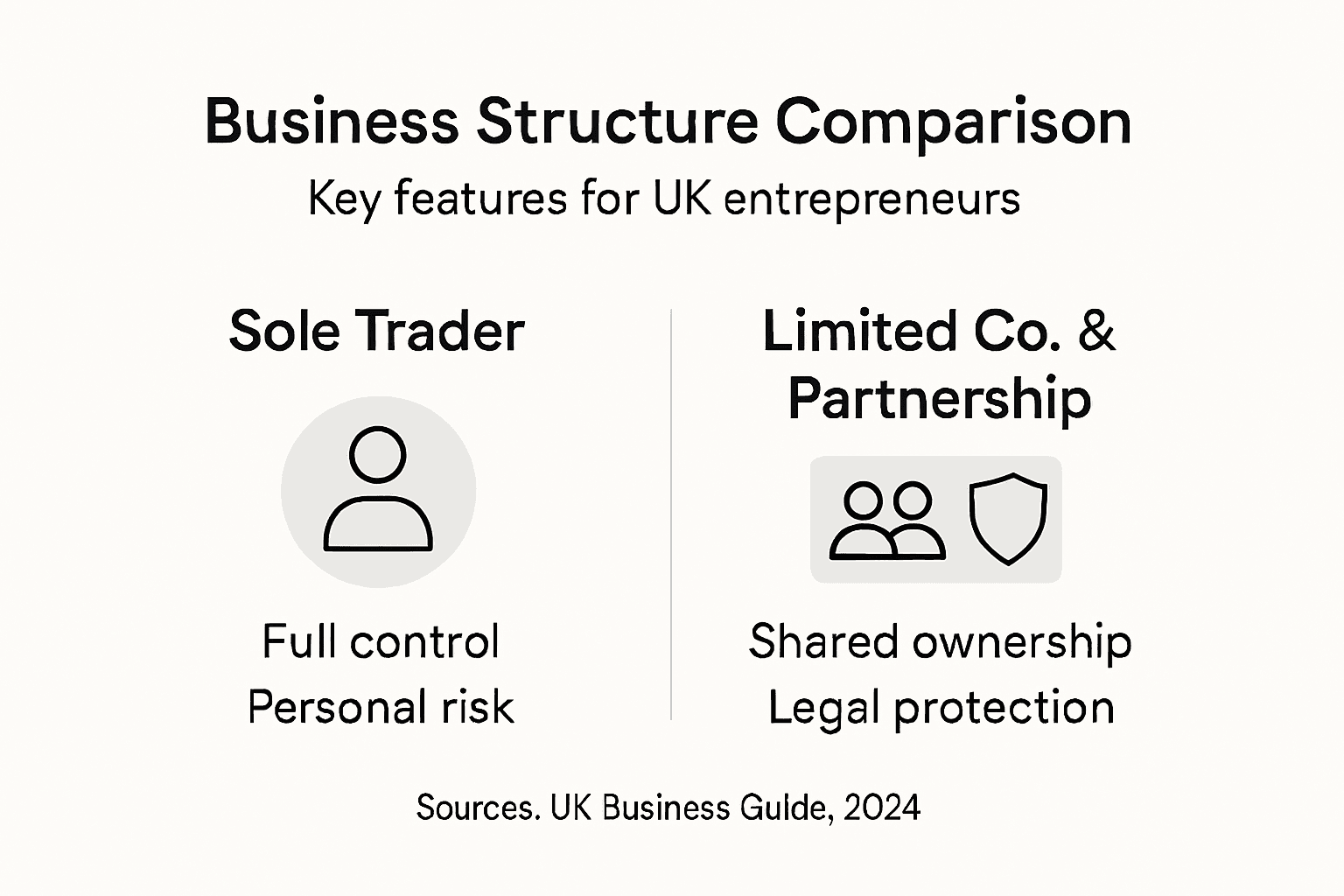
Partnerships introduce another layer of complexity. These structures involve shared ownership and responsibilities/13%3A_Forms_of_Business_Organizations/13.01%3A_Sole_Proprietorships_and_Partnerships) between two or more individuals. Depending on the partnership type, liability and decision-making can be distributed differently, providing more collaborative business opportunities compared to sole trader status.
To help clarify business structure choices in the UK, see this comparative table:
| Feature | Sole Trader | Limited Company | Partnership |
|---|---|---|---|
| Legal Identity | Not separate from owner | Distinct legal entity | Varies with partnership type |
| Personal Liability | Unlimited; owner’s assets at risk | Limited to shares held | Shared; varies by structure |
| Tax Treatment | Personal income tax on profits | Corporation tax, possible dividends | Shared income, taxed individually |
| Funding Opportunities | Mostly personal or bank loans | More options, including investors | May pool partner resources |
| Suitability | Low-risk, simple businesses | Growing or high-risk operations | Jointly-owned ventures |
Pro tip: Consult a professional accountant to conduct a comprehensive analysis of which business structure aligns best with your specific financial goals and operational requirements.
Who sole trader suits best and when to reconsider
Small business entrepreneurs must carefully evaluate whether sole trader status matches their specific operational needs and future growth ambitions. The structure offers unique advantages for certain professional profiles and business models.
Sole trader status is ideally suited for:
- Freelance professionals
- Independent contractors
- Small service providers
- Tradespeople with minimal overhead
- Single-person consultancy businesses
- Low-risk service-based operations
- Professionals seeking immediate business launch
The ideal candidate for sole trader status typically operates in sectors with low financial risk and manageable business complexity. Professionals like graphic designers, writers, photographers, and independent consultants often find this structure perfectly aligned with their operational requirements.
Business complexity and financial risks should trigger serious reconsideration of the sole trader model. Entrepreneurs should contemplate transitioning when experiencing significant growth, encountering substantial legal risks, or requiring more sophisticated financial structures. Limited companies become more attractive when annual profits exceed £30,000, potential legal liabilities increase, or external investment becomes necessary.
The following table summarises when sole trader status is most suitable versus when to consider switching:
| Situation | Best Fit: Sole Trader | Consider Changing Structure |
|---|---|---|
| Early-stage, simple operations | Strongly recommended | Rarely advantageous |
| Rapid growth or rising revenue | May become limiting | Switch for better scalability |
| Significant legal or financial risk | Limited protection offered | Limited company safer |
| Seeking external investment | Flexible but narrow access | Company structure preferred |
Pro tip: Regularly review your business structure annually, assessing whether your current model still serves your evolving entrepreneurial goals and financial landscape.
Navigate Sole Trader Success with Expert Support from KefiHub
Understanding the challenges of sole trader status such as unlimited personal liability, tax obligations and limited funding options can feel overwhelming. Whether you are launching a small service or managing rapid growth, recognising when to maintain your sole trader model or consider alternatives is crucial. Avoid costly mistakes by accessing clear guidance on managing your legal responsibilities and maximising your business flexibility.
Take control of your entrepreneurial journey today by visiting KefiHub for expert insights tailored to UK sole traders. Explore practical advice on registering properly, meeting tax deadlines and deciding if a limited company might better suit your evolving needs. Don’t wait until risks escalate. Start making informed decisions now at KefiHub, your trusted source for professional business solutions in the United Kingdom.
Frequently Asked Questions
What are the key benefits of choosing sole trader status?
Sole trader status offers several advantages, including complete control over business decisions, full retention of profits, minimal start-up costs, and operational flexibility, making it an attractive option for many entrepreneurs.
What are the risks associated with being a sole trader?
The primary risks include unlimited personal liability for business debts, potentially higher personal tax burdens, and limited access to external funding. This means your personal assets could be at risk if the business encounters financial difficulties.
How does sole trader status differ from a limited company?
Sole traders have unlimited personal liability, meaning business debts can impact personal assets, whereas limited companies provide legal protection separating personal and business finances. Additionally, sole traders face simpler administrative requirements than limited companies.
Who is sole trader status best suited for?
Sole trader status is ideal for freelance professionals, small service providers, tradespeople, and low-risk service-based operations. It works best in sectors where there is minimal financial risk and manageable business complexity.
Recommended
- Why Form a Limited Company in the UK? – Kefihub
- 7 Key Types of Business Structures for UK Small Firms – Kefihub
- Why Choose Limited Company? Key Benefits Explained – Kefihub
- 7 Types of Business Models for UK Service Providers – Kefihub
- How to Set Up Business Finances for Success in the UK