


Too many British small business owners worry that making the leap to a limited company is only for big corporations or experts. In fact, more than 95 percent of incorporated businesses in the United Kingdom have fewer than 50 employees. Getting the facts straight on limited company status, legal responsibilities, and tax advantages helps British entrepreneurs avoid costly misconceptions and unlock genuine risk protection. This guide clears up confusion so you can approach incorporation with confidence and clarity.
Table of Contents
- Defining A Limited Company And Common Misconceptions
- Key Types Of Limited Companies In The UK
- Main Features And How Limited Companies Operate
- Legal Responsibilities And Company Director Duties
- Liability, Tax Advantages, And Financial Impact
- Comparing Limited Companies With Sole Traders
Key Takeaways
| Point | Details |
|---|---|
| Understanding Limited Companies | Limited companies provide legal protection by separating personal and business assets, which is essential for safeguarding individual wealth. |
| Types of Limited Companies | There are three main types: Private Limited by Shares, Private Limited by Guarantee, and Public Limited Company, each serving different purposes and liability structures. |
| Operational Governance | Limited companies are governed by strict regulations requiring financial transparency and accountability from directors, enhancing business integrity. |
| Tax and Liability Advantages | Limited companies offer lower tax rates and shield personal assets from business liabilities, making them a more secure and potentially profitable option than sole traders. |
Defining a Limited Company and Common Misconceptions
A limited company represents a specific legal business structure where company shareholders’ financial liability is restricted to their investment. Unlike other business models, this approach provides crucial protection for business owners by legally separating personal and business assets. Companies Act 2006 establishes the comprehensive framework defining how these entities operate in the United Kingdom.
Understanding the fundamental characteristics of limited companies is essential for small business owners. These entities can be structured in two primary ways: companies limited by shares and companies limited by guarantee. In a share-limited company, shareholders’ liability is capped at the nominal value of their shares, which means their personal wealth remains protected if the business encounters financial difficulties. Alternatively, companies limited by guarantee are typically used by non-profit organisations, where members pledge a predetermined amount towards the company’s debts if it becomes insolvent.
Common misconceptions often arise regarding the nature of limited companies. Many entrepreneurs mistakenly believe that forming a limited company is overly complex or exclusively suitable for large enterprises. In reality, limited company structures are accessible and beneficial for businesses of all sizes, offering significant advantages such as enhanced credibility, potential tax efficiencies, and robust legal protections. Small business owners can leverage these structures to separate personal and professional financial risks while presenting a more professional image to potential clients and investors.
Pro tip: Before registering a limited company, consult with an accountant or legal professional to understand the specific registration requirements and potential tax implications for your unique business circumstances.
Key Types of Limited Companies in the UK
In the United Kingdom, limited companies are structured into three primary categories, each offering distinct characteristics and operational frameworks. The most prevalent form is the Private Company Limited by Shares (Ltd), which represents the backbone of small to medium-sized business operations. Legal entity types in the UK provide entrepreneurs with flexible business structures tailored to specific organisational needs.
Private companies limited by shares are characterised by shareholders whose financial liability is restricted to the nominal value of their shares. This structure allows business owners to protect personal assets while maintaining a professional corporate identity. In contrast, Private Companies Limited by Guarantee operate differently, typically used by non-profit organisations, charities, and social enterprises. Members of these companies pledge a predetermined guarantee amount, which becomes payable if the organisation is wound up, providing a unique mechanism for community-focused entities.
The third category, Public Limited Companies (PLCs), represent the most complex and regulated business structure. These companies can offer shares to the public through stock exchanges, requiring a minimum share capital of £50,000 and adhering to more stringent regulatory requirements. Limited company structures in the UK offer businesses a robust legal framework that balances operational flexibility with investor protection, enabling companies to scale and attract external investment while maintaining clear financial boundaries.
Pro tip: Consult with a qualified accountant or legal professional to determine the most appropriate limited company structure for your specific business goals and operational requirements.
Here’s a summary of the key distinctions between the main types of limited companies in the UK:
| Type of Company | Purpose & Typical Use | Liability Structure | Minimum Capital Requirement |
|---|---|---|---|
| Private Limited by Shares (Ltd) | Commercial businesses | Shareholder liability limited to shares | No minimum |
| Private Limited by Guarantee | Non-profit and charities | Member guarantee liability | No minimum |
| Public Limited Company (PLC) | Large, publicly traded companies | Shareholder liability limited to shares | £50,000 minimum |
Main Features and How Limited Companies Operate
Limited companies in the United Kingdom are governed by a sophisticated legal framework that establishes them as distinct legal entities separate from their owners. United Kingdom company law provides a comprehensive structure defining how these businesses function, ensuring transparency, accountability, and protection for both shareholders and stakeholders.

The operational mechanism of limited companies centres on a clear separation between ownership and management. Shareholders invest capital by purchasing shares, which determine their financial stake and voting rights, while directors manage day-to-day business operations. This structure allows for professional management and enables businesses to raise capital through share issuance. Critically, the limited liability principle protects shareholders by restricting their financial risk to the amount they have invested, preventing personal assets from being seized in case of business failure.
Corporate governance in limited companies involves several mandatory requirements that ensure financial accountability and regulatory compliance. Companies must maintain accurate financial records, file annual accounts with Companies House, and conduct regular shareholder meetings. Directors have legal obligations to act in the company’s best interests, maintain proper accounting records, and submit annual returns. These requirements create a robust framework that promotes business transparency and provides stakeholders with clear insights into the company’s financial health and operational performance.
Pro tip: Maintain meticulous financial documentation and consider engaging a professional accountant to help navigate the complex reporting requirements for limited companies.
Legal Responsibilities and Company Director Duties
Company directors in the United Kingdom operate under a complex set of legal obligations that define their professional conduct and responsibilities. Directors’ duties in the United Kingdom are comprehensively outlined in the Companies Act 2006, establishing a robust framework of legal and ethical expectations that govern corporate leadership.
The core legal responsibilities of directors encompass several critical dimensions. Directors must act within the company’s constitutional powers, promoting the organisation’s success while demonstrating independent judgment. This includes maintaining a duty of care that requires directors to exercise reasonable skill, diligence, and professional competence in their decision-making processes. They are legally obligated to avoid conflicts of interest, refusing any third-party benefits that might compromise their independent judgment or the company’s best interests.
Potential consequences for breaching these duties can be severe, ranging from financial penalties to disqualification from directorship. Directors must maintain transparent financial records, ensure compliance with regulatory requirements, and act in a manner that protects the interests of shareholders, employees, and other stakeholders. This includes making informed decisions, conducting regular board meetings, filing accurate annual returns, and maintaining comprehensive documentation of the company’s financial and operational activities. The legal framework demands not just compliance, but a proactive approach to corporate governance that demonstrates integrity, accountability, and strategic leadership.
Pro tip: Regularly update your understanding of director responsibilities by attending professional development courses and consulting with legal professionals who specialise in corporate governance.
Liability, Tax Advantages, and Financial Impact
Forming a limited company in the United Kingdom offers significant financial advantages through a robust liability protection mechanism that shields business owners from personal financial risk. Limited liability principles ensure that shareholders are only responsible for the amount they have invested, creating a critical financial safety net for entrepreneurs and investors.
The tax landscape for limited companies presents substantial benefits compared to other business structures. According to current UK tax regulations, companies can benefit from flexible Corporation Tax rates that vary based on profit levels. As of 2025, the main Corporation Tax rate is 25% for profits exceeding £250,000, with a more favourable small profits rate of 19% applicable to companies earning under £50,000. This graduated tax structure allows small businesses to retain more of their earnings and strategically reinvest in growth, providing a financial advantage over sole trader arrangements.
Beyond tax considerations, limited companies offer enhanced financial flexibility and credibility. The ability to retain profits within the business, defer personal tax liabilities, and demonstrate a more professional business structure can attract investors, secure better financing terms, and create opportunities for strategic expansion. The separation of personal and business finances provides additional layers of financial protection, enabling business owners to manage risk more effectively and build a more resilient commercial entity.
Pro tip: Consult with a qualified accountant to develop a tax-efficient strategy that maximises your limited company’s financial potential and aligns with your specific business goals.
Comparing Limited Companies with Sole Traders
Navigating the business landscape in the United Kingdom requires understanding the fundamental differences between limited companies and sole traders. Companies Act 2006 establishes the legal framework that distinguishes these two business structures, each offering unique advantages and challenges for entrepreneurs.
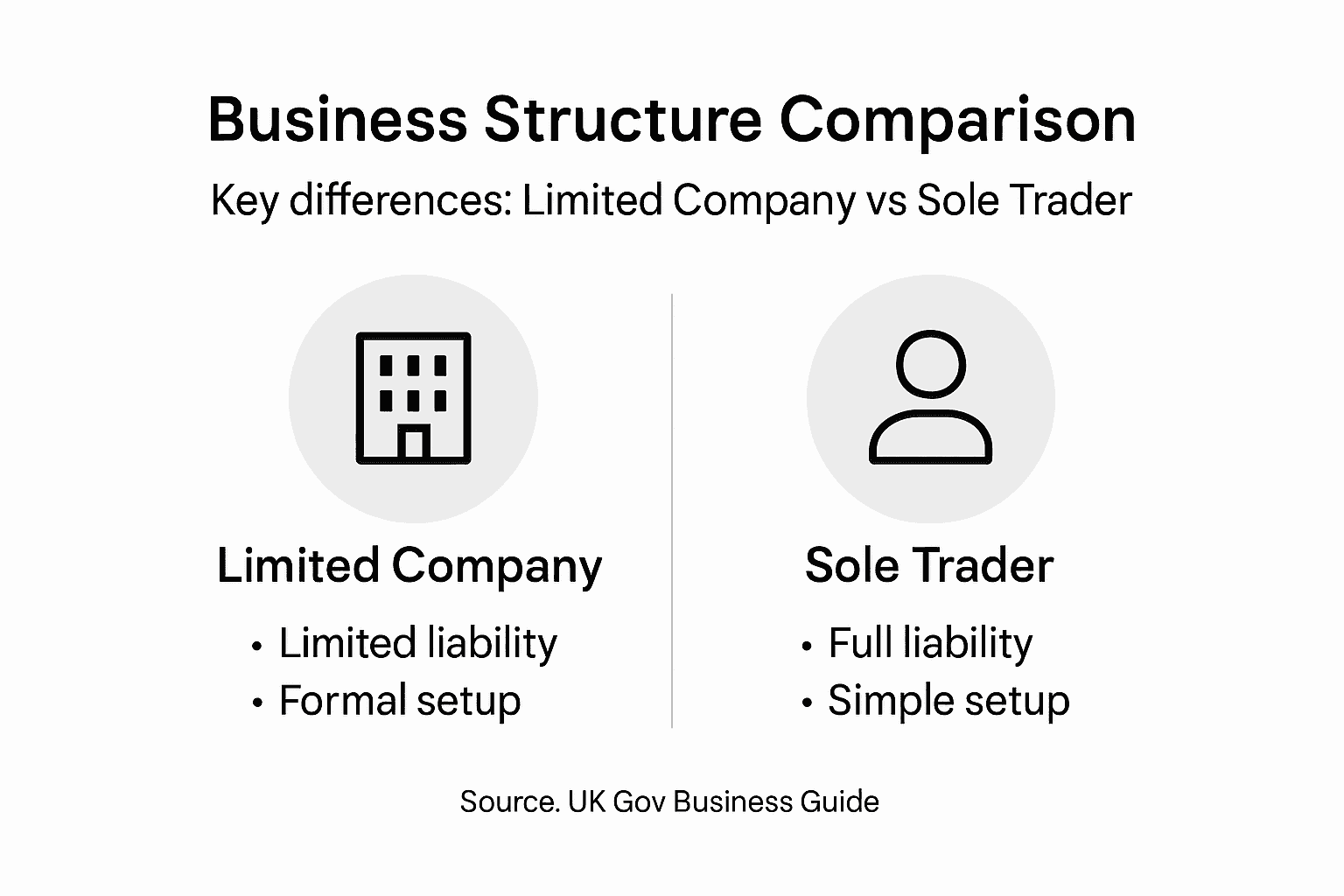
The most critical distinction lies in personal liability. Sole traders operate as individuals, which means they are personally responsible for all business debts and legal claims. This unlimited liability exposes personal assets like homes and savings to potential business risks. In stark contrast, limited companies create a legal separation between the business and its owners, protecting shareholders’ personal wealth. If a limited company encounters financial difficulties, shareholders’ risk is typically restricted to their initial investment, providing a crucial financial safety net for business owners.
Tax and administrative considerations further differentiate these business models. Sole traders experience a simpler administrative process with minimal reporting requirements and direct tax calculations based on personal income. Limited companies, however, face more complex regulatory obligations, including mandatory annual accounts filing, corporation tax returns, and potential payroll responsibilities. Despite this increased complexity, limited companies often benefit from more tax-efficient strategies. They can retain profits within the business, potentially pay lower overall tax rates, and offer more sophisticated options for managing personal income through director salaries and dividends. These financial flexibilities make limited companies increasingly attractive for businesses with higher turnover or significant growth potential.
Pro tip: Consult a professional accountant to analyse your specific business circumstances and determine whether a sole trader or limited company structure best suits your financial and operational goals.
Below is a concise comparison of limited companies and sole traders to highlight operational advantages:
| Aspect | Limited Company | Sole Trader |
|---|---|---|
| Personal Liability | Restricted to investment amount | Unlimited, includes personal assets |
| Tax Arrangement | Corporation Tax and dividends | Personal Income Tax only |
| Regulatory Burden | Annual accounts and returns filed | Minimal, less administrative work |
| Business Credibility | Higher with professional image | Often viewed as less formal |
Discover How Forming a Limited Company Can Transform Your Business
Understanding the importance of limited liability and the benefits of a clear legal structure can be overwhelming for many entrepreneurs starting their journey in the United Kingdom. If you are concerned about protecting your personal assets, navigating complex tax advantages, or ensuring compliance with company director responsibilities, you are not alone. The challenge lies in making informed decisions that safeguard your future while enabling your business to grow confidently.

At KefiHub, we specialise in delivering clear, practical guidance tailored to UK small business owners who want to unlock the full potential of limited companies. Our expert insights help you navigate the difference between sole trader and limited company structures, clarify your tax advantages, and manage your legal obligations without confusion. Take the next step today and visit KefiHub to access trusted information, real-world advice and support designed for your unique business needs. Discover how a limited company structure can offer you peace of mind and financial security by exploring Why Form a Limited Company in the UK? now.
Frequently Asked Questions
What are the benefits of forming a limited company?
Forming a limited company offers benefits such as limited liability protection for personal assets, enhanced credibility with clients and investors, and potential tax efficiencies through various structures.
How does limited liability protect shareholders?
Limited liability ensures that shareholders’ financial risk is capped to the amount they have invested in the company, meaning personal assets are generally safe from the company’s debts and legal claims.
What are the main types of limited companies?
The main types of limited companies are Private Companies Limited by Shares (Ltd), Private Companies Limited by Guarantee, and Public Limited Companies (PLC), each with different liability structures and purposes.
What legal responsibilities do company directors have?
Company directors have legal obligations outlined in the Companies Act 2006, including acting in the company’s best interests, maintaining accurate financial records, and ensuring compliance with regulatory requirements.
Recommended
- Company Formation Explained: Key Steps for UK SMEs – Kefihub
- Company Formation Explained: Key Steps for UK SMEs – Kefihub
- Why Register a UK Company – Legal and Financial Impact – Kefihub
- Why Register a UK Company – Legal and Financial Impact – Kefihub