


Many UK employers assume employment law is stable and slow to change. That assumption is now costly. Major reforms are being phased in through 2026 and 2027, including day-one rights for statutory sick pay and a dramatically shorter unfair dismissal qualifying period. Miss these changes and you risk tribunal claims, financial penalties, and reputational damage. This guide decodes what employment law actually covers, explains the 2026 to 2027 essentials, and gives you the practical steps to stay on the right side of the law.
Table of Contents
- What is employment law?
- Core employment rights and obligations in the UK
- 2026 to 2027 employment law reforms: What’s changing?
- Employment status and why it matters
- Practical steps for compliance: Small business essentials
- Key challenges and expert insights for UK employers
- Guidance and resources: Next steps for your business
- Frequently asked questions
Key Takeaways
| Point | Details |
|---|---|
| Know your obligations | Every UK employer must understand current and upcoming employment law requirements for legal compliance. |
| Track law reforms | Major changes in 2026-2027 mean employment policies must be reviewed and updated regularly. |
| Correctly classify staff | Accurately distinguishing staff as employees, workers, or self-employed is essential to apply the right legal rights. |
| Document everything | Written statements, contracts, and policy updates help prove compliance and reduce tribunal risks. |
| Use compliance resources | Checklists and expert guides help SMEs avoid common employment law traps and build robust HR systems. |
What is employment law?
Employment law governs the rights and responsibilities of employers and workers across every stage of the working relationship, from recruitment through to dismissal. It is not a single piece of legislation. Instead, it draws from multiple sources, and understanding those sources is the first step toward genuine legal compliance basics.
The three pillars you need to know are the Employment Rights Act 1996, Equality Act 2010, and Working Time Regulations 1998. Together, these statutes set minimum standards, protect against unfair treatment, and define contractual obligations for both sides of the employment relationship. Alongside statute, case law from employment tribunals shapes how rules are interpreted in practice.
Employment law is not just about protecting workers. It also gives employers a clear framework for managing staff fairly, reducing disputes, and building a stable workforce.
For small business owners, gaps in understanding can be particularly damaging. A missed obligation, such as failing to issue a written contract or mishandling a disciplinary process, can quickly escalate into a formal claim. Exploring employment law for small businesses is a practical starting point for anyone building or reviewing their HR foundations.
Key areas covered by employment law include:
- Recruitment and pre-employment checks
- Employment contracts and written statements
- Pay, working hours, and leave entitlements
- Discrimination and equality in the workplace
- Disciplinary procedures and dismissal
- Redundancy and business transfers
Core employment rights and obligations in the UK
Now that the legal framework is clear, let us break down the concrete day-to-day rights and rules you need to know. These are not optional extras. They are legal minimums, and enforcement is tightening.
Core rights include written statements, minimum wage, annual leave, working hour limits, anti-discrimination, and unfair dismissal protection. Here is a summary of the key provisions:

| Right or obligation | Current standard (2026) |
|---|---|
| Written statement of particulars | Must be provided on day one |
| National Minimum Wage (21+) | £12.71 per hour from April 2026 |
| Annual leave | 5.6 weeks paid leave per year |
| Working time limit | 48-hour average per week (opt-out available) |
| Unfair dismissal qualifying period | 2 years (reducing to 6 months in January 2027) |
| Protected characteristics | 9 under the Equality Act 2010 |
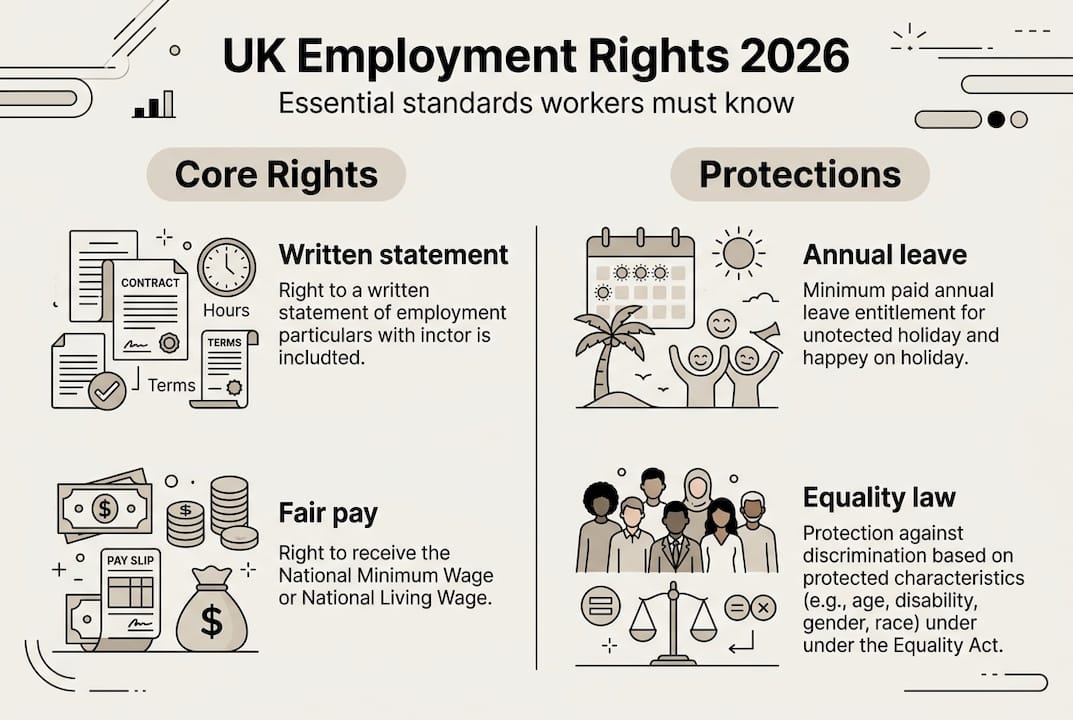
The nine protected characteristics under the Equality Act are age, disability, gender reassignment, marriage and civil partnership, pregnancy and maternity, race, religion or belief, sex, and sexual orientation. Discrimination on any of these grounds is unlawful at every stage of employment.
Pro Tip: Review your employment contracts and staff handbook against the current National Minimum Wage rate every April. An outdated rate is one of the most common and easily avoided compliance failures for SMEs. Check our HR compliance tips for a structured approach.
For a structured review of your obligations, an employment compliance checklist can help you identify gaps before they become claims.
2026 to 2027 employment law reforms: What’s changing?
While the fundamentals are crucial, new reforms mean you must be proactive. The Employment Rights Act 2025 is the most significant overhaul of UK employment law in a generation, and its provisions are being introduced in phases.
Phased reforms include day-one sick pay, family leave changes, a shorter unfair dismissal period, and restrictions on zero-hours contracts. Here is what is changing and when:
| Reform | Previous rule | New rule |
|---|---|---|
| Statutory Sick Pay | 3 waiting days before payment | Day-one entitlement from April 2026 |
| Unfair dismissal qualifying period | 2 years’ service | 6 months from January 2027 |
| Zero-hours contracts | Largely unrestricted | Exploitative arrangements restricted |
| Fire and rehire | Common practice | Significantly limited |
| Harassment duty | Reactive obligation | Proactive prevention duty |
The key changes to act on now are:
- Update your sickness absence policy to reflect day-one SSP entitlement. Waiting day clauses are no longer valid.
- Review your probationary period processes because from January 2027, employees can bring unfair dismissal claims after just six months.
- Audit any zero-hours arrangements to ensure they do not fall foul of the new restrictions on exploitative contracts.
- Strengthen your anti-harassment policies to demonstrate proactive prevention, not just reactive response.
- Prepare for the Fair Work Agency, which will take an active enforcement role from April 2026 onward.
The introduction of the Fair Work Agency is a significant shift. Enforcement is moving from a reactive, claim-driven model to active checks and investigations. This means you cannot rely on no one complaining. Compliance must be built into your processes. Reviewing how you update policies for legal changes is now a business-critical task, not an administrative one.
Employment status and why it matters
New duties mean nothing if you do not know who they actually apply to. Employment status is one of the most misunderstood areas of UK employment law, and the consequences of getting it wrong are serious.
There are three categories:
- Employees enjoy the full suite of legal protections, including unfair dismissal rights, statutory sick pay, and parental leave.
- Workers receive fewer protections but are still entitled to minimum wage, holiday pay, and protection from discrimination.
- Self-employed individuals have only the rights set out in their contracts, with no statutory employment protections.
Tribunals assess employment status based on the substance of the working relationship, not the label on the contract. Control, mutuality of obligation, and personal service are the key tests.
This matters enormously in practice. Gig economy cases and IR35 disputes have repeatedly shown that calling someone a contractor does not make them one in law. If a tribunal finds misclassification, you could face back pay for holiday and sick pay, unpaid pension contributions, and significant awards. Knowing how to hire legally from the outset protects you from these risks.
Practical steps for compliance: Small business essentials
Having clarified employment status, here is how you can turn compliance into a manageable routine with the latest reforms in mind.
Small business owners must provide a written statement on day one, comply with minimum wage, update policies, and follow ACAS codes to avoid financial penalties. Follow these steps:
- Issue a written statement of particulars on day one for every new starter, covering pay, hours, holiday, and notice periods.
- Check wage rates every April and update payroll before the new rate takes effect.
- Review contracts and policies annually, particularly in light of the 2026 to 2027 reforms.
- Train line managers on disciplinary and grievance procedures, following the ACAS code of practice.
- Document every significant decision, from performance conversations to redundancy consultations.
Common mistakes to avoid:
- Issuing contracts days or weeks after a start date
- Using outdated wage rates in offer letters
- Handling disciplinary matters informally without written records
- Failing to update policies after legislative changes
- Overlooking the right to request flexible working from day one
Pro Tip: Set a compliance calendar with annual review dates for wage rates, policies, and contracts. Pair this with ACAS guidance and you will have a reliable system that keeps pace with legislative change.
SMEs should prioritise compliance checklists as enforcement shifts from reactive to proactive in 2026. Explore small business law essentials and employment obligations for SMEs for further practical guidance.
Key challenges and expert insights for UK employers
While practical steps help, expert input and a strategic approach are increasingly important in the new landscape. The 2025 reforms are widely seen as pro-worker, and that creates real operational challenges for smaller employers.
Reforms are seen as pro-worker, but SMEs warn of higher administration and absence costs, with tribunals continuing to emphasise substance over form in worker disputes. The key challenges employers are raising include:
- Higher costs from day-one SSP entitlement, particularly for businesses with high staff turnover
- Increased administrative burden from more robust onboarding and documentation requirements
- Greater exposure to unfair dismissal claims during probationary periods from January 2027
- The need to invest in manager training to handle disputes correctly from the outset
The shift to proactive enforcement means that waiting for a claim before reviewing your practices is no longer a viable strategy. The Fair Work Agency will not wait for complaints.
The most effective approach is to treat compliance as an ongoing business function rather than a one-off task. Document decisions clearly, keep policies current, and ensure transparency with your workforce. Explore legal compliance for professionals and consider optimising HR for compliance as part of your broader business strategy.
Guidance and resources: Next steps for your business
If you are ready to act on what you have read, KefiHub has the resources to support you. Navigating employment law reforms is far more manageable when you have clear, practical guidance at your fingertips.
Explore our small business compliance guide for step-by-step checklists tailored to UK SMEs, or follow our business growth roadmap to build a legally sound foundation alongside your commercial ambitions. If you are facing a specific legal challenge, understanding the role of solicitors in business can help you decide when professional legal advice is the right investment. KefiHub brings together expert commentary, practical tools, and real-world guidance so that UK professionals and small business owners can make confident, informed decisions at every stage.
Frequently asked questions
Who enforces employment law in the UK?
From April 2026, the newly established Fair Work Agency takes a leading enforcement role, working alongside existing employment tribunals to conduct active checks rather than waiting for complaints.
What counts as an ‘employee’ for legal protection?
Employment tribunals decide status by examining the reality of the working relationship, considering factors such as control, mutuality of obligation, and personal service, rather than relying on contract labels alone.
What are the penalties for failing employment law compliance?
Businesses can face uncapped tribunal awards, back pay obligations, and fines. From 2027, stricter enforcement rules mean the financial exposure for non-compliance increases significantly.
How often is UK employment law updated?
Employment law is updated regularly, with major reforms being phased in throughout 2026 and 2027 under the Employment Rights Act 2025, making annual policy reviews essential.
What should small business owners do to stay compliant?
Use structured compliance checklists, review contracts and policies at least annually, and follow ACAS and government guidance to keep pace with legislative changes as enforcement becomes more proactive.
Recommended
- UK Employment Law – What Every Small Business Needs – Kefihub
- How to Hire Staff UK: Legal Steps for Small Businesses – Kefihub
- Legal Compliance: Why It Matters for UK Professionals – Kefihub