


Over 50 percent of British small business owners report confusion over legal requirements when hiring their first employee. Getting staffing decisions right can shape your company’s future, yet one misstep increases risk of costly fines or wasted investment. This guide will help British entrepreneurs navigate each step clearly, offering practical advice you can actually use for legal compliance and smarter recruitment.
Table of Contents
- Step 1: Assess Your Hiring Needs
- Step 2: Draft Compliant Job Descriptions
- Step 3: Conduct Fair Recruitment Processes
- Step 4: Verify Right To Work Documentation
- Step 5: Issue Legal Contracts And Onboarding
Quick Summary
| Key Point | Explanation |
|---|---|
| 1. Assess your hiring needs thoroughly | Evaluate workload and operational gaps to determine if hiring is necessary and define the role accurately. |
| 2. Create compliant job descriptions | Ensure job descriptions outline responsibilities clearly and comply with employment regulations to attract suitable candidates. |
| 3. Implement fair recruitment processes | Establish an objective recruitment process with standardised methods to avoid bias and ensure legal compliance. |
| 4. Verify right to work documentation | Conduct mandatory checks on each new hire’s work eligibility to avoid severe legal penalties for non-compliance. |
| 5. Develop structured onboarding processes | Create a comprehensive onboarding programme that sets clear expectations and integrates the new employee effectively into the workplace. |
Step 1: Assess your hiring needs
Deciding to bring your first employee onboard is an exciting milestone for any small business. Your goal in this step is to thoroughly evaluate whether you genuinely need to hire someone and precisely define what that role will entail.
Start by conducting a detailed analysis of your current workload and operational gaps. Comprehensive hiring budgeting requires more than just considering salary expectations. You need to map out the specific tasks that are overwhelming your current capacity and determine whether these responsibilities justify a permanent hire. Consider if the work could be effectively managed through alternative arrangements like part time employment, contractor agreements, or freelance support.
Break down the potential role by identifying exact skills required and expected outputs. Calculate the financial implications beyond basic salary including National Insurance contributions, pension requirements, workspace provisions, potential training investments, and recruitment costs. Defining role requirements helps you create a precise job description and understand the true investment needed.
Top recommendation: Before committing to a full time employee, trial your staffing needs by using short term contracts or project based hires to validate the actual workload and skill requirements.
Here’s a summary of key considerations when deciding hiring arrangements:
| Hiring Arrangement | Typical Use Case | Key Benefits | Main Drawback |
|---|---|---|---|
| Full time employee | Ongoing, critical workload | Stability, long-term commitment | Higher costs, complex legal |
| Part time employee | Variable or reduced workload | Flexibility, cost savings | Limited hours, less coverage |
| Contractor/Freelancer | Short-term/task-based projects | Specialised skills, no PAYE | Less integration, variable availability |
Step 2: Draft compliant job descriptions
Creating a precise and legally sound job description is crucial when bringing new talent into your small business. Your goal is to develop a document that clearly communicates role expectations while ensuring full compliance with employment regulations.

Start by structuring a comprehensive description that outlines specific responsibilities, required skills, and performance expectations. Drafting legally compliant descriptions demands careful attention to language that avoids potential discrimination. Focus on essential job functions and qualifications that directly relate to the role’s core requirements. Be explicit about duties, reporting lines, working conditions, and necessary qualifications without introducing unnecessary barriers that might exclude candidates with protected characteristics.
Ensure your description aligns with the Equality Act 2010 guidelines. This means crafting language that is neutral, objective, and focuses on the skills and capabilities needed to perform the job effectively. Consider potential flexible working arrangements and be open to reasonable adjustments for candidates with disabilities. Your job description should serve as a clear roadmap for potential employees while demonstrating your commitment to fair and inclusive recruitment practices.
Expert suggestion: Have an independent third party review your job description to ensure it meets legal standards and removes any unintentional bias before publishing.
Step 3: Conduct fair recruitment processes
Recruitment is more than finding the right candidate it is about creating an equitable and transparent selection journey that protects both your business and potential employees. Your primary objective is to build a selection process that is objective, consistent, and legally compliant.
Fair recruitment practices demand meticulous attention to detail at every stage. Begin by designing a clear advertising strategy that reaches diverse candidate pools using inclusive language. Develop standardised application forms and interview questions that focus strictly on job related skills and qualifications. Each candidate should experience the same assessment criteria ensuring no individual faces unfair disadvantage. This means creating structured evaluation frameworks where every applicant is measured against predefined objective benchmarks that directly correlate with the role requirements.
Legal recruitment considerations require documenting each decision and maintaining transparent communication throughout the process. Implement consistent scoring methods during interviews and keep detailed records of candidate interactions. Pay particular attention to avoiding any questions that might inadvertently discriminate based on protected characteristics such as age, gender, disability, or ethnic background. Your recruitment process should reflect a commitment to equal opportunities and demonstrate professional integrity.
Expert recommendation: Create a standardised recruitment checklist that you follow systematically for every candidate to eliminate potential unconscious bias and ensure consistent evaluation.
Step 4: Verify right to work documentation
Verifying an employee’s right to work is a critical legal requirement that protects your business from potentially severe financial and criminal penalties. Your goal is to conduct thorough and fair documentation checks before an individual begins working for your organisation.
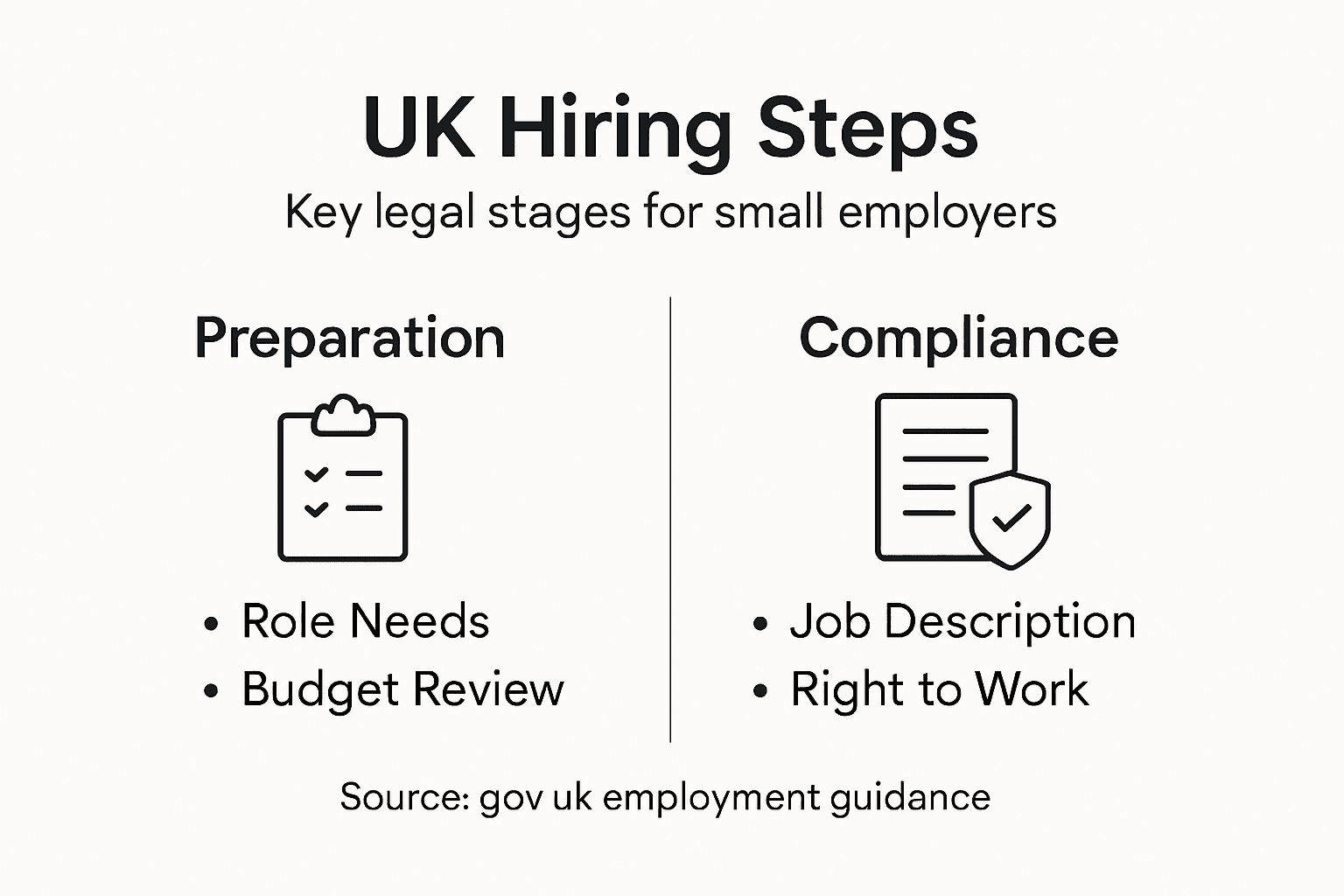
Right to work checks are mandatory for every new hire in the United Kingdom. You must review original documentation that confirms an individual’s legal status to work. This typically involves examining passports, biometric residence permits, or using the Home Office online verification service. Carefully inspect these documents before employment commences ensuring all original documents are genuine and current. Pay special attention to checking the validity of immigration status and work permissions for non British citizens.
Updated verification rules will require different approaches depending on an employee’s nationality. From February 2025 digital checks will become more prominent with specific protocols for British and Irish passport holders versus international workers. Maintain meticulous records of all verification checks dated and securely stored. Remember that penalties for non compliance can reach up to £60,000 per illegal worker and potentially include criminal prosecution.
Expert recommendation: Establish a consistent verification process with a dedicated checklist and set reminders to periodically recheck documentation for employees with time limited work permissions.
Step 5: Issue legal contracts and onboarding
Issuing legal contracts and creating a comprehensive onboarding process are critical steps in welcoming a new team member while protecting your business legally. Your primary objective is to establish clear expectations and integrate your new employee smoothly and professionally.
Effective employment contracts must specify precise details including job role, salary, working hours, holiday entitlement, and notice periods. These documents should be delivered before the employee’s first day and include essential policies covering data protection, health and safety, and confidentiality. Ensure your contract comprehensively outlines probation periods and performance expectations to establish a clear framework for the working relationship.
The onboarding process extends beyond paperwork into practical integration. Small business onboarding strategies involve registering for PAYE and pension auto-enrolment, preparing necessary equipment and system access, and planning initial training sessions. Create a structured welcome programme that helps your new employee understand your organisation’s culture, operational procedures, and their specific role responsibilities. This approach not only ensures legal compliance but also supports a positive start for your new team member.
This table outlines essential contract and onboarding elements for new hires:
| Aspect | Legal Requirement | Integration Benefit | Example Action |
|---|---|---|---|
| Employment contract | Clearly define terms | Sets expectations | Specify salary and duties |
| Data protection policy | Compliance with GDPR | Builds trust | Provide written privacy notice |
| Onboarding programme | Not legally mandated | Supports productivity | Schedule induction meeting |
Expert recommendation: Develop a standardised onboarding checklist that you can repeat consistently for each new hire to ensure no critical steps are overlooked during the integration process.
Make Hiring Simple and Legally Sound with KefiHub
Hiring your first employee in the United Kingdom is a critical moment that brings both opportunity and complexity. This article highlights how crucial it is to understand legal responsibilities such as right to work verification, drafting compliant job descriptions, and conducting fair recruitment. These steps can be daunting and overwhelming for small business owners trying to grow their teams with confidence and compliance.
At KefiHub, we recognise the challenges behind these vital legal and business decisions. Our Business Archives – KefiHub offer down-to-earth guidance and expert insights designed to help you master employment law essentials and streamline your hiring approach.
Take action now to ensure your hiring process is both efficient and legally robust. Explore our resources and expert commentary at KefiHub and start building your workforce on a solid foundation. For practical support across all your early-stage staffing challenges, visit the Introduction Archives – KefiHub and empower your small business with the confidence to hire right the first time.
Frequently Asked Questions
What are the first steps to assess my hiring needs in the UK?
Begin by analysing your current workload and identifying operational gaps. List the specific tasks that are overwhelming your capacity and determine if a permanent hire is justified or if alternative arrangements like part-time work could suffice.
How do I draft a legally compliant job description for a new employee?
Create a job description that outlines responsibilities, required skills, and performance expectations, ensuring it adheres to discrimination laws. Use neutral language that focuses on the essential functions of the job to attract a diverse range of candidates.
What should I include in a recruitment process to ensure fairness?
Establish a structured recruitment process that uses standardised application forms and interview questions based solely on job-related skills. Keep detailed records of candidate evaluations to maintain transparency and fairness throughout the selection journey.
How do I verify an applicant’s right to work in the UK?
Conduct mandatory checks by reviewing original documents that confirm an individual’s legal status to work, such as passports or biometric permits. Ensure all checks are completed before employment begins and keep records of each verification for compliance purposes.
What must be included in an employment contract for new hires?
An employment contract should specify job role, salary, working hours, holiday entitlement, and notice periods. Ensure that it also covers essential policies such as data protection and health and safety to establish clear expectations from the outset.
How can I create a successful onboarding process for new employees?
Develop a structured onboarding programme that includes essential training and introduces new hires to your organisational culture. Schedule activities like induction meetings and ensure all necessary equipment and system access is prepared before their first day.
Recommended
- Business Registration Step by Step for UK Owners – Kefihub
- Company Formation Explained: Key Steps for UK SMEs – Kefihub
- Why Build a Website: Boosting UK Small Businesses – Kefihub
- What Is Business Succession and Why It Matters – Kefihub