


Many UK small business owners believe a single form of intellectual property protection covers everything from their company logo to their marketing materials. This misconception can leave critical business assets vulnerable to copying or legal disputes. Trademarks and copyrights serve fundamentally different purposes under UK law, each protecting distinct aspects of your business. Understanding which protection applies to your brand identity versus your creative works ensures you secure the right legal safeguards. This guide clarifies the key differences between trademarks and copyrights, explains when to use each, and shows you practical steps to protect both your brand and original content effectively in 2026.
Table of Contents
- What Is Trademark Protection In The UK?
- Understanding Copyright In The UK: Scope And Protection
- Trademark Versus Copyright: Key Differences And When To Use Each
- How To Protect Your Brand And Creative Work Effectively In The UK
- How Kefihub Supports Your Business Growth And Legal Needs
Key takeaways
| Point | Details |
|---|---|
| Trademarks protect brand identity | They safeguard logos, names, and symbols that distinguish your business from competitors. |
| Copyright protects creative works | It covers original content like written materials, designs, photographs, and software code. |
| Different registration processes | Trademarks require UK IPO registration whilst copyright protection is automatic upon creation. |
| Both strengthen business assets | Understanding their distinct roles helps you avoid legal risks and build stronger IP foundations. |
What is trademark protection in the UK?
A trademark is a legal tool that protects the distinctive signs, symbols, words, or logos that identify your business and set it apart from competitors. Trademarks protect brand identifiers through registration with the UK Intellectual Property Office, giving you exclusive rights to use those marks in your industry. This protection prevents other businesses from using confusingly similar branding that could mislead your customers or dilute your reputation.
The UK recognises several types of marks eligible for trademark protection. Word marks protect company names, product names, and slogans. Logo marks safeguard visual designs and graphic elements. You can even register shapes, colours, sounds, or patterns if they distinctively identify your goods or services. The key requirement is that your mark must be capable of distinguishing your offerings from those of other traders.
Registering your trademark with the UK IPO provides substantial benefits beyond common law rights. Registration creates a public record of ownership, making enforcement much simpler. You gain the legal presumption of validity and exclusive rights to use the mark across the UK for the goods or services you specify. This protection lasts ten years and can be renewed indefinitely, providing long term security for your brand investment. Registration also allows you to use the ® symbol, signalling professional credibility to customers and deterring potential infringers.
Trademarks prevent competitors from adopting marks that create confusion in the marketplace. If another business uses a similar name or logo for related products, your registered trademark gives you grounds to challenge their use through legal action or negotiation. This protection is crucial for maintaining brand integrity and customer trust as your business grows.
Common business assets protected as trademarks include:
- Company names and trading names
- Product and service names
- Logos and brand symbols
- Marketing slogans and taglines
- Distinctive packaging designs
- Colour combinations unique to your brand
Pro Tip: Before finalising your branding, conduct thorough trademark searches through the UK IPO database to ensure your chosen marks do not infringe existing registrations. This simple step prevents costly rebranding and potential legal disputes down the line.
Understanding copyright in the UK: scope and protection
Copyright operates very differently from trademark protection. Whilst trademarks safeguard brand identity, copyright automatically protects original creative works the moment you create them in the UK. No registration, application, or fee is required. This automatic protection covers literary, artistic, musical, and dramatic works, giving creators exclusive rights to copy, distribute, adapt, and publicly perform their creations.

The scope of copyright is remarkably broad for business owners. Written content like blog posts, marketing copy, website text, and instruction manuals all qualify for protection. Software code receives copyright protection as a literary work. Photographs, illustrations, graphic designs, and architectural drawings are protected as artistic works. Even databases and compilations can be covered if they demonstrate sufficient originality in selection or arrangement.
Copyright differs fundamentally from trademark protection in both purpose and mechanism. Trademarks protect commercial identifiers that distinguish your business, requiring registration and focusing on preventing consumer confusion. Copyright protects the expression of ideas in creative works, arising automatically without formalities and preventing unauthorised copying or adaptation. You can hold both trademark and copyright in the same asset, such as a logo that functions as both brand identifier and original artistic work.
UK copyright typically lasts for the life of the creator plus 70 years, providing long term protection that far exceeds trademark renewal periods. During this time, you hold exclusive rights to reproduce the work, issue copies to the public, perform or show the work publicly, communicate it to the public, and create adaptations or derivative works. These rights allow you to control how others use your creative output and generate licensing revenue if you choose.
Common business materials protected by copyright include:
- Marketing brochures and sales materials
- Website content and blog articles
- Product photography and promotional images
- Software applications and code
- Training manuals and instructional videos
- Graphic designs and illustrations
Pro Tip: Always include copyright notices on your published materials and use written contracts with freelancers or employees to clarify IP ownership. Whilst not required for protection, these practices strengthen your position in enforcement situations and prevent disputes about who owns the work.
Trademark versus copyright: key differences and when to use each
Understanding when to rely on trademark protection versus copyright requires recognising their distinct legal frameworks and practical applications. The following comparison clarifies the essential differences between these two forms of intellectual property protection in the UK.
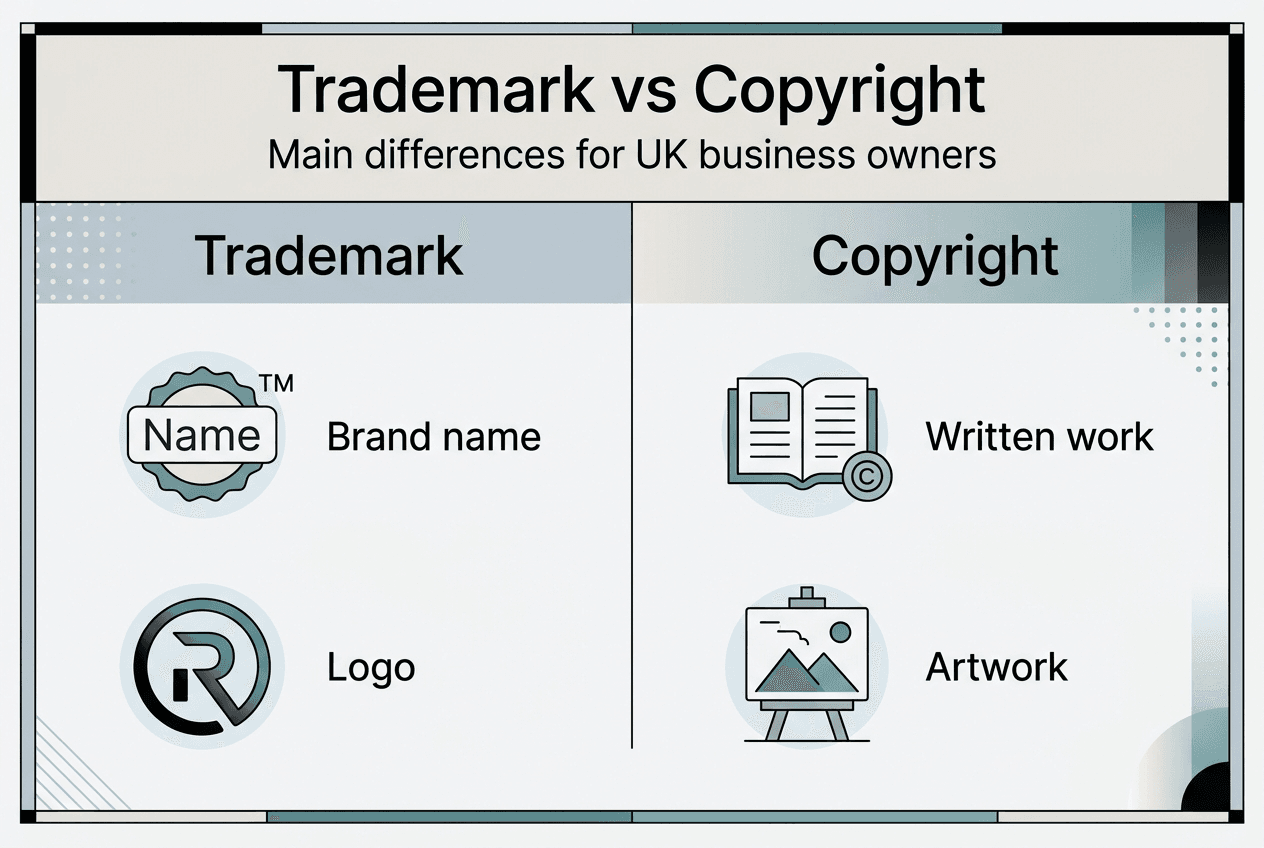
| Aspect | Trademark | Copyright |
|---|---|---|
| What it protects | Brand identifiers like names, logos, slogans, and symbols | Original creative works like text, images, music, and software |
| Registration requirement | Must register with UK IPO for full protection | Automatic upon creation, no registration needed |
| Duration | 10 years, renewable indefinitely | Life of creator plus 70 years |
| Primary purpose | Prevent consumer confusion and protect brand identity | Prevent unauthorised copying or adaptation of creative expression |
| Enforcement basis | Likelihood of confusion in the marketplace | Substantial copying of original work |
Trademarks and copyrights serve different legal functions and the choice between them depends on what you need to protect. Register a trademark when you want to secure exclusive rights to use specific branding elements in your industry. This applies to company names, product names, logos, and slogans that identify your business to customers. Trademark protection is essential for building brand recognition and preventing competitors from trading on your reputation.
Rely on copyright protection when you create original content or artistic works. This includes written materials, photographs, illustrations, software, and designs. Copyright automatically protects these works without registration, though maintaining clear records of creation dates and authorship strengthens your position if disputes arise. Copyright is particularly valuable for businesses that generate significant creative content or develop proprietary software.
Situations when each protection applies:
- Use trademark registration for your business name, logo, and product names to prevent competitors using similar branding
- Rely on copyright for your website content, marketing copy, product photography, and promotional videos
- Apply both protections to logos that function as brand identifiers and original artistic works
- Register trademarks for slogans and taglines that identify your business
- Use copyright for software code, mobile applications, and digital products
- Protect packaging designs with both trademark (distinctive trade dress) and copyright (original artwork)
Some business assets can receive both trademark and copyright protection simultaneously. A logo, for example, may be protected by copyright as an original artistic work and by trademark as a brand identifier. The copyright prevents others from copying the design itself, whilst the trademark prevents use of confusingly similar marks in commerce. Brand names, however, typically receive only trademark protection since they are not original creative works eligible for copyright.
For UK businesses, choosing the right protection strategy requires evaluating your assets and business model. Building a strong brand often requires trademark registration for core identity elements, whilst content heavy businesses benefit most from documenting copyright ownership and enforcing it against copiers. Many successful businesses maintain both forms of protection as complementary layers of legal security.
How to protect your brand and creative work effectively in the UK
Securing your intellectual property requires deliberate action beyond simply creating assets or choosing brand names. The trademark registration process with the UK Intellectual Property Office involves several clear steps that small business owners can navigate with proper preparation. Start by conducting comprehensive searches of existing trademarks to ensure your mark is available and distinctive. Use the UK IPO online database and consider searching company names registers and domain registrations to identify potential conflicts.
Once you confirm availability, register your trademark through the UK IPO by filing an application that specifies your mark and the classes of goods or services it will cover. The application fee starts at £170 for one class, with additional charges for multiple classes. The IPO examines your application to ensure it meets legal requirements and does not conflict with existing marks. If approved, your mark is published for opposition, allowing third parties to challenge it. Assuming no successful opposition, your trademark is registered and you receive a certificate of registration.
Using copyright effectively requires different practices since protection is automatic. Document your creation process by keeping dated drafts, design files, and correspondence that establish when you created the work and your authorship. Mark published materials with the copyright symbol ©, your name, and the year of first publication. Whilst not legally required for protection, these notices remind others of your rights and deter casual copying.
Monitoring and enforcing your intellectual property rights involves ongoing vigilance:
- Set up alerts for new trademark applications in your industry that might conflict with your marks.
- Regularly search online marketplaces, social media, and competitor websites for unauthorised use of your branding or content.
- Document any instances of potential infringement with screenshots, purchase records, and dates.
- Send cease and desist letters to infringers, clearly stating your rights and requesting they stop unauthorised use.
- Escalate to legal action through solicitors if informal resolution fails or infringement causes significant commercial harm.
- Renew trademark registrations before the ten year deadline to maintain continuous protection.
Pro Tip: Consult intellectual property solicitors or trademark attorneys before filing applications or pursuing enforcement actions. Professional guidance prevents procedural errors that could invalidate your rights and helps you develop cost effective strategies for protecting your most valuable assets.
Effective IP protection requires treating it as an ongoing business function rather than a one time task. Sustainable business growth depends on safeguarding the brand equity and creative assets you build over time. Regular audits of your IP portfolio ensure you identify new assets worth protecting and maintain existing registrations properly. As your business expands into new products, services, or markets, reassess whether additional trademark classes or registrations are needed.
Integrate IP considerations into employee contracts and freelancer agreements from the start. Standard contracts should include clauses assigning intellectual property rights to your business for any work created during employment or under commission. This prevents disputes about ownership and ensures you control the assets your business depends on. Similarly, building strong professional networks with other business owners can help you learn from their IP experiences and identify potential infringement issues earlier.
How Kefihub supports your business growth and legal needs
Protecting your intellectual property forms just one part of building a successful UK business. Understanding legal requirements, maintaining compliance, and accessing expert guidance across multiple domains strengthens your foundation for growth. Kefihub provides UK small business owners with practical resources that connect legal protections like trademarks and copyrights to broader business strategy and operational excellence.
Our platform offers detailed guides on business growth strategies that help you scale sustainably whilst protecting your brand and creative assets. You will find actionable advice on compliance requirements for UK SMEs, ensuring you meet legal obligations as you expand. We also provide insights into building professional networks that connect you with peers, advisers, and potential partners who understand the challenges of growing a UK business. Explore Kefihub’s resources to complement your IP protection efforts with comprehensive support across law, business development, and professional services.
FAQ
Is a trademark or copyright better for protecting my business logo?
Your logo can benefit from both forms of protection serving different purposes. Copyright automatically protects the original artistic design from being copied, whilst trademark registration protects the logo as a brand identifier in commerce. Registering your logo as a trademark provides stronger exclusive rights to use it in your industry and prevents competitors from adopting confusingly similar marks that could mislead customers.
Do I need to register a copyright in the UK to be protected?
No registration is required for copyright protection in the UK. Your rights begin automatically the moment you create an original work in a tangible form. However, maintaining clear documentation of creation dates, authorship records, and using copyright notices strengthens your ability to enforce your rights if someone copies your work without permission.
How long does trademark protection last compared to copyright?
Registered trademarks in the UK last for ten years from the filing date and can be renewed indefinitely for successive ten year periods as long as you continue using the mark and pay renewal fees. Copyright protection lasts much longer, typically for the life of the creator plus 70 years, after which the work enters the public domain.
Can I enforce my trademark or copyright rights without legal help?
You can take initial enforcement steps yourself, such as sending cease and desist letters to infringers or filing complaints with online platforms. However, complex cases involving significant commercial harm, international infringement, or defendants who refuse to cooperate typically require solicitor assistance to navigate court procedures and maximise your chances of successful enforcement. Professional legal advice often proves cost effective by resolving disputes efficiently and protecting your business interests thoroughly.
Recommended
- How to register a trademark in the UK: a simple 2026 guide – Kefihub
- Contract Law Explained: Safeguarding Your UK Business – Kefihub
- Role of Contracts in Business – Protecting UK Interests – Kefihub
- Starting a Small Business UK: Step-by-Step Legal Guide – Kefihub