


Registering a trademark protects your brand identity, but navigating the UK Intellectual Property Office process can feel overwhelming for small business owners. Many applications fail due to incorrect class selection or conflicting marks, wasting both time and money. This guide breaks down the 2026 trademark registration process into clear, actionable steps, helping you avoid common pitfalls and secure your brand rights efficiently. You’ll learn what to prepare, how to apply, and how to maintain your trademark once registered.
Table of Contents
- What You Need Before Registering A Trademark
- Step By Step Trademark Registration Process
- Common Challenges And How To Avoid Them
- After Registration: Maintaining And Enforcing Your Trademark Rights
- Professional Support For Trademark Registration And Business Growth
Key takeaways
| Point | Details |
|---|---|
| UKIPO handles all UK registrations | The UK Intellectual Property Office manages trademark applications independently from EU systems post-Brexit |
| Class selection is critical | Choosing wrong goods/services classes leads to rejection without refund, so research thoroughly before applying |
| Search existing marks first | Checking the IPO database prevents conflicts and saves application fees on marks that cannot be registered |
| Expect 4 to 6 months processing | Timeline varies based on objections, oppositions, or examination reports requiring your response |
| Renewal every 10 years | Trademark rights require active maintenance and monitoring to preserve brand protection |
What you need before registering a trademark
Before submitting your application, understanding eligibility and preparation requirements saves considerable expense and frustration. Any individual or business can apply for a UK trademark, but your mark must be distinctive enough to identify your goods or services from competitors. Generic terms like “Best Bakery” typically fail because they lack distinctiveness.
Selecting the correct trademark classes represents one of the most crucial preparation steps. Applicants need to decide which trademark classes cover their specific goods or services from 45 available categories. Each class incurs separate fees, so precision matters. A clothing retailer needs Class 25, whilst a restaurant requires Class 43. Misclassification leads to rejection or inadequate protection.

Searching existing trademarks prevents wasted applications. The IPO offers a search service to check if similar marks already exist in your chosen classes. Conduct thorough searches across phonetic similarities, visual resemblances, and conceptual overlaps. A mark identical or confusingly similar to an existing registration will be refused.
Common rejection reasons include selecting overly broad class descriptions, applying for generic terms, or conflicting with prior registrations. The IPO examines each application against existing marks and legal requirements. Applications lacking distinctiveness or attempting to register prohibited symbols face immediate refusal.
Pro Tip: Consult the IPO’s classification database and consider professional trademark searches before applying. Spending £200 on preliminary research beats losing £170 in application fees plus months of waiting. Similar to how thorough preparation streamlines business registration in the UK, trademark applications benefit enormously from upfront diligence.
- Check your mark’s distinctiveness against competitors in your industry
- Identify all relevant classes covering current and planned business activities
- Search phonetic variations and foreign language equivalents of your proposed mark
- Document your first use date if claiming prior rights
- Prepare a clear representation of your mark in acceptable file formats
Step by step trademark registration process
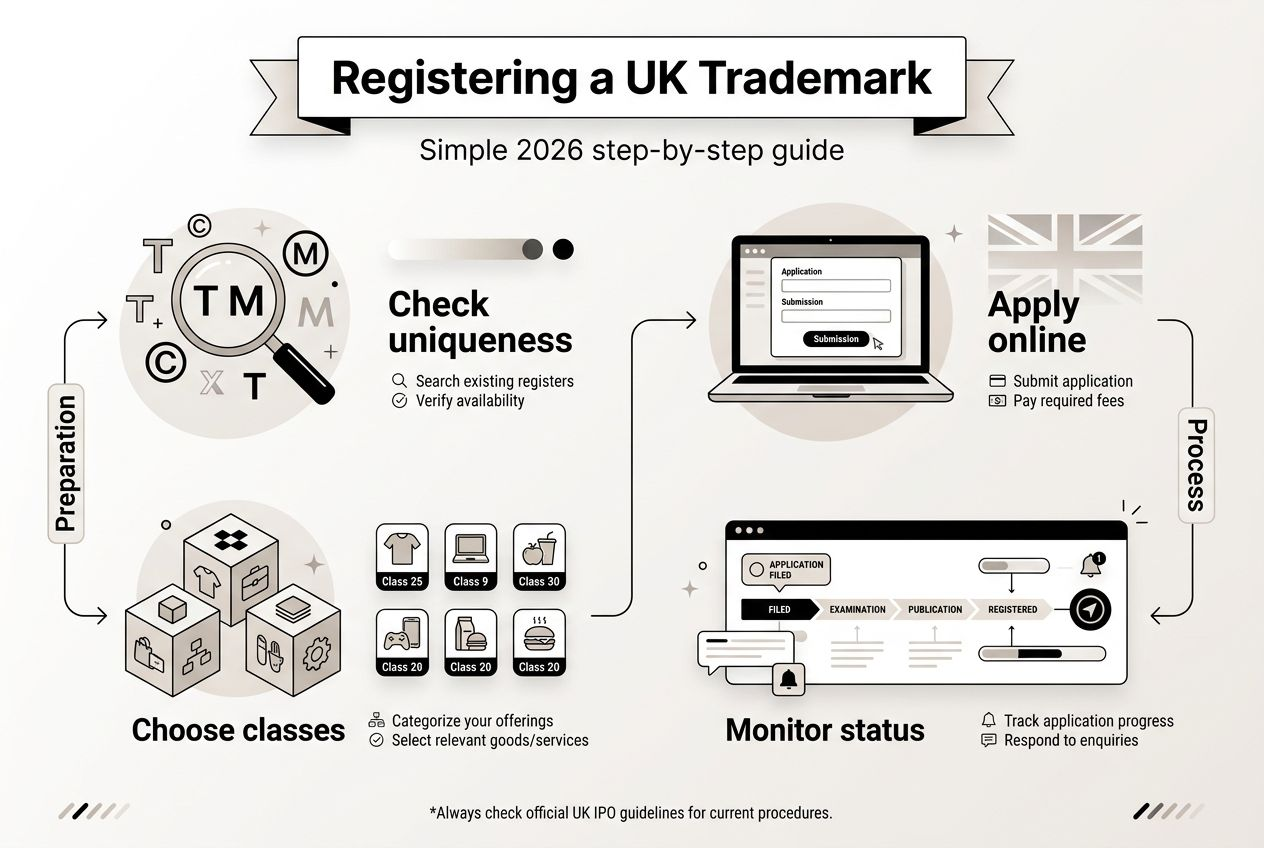
Once preparation is complete, the Intellectual Property Office provides a step-by-step guide for submitting your application online. The process follows five clear stages, each requiring attention to detail and prompt responses.
-
Final eligibility review: Verify your mark meets distinctiveness requirements and accurately represents how you’ll use it commercially. Ensure your chosen classes precisely match your goods or services. Double check that no conflicting marks exist in the IPO database.
-
Complete the online application: Access the UKIPO website and fill out the trademark application form. Provide your contact details, a clear representation of your mark, and detailed descriptions for each class. Upload logos in JPG or PNG format at 300 DPI minimum resolution. Specify whether you’re applying for a word mark, logo, or combination.
-
Pay application fees: Standard fees start at £170 for one class online, with £50 for each additional class. Payment must be made immediately via credit card or debit card. The IPO does not process applications until fees clear. Budget for potential additional costs if objections arise later.
-
Examination period: The IPO examines your application within two to three weeks, checking for conflicts and compliance. You’ll receive an examination report highlighting any issues. Common objections include insufficient distinctiveness, conflicting prior marks, or unclear class descriptions. This stage determines whether your application proceeds to publication.
-
Respond to objections: If the examination report raises concerns, you typically have two months to respond. Provide evidence of distinctiveness, amend your application, or argue why objections don’t apply. Missing deadlines results in application abandonment. Successfully addressing objections moves your mark to publication in the Trade Marks Journal.
After publication, there’s a two month opposition period where third parties can challenge your application. If no oppositions arise, your trademark registers automatically. The entire process typically takes four to six months for straightforward applications.
Pro Tip: Set calendar reminders for all UKIPO deadlines. Missing a response deadline by even one day can kill your application with no refund. Just as company formation requires careful timing, trademark registration demands strict deadline management.
- Monitor your email daily during examination for IPO communications
- Prepare supporting evidence of brand use before applying to speed objection responses
- Consider filing intent to use applications if launching products in coming months
- Keep detailed records of all application correspondence and dates
- Budget extra time if your mark includes non-English words requiring translation
Common challenges and how to avoid them
Understanding frequent pitfalls helps you navigate the application process more smoothly and avoid unnecessary expenses. A trademark application can be rejected if it doesn’t meet requirements, with no refund of fees paid.
Generic or descriptive marks represent the most common rejection cause. Terms that simply describe your product, like “Speedy Delivery” for courier services, lack the distinctiveness required for registration. Marks that mislead consumers about product origin or quality also face refusal. Prohibited symbols including national flags, royal insignia, or offensive content cannot be registered.
Conflicting trademarks create substantial obstacles. Even if your initial search seemed clear, the examiner might identify similar marks you missed. Phonetic similarities matter as much as visual ones. “Kwik” and “Quick” could conflict despite different spellings. Conceptual overlaps, where marks convey similar ideas through different words or images, also trigger objections.
Incomplete applications waste time and money. Missing information, unclear class descriptions, or poor quality logo files cause delays. The IPO issues deficiency notices requiring corrections, extending your timeline by weeks. Providing comprehensive, accurate information from the start prevents these setbacks.
The cost of trademark registration can exceed initial quotes due to oppositions and additional requirements. Third party oppositions trigger formal proceedings, potentially requiring legal representation costing thousands of pounds. Translation fees apply if your mark includes non-English text. Each additional class adds £50, and complex applications involving multiple jurisdictions multiply costs quickly.
Post-Brexit changes require separate UK strategies. EU trademarks no longer protect UK rights automatically. Businesses operating across Europe need parallel UK and EU registrations, doubling costs and administrative burden. This separation affects renewal schedules, enforcement actions, and licensing agreements.
| Challenge | Potential Cost Impact | Prevention Strategy |
| — | — |
| Generic mark rejection | £170 to £500 lost fees | Conduct distinctiveness assessment before applying |
| Third party opposition | £1,000 to £5,000 legal costs | Thorough conflict searches and professional opinions |
| Incorrect class selection | £50 to £200 per amendment | Use IPO classification tools and examples |
| Missed deadlines | Total application loss | Calendar reminders and professional monitoring |
| Post-Brexit dual filing | Double registration costs | Strategic market analysis and phased protection |
Pro Tip: Budget 150% of quoted fees to cover potential complications. Understanding legal impacts of proper registration helps justify this investment in brand protection.
- Avoid purely descriptive terms by adding distinctive elements to your mark
- Respond to opposition threats promptly with evidence of prior use and distinctiveness
- Keep application details consistent across all IPO communications
- Consider professional representation if facing complex objections
- Plan UK and EU strategies separately post-Brexit rather than assuming coverage
After registration: maintaining and enforcing your trademark rights
Securing registration represents just the beginning of trademark ownership. Active maintenance and enforcement preserve your brand’s value over decades. UK trademarks last ten years from the filing date, with unlimited renewal periods available.
Renewal procedures require attention six months before expiry. The IPO sends reminder notices, but ultimate responsibility rests with you. Renewal fees match initial registration costs: £200 for one class, £50 for each additional class. Missing renewal deadlines triggers a six month grace period with additional fees, after which your trademark lapses entirely. Competitors can then apply for identical marks in your classes.
Monitoring the market protects against infringement and dilution. Watch for new applications in the Trade Marks Journal that might conflict with your rights. The IPO provides free monitoring tools, though professional watch services offer more comprehensive coverage. Detecting infringement early enables cost effective resolution before substantial damage occurs.
Enforcement options range from informal cease and desist letters to formal legal proceedings. Many disputes resolve through negotiation once infringers realise your registered rights. For persistent violations, county court proceedings or Intellectual Property Enterprise Court actions provide remedies including injunctions, damages, and account of profits. Alternative dispute resolution through mediation often proves faster and cheaper than litigation.
Protecting your brand in the UK now requires a standalone strategy post-Brexit. EU enforcement actions no longer affect UK infringers, necessitating separate UK proceedings. Licensing agreements, quality control measures, and geographic expansion plans must account for this jurisdictional split.
Proactive strategies maintain trademark strength over time. Use your mark consistently in commerce to prevent abandonment claims. Document all uses with dated examples, sales figures, and marketing materials. Police unauthorised uses promptly to avoid implied consent arguments. Register your mark as a domain name and on major online marketplaces to prevent cybersquatting.
Small businesses benefit from systematic brand protection routines. Set annual calendar reminders for renewal deadlines and monitoring reviews. Maintain a trademark portfolio spreadsheet tracking registration dates, classes, and renewal schedules. Budget ongoing costs including renewals, monitoring services, and potential enforcement actions. Similar to how SME compliance requires regular attention, trademark maintenance demands consistent effort.
- Schedule renewal reminders 12 months before expiry to avoid last minute complications
- Subscribe to IPO email alerts for new applications in your business sectors
- Keep evidence files of continuous trademark use including invoices and marketing materials
- Address potential infringements within weeks, not months, to demonstrate diligence
- Review your trademark portfolio annually to assess whether all classes remain commercially relevant
Professional support for trademark registration and business growth
Navigating trademark registration alone risks costly mistakes that professional guidance prevents. Understanding when to seek expert help protects your investment and accelerates successful registration.
Kefihub provides comprehensive resources tailored for UK small businesses facing trademark decisions. Our business growth roadmap integrates brand protection into broader commercial strategies, ensuring your trademark supports long term expansion. Access step by step guides that demystify complex legal requirements without overwhelming jargon.

Intellectual property solicitors offer invaluable expertise for complex applications or opposition proceedings. The role of solicitors in business extends beyond registration to strategic brand management, licensing negotiations, and enforcement actions. Professional searches identify conflicts you might miss, whilst expert classification advice prevents costly class selection errors. For businesses planning international expansion or facing opposition threats, legal representation often proves essential.
Balancing DIY efforts with professional support optimises costs and outcomes. Handle straightforward word mark applications independently using IPO resources and Kefihub guides. Engage solicitors for logo marks, complex class structures, or when examination reports raise objections. This hybrid approach controls expenses whilst accessing expertise when it matters most. Explore small business compliance guidance to understand how trademark protection fits within your broader legal obligations.
FAQ
How long does trademark registration take in the UK?
Typically, the process takes four to six months from application to registration if no objections arise. Delays occur when examination reports require responses or third parties file oppositions. Complex cases involving multiple classes or international elements may extend beyond six months.
What are trademark classes and why are they important?
Trademark classes categorise the 45 types of goods and services your mark can protect. Correct selection is vital because wrong classes cause application refusal or leave gaps in your protection. Each class incurs separate fees, so precision prevents both rejection and unnecessary expense.
Can I register a UK trademark if I already have an EU trademark?
Post-Brexit, EU trademarks no longer protect in the UK automatically. A separate UK IPO registration is required for UK brand protection. Businesses operating across Europe need parallel registrations, managing renewals and enforcement independently in each jurisdiction.
What should I do if my trademark application is refused?
Review the examination report carefully to understand specific objections raised. Consider amending your application, providing evidence of distinctiveness, or arguing why concerns don’t apply. Seek legal advice for complex refusals, and respond within the two month deadline to avoid abandonment. Reapplication with modifications often succeeds where initial attempts failed.
Recommended
- Business Registration Step by Step for UK Owners – Kefihub
- How to Register a UK Company: 90% Approved in 24 Hours – Kefihub
- Why Register a UK Company – Legal and Financial Impact – Kefihub