


The task of sorting a loved one’s affairs can feel overwhelming the moment you become responsible for their estate. Without clear guidance, understanding what probate means in the UK can seem daunting, especially with banks and property companies requiring formal proof before releasing assets. This article breaks down the real meaning of probate and outlines who manages the process, helping you stay legally compliant while keeping stress levels in check.
Table of Contents
- What Probate Means In The UK
- When Probate Is Needed And By Whom
- Step-By-Step Application And Legal Duties
- Inheritance Tax, Costs And Common Pitfalls
- Avoiding Delays, Disputes And Stress
Key Takeaways
| Point | Details |
|---|---|
| Understanding Probate | Probate is the legal process for managing a deceased person’s estate, requiring a personal representative, either an executor or administrator, to handle affairs. |
| Legal Authority Requirement | A Grant of Probate or Letters of Administration are necessary to access and manage assets; banks and property companies will not release funds without them. |
| Handling Inheritance Tax | If the estate exceeds £325,000, inheritance tax must be handled prior to applying for probate, necessitating accurate asset valuation to avoid penalties. |
| Communication is Key | Early and transparent communication with all beneficiaries can prevent disputes and delays during the probate process. |
What Probate Means in the UK
Probate is the legal process that handles everything left behind when someone dies. It covers their property, money, savings, possessions—everything that made up their estate. A named person called the personal representative takes charge of sorting it all out, from the moment of death until beneficiaries receive their inheritance.
The personal representative could be an executor named in the will, or an administrator if no will exists. Either way, they carry significant legal responsibility. They must apply for official legal authority to deal with the deceased’s assets, particularly when accessing bank accounts, selling property, or distributing money.
Who Manages the Estate?
Executors are people the deceased named in their will to handle their affairs. If there’s no will, the closest living relative becomes the administrator. Both roles require applying for legal documents before they can access most assets.
- Executors need a Grant of Probate
- Administrators need Letters of Administration
- Both grant legal authority to manage the estate
Without these documents, banks and property companies won’t release funds or transfer ownership. The process is designed to protect everyone involved—the deceased’s wishes, the family, and creditors owed money.
What Actually Gets Done During Probate?
The personal representative handles several important tasks over the administration period. Understanding the legal process of managing a deceased person’s estate helps clarify what needs attention.
Key responsibilities include:
- Collecting assets from all accounts and sources
- Paying outstanding debts and funeral expenses
- Filing inheritance tax returns with HM Revenue and Customs
- Paying any taxes owed (Income Tax and Capital Gains Tax)
- Distributing remaining money and property to beneficiaries
- Resolving any disputes that emerge during administration
Some estates are straightforward. Others involve property sales, business assets, trusts, or family disagreements. Complex situations often benefit from professional legal support.
The process concludes once debts are settled and assets reach the intended beneficiaries—not before.
How Long Does Probate Take?
There’s no fixed deadline, though most straightforward estates complete within 6-12 months. More complex situations—particularly those involving property valuation and associated searches—can take considerably longer. Waiting periods for tax clearance, property sales, or resolving disputes all extend the timeline.
Many people think probate is required for everything, but some assets pass outside the process entirely. Life insurance policies with named beneficiaries, certain joint accounts, and property held as tenants in common sometimes bypass probate altogether.
Pro tip: Gather all financial documents—bank statements, property deeds, insurance policies, pension information—before the personal representative applies for probate; this dramatically speeds up the legal process and reduces stress during an already difficult time.
When Probate Is Needed and By Whom
Probate becomes necessary the moment you need to access or deal with a deceased person’s assets. This includes property, bank accounts, investments, or possessions of significant value. Without probate, most financial institutions and property companies won’t release funds or transfer ownership, regardless of what the will says.
The key trigger is legal authority. Banks need proof you have the right to access accounts. Property companies need confirmation before transferring titles. Creditors want assurance that debts will be paid properly. Probate provides that legal proof through official documents granted by the courts.
Who Actually Applies for Probate?
The person responsible for applying depends on whether a will exists. If the deceased left a valid will, the executor named in it applies. If there’s no will, the closest living relative must apply instead.

When applying for probate, understand the legal authority needed to manage assets. This formal application grants either a Grant of Probate (with a will) or Letters of Administration (without a will).
Applications come from:
- Named executors in an existing will
- Spouses or civil partners if there’s no will
- Adult children if no spouse exists
- Parents, siblings, or more distant relatives in order of priority
Only one person can apply initially, though they can appoint others to help later. The applicant becomes the personal representative—the person legally responsible for everything.
When Is Probate Actually Required?
Probate is compulsory when dealing with most substantial assets. You’ll need it for property ownership transfers, accessing bank accounts over certain thresholds, or selling shares and investments. Some institutions set their own limits—a bank might release £5,000 without probate but require it for larger sums.
Not every asset requires probate. Life insurance with named beneficiaries, joint bank accounts, and pension benefits often pass directly to recipients outside this process.
Some estates bypass probate entirely if assets are small enough or structured correctly. However, if there’s any doubt, applying for probate protects everyone involved and prevents future legal complications.
When There’s No Will
Managing an estate without a will follows strict inheritance rules. These intestacy rules determine who inherits what, and probate is still required to distribute assets according to law. The closest living relative must apply for Letters of Administration instead of a Grant of Probate.
Without a will, you can’t choose how things are divided. The law decides, based on whether the deceased left a spouse, children, parents, or siblings.
Pro tip: Start gathering the original will, death certificate, and a complete list of all assets—property, bank accounts, pensions, insurance—before the executor applies for probate; this information is essential for the court application and prevents delays.
Here’s a quick comparison of probate with and without a will in the UK:
| Aspect | With a Will (Executors) | Without a Will (Administrators) |
|---|---|---|
| Legal Document Required | Grant of Probate | Letters of Administration |
| Who Applies | Named executor in will | Closest living relative |
| Asset Distribution | As specified by will | By intestacy law hierarchy |
| Decision Power | Follows deceased’s wishes | Strict legal rules apply |
| Application Complexity | Usually more straightforward | Often involves tracing relatives |
Step-by-Step Application and Legal Duties
Applying for probate involves several distinct phases, each with specific requirements and deadlines. The process starts long before you submit forms to the courts—proper preparation prevents delays and costly mistakes.
You’ll need to gather documents, value assets, handle inheritance tax, and coordinate with HM Revenue and Customs if tax is due. Only then can you submit your formal application to HM Courts & Tribunals Service.
Preparing Your Application
Before touching a single form, you must establish the estate’s true value. This means listing everything the deceased owned—property, bank accounts, shares, life insurance, personal possessions—and everything they owed.
Key preparation steps:
- Locate the original will and death certificate
- Obtain valuations for property and substantial assets
- Gather statements from all bank and investment accounts
- Identify debts, mortgages, and funeral costs
- Note any significant gifts made within seven years of death
- Calculate the net estate value by subtracting debts from assets
Inheritance tax thresholds depend on the total estate value and whether the deceased left a surviving spouse. If the estate exceeds £325,000 (or £500,000 with a surviving spouse), inheritance tax becomes due. Understanding how to value estate assets correctly ensures you meet HMRC requirements before applying.
Handling Inheritance Tax
If inheritance tax applies, you must complete a tax return and make initial payment to HMRC before applying for probate. This creates a catch-22 for some families—you need probate authority to access bank funds, but you need money to pay the tax.
Solutions exist. HMRC allows payment plans in certain circumstances, and banks sometimes release funds specifically to cover tax bills. Contact HMRC early if this affects your situation.
Get a tax reference code from HMRC before submitting your probate application—the courts need this reference number.
The Formal Application
Submitting your probate application properly requires completing official forms, providing documents, and paying court fees. Most applications now happen online through the probate portal, though postal applications remain available.
You’ll submit:
- The probate application form (PA1P with a will, PA1A without)
- Original death certificate
- Original will (if one exists)
- Inheritance tax forms and HMRC reference code
- Court fees (currently ranging from £0 to £155 depending on estate value)
- Supporting documents like valuations and asset statements
If multiple executors are applying jointly, you designate one as the lead applicant, but all must sign legal declarations under oath. The courts verify everything before issuing the grant.
Your Legal Duties Begin Now
Once you hold the grant, you become legally accountable for the estate. Your responsibilities include settling all debts in full, filing final tax returns, distributing assets precisely as the will directs (or according to intestacy law), and maintaining detailed records of every transaction.
You must act honestly and in the beneficiaries’ interests. Failing to do so can result in personal liability. Many executors find professional guidance invaluable here, particularly with complex estates or multiple beneficiaries.
Pro tip: Create a spreadsheet tracking every asset, debt, payment, and distribution from day one; this protects you legally and provides beneficiaries with transparent evidence of fair administration.
Inheritance Tax, Costs and Common Pitfalls
Inheritance Tax represents one of the largest unexpected bills families face after a death. Understanding how it works, what it costs, and where people go wrong can save thousands of pounds and prevent costly mistakes.
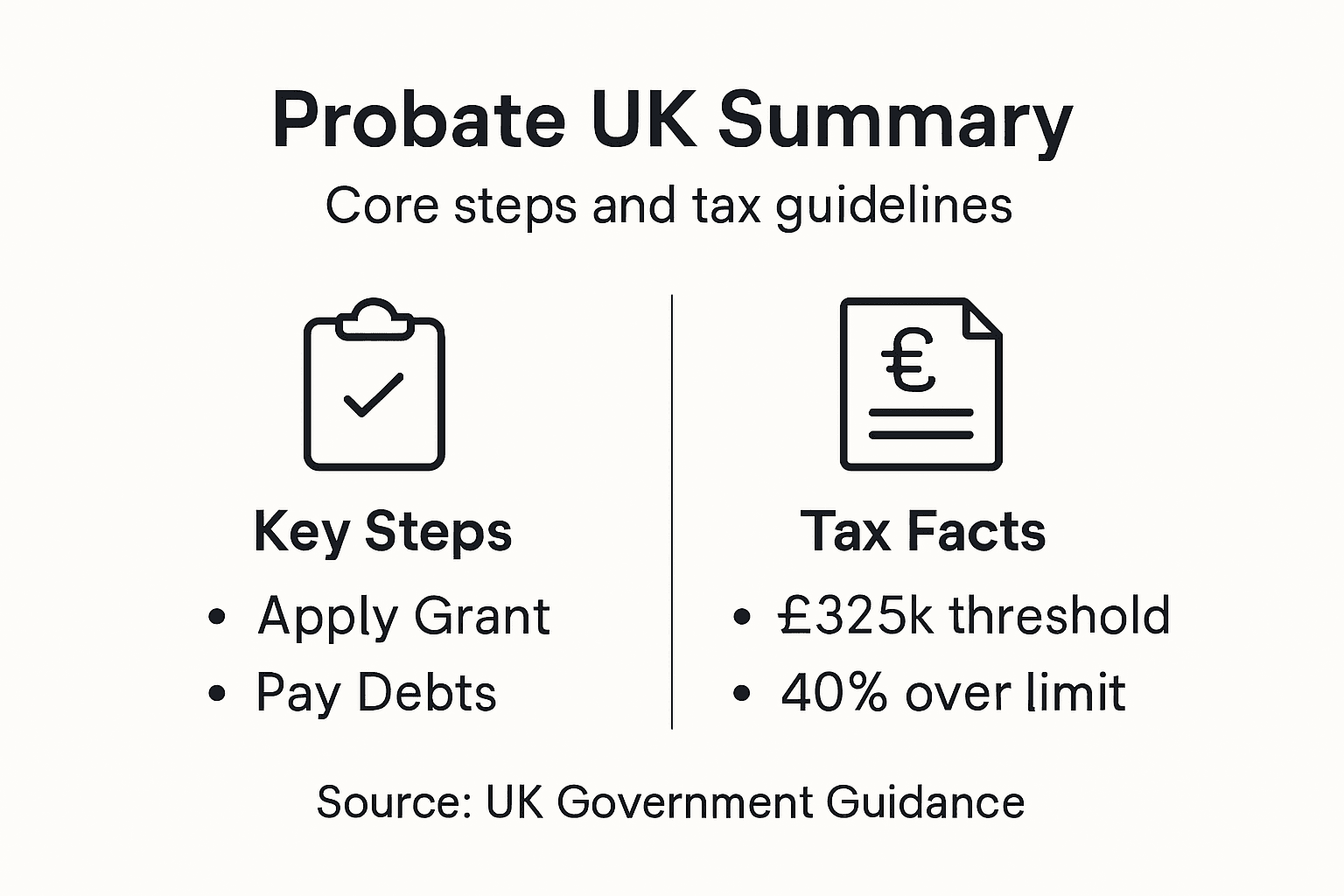
Inheritance Tax applies to estates exceeding £325,000 in value. The tax rate is 40% on everything above that threshold. A surviving spouse or civil partner can sometimes double this allowance to £650,000, but only if the first spouse’s unused allowance transfers to them.
How Much Tax Will You Actually Pay?
The calculation seems straightforward until you realise what counts towards the estate value. It’s not just bank accounts and property.
Your estate includes:
- Property and land ownership
- Bank accounts and savings
- Shares, investments, and unit trusts
- Personal possessions with financial value (jewellery, art, vehicles)
- Life insurance proceeds
- Gifts made within seven years before death
- Any beneficial interests in trusts
- Overseas assets
Estimating estate value accurately is critical because underestimation triggers HMRC penalties. Debts and funeral costs reduce the taxable amount, but many people forget to include gifts made in the seven years before death—these count as part of the estate and push the total higher.
Common Costly Mistakes
Executors regularly make errors that trigger penalties and interest charges. The most frequent pitfall is undervaluing the estate, particularly property and personal items. HMRC scrutinises valuations closely and can demand reassessment.
Other common mistakes include:
- Forgetting gifts made within seven years of death
- Not accounting for overseas property or assets
- Missing beneficial interests in trusts
- Paying inheritance tax late, incurring interest at 6% annually
- Failing to claim available reliefs like charitable donations or agricultural exemptions
- Not registering for a tax reference before applying for probate
Delays in paying tax are expensive. Interest accrues from six months after death, compounding daily. Contact HMRC immediately if you cannot pay on time; they offer instalment plans for certain assets like property.
Missing the inheritance tax deadline costs real money—act quickly, even if you’re unsure about valuations.
Probate Costs Beyond Tax
Inheritance Tax is just one expense. Court fees for probate applications range from £0 to £155 depending on estate value. Solicitor fees typically run £2,000 to £10,000 for straightforward estates, rising significantly for complex situations.
Valuation surveys for property cost £500 to £1,500. Professional asset valuations add further expense. Some families choose to handle probate themselves to save on legal fees, but mistakes can prove far costlier than professional guidance.
Pro tip: Request written quotations from probate solicitors upfront, clarifying exactly what services are included; compare fees across firms, as charges vary substantially for similar work.
For easy reference, here is a summary of typical estate costs during probate:
| Expense Type | Typical Amount | Notes |
|---|---|---|
| Probate Court Fees | £0–£155 | Depends on estate value |
| Solicitor Fees | £2,000–£10,000+ | Increases for complex estates |
| Property Valuation | £500–£1,500 | Varies by property location |
| Professional Asset Valuation | £200–£1,000+ | Required for significant items |
| Inheritance Tax | 40% above allowance | Thresholds vary with spouse status |
Avoiding Delays, Disputes and Stress
Probate administration tests families emotionally and financially. The process stretches over months, involves complex decisions, and often surfaces hidden tensions. Smart planning and clear communication prevent most problems before they start.
The biggest delays stem from poor organisation, unclear beneficiary expectations, and unresolved disagreements. Many families lose months to preventable conflicts that derail the entire timeline.
Communication Prevents Conflict
Start conversations early with all beneficiaries and co-executors. Explain the process, timelines, and what you’re discovering about the estate. Transparency builds trust even when news isn’t what people hoped to hear.
Key communication steps:
- Inform beneficiaries of their entitlements promptly
- Share regular updates on asset sales and financial progress
- Explain delays honestly rather than going silent
- Discuss agreements about asset distribution before problems arise
- Document all conversations in writing
ManyConflicts escalate when people feel excluded or uninformed. A simple email summarising estate progress takes minutes but prevents weeks of rumour and resentment.
Managing Multiple Executors
When two or more executors share responsibility, decisions require agreement. Disagreements between co-executors can paralyse the entire process.
Make joint decisions by discussing major choices upfront. Agree on whether to sell assets quickly or wait for better prices. Decide together on professional help and costs. Document these agreements in writing so nobody later claims they weren’t consulted.
One executor should take the lead role—coordinating tasks, communicating with beneficiaries, and managing deadlines. This prevents confusion about who’s responsible for what.
Handling Disputes Promptly
Resolving probate disputes early prevents escalation into expensive legal battles. Common triggers include contested wills, concerns over executor conduct, or disagreements over asset distribution.
When conflict emerges, act quickly. First, try negotiation between the parties involved. If that fails, mediation offers a faster, cheaper alternative to court proceedings. Mediation costs £500 to £2,000 typically, versus £10,000 plus for contested probate litigation.
Unresolved disputes don’t disappear—they multiply stress and drain the estate’s value through legal fees.
Professional Support Reduces Stress
Many executors try to handle everything alone to save money. This often backfires. Probate solicitors manage complex cases, coordinate with HMRC, and prevent costly errors. They also act as neutral advisers when family tensions rise, bringing objectivity when emotions run high.
Consider professional help if your estate involves:
- Property sales
- Multiple beneficiaries with conflicting interests
- Complex assets or trusts
- Disputes or contested wills
- Any executors lacking confidence or experience
Paying for guidance now prevents expensive mistakes that cost far more later. Acting transparently and staying organised throughout the process protects everyone and minimises delays.
Pro tip: Keep a detailed administration log tracking every decision, conversation, and transaction from day one; share this with all beneficiaries monthly, which prevents misunderstandings and demonstrates fair, thorough management.
Simplify Your Probate Journey with Expert UK Insights
Navigating the probate process in the United Kingdom can be overwhelming and fraught with legal complexities such as applying for a Grant of Probate or Letters of Administration. Many face delays due to incomplete documentation or misunderstandings about inheritance tax and asset valuations. The personal responsibility of executors or administrators demands clear guidance to avoid costly mistakes and reduce stress during a difficult time.
KefiHub offers trustworthy, practical advice tailored to your needs as you manage estate administration. From understanding legal duties to handling inheritance tax efficiently, our comprehensive platform equips you with the knowledge you need to act confidently. Explore our wealth of resources at KefiHub and learn how to protect yourself and the beneficiaries while streamlining this sensitive process.

Take control of your probate responsibilities now by visiting KefiHub’s insights on business and law for expert commentary and actionable advice. Don’t let confusion or delays stand in the way of honouring your loved one’s wishes. Start your informed probate journey today.
Frequently Asked Questions
What is the probate process?
Probate is the legal process that manages a deceased person’s estate, including their property, money, and possessions, by appointing a personal representative to handle the distribution of assets and payment of debts.
Who can apply for probate?
The person who applies for probate depends on whether there is a will; if one exists, the named executor applies. If there is no will, the closest living relative becomes the administrator responsible for the application.
How long does the probate process take?
While the timeframe varies, straightforward estates usually complete probate within 6-12 months. Complex estates or those involving disputes can take significantly longer to resolve.
What costs are associated with probate?
Probate costs can include court fees, solicitor fees, property valuation costs, and inheritance tax, with total expenses varying greatly depending on the complexity of the estate.
Recommended
- How to Find Reliable Legal Advice for UK Homebuyers – Kefihub
- 7 Essential Conveyancing Tips UK Professionals Must Know – Kefihub
- 7 Essential Conveyancing Tips UK Professionals Must Know – Kefihub
- Legal Aid UK: Removing Barriers to Justice – Kefihub