


Most british entrepreneurs underestimate the power of a strong business plan, even though research shows that businesses with a written plan are 30 percent more likely to grow. In a rapidly changing market, especially across the United Kingdom, the right strategy can mean the difference between thriving and struggling. This guide brings clarity to what a business plan actually is, tackles the biggest myths, and shows you why getting it right matters for every british business.
Table of Contents
- Defining A Business Plan And Common Myths
- Types Of Business Plans For UK Businesses
- Core Components And What To Include
- Legal Standing And Uses In The UK
- Common Pitfalls And How To Avoid Them
Key Takeaways
| Point | Details |
|---|---|
| Dynamic Nature of Business Plans | A business plan is not just a static document; it should evolve with your business to effectively navigate changing circumstances. |
| Variety of Business Plan Types | Entrepreneurs should choose a business plan format that aligns with their specific needs, whether comprehensive or lean. |
| Core Components are Essential | Include critical sections such as market analysis and financial projections to provide a holistic view of your business. |
| Avoid Common Pitfalls | Stay realistic in financial projections and ensure a clear understanding of your market to enhance the effectiveness of your business plan. |
Defining a Business Plan and Common Myths
A business plan represents far more than a dusty document gathering cobwebs in a filing cabinet. It is a dynamic strategic roadmap that transforms entrepreneurial vision into actionable steps, providing clarity, direction, and crucial insights for sustainable growth. Unlike popular misconceptions, business plans are not rigid documents reserved only for large corporations or venture capital pitches.
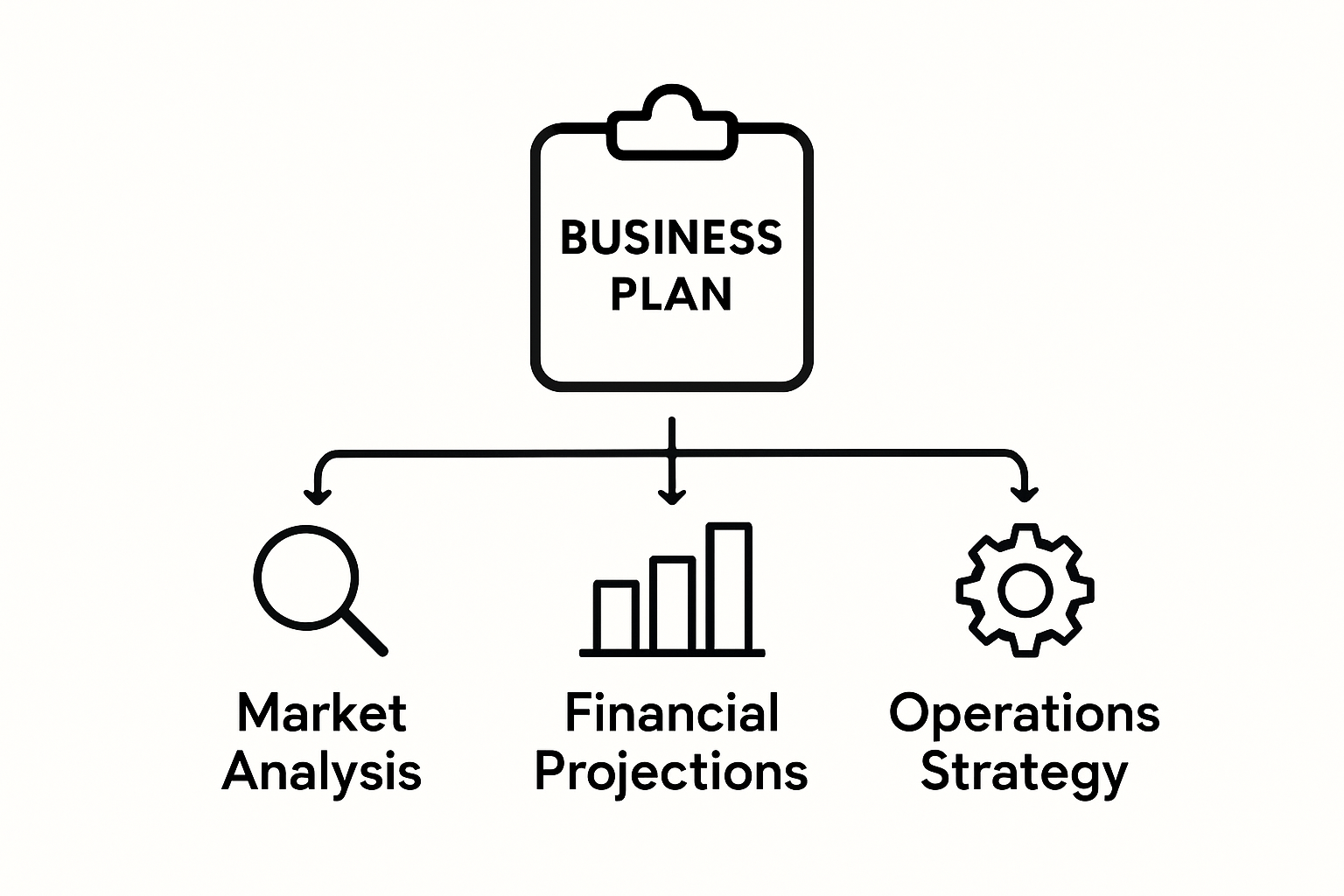
At its core, a business plan serves multiple critical functions for UK entrepreneurs and small business owners. Strategic planning becomes tangible through comprehensive documentation that outlines your business model, market analysis, financial projections, and operational strategies. By creating a structured approach, you’re essentially crafting a navigational tool that helps anticipate challenges, identify opportunities, and maintain focus on your primary objectives.
Common myths surrounding business plans often discourage potential entrepreneurs from creating this essential strategic document. Let’s debunk a few prevalent misconceptions:
-
Myth 1: Business Plans Are Only for Securing Funding
- Reality: While financial institutions appreciate comprehensive plans, they’re equally valuable for internal decision-making
- Helps track progress and adapt strategies
- Provides a benchmark for measuring business performance
-
Myth 2: Business Plans Must Be Extremely Lengthy
- Reality: Concise, focused plans are often more effective
- Length matters less than content quality and strategic insight
- Aim for clarity and precision over unnecessary complexity
-
Myth 3: Business Plans are One-Time Documents
- Reality: Successful businesses treat plans as living documents
- Regular review and updates are crucial
- Reflect changing market conditions and business evolution
Effective business planning requires a balance between thorough analysis and practical flexibility. By understanding these core principles, UK entrepreneurs can transform their business plans from theoretical documents into powerful strategic tools that genuinely drive organisational success. The key is viewing your plan not as a static document, but as a dynamic blueprint for navigating the complex landscape of business growth.
Remember, a well-crafted business plan is your compass in the uncertain terrain of entrepreneurship – it doesn’t guarantee success, but it significantly improves your navigation and decision-making capabilities.
Types of Business Plans for UK Businesses
Navigating the landscape of business planning requires understanding the diverse approaches available to entrepreneurs. Business plans are not one-size-fits-all documents, but strategic tools with multiple variations designed to meet specific organisational needs and objectives. Lean startup methodologies have revolutionised traditional planning approaches, offering more flexible frameworks for modern businesses.
The primary business plan types suitable for UK ventures include traditional comprehensive plans, lean startup plans, internal operational plans, and strategic growth plans. Each serves a unique purpose and provides distinct advantages depending on your business stage, industry, and strategic goals. Understanding these variations allows entrepreneurs to select the most appropriate planning approach for their specific context.
Primary Business Plan Categories
-
Traditional Comprehensive Business Plan
- Detailed, extensive documentation
- Typically 20-50 pages long
- Ideal for:
- Seeking external funding
- Presenting to potential investors
- Comprehensive organisational roadmap
-
Lean Startup Business Plan
- Concise, focused document
- Typically 1-5 pages
- Emphasises rapid iteration and flexibility
- Best for:
- Tech startups
- Innovative business models
- Businesses in rapidly changing markets
-
Internal Operational Business Plan
- Focuses on day-to-day management
- Detailed workflow and process documentation
- Guides team performance and alignment
-
Strategic Growth Business Plan
- Concentrates on long-term expansion
- Outlines scaling strategies
- Addresses potential market opportunities
For UK entrepreneurs, selecting the right business plan type is crucial. The plan should reflect your business’s unique characteristics, growth stage, and strategic objectives. Whether you’re a tech startup seeking rapid development or a traditional small business looking for structured growth, there’s a business plan format that can effectively support your journey.
Remember, a well-crafted business plan is more than a document – it’s a strategic tool that provides clarity, direction, and a roadmap for sustainable success. The key is choosing a format that genuinely serves your business’s specific needs and adapting it as your venture evolves.
Core Components and What to Include
Crafting a comprehensive business plan requires strategic thinking and meticulous attention to detail. Effective business documentation demands a structured approach that clearly communicates your venture’s vision, potential, and operational framework. Each component serves a critical purpose, transforming your entrepreneurial concept into a tangible roadmap for success.

The fundamental elements of a robust business plan encompass several key sections that collectively provide a holistic view of your business. Comprehensive market research forms the backbone of a compelling document, demonstrating your understanding of the competitive landscape and potential opportunities.
Essential Business Plan Components
-
Executive Summary
- Concise overview of entire business plan
- Highlights key points and unique value proposition
- Typically 1-2 pages long
- Must capture reader’s interest immediately
-
Business Description
- Detailed explanation of business model
- Mission statement and core objectives
- Legal structure and ownership details
- Unique selling points
-
Market Analysis
- Comprehensive industry research
- Target market demographics
- Competitor landscape
- Market size and growth potential
-
Product/Service Details
- Specific offerings
- Pricing strategy
- Unique features and benefits
- Development stage and roadmap
-
Marketing and Sales Strategy
- Customer acquisition methods
- Promotional channels
- Sales forecasting
- Branding approach
-
Operational Plan
- Organisational structure
- Key team members
- Production processes
- Operational logistics
-
Financial Projections
- Revenue forecasts
- Profit and loss statements
- Cash flow analysis
- Funding requirements
- Break-even calculations
While constructing your business plan, remember that clarity and precision are paramount. Each section should flow logically, providing potential investors or stakeholders with a comprehensive understanding of your business’s potential. The goal is not just to document your vision, but to demonstrate your strategic thinking and potential for sustainable growth.
Ultimately, a well-crafted business plan is more than a bureaucratic exercise – it’s a dynamic tool that helps you navigate the complex landscape of entrepreneurship, anticipate challenges, and articulate your unique value proposition to the world.
Legal Standing and Uses in the UK
Understanding the legal framework surrounding business plans in the United Kingdom is crucial for entrepreneurs seeking to establish and grow their ventures. Strategic documentation serves more than a mere administrative function – it represents a fundamental tool for legal and financial positioning within the British business ecosystem.
In the UK, while a business plan is not a legally mandated document for all business structures, it carries significant legal and financial implications. Investor attraction and regulatory compliance depend heavily on the quality and comprehensiveness of your business planning documentation. Different legal entities – from sole traders to limited companies – have varying requirements that can be effectively addressed through a well-constructed business plan.
Legal Implications and Uses
-
Regulatory Compliance
- Demonstrates business viability
- Provides transparent operational framework
- Supports regulatory reporting requirements
- Essential for certain business registrations
-
Funding and Investment
- Critical for securing bank loans
- Required by venture capital firms
- Provides legal evidence of business potential
- Supports grant applications
-
Contractual Preparedness
- Outlines business capabilities
- Supports tender and procurement processes
- Provides legal foundation for business agreements
- Demonstrates professional credibility
-
Intellectual Property Protection
- Documents unique business concepts
- Supports trademark and patent applications
- Creates record of business innovation
- Establishes developmental timeline
For UK entrepreneurs, a business plan transcends simple documentation – it represents a strategic instrument that communicates legal and financial competence. The document serves as an official representation of your business’s potential, providing a structured narrative that regulatory bodies, investors, and potential partners can evaluate.
Remember, in the complex landscape of British business regulations, a meticulously crafted business plan is your first line of defence and your most powerful tool for demonstrating professional legitimacy and strategic vision.
Common Pitfalls and How to Avoid Them
Crafting a business plan is a delicate process that requires strategic thinking and meticulous attention to detail. Navigating potential challenges demands awareness of the most frequent mistakes entrepreneurs encounter when developing their strategic documentation.
The journey of business planning is fraught with potential missteps that can undermine your venture’s credibility and potential. Understanding these common pitfalls allows you to proactively design a robust, compelling business plan that effectively communicates your vision and strategic approach.
Critical Business Plan Pitfalls
-
Unrealistic Financial Projections
- Avoid overly optimistic revenue estimates
- Ground projections in verifiable market research
- Include conservative and aggressive scenarios
- Demonstrate clear calculation methodologies
-
Lack of Market Understanding
- Conduct comprehensive competitor analysis
- Understand target market demographics
- Identify genuine market needs
- Demonstrate deep industry insights
-
Vague Executive Summaries
- Provide clear, concise business overview
- Highlight unique value proposition
- Capture reader’s interest immediately
- Ensure consistency with detailed plan
-
Inadequate Operational Details
- Outline precise operational strategies
- Define team roles and responsibilities
- Explain production/service delivery processes
- Demonstrate scalability potential
-
Poor Financial Management Sections
- Include detailed cash flow projections
- Explain funding requirements
- Demonstrate break-even analysis
- Highlight potential revenue streams
-
Neglecting Risk Assessment
- Identify potential business risks
- Develop mitigation strategies
- Show proactive problem-solving approach
- Demonstrate adaptability
Successful business plans transcend mere documentation – they represent a strategic narrative that communicates your venture’s potential, understanding, and preparedness. By avoiding these common pitfalls, entrepreneurs can create compelling documents that resonate with investors, stakeholders, and potential partners.
Remember, your business plan is a living document that reflects your strategic thinking. Approach it as a dynamic tool for growth, continuously refining and updating it to mirror your evolving business landscape.
Unlock Your UK Business Potential with Expert Guidance
Crafting an effective business plan is one of the biggest challenges UK entrepreneurs face. From overcoming common myths to avoiding financial pitfalls, understanding the strategic roadmap is crucial for turning your vision into reality. If you want clarity on developing a dynamic, flexible plan that anticipates risks and aligns your business goals, expert support can make all the difference.

Explore practical insights and actionable advice on how to develop a business plan tailored to UK businesses. Benefit from comprehensive guidance on market analysis, operational planning, and legal considerations at KefiHub, your trusted UK-based platform for clear, reliable business expertise. Take the first step today and bring your business vision to life by visiting KefiHub now.
Frequently Asked Questions
What are the key components of a business plan?
A robust business plan typically includes an executive summary, business description, market analysis, product/service details, marketing and sales strategy, operational plan, and financial projections.
Why is a business plan important for securing funding?
A comprehensive business plan demonstrates your business’s viability and potential to investors and lenders, providing a structured framework for evaluating funding requests.
How often should a business plan be updated?
A business plan should be treated as a living document, requiring regular reviews and updates to reflect changes in market conditions, business performance, or strategic direction.
What common pitfalls should be avoided when creating a business plan?
Common pitfalls include unrealistic financial projections, lack of market understanding, vague executive summaries, inadequate operational details, poor financial management sections, and neglecting risk assessment.
Recommended
- How to Avoid Common Business Mistakes for UK Professionals – Kefihub
- Starting a Small Business UK: Step-by-Step Legal Guide – Kefihub
- Role of Business Consultant: Impact on UK SMEs – Kefihub
- Complete Guide to Why Incorporate a Business – Kefihub