


TL;DR:
- Most UK small businesses assume GDPR applies only to large firms, but it affects any personal data handling.
- Compliance is ongoing and involves practical steps like data mapping, updating notices, securing data, and staff training.
- Risk-based, pragmatic approaches and documented efforts are supported by regulators and key to maintaining trust and avoiding enforcement actions.
Most UK small business owners assume GDPR is a concern for large corporations with dedicated legal teams. The reality is quite different. If you collect a customer’s email address, store staff records, or use a CRM system, you are already processing personal data and GDPR applies to you. Fines are proportionate and the ICO actively supports smaller organisations, but that does not mean you can ignore your obligations. This guide cuts through the complexity, giving you a clear picture of what compliance actually requires, where businesses commonly go wrong, and how getting it right builds genuine trust with your customers.
Table of Contents
- Understanding GDPR: Why compliance matters for small businesses
- Step-by-step: The GDPR compliance process for UK SMEs
- Common pitfalls and enforcement risks: What small businesses get wrong
- GDPR in action: Contracts, processors, and special data situations
- Our view: Why pragmatic, risk-based GDPR compliance is more powerful than perfectionism
- Next steps: Empower your business with smart compliance tools
- Frequently asked questions
Key Takeaways
| Point | Details |
|---|---|
| GDPR applies to most SMEs | If you handle customer or staff data, you must meet GDPR requirements. |
| Follow practical steps | Mapping data, securing records, transparency, and training are core to compliance. |
| ICO supports SME compliance | Support, helplines and proportionate oversight mean SMEs who try to comply are rarely fined. |
| Avoid common pitfalls | Gaps in security and ignoring data requests are the biggest causes of enforcement. |
| Aim for progress, not perfection | Consistent, risk-based efforts build trust and reduce legal risks more than chasing flawless compliance. |
Understanding GDPR: Why compliance matters for small businesses
The UK GDPR, which retained the core principles of the EU regulation following Brexit, sets out rules for how personal data must be collected, stored, used, and protected. It applies to virtually any organisation that handles information about identifiable individuals, whether those are customers, prospects, employees, or suppliers. For small businesses, this is not a distant legal concern. It is a day-to-day operational reality.
Many sole traders and micro-SMEs operate under the assumption that their size provides some form of exemption. It does not. The essential compliance steps are largely the same regardless of whether you employ two people or two hundred. What changes is the scale and complexity of what you need to do. The ICO takes a risk-based, proportionate approach to compliance, meaning a small florist handling a customer mailing list is held to a different standard than a healthcare provider processing sensitive records.
The benefits of compliance extend well beyond avoiding penalties. Customers increasingly expect businesses to handle their data responsibly. Demonstrating that you take privacy seriously can strengthen relationships, improve your reputation, and even open doors to contracts with larger organisations that require suppliers to meet data protection standards.
Here is why why compliance matters for your business:
- Legal obligation: Failure to comply can result in fines, reprimands, and enforcement action.
- Customer trust: Transparent data practices build loyalty and confidence.
- Business resilience: Good data hygiene reduces the risk of breaches and their associated costs.
- Commercial opportunity: Many procurement processes now require evidence of GDPR compliance.
“The ICO’s approach is to support small organisations with practical guidance, not to penalise those making genuine efforts to comply. Compliance is proportionate to the data you handle and the risks involved.”
The ICO provides extensive free resources and self-assessment tools specifically designed for smaller organisations, making it far more accessible than many business owners realise.
Step-by-step: The GDPR compliance process for UK SMEs
Having covered why compliance matters, we can now break the process down into practical, business-friendly steps. The good news is that for most small businesses, the core actions are straightforward once you understand what is required.
The ICO’s assessment for small business owners outlines the following sequence:
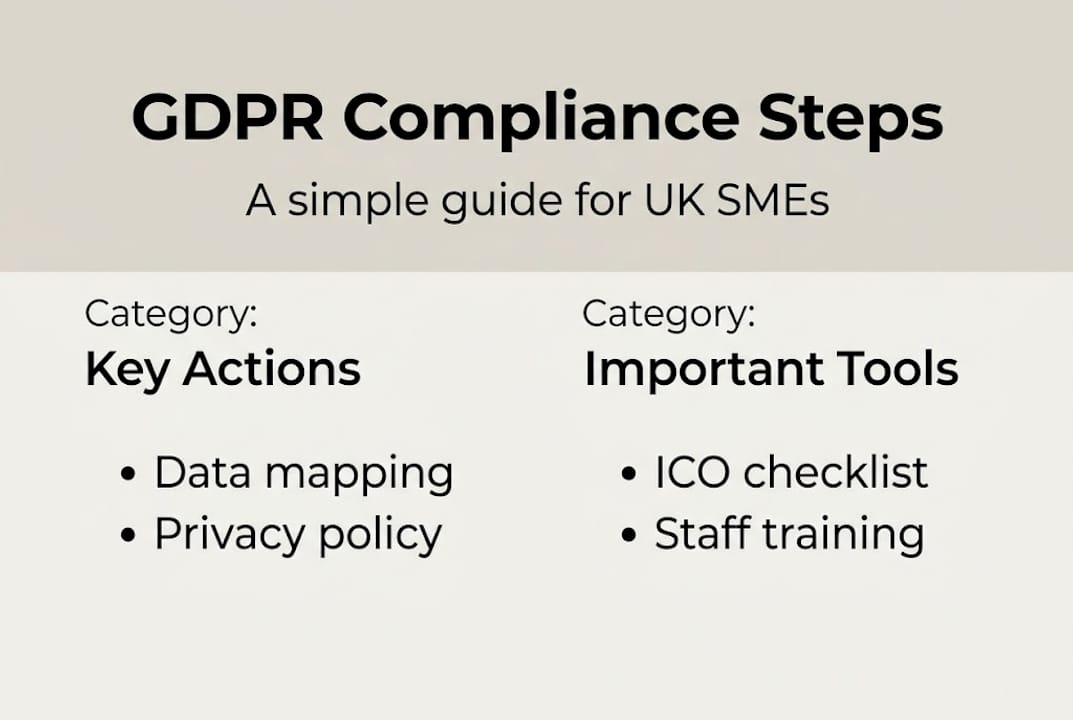
- Map your data. List every type of personal data you collect, where it comes from, how you use it, and where it is stored. This is sometimes called a data audit or data mapping exercise.
- Establish your legal basis. For each type of data processing, identify your lawful basis. Common options include consent, legitimate interests, or contractual necessity.
- Update your privacy notice. Your website and customer communications must clearly explain what data you collect, why, and how individuals can exercise their rights.
- Secure your data. Implement appropriate technical and organisational measures. This includes strong passwords, encrypted storage, and access controls.
- Respond to individuals’ rights. You must be able to handle subject access requests, deletion requests, and objections within statutory timeframes.
- Prepare a breach response plan. Know how to identify, log, and report a data breach to the ICO within 72 hours if required.
- Train your staff. Everyone who handles personal data should understand their responsibilities.
- Register with the ICO. Most small businesses must register with the ICO and pay an annual data protection fee, typically £40 to £60 for smaller organisations.
| Compliance action | Priority | Typical effort |
|---|---|---|
| Data mapping | High | 2 to 4 hours |
| Privacy notice update | High | 1 to 3 hours |
| ICO registration | High | 30 minutes |
| Staff training | Medium | Half day |
| Breach response plan | Medium | 1 to 2 hours |
| Annual review | Ongoing | 1 to 2 hours |
You can also use our legal compliance checklist and website legal compliance guidance to cross-reference your obligations.
Pro Tip: Set a recurring calendar reminder to review your compliance procedures at least once a year, or whenever you introduce a new product, service, or data collection method.
Common pitfalls and enforcement risks: What small businesses get wrong
Understanding the basic obligations is one thing. Knowing where SMEs typically stumble is equally important. The ICO’s 2024/25 annual report recorded £3.8 million in GDPR fines and 12 formal reprimands issued to UK SMEs, a clear signal that enforcement is real, even at smaller scales.

Research from the UK Business Data Survey 2024 found that accountability gaps and weak privacy-by-design practices remain widespread, with many businesses only addressing compliance after a breach or when a client contract demands it.
The most common pitfalls include:
- Weak data security: Using shared passwords, unencrypted spreadsheets, or outdated software leaves data exposed.
- Ignoring subject access requests: Failing to respond within 30 days is one of the most frequent complaints the ICO receives.
- Outdated or absent privacy notices: Many small business websites still carry generic or inaccurate privacy policies.
- Untrained staff: Employees who do not understand GDPR basics are a significant vulnerability.
- PECR breaches: Sending unsolicited marketing emails without proper consent violates the Privacy and Electronic Communications Regulations, which sit alongside GDPR.
- No breach logging process: Even minor incidents should be documented internally.
Exploring small business law essentials can help you identify gaps you may not have considered. The ICO’s current stance is supportive and educational, but it does act when businesses repeatedly ignore obligations or cause genuine harm to individuals. The reputational damage from a publicised enforcement action can far outweigh any fine.
Key insight: Most enforcement actions are triggered not by technical failures but by a failure to respond appropriately when something goes wrong. Having a plan matters enormously.
GDPR in action: Contracts, processors, and special data situations
Beyond your own internal practices, GDPR also governs how you work with third parties. If you use a cloud storage provider, a payroll platform, an email marketing tool, or any other external service that handles personal data on your behalf, that provider is acting as a data processor. You, as the business owner, remain the data controller and retain ultimate responsibility.
The ICO’s processors checklist sets out that processors must keep records, operate under a written contract, secure any sub-processors they use, and assist controllers in responding to breaches and rights requests. You should review your contracts with key suppliers to ensure these obligations are clearly documented.
| Scenario | Your role | Key requirement |
|---|---|---|
| Using a cloud CRM | Controller | Data processing agreement with provider |
| Outsourcing payroll | Controller | Written contract, data security clauses |
| Providing IT services to clients | Processor | Records of processing, breach support |
| Using AI tools for marketing | Controller | DPIA may be required |
A Data Protection Impact Assessment (DPIA) is a formal process for identifying and reducing privacy risks before starting high-risk processing activities. According to the ICO, DPIAs are required when you use AI tools, process biometric data, or conduct large-scale monitoring. Most small businesses will not need one for routine activities, and you are unlikely to need a dedicated Data Protection Officer either.
If you are considering registering a UK company or restructuring your business, it is worth reviewing how that change affects your data processing activities. You can also find broader privacy and safety best practices relevant to your sector.
“Most SMEs do not need a DPO or a full DPIA. Focus your energy on the basics: clear contracts, secure systems, and documented processes.”
Our view: Why pragmatic, risk-based GDPR compliance is more powerful than perfectionism
At KefiHub, we have seen too many small business owners either dismiss GDPR entirely or become so anxious about getting every detail right that they do nothing at all. Both responses are understandable, and both are counterproductive.
The ICO consistently signals that it supports risk-based compliance journeys for SMEs. What regulators actually want to see is genuine effort, documented decisions, and a willingness to improve. A business that has mapped its data, written a clear privacy notice, and trained its staff, even imperfectly, is in a far stronger position than one that has done nothing while waiting to get it perfect.
Our view is that compliance is not a destination you arrive at. It is an ongoing practice. The businesses that handle GDPR best are those that build it into their operations naturally rather than treating it as a one-off project. Document what you are doing and why. That transparency is often what matters most when the ICO investigates a complaint. You can deepen your understanding of risk-based compliance strategies to build this into your wider business approach.
Pro Tip: Keep a simple log of your compliance decisions, even informal notes. If a complaint ever arises, showing that you considered the issue carefully carries real weight.
Next steps: Empower your business with smart compliance tools
GDPR does not have to be overwhelming. With the right resources and a clear plan, you can build a compliance framework that protects your customers, satisfies regulators, and supports your business growth.

KefiHub offers a range of practical tools and guidance designed specifically for UK small businesses. Our detailed small business compliance guide walks you through every obligation in plain English, while our business growth roadmap helps you integrate compliance into your broader strategy. For professionals looking to strengthen their legal foundations, our legal compliance for professionals resource provides targeted, actionable guidance. Take the next step with confidence.
Frequently asked questions
Do all UK small businesses need to comply with the GDPR?
Yes, if your business collects or handles any personal data from individuals in the UK or EU, GDPR compliance is required. The ICO confirms this applies to most small businesses, including sole traders.
What is the ICO registration and fee for small businesses?
Most SMEs must register with the ICO and pay a yearly data protection fee, usually between £40 and £60 depending on your organisation’s size and turnover.
How do I handle a GDPR data breach?
You must assess the risk and, if it is likely to affect individuals’ rights, report to the ICO within 72 hours. Always log every incident internally, even those that do not require reporting.
Do we need a Data Protection Officer or DPIA?
Most small businesses do not. The ICO confirms that DPOs and DPIAs are only required when you conduct large-scale or high-risk processing, such as using AI or handling sensitive personal data at volume.
What is the biggest GDPR risk for UK SMEs?
Failing to implement basic security measures and not responding to individuals’ data rights requests are the most common enforcement triggers, according to the ICO’s 2025 annual report.
Recommended
- Small Business Compliance Guide: Essential Steps for UK SMEs – Kefihub
- 7 Steps to a Robust Legal Compliance Checklist for UK SMEs – Kefihub
- Step-by-Step Website Legal Compliance UK Guide – Kefihub
- Legal Compliance: Why It Matters for UK Professionals – Kefihub