


TL;DR:
- B2B influencers are valued for their sector expertise and professional credibility.
- They enhance brand visibility and trust through content co-creation, event participation, and social sharing.
- Success relies on patience, long-term relationships, and measuring engagement, lead quality, and sentiment.
Influencer marketing is frequently dismissed as a tool reserved for consumer brands selling trainers or skincare products. That assumption is costing B2B firms real opportunities. Across the UK, professional services firms, from legal consultancies to financial advisers, are quietly discovering that the right influencer relationship can accelerate credibility, extend reach into niche markets, and shorten the trust-building cycle with prospective clients. This article sets out exactly how B2B influencer strategies work, what makes them different from their consumer counterparts, and how you can apply them practically within your professional services context.
Table of Contents
- What makes an influencer valuable in B2B?
- How influencers enhance brand visibility and trust
- Choosing the right influencer: Criteria and pitfalls
- Measuring influencer impact for professional services
- Why B2B influencer strategies require patience and precision
- Explore practical B2B solutions for growth
- Frequently asked questions
Key Takeaways
| Point | Details |
|---|---|
| Sector expertise matters | B2B influencers must understand specialised professional services to resonate with targeted audiences. |
| Trust drives results | Credibility and authentic engagement are central to successful influencer campaigns for B2B brands. |
| Measurement is critical | Metrics like engagement, lead quality, and sentiment reveal true influencer impact. |
| Avoid popularity traps | Selecting influencers based on relevance, not follower count, produces higher returns for professional services. |
| Patience pays off | B2B influencer marketing is a long-term strategy that strengthens brand resilience with time. |
What makes an influencer valuable in B2B?
Building on the introduction, let us clarify exactly who B2B influencers are and why they are uniquely valuable in professional services.
A B2B influencer is not defined by follower count. They are defined by authority. In consumer markets, a lifestyle blogger with a million followers can shift product sales through aspiration alone. In B2B, your target audience consists of decision-makers who are sceptical, time-poor, and highly attuned to credibility signals. They respond to expertise, not entertainment.
The table below illustrates the core differences between B2B and B2C influencer profiles:
| Factor | B2B influencer | B2C influencer |
|---|---|---|
| Primary currency | Expertise and sector authority | Popularity and lifestyle appeal |
| Audience size | Smaller but highly targeted | Broad and varied |
| Content format | Thought leadership, case studies | Visual content, reviews |
| Decision cycle | Long, multi-stakeholder | Short, individual |
| Trust mechanism | Professional credibility | Relatability and aspiration |
For professional services, this distinction matters enormously. When a procurement director is evaluating a legal technology provider or a CFO is shortlisting accounting firms, they are not swayed by celebrity endorsements. They respond to recognised voices within their sector. B2B influencers help companies establish credibility and reach niche audiences in ways that paid advertising simply cannot replicate.
Key qualities to look for in a B2B influencer include:
- Sector-specific knowledge: They should understand the regulatory, operational, and commercial pressures your clients face.
- An engaged professional network: Quality of audience interaction matters more than raw numbers.
- Consistent thought leadership: Regular, substantive content signals genuine expertise rather than opportunistic positioning.
- Alignment with your brand values: Their public positions should complement, not contradict, your firm’s ethos.
For firms working on scaling professional services, influencer partnerships can provide the external validation that accelerates growth into new market segments.
Pro Tip: When approaching potential influencers, review at least six months of their published content. Look for consistency in topic focus, depth of analysis, and how their audience responds. A smaller audience that actively comments and shares is far more valuable than a passive following of tens of thousands.
How influencers enhance brand visibility and trust
Having outlined what makes B2B influencers valuable, let us examine the ways they tangibly impact brand visibility and trust for professional services firms.

Visibility in B2B is not simply about being seen. It is about being seen by the right people, in the right context, at the right moment in their decision-making process. Influencers who are embedded in your target sector can place your brand in front of qualified audiences during industry conversations, conference discussions, and professional community exchanges.
Influencer engagement can increase B2B brand visibility by up to 30%, according to research from TopRank Marketing. That is a meaningful uplift for firms that typically rely on slow-burn tactics such as SEO and referral networks.
Here are the primary ways influencers build visibility and trust for professional services brands:
- Content co-creation: Partnering with an influencer to produce a whitepaper, podcast episode, or webinar places your brand alongside a trusted voice. The influencer’s credibility transfers to your firm.
- Event participation: When a respected industry figure speaks at your hosted event or endorses your presence at a sector conference, it signals legitimacy to attendees.
- Testimonials and case studies: Influencers who have directly experienced your service can provide testimonials that carry significantly more weight than anonymous client quotes.
- Social amplification: Influencers sharing your content to their professional networks extends your organic reach without additional paid spend.
- Community dialogue: Active participation in LinkedIn groups, industry forums, or roundtables where your influencer is already respected positions your brand within ongoing professional conversations.
The data below shows how influencer-driven tactics compare to traditional B2B brand awareness methods:
| Method | Average engagement rate | Trust signal strength | Time to measurable impact |
|---|---|---|---|
| Paid advertising | 0.5 to 1.5% | Low | Immediate |
| SEO content | 2 to 4% | Medium | 3 to 6 months |
| Influencer collaboration | 4 to 8% | High | 1 to 3 months |
| Referral networks | Variable | Very high | 6 to 12 months |
For firms exploring marketing strategies for SMEs, influencer collaboration sits at a compelling intersection of speed and credibility.
Choosing the right influencer: Criteria and pitfalls
With visibility and trust in focus, the next challenge is choosing influencers who genuinely fit your brand and audience.
The most common mistake B2B marketers make is treating influencer selection like a media buy. They look at follower counts, negotiate a fee, and expect results. This approach consistently underdelivers. Selecting influencers with deep sector knowledge provides more effective results in B2B, because professional audiences can immediately detect whether an influencer genuinely understands the challenges they face.
Use the following criteria when evaluating potential influencer partners:
- Sector knowledge: Can they speak fluently about the regulatory, operational, and commercial realities of your industry?
- Audience fit: Does their following include the job titles, sectors, and seniority levels you are targeting?
- Engagement quality: Are their comments substantive and professional, or superficial and generic?
- Content authenticity: Do they maintain consistent positions over time, or do they appear to shift opinions based on who is paying?
- Reputation integrity: Have they been involved in any controversies that could reflect poorly on your brand?
Common pitfalls to avoid:
- Overvaluing follower count: A LinkedIn profile with 50,000 followers but 0.2% engagement is far less valuable than one with 8,000 followers and active professional dialogue.
- Ignoring relevance: An influencer popular in general business commentary may have no genuine credibility within your specific professional services niche.
- Skipping due diligence: Always review their full content history before committing to a partnership.
“Credibility trumps reach in B2B influencer partnerships. One genuinely trusted voice in your sector is worth more than ten broadly popular ones.”
For firms considering technology in law firm marketing, this principle applies directly. A legal technology influencer with genuine practitioner experience will resonate far more with solicitors and partners than a generic marketing commentator.
Pro Tip: Ask prospective influencers for their audience analytics before agreeing terms. Specifically request data on follower seniority, industry breakdown, and geographic location. This protects your investment and confirms genuine alignment.
Measuring influencer impact for professional services
After identifying ideal influencers, measuring their impact makes or breaks B2B campaigns.
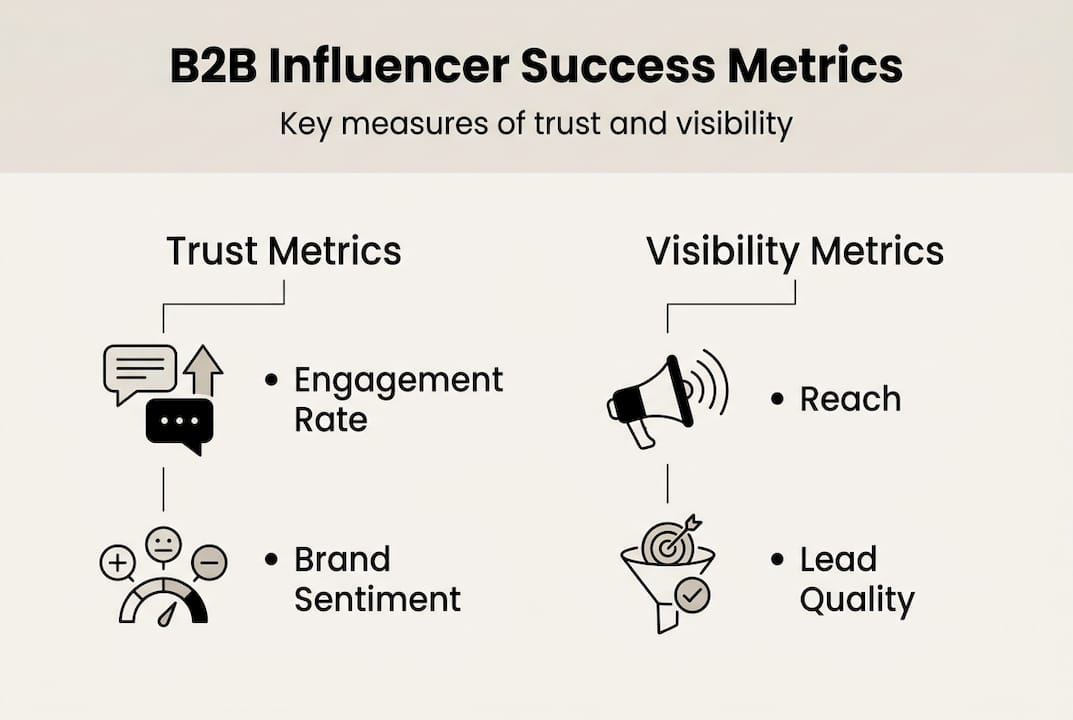
Many professional services firms invest in influencer partnerships and then struggle to demonstrate return on investment to senior stakeholders. The solution is establishing clear metrics before the campaign begins, not after. The most-used KPIs in B2B influencer campaigns include engagement rate, lead quality, and sentiment, according to Statista.
Follow these steps to build a robust measurement framework:
- Set baseline metrics: Before the campaign launches, record your current engagement rates, website traffic from target sectors, and lead volume.
- Track engagement rate: Monitor likes, comments, shares, and saves on influencer content featuring your brand. Segment by platform.
- Assess lead quality: Use CRM tagging to identify leads that originated from influencer touchpoints. Measure their conversion rates against other sources.
- Monitor brand sentiment: Use social listening tools to track how your brand is being discussed before, during, and after the campaign.
- Evaluate content performance: Assess which co-created content formats generated the most qualified traffic and engagement.
Useful measurement tools for B2B marketers include:
- LinkedIn Analytics: Essential for tracking professional audience engagement and content reach.
- Google Analytics 4: Monitors referral traffic and on-site behaviour from influencer-driven visits.
- Brandwatch or Mention: Tracks brand sentiment and share of voice across professional communities.
- HubSpot or Salesforce CRM: Tags and tracks leads by acquisition source for accurate conversion attribution.
For a broader perspective on evaluating digital tools, the legal advice platforms comparison on KefiHub offers a useful framework for assessing platform value in professional contexts.
| KPI | What it measures | Why it matters in B2B |
|---|---|---|
| Engagement rate | Audience interaction with content | Signals relevance and resonance |
| Lead quality score | Seniority and fit of inbound leads | Indicates ROI potential |
| Brand sentiment | Positive or negative perception shifts | Tracks long-term trust building |
| Referral traffic | Visitors from influencer channels | Measures direct visibility impact |
Why B2B influencer strategies require patience and precision
Here is what most B2B marketers miss about influencer success, and it is not a tactical detail. It is a mindset issue.
The pressure to demonstrate quick wins leads firms to treat influencer marketing as a campaign rather than a relationship. They run a six-week collaboration, see modest immediate results, and conclude the channel does not work. This is a fundamental misreading of how B2B trust actually develops.
In professional services, buying decisions are rarely made in weeks. They are made over months, sometimes years, as potential clients accumulate evidence that a firm is credible, consistent, and genuinely expert. An influencer who repeatedly endorses your thinking, participates in your events, and references your work within their community is contributing to that accumulation. The results are gradual but highly resilient, because they are built on genuine professional reputation rather than paid visibility.
The contrarian view worth holding is this: authenticity in B2B influencer marketing is not a nice-to-have. It is the entire mechanism. Sector nuances matter far more than general reach. A single credible voice within your specific professional community will outperform a broad campaign targeting generic business audiences every time. For firms serious about scalable professional services strategies, investing in long-term influencer relationships rather than one-off campaigns is the approach that compounds over time.
Explore practical B2B solutions for growth
If the frameworks in this article have prompted you to think differently about how your firm builds credibility and reaches decision-makers, the next step is putting that thinking into action.
KefiHub provides UK-focused guidance designed specifically for professional services firms and B2B decision-makers. Whether you are mapping out a business growth roadmap or looking to strengthen your professional network through networking for SMEs, you will find practical, reliable resources tailored to the realities of UK business. Explore the platform to identify the strategies that align with your current growth priorities and take confident, informed steps forward.
Frequently asked questions
What distinguishes B2B influencers from B2C influencers?
B2B influencers possess sector-specific expertise and target niche professional audiences, whereas B2C influencers focus on broad consumer appeal and lifestyle aspiration. B2B influencers help companies establish credibility in ways that resonate with decision-makers rather than general consumers.
How do B2B influencers build trust for professional services?
They use authoritative content, professional testimonials, and participation in industry events to reinforce brand credibility over time. Influencer engagement can increase B2B brand visibility by up to 30%, which compounds into meaningful trust signals for prospective clients.
What is the most important metric for measuring influencer impact in B2B?
Engagement rate is the primary KPI, supported by lead quality scoring and brand sentiment tracking. The most-used KPIs in B2B influencer campaigns reflect the need to measure both immediate interaction and longer-term reputation shifts.
What are common pitfalls when selecting B2B influencers?
Relying solely on follower count or choosing influencers without genuine sector relevance leads to ineffective partnerships. Selecting influencers with deep sector knowledge consistently produces stronger results than prioritising reach over credibility.
Recommended
- Why branding matters: 81% trust boost for UK SMEs – Kefihub
- 7 Smart Brand Building Tips for UK Small Businesses – Kefihub
- 7 Effective Marketing Strategies for SMEs to Drive Growth – Kefihub
- Role of Social Media for Business Success – Kefihub
- How to use social proof in legal marketing for client trust