


{
“@type”: “Article”,
“image”: {
“url”: “https://csuxjmfbwmkxiegfpljm.supabase.co/storage/v1/object/public/blog-images/organization-8865/1772847123697_image.png”,
“@type”: “ImageObject”,
“caption”: “UK SME manager reviewing HR report”
},
“author”: {
“url”: “https://kefihub.co.uk”,
“name”: “Kefihub”,
“@type”: “Organization”
},
“@context”: “https://schema.org”,
“headline”: “Optimise HR in UK SMEs for growth and compliance”,
“publisher”: {
“url”: “https://kefihub.co.uk”,
“name”: “Kefihub”,
“@type”: “Organization”
},
“inLanguage”: “en-US”,
“articleBody”: “Discover how UK SMEs can optimise HR for growth and compliance in 2026. Practical strategies for recruitment, retention, technology, and regulatory changes.”,
“description”: “Discover how UK SMEs can optimise HR for growth and compliance in 2026. Practical strategies for recruitment, retention, technology, and regulatory changes.”,
“datePublished”: “2026-03-07T01:33:24.995Z”
}
Over 90% of UK SMEs expect skills gaps to affect their growth this year, especially in entry-level positions. Yet HR in small businesses is often seen as a paperwork burden, not a strategic driver. This guide shows you how to transform your HR function into a powerful tool for compliance, talent retention, and sustainable growth in 2026.
Table of Contents
- Understanding The Strategic Role Of Hr In Smes
- Key Hr Challenges Facing Uk Smes In 2026
- Effective Recruitment And Retention Strategies For Smes
- Navigating Hr Compliance And Regulatory Changes
- Leveraging Hr Technology And Outsourcing To Maximise Impact
- Employee Development And Wellbeing As Business Drivers
- Common Misconceptions About Hr In Smes
- Practical Framework For Optimising Hr In Resource-Constrained Smes
- Boost Your Sme Growth With Smart Hr And Compliance Support
- Frequently Asked Questions
Key takeaways
| Point | Details |
|---|---|
| HR drives strategic growth | HR in SMEs is more than administration; it actively supports revenue growth, compliance, and business sustainability. |
| Address critical challenges | Skills shortages, cost-of-living pressures, and new Employment Rights Bill compliance are top priorities for UK SMEs. |
| Smart recruitment and retention | Skills-first hiring and Stay Interviews help SMEs tackle workforce gaps and reduce employee churn. |
| Technology extends capacity | HR tech and selective outsourcing enable resource-constrained SMEs to scale HR impact cost-effectively. |
| Wellbeing fuels performance | Employee development and wellbeing programmes directly boost productivity, engagement, and retention. |
Understanding the strategic role of HR in SMEs
HR in UK SMEs is no longer just about payroll and contracts. It’s a strategic function that shapes culture, drives technology adoption, and directly influences business outcomes. SMEs that reported average revenue growth of 27% in recent years linked this momentum to effective HR strategies.
The shift to hybrid work models has intensified HR’s importance. Hybrid working in SMEs requires policies that balance flexibility with accountability, trust with productivity. HR professionals must now design frameworks that support remote collaboration whilst maintaining team cohesion and performance standards.
Consider these strategic contributions HR brings to SMEs:
- Building and maintaining organisational culture across distributed teams
- Implementing technology that supports both in-office and remote workers
- Developing talent pipelines that address skills gaps proactively
- Creating compliance frameworks that reduce legal risks and operational disruptions
“HR isn’t a support function anymore. In successful SMEs, it’s central to how we compete, innovate, and grow sustainably.”
When you treat HR as strategic, you unlock competitive advantages. Better policies attract stronger candidates. Clear career pathways reduce turnover. Proactive compliance prevents costly disputes. Understanding UK employment law for small business becomes part of your growth strategy, not an afterthought.
Key HR challenges facing UK SMEs in 2026
UK SMEs face mounting HR pressures that threaten both compliance and productivity. The cost-of-living crisis causes 75% productivity loss as employees struggle with financial stress. This isn’t abstract; it shows up in reduced focus, increased absenteeism, and higher turnover rates.

The 2025 Employment Rights Bill introduces new compliance requirements that small businesses must navigate carefully. Changes to flexible working rights, day-one protections for employees, and enhanced enforcement mechanisms mean SMEs need robust HR processes to avoid penalties.
Critical challenges you’ll face:
- Skills shortages at entry level: Finding capable junior staff has become significantly harder, forcing SMEs to invest more in training and development.
- Compliance complexity: New regulations demand formal policies, documented processes, and regular audits even in micro businesses.
- Employee wellbeing pressures: Mental health, financial stress, and work-life balance concerns directly impact your team’s performance and retention.
- Resource constraints: Limited HR budgets and small teams must deliver strategic outcomes whilst managing daily operations.
75% of SMEs worry about increased compliance risks heading into 2026. The gap between legal requirements and actual HR capacity is widening. You need practical systems that address compliance without overwhelming your resources.
The challenge isn’t just meeting legal minimums. It’s building HR practices that actively support your business goals whilst keeping your team engaged and productive. A comprehensive legal compliance checklist for small business helps you stay ahead of regulatory changes without constant crisis management.
Effective recruitment and retention strategies for SMEs
Skills-first hiring transforms how SMEs tackle entry-level recruitment challenges. Instead of demanding years of experience, focus on candidates’ potential to learn and their alignment with your company values. 32% of SMEs report entry-level skills shortages, but 30% have successfully adopted skills-first approaches to widen their talent pools.
Stay Interviews give you early warning signals about disengagement. Unlike exit interviews that happen too late, Stay Interviews are structured conversations with current employees about what keeps them engaged and what might drive them away. You learn about concerns whilst you can still address them.
Practical recruitment steps:
- Define core competencies and cultural fit criteria before advertising roles
- Design interview questions that reveal learning ability and problem-solving skills
- Offer clear career development pathways from day one
- Use trial projects or paid assessments to evaluate real-world capabilities
- Build talent pipelines through apprenticeships and graduate schemes
| Strategy | Implementation | Expected Outcome |
|---|---|---|
| Skills-first hiring | Focus on potential over experience in job specs | Wider candidate pool, reduced time to hire |
| Stay Interviews | Quarterly conversations with all employees | Early identification of retention risks |
| Upskilling programmes | Partner with local colleges or online platforms | Internal talent development, reduced recruitment costs |
| Cultural ambassadors | Current employees share authentic experiences | Higher quality applicants, better cultural fit |
Pro Tip: Create a simple scorecard that weights cultural fit and learning potential equally with technical skills. This forces hiring managers to consider the whole candidate, not just their CV.
Retention starts before recruitment ends. Clear onboarding, regular feedback, and visible career progression keep new hires engaged. Your marketing strategies for SMEs should extend to employer branding, showcasing why talented people choose to stay and grow with you.
Navigating HR compliance and regulatory changes
The 2025 Employment Rights Bill reshapes how UK SMEs manage their workforce. Day-one unfair dismissal rights, enhanced flexible working protections, and stronger collective consultation requirements mean your HR processes need immediate review. 75% of SMEs worry about compliance risks, yet many lack formal audit systems.
Regular compliance checks prevent expensive mistakes. Set quarterly reviews of your employment contracts, policies, and procedures against current legislation. Document every review with dated notes and action items. This creates an audit trail that protects you if disputes arise.
Core compliance priorities:
- Review and update employment contracts to reflect new statutory rights
- Formalise flexible working request processes with clear decision criteria
- Document all performance management and disciplinary procedures
- Ensure right-to-work checks meet current Home Office standards
- Update data protection practices in line with UK GDPR requirements
Pro Tip: Create a compliance calendar that flags key dates for policy reviews, mandatory training renewals, and regulatory deadline submissions. Set reminders three months in advance to avoid last-minute scrambles.
External HR consultants offer cost-effective compliance support for complex situations. You don’t need a full-time HR director to access expert guidance on tricky dismissals, TUPE transfers, or discrimination claims. Many consultancies offer pay-as-you-go advice that fits SME budgets.
Even small teams need formal policies. A five-person business faces the same employment law obligations as a fifty-person company. Written policies on disciplinary procedures, grievances, and equal opportunities aren’t bureaucracy; they’re legal protection. Your legal compliance checklist for small business and small business compliance guide provide frameworks tailored to SME realities.
Embed compliance in daily operations rather than treating it as separate from business activities. When managers understand why policies exist and how they protect everyone, compliance becomes natural rather than burdensome.
Leveraging HR technology and outsourcing to maximise impact
HR technology transforms how resource-constrained SMEs operate. Cloud-based platforms automate payroll, track holidays, and manage performance reviews for a fraction of traditional HR costs. 60% of SMEs plan increased HR outsourcing in 2026, recognising that technology and external expertise extend their capabilities without expanding headcount.
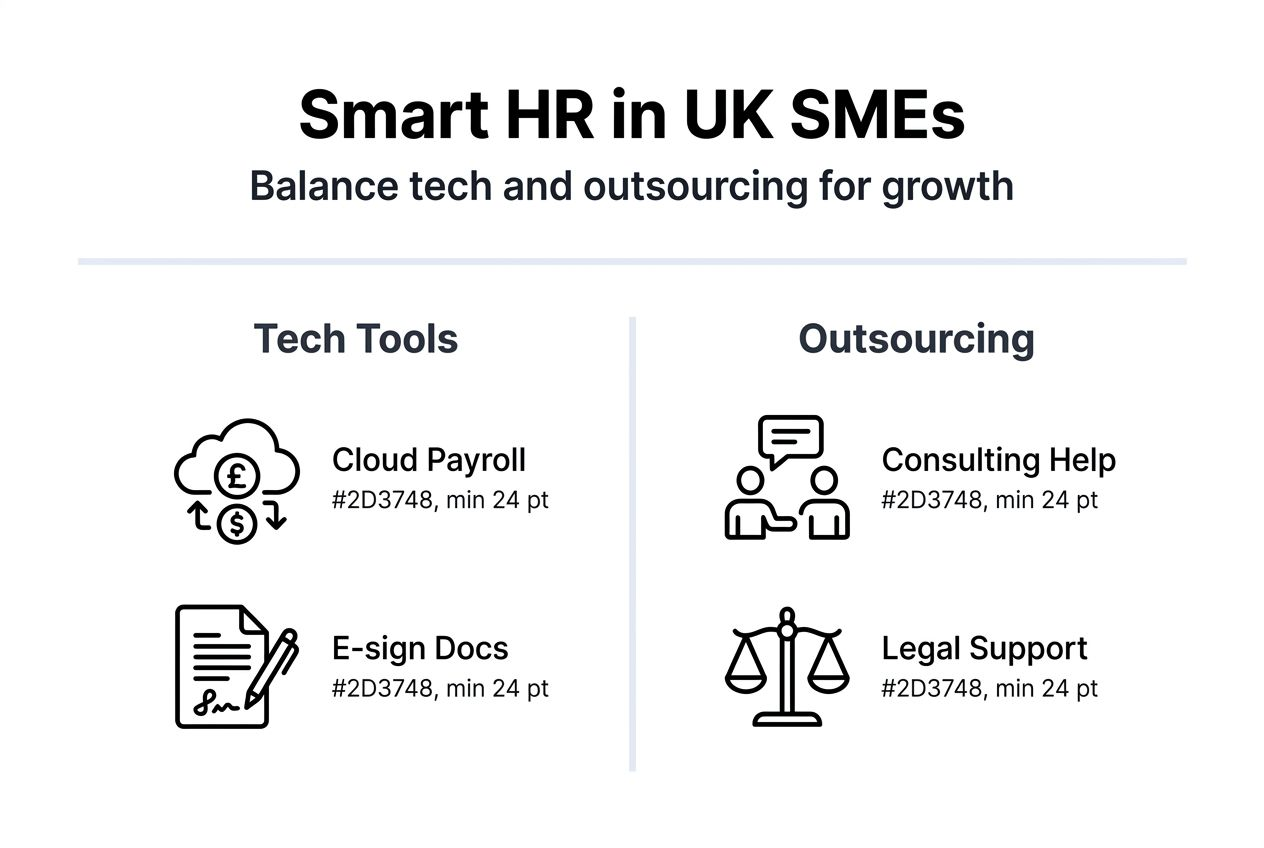
Hybrid work models demand digital HR infrastructure. Absence tracking, document signing, and employee communications can’t rely on paper systems when teams work remotely. Modern HR platforms centralise these functions whilst maintaining compliance records automatically.
| HR Function | In-House Approach | Technology Solution | Outsourced Option |
|---|---|---|---|
| Payroll processing | Manual calculations, high error risk | Automated software with tax updates | Third-party bureau handles everything |
| Recruitment | Time-intensive screening | Applicant tracking systems filter candidates | Recruitment agency manages full process |
| Policy development | Generic templates adapted slowly | Policy libraries with regular updates | HR consultancy writes bespoke policies |
| Employee records | Spreadsheets and filing cabinets | Secure cloud database with audit trails | Managed HR service maintains compliance |
Pro Tip: Start with one HR technology platform that solves your biggest pain point, master it completely, then add integrations. Trying to implement multiple systems simultaneously overwhelms small teams and reduces adoption rates.
Outsourcing works best for specialised or infrequent tasks. Complex dismissals, employment tribunal representation, and annual policy reviews benefit from expert input. Routine tasks like payroll and benefits administration suit technology solutions or external providers. Keep core people management in-house where relationship building and cultural alignment matter most.
Balance matters. A micro business might outsource everything except day-to-day line management. A 50-person SME might have one HR generalist supported by technology and external specialists for complex issues. Match your approach to your size, budget, and growth trajectory.
Training employees to use HR technology maximises your investment. Systems only deliver value when people actually use them correctly. Build change management and user training into every technology project. Your why upskill your team resources explain how continuous learning drives technology adoption and broader business benefits.
Employee development and wellbeing as business drivers
Employee Assistance Programmes tackle the cost-of-living stress that reduces productivity by 75% in affected SMEs. Confidential counselling, financial advice, and mental health support help employees manage personal challenges before they derail performance. EAPs cost less than replacing stressed employees who leave.
Continuous learning closes skills gaps whilst boosting engagement. Employees who see clear development pathways stay longer and perform better. You don’t need expensive training budgets; structured mentoring, online courses, and cross-functional projects all build capabilities.
Practical development initiatives:
- Quarterly skills assessments identify gaps and inform training priorities
- Lunch-and-learn sessions where team members share expertise internally
- Sponsored professional certifications aligned with business needs
- Cross-training programmes that build team resilience and career breadth
- External conferences and networking events that bring fresh perspectives
Cross-functional training creates adaptable teams. When multiple people understand critical processes, you avoid single points of failure. Employees gain broader skills and clearer views of how their work contributes to business success. This builds engagement whilst improving operational resilience.
Wellbeing correlates directly with retention and productivity. Employees who feel supported, valued, and healthy deliver better results. Simple initiatives like flexible working hours, regular check-ins, and recognition programmes make tangible differences without major costs.
Invest in development as systematically as you invest in equipment or marketing. Your people drive every business outcome. Upskilling isn’t a nice-to-have; it’s fundamental to competing effectively. Resources on why upskill your team detail how learning cultures transform SME performance and employee satisfaction.
Common misconceptions about HR in SMEs
Many SME owners believe HR is purely administrative, handling contracts and holiday requests. This outdated view costs businesses competitive advantage. Strategic HR shapes culture, attracts talent, and drives measurable business outcomes. The administrative tasks are necessary, but they’re not where HR creates real value.
Myths that hold SMEs back:
- “We’re too small for formal HR”: Employment law applies equally to five-person and fifty-person businesses. Informal approaches create legal vulnerabilities and cultural inconsistency.
- “Outsourcing is too expensive”: Pay-as-you-go HR support often costs less than the consequences of poor decisions. You access expertise without full-time salaries.
- “Policies create bureaucracy”: Clear policies actually reduce confusion and conflict. They protect both employers and employees by setting consistent expectations.
- “HR doesn’t affect our bottom line”: Recruitment costs, turnover expenses, and productivity losses from poor people management directly impact profitability.
Some owners fear formal HR will slow decision-making or create rigid structures. The opposite is true. Well-designed HR processes enable faster, more confident decisions because frameworks and precedents already exist. You spend less time reinventing responses to common situations.
Outsourcing suits SMEs precisely because it’s flexible and scalable. You pay for expertise when you need it, not year-round salaries for skills you use occasionally. This matches SME realities far better than trying to build in-house HR teams before you reach sufficient scale.
Even micro businesses benefit from documented policies. A simple handbook covering core employment terms, holiday processes, and behavioural expectations prevents misunderstandings and provides reference points when issues arise. It’s not bureaucracy; it’s clarity that protects everyone.
Practical framework for optimising HR in resource-constrained SMEs
Start with a compliance and capability audit. Document your current policies, contracts, and procedures. Compare them against legal requirements and identify gaps. This baseline shows where immediate action prevents risks and where you have breathing room for strategic improvements.
Stepwise optimisation approach:
- Secure compliance foundations: Update contracts, formalise essential policies, and establish audit routines for ongoing legal alignment.
- Strengthen core processes: Implement structured recruitment, onboarding, and performance management that support business goals.
- Address critical gaps: Tackle your biggest pain points first, whether that’s high turnover, skills shortages, or productivity issues.
- Deploy targeted technology: Choose tools that solve specific problems rather than comprehensive platforms you’ll underutilise.
- Build strategic capability: Develop HR practices that actively drive growth, innovation, and competitive advantage.
| Business Size | Priority Focus | Recommended Mix |
|---|---|---|
| 1-10 employees | Compliance, core policies | Outsourced advice + simple HR software |
| 11-30 employees | Recruitment, retention systems | Part-time HR + technology platforms |
| 31-50 employees | Strategic HR, culture building | HR generalist + specialist consultants |
| 50+ employees | Integrated people strategy | Small HR team + technology ecosystem |
Pro Tip: Track three HR metrics monthly: time to hire, voluntary turnover rate, and employee engagement scores. These leading indicators show whether your HR optimisation efforts are working before problems become crises.
Align every HR initiative with business objectives. If you’re expanding into new markets, HR should focus on talent acquisition and onboarding. If you’re improving margins, HR should address productivity and retention. Strategic alignment ensures HR investment delivers measurable business returns.
Monitor outcomes systematically. Reduced turnover saves recruitment costs. Faster hiring supports growth targets. Improved engagement drives productivity. Quantify these impacts to justify continued HR investment and refine your approach based on what actually works in your specific context.
Boost your SME growth with smart HR and compliance support
Optimising your HR function is just one piece of building a thriving SME. You need practical guidance across growth strategy, compliance frameworks, and business development to compete effectively in 2026.
Kefihub provides expert resources tailored specifically for UK SMEs. Our business growth roadmap for UK SMEs guides you through scaling systematically whilst maintaining quality and culture. The small business compliance guide for UK SMEs ensures you meet legal obligations without drowning in bureaucracy. Explore our networking for SMEs guide to build the connections that open doors to new opportunities, partnerships, and markets.
Frequently asked questions
What is the role of HR in small and medium-sized enterprises?
HR in SMEs drives recruitment, retention, compliance, and culture development. It’s a strategic function that supports sustainable growth, not just administrative paperwork. Effective HR shapes how you attract talent, develop capabilities, and maintain legal compliance whilst building organisational culture that differentiates you from competitors.
How can SMEs manage HR compliance effectively with limited resources?
Conduct regular compliance audits using simple checklists against current employment law. Leverage external HR consultants for complex issues and legal updates. Technology platforms automate compliance tracking for policies, training, and documentation. This combination delivers robust compliance without requiring full-time specialist staff or overwhelming small teams.
What are effective ways for SMEs to retain employees in 2026?
Implement Stay Interviews quarterly to understand what keeps employees engaged and address concerns proactively. Provide Employee Assistance Programmes for wellbeing support and mental health resources. Offer continuous upskilling opportunities through training, mentoring, and clear career pathways. Recognition, flexible working, and transparent communication complete a retention strategy that reduces costly turnover.
Should small businesses outsource HR or keep it in-house?
Balance in-house and outsourced HR based on your size and needs. Keep core people management in-house for culture and relationships. Outsource specialised tasks like complex dismissals, policy writing, and tribunal representation. Technology handles routine administration like payroll and absence tracking. This hybrid approach maximises expertise whilst controlling costs for resource-constrained SMEs.
How does HR technology help small businesses compete with larger firms?
HR technology automates time-consuming administrative tasks, freeing your team for strategic work. Cloud platforms provide enterprise-grade capabilities at SME-friendly prices, levelling the playing field. Digital tools support hybrid working, enable data-driven decisions, and create professional employee experiences that help you attract talent despite smaller budgets. Technology extends your HR capacity without expanding headcount, allowing strategic impact within resource constraints.
Recommended
- 7 Steps to a Robust Legal Compliance Checklist for UK SMEs – Kefihub
- How to Optimise Professional Website for UK SMEs – Kefihub
- Small Business Compliance Guide: Essential Steps for UK SMEs – Kefihub
- 7 Smart Business Growth Strategies for UK Professionals – Kefihub
- Sales Performance Management: Driving Consistent UK Growth
- Digital Forensics in HR Cases: 85% Evidence Discovery Rate