


{
“@type”: “Article”,
“image”: {
“url”: “https://csuxjmfbwmkxiegfpljm.supabase.co/storage/v1/object/public/blog-images/organization-8865/1770277948021_image.png”,
“@type”: “ImageObject”,
“caption”: “Legal team reviews contracts in boardroom”
},
“author”: {
“url”: “https://kefihub.co.uk”,
“name”: “Kefihub”,
“@type”: “Organization”
},
“@context”: “https://schema.org”,
“headline”: “Contract Law Explained: Safeguarding Your UK Business”,
“publisher”: {
“url”: “https://kefihub.co.uk”,
“name”: “Kefihub”,
“@type”: “Organization”
},
“inLanguage”: “en-US”,
“articleBody”: “”,
“description”: “Learn the essentials of contract law for UK businesses, including key requirements, risks, types of contracts, and legal obligations for owners.”,
“datePublished”: “2026-02-05T07:53:10.904Z”
}
Legal misunderstandings can easily catch UK small business owners off guard, especially when it comes to contract law. Clarity on the true meaning and common myths behind contracts is essential because even basic mistakes can lead to costly disputes or risk your business interests. This guide brings practical insight into the core legal elements that make agreements valid, helping you recognise common pitfalls and understand how solid contracts protect your team and assets.
Table of Contents
- Contract Law: Core Meaning And Myths
- Types Of Business Contracts Explained
- Essential Elements In UK Contracts
- Legal Framework Governing Contracts
- Rights, Duties And Common Pitfalls
- Managing Risks And Breaches Effectively
Key Takeaways
| Point | Details |
|---|---|
| Understanding Contract Law | Grasp the key elements such as offer, acceptance, and consideration to create enforceable agreements. |
| Beware of Misconceptions | Many small business owners mistakenly believe verbal contracts are enforceable or that terms can be altered without consequences. |
| Importance of Professional Review | Always consult a legal professional for contract drafting and review to avoid potential legal vulnerabilities. |
| Effective Risk Management | Implement proactive monitoring and clear escalation procedures to address potential contract breaches effectively. |
Contract Law: Core Meaning and Myths
Contract law serves as the foundational framework governing legal agreements between parties in business and personal interactions. Understanding its core principles is crucial for protecting your commercial interests and avoiding potential disputes. University of London’s contract law study guide emphasises the importance of comprehending not just the rules, but the analytical skills required to navigate complex legal scenarios.
At its essence, contract law defines the legal requirements for creating valid, enforceable agreements. These requirements typically involve several key elements that must be present to establish a legally binding contract:
- Offer: A clear proposal made by one party
- Acceptance: Unambiguous agreement to the proposed terms
- Consideration: Something of value exchanged between parties
- Intention to Create Legal Relations: Mutual understanding that the agreement is legally serious
- Capacity: Legal ability of parties to enter into a contract
Many small business owners harbour misconceptions about contract law that can lead to significant legal vulnerabilities. Some prevalent myths include believing that verbal agreements are not enforceable or that contract terms can be changed unilaterally without consequences. These misunderstandings can expose businesses to unnecessary financial and legal risks.
Contract law isn’t about finding loopholes, but about establishing clear, mutually understood expectations between parties.
To effectively protect your business, you must move beyond simplistic interpretations and develop a nuanced understanding of contractual principles. This means recognising that contracts are living documents requiring careful drafting, thorough review, and strategic management.
Pro tip: Always consult a legal professional to review complex contracts and ensure your business’s interests are comprehensively protected.
Types of Business Contracts Explained
Navigating the complex world of business contracts requires a comprehensive understanding of different legal agreements that protect your company’s interests. UK business contract fundamentals reveal several critical contract types essential for small and medium enterprises.
Business contracts serve as the backbone of commercial interactions, providing legal frameworks that define expectations, responsibilities, and potential remedies. The most common types of business contracts include:
- Employment Contracts: Defining terms of employment, roles, responsibilities, and compensation
- Service Agreements: Outlining specific services to be provided, performance expectations, and payment terms
- Supplier Contracts: Establishing purchasing terms, delivery requirements, and quality standards
- Non-Disclosure Agreements (NDAs): Protecting confidential business information
- Lease Agreements: Defining terms for using commercial property or equipment
- Partnership Agreements: Establishing terms of business partnerships and shared responsibilities
Each contract type carries unique legal implications and requires careful consideration. Employment contracts, for instance, must comply with UK labour laws, while service agreements need precise language defining deliverables and performance metrics. Small business owners must understand that these documents are not mere formalities but legally binding instruments that can significantly impact business operations.

The following table highlights the key differences between common types of business contracts in the UK:
| Contract Type | Main Purpose | Special Legal Consideration |
|---|---|---|
| Employment Contract | Sets employee terms and benefits | Must comply with labour regulations |
| Service Agreement | Specifies services and deliverables | Detailed scopes prevent disputes |
| Supplier Contract | Manages goods purchasing terms | Delivery and quality clauses crucial |
| Non-Disclosure Agreement | Protects confidential information | Breach can result in court injunction |
| Lease Agreement | Allows property or equipment use | Lease duration and renewal terms matter |
| Partnership Agreement | Defines roles and profit sharing | Requires clarity for liability sharing |
A well-drafted contract is your first line of defence against potential legal disputes and financial uncertainties.
The complexity of these agreements underscores the importance of professional legal review. While template contracts might seem convenient, they often fail to address the nuanced requirements of individual businesses. Context matters, and generic documents can leave critical gaps in protection.
Pro tip: Invest in professional legal consultation when drafting or reviewing business contracts to ensure comprehensive protection of your commercial interests.
Essential Elements in UK Contracts
Understanding the fundamental elements that constitute a legally binding contract is crucial for UK business owners seeking to protect their commercial interests. Essential contract law principles provide a comprehensive framework for creating robust and enforceable agreements.
A valid UK contract requires several critical components that collectively ensure legal integrity and mutual protection. These essential elements include:
- Offer: A clear, specific proposal made by one party
- Acceptance: Unambiguous agreement to the proposed terms
- Consideration: Something of value exchanged between parties
- Intention to Create Legal Relations: Demonstrable mutual commitment
- Capacity: Legal ability of parties to enter into an agreement
- Certainty of Terms: Clear, precise, and unambiguous contract language
- Lawful Purpose: Objectives that do not violate legal regulations
Each element plays a vital role in establishing contractual validity. An offer must be definitive and communicated clearly, while acceptance requires an unequivocal agreement to those precise terms. Consideration involves a tangible exchange of value, which could be monetary or a commitment to perform specific actions. The intention to create legal relations separates casual agreements from legally binding contracts.
A contract is only as strong as its weakest legal element.
The legal capacity of parties is equally important, ensuring that all signatories have the legal authority to enter into the agreement. This means individuals must be of legal age, mentally competent, and not under undue pressure or misrepresentation. Small business owners must pay particular attention to these nuanced requirements to prevent potential future disputes.
Pro tip: Always have a legal professional review your contracts to ensure all essential elements are comprehensively and accurately addressed.
Legal Framework Governing Contracts
The legal landscape of contract governance in the United Kingdom comprises a complex, multilayered system that balances statutory requirements with common law principles. Public sector procurement regulations provide critical insights into the intricate legal frameworks that guide contractual interactions across different sectors.
The UK’s contract law framework is fundamentally built upon several key regulatory components:
- Common Law: Traditional judicial precedents and court interpretations
- Statutory Legislation: Acts of Parliament defining specific contractual rules
- European Retained Law: Regulations maintained post-Brexit
- International Conventions: Global trade and contract standards
- Sector-Specific Regulations: Industry-focused legal requirements
- Government Procurement Guidelines: Official standards for public and private contracts
Common law remains the foundational bedrock of contract governance, with judicial decisions creating precedents that guide future interpretations. Statutory legislation, such as the Sale of Goods Act and Consumer Rights Act, provides additional layers of protection and definition. These legal instruments work collaboratively to ensure fairness, transparency, and accountability in contractual relationships.
Legal frameworks are not static walls, but dynamic bridges connecting business interests with regulatory protection.
The interplay between different legal sources creates a robust system that adapts to evolving business practices while maintaining core principles of contractual integrity. Small business owners must recognise that understanding these frameworks is not just a legal requirement, but a strategic advantage in navigating complex commercial landscapes.
Pro tip: Regularly consult legal professionals to stay updated on the latest regulatory changes affecting your specific industry and contractual requirements.
Rights, Duties and Common Pitfalls
Navigating the intricate landscape of contractual rights and duties requires a nuanced understanding of potential legal complexities. Comprehensive contract law principles reveal the delicate balance between contractual freedoms and legal responsibilities that UK businesses must carefully manage.
In the realm of contract law, parties possess distinct rights and corresponding duties that form the foundation of legal agreements:
-
Right to Performance: Expecting contractual obligations to be fulfilled
-
Duty of Good Faith: Acting honestly and transparently
-
Right to Compensation: Seeking remedies for contractual breaches
-
Duty of Reasonable Care: Maintaining professional standards
-
Right to Terminate: Ending agreements under specified conditions
-
Duty of Disclosure: Sharing material information openly
Common pitfalls can transform seemingly straightforward contracts into potential legal minefields. Misrepresentation, ambiguous terms, and unintentional breaches frequently emerge as significant risks for small business owners. Verbal agreements, while sometimes technically enforceable, often lack the precision required to withstand legal scrutiny.
Contracts are not mere paperwork, but strategic documents that define business relationships.
The most frequent contractual mistakes include failing to clearly define terms, overlooking potential scenarios, and neglecting to include dispute resolution mechanisms. Small businesses are particularly vulnerable to these oversights, which can result in costly legal disputes and damaged professional relationships.
Pro tip: Always draft contracts with extreme clarity and have a legal professional review them to identify potential weaknesses before signing.
Managing Risks and Breaches Effectively
Effective contract management requires a strategic approach to identifying, mitigating, and responding to potential risks and breaches. Public sector contract management standards provide valuable insights into proactive risk management techniques that can be adapted by businesses of all sizes.
Key strategies for managing contractual risks and potential breaches include:
- Proactive Monitoring: Continuous assessment of contract performance
- Clear Escalation Procedures: Defined steps for addressing potential issues
- Comprehensive Documentation: Maintaining detailed records of interactions
- Risk Assessment Frameworks: Systematic identification of potential vulnerabilities
- Contingency Planning: Developing alternative strategies for potential breaches
- Regular Contract Reviews: Periodic evaluation of agreement terms and performance
Breaches can manifest in multiple forms, from minor performance issues to significant contractual violations. Small business owners must distinguish between material breaches that fundamentally undermine the contract and minor infractions that can be remedied. Understanding the nuanced difference requires careful legal interpretation and strategic decision-making.
Risk management is not about eliminating all potential problems, but about creating robust systems to identify and address them effectively.
The most effective approach involves a combination of preventative measures and responsive strategies. This means developing clear contractual language, establishing communication protocols, and creating mechanisms for swift resolution of potential disputes. Technology and systematic documentation play crucial roles in maintaining contractual integrity and providing evidence in case of potential legal challenges.
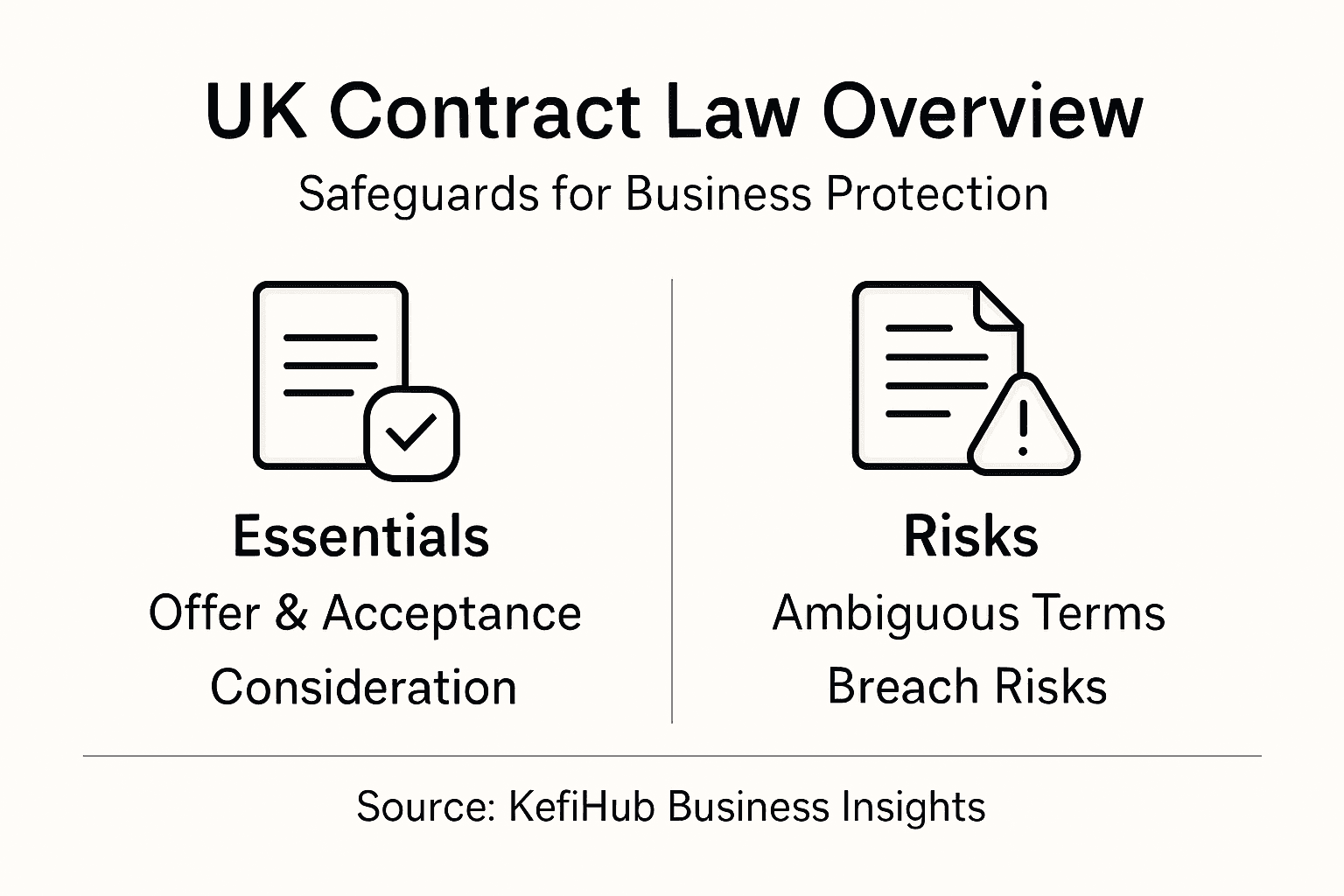
Here is a summary of strategies for managing risks and contract breaches effectively:
| Strategy | Purpose | Example Benefit |
|---|---|---|
| Proactive Monitoring | Detect early warning signs | Issues addressed before escalation |
| Clear Escalation | Shape response to problems | Staff know precise reporting steps |
| Comprehensive Documentation | Maintain evidence for disputes | Easier to prove obligations met |
| Risk Assessment | Identify vulnerabilities | Focuses efforts on high-risk areas |
| Contingency Planning | Prepare for breaches | Minimises operational disruptions |
| Regular Reviews | Update for relevant changes | Keeps contracts compliant and current |
Pro tip: Develop a standardised risk management process that includes regular contract audits, clear escalation procedures, and predetermined response strategies for potential breaches.
Secure Your Business with Expert Contract Law Insights
Understanding contract law is essential to protect your UK business from costly disputes and legal pitfalls. This article highlights critical concepts such as offer, acceptance, consideration, and the intention to create legal relations. It also reveals common misunderstandings like assuming verbal agreements are always unenforceable. Without clear, well-drafted contracts, your business risks financial loss and operational uncertainty.
At KefiHub, we provide practical guidance tailored for small business owners who want to confidently navigate the complexities of UK contract law. We offer actionable advice on drafting and managing employment contracts, service agreements, and non-disclosure arrangements to safeguard your commercial interests. Discover how to avoid common pitfalls and implement effective risk management strategies by exploring our expert resources at KefiHub.

Take control of your business’s legal foundation now. Visit KefiHub to access clear, reliable insights designed to empower you with the knowledge needed to draft, review, and manage contracts successfully. Don’t leave your business’s future to chance. Start building stronger agreements today with trusted guidance from KefiHub.
Frequently Asked Questions
What are the essential elements of a valid contract?
A valid contract requires several key elements: an offer, acceptance, consideration, intention to create legal relations, capacity, certainty of terms, and a lawful purpose. Each component is critical for establishing enforceability and legal integrity.
How can small businesses protect themselves from contract disputes?
Small businesses can protect themselves by clearly defining contract terms, consulting legal professionals for reviews, and drafting comprehensive agreements that include dispute resolution mechanisms and clear performance expectations.
What risks should businesses be aware of when entering into contracts?
Businesses should be aware of risks such as misrepresentation, ambiguous terms, and the potential for breaches. Regular contract reviews and proactive risk management strategies can help identify and mitigate these threats before they escalate into disputes.
Why is it important to include consideration in a contract?
Consideration refers to something of value exchanged between the parties, which demonstrates that both parties are committed to the agreement. Without consideration, a contract may lack enforceability and could be deemed a gift rather than a binding agreement.
Recommended
- Role of Contracts in Business – Protecting UK Interests – Kefihub
- 7 Key Benefits of Registering a Business in the UK – Kefihub
- Why Form a Limited Company in the UK? – Kefihub
- Why Choose Limited Company? Key Benefits Explained – Kefihub
- A Rock-Solid Guarantee – Summit Scale