


High-conflict divorce can quickly escalate when one party uses subtle manipulation to avoid accountability. Understanding DARVO manipulation is crucial because it enables abusers to undermine credibility and shift blame, severely impacting the outcome of family court proceedings. By recognising the core tactics—deny, attack, and reverse victim and offender—solicitors and families can protect themselves from false allegations and build stronger, evidence-based cases in the face of emotional abuse.
Table of Contents
- DARVO Manipulation: Definition and Core Concepts
- Recognising DARVO Patterns in Family Proceedings
- Legal Recognition Under UK Domestic Abuse Law
- Building Evidence Against DARVO Tactics Effectively
- Practical Strategies for Families and Solicitors
Key Takeaways
| Point | Details |
|---|---|
| Understanding DARVO | DARVO is a psychological manipulation technique used to avoid accountability by denying allegations, attacking accusers, and portraying oneself as the victim. |
| Recognising Manipulation in Family Law | Awareness of DARVO tactics is crucial for legal professionals to fairly assess interpersonal disputes and protect genuine victims. |
| Legal Evolution in the UK | UK Domestic Abuse Law acknowledges psychological abuse as serious as physical violence, emphasising the importance of understanding coercive control and emotional manipulation. |
| Building Robust Evidence | Effective countering of DARVO requires meticulous documentation, including chronological records and corroborating witness statements, to expose manipulation tactics. |
DARVO Manipulation: Definition and Core Concepts
DARVO represents a sophisticated psychological manipulation strategy frequently encountered in complex legal and interpersonal conflicts. Understanding abuse manipulation patterns reveals how perpetrators strategically avoid accountability through deliberate behavioural responses.
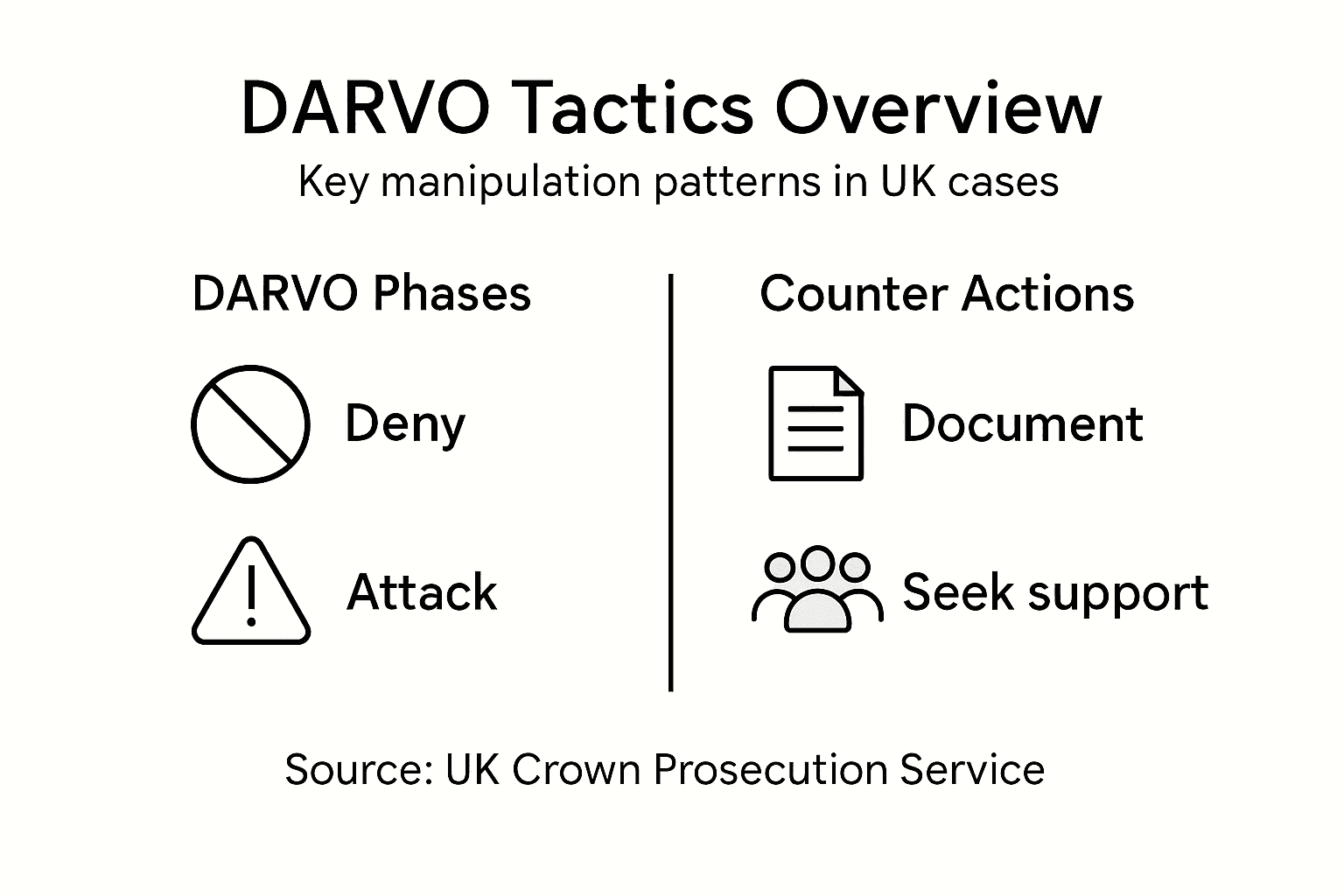
At its core, DARVO is an acronym that describes a three-stage emotional manipulation technique designed to undermine a victim’s credibility. The stages include:
- Deny: Completely rejecting any allegations or accusations
- Attack: Launching counter-accusations against the person making the original claim
- Reverse Victim and Offender: Repositioning themselves as the actual victim
This psychological mechanism allows individuals to deflect responsibility by creating confusion and shifting narrative control. The manipulator essentially transforms from an alleged perpetrator into an apparently wronged party, strategically challenging the victim’s version of events.
In legal contexts, particularly family law proceedings, DARVO tactics can significantly impact how observers and decision-makers perceive conflicting testimonies. Professionals must recognise these manipulation strategies to ensure fair assessment of complex interpersonal disputes.
DARVO represents a calculated attempt to destabilise the victim’s narrative by creating doubt about their account of events.
Recognising DARVO requires understanding its nuanced psychological dynamics. Manipulators often employ subtle techniques like minimising harmful behaviours, presenting themselves as reasonable, and systematically undermining the victim’s emotional credibility.
Pro tip: Document every interaction meticulously, recording specific behaviours and statements that demonstrate manipulation patterns.
Recognising DARVO Patterns in Family Proceedings
Understanding complex psychological manipulation in family court requires careful observation of nuanced behavioural patterns that go beyond surface-level interactions. DARVO tactics frequently emerge as sophisticated strategies designed to distort legal proceedings and undermine genuine victims’ credibility.
Family law practitioners should be alert to several critical manifestations of DARVO manipulation:
- Persistent Denial: Categorically rejecting all allegations without substantive evidence
- Aggressive Counterattacks: Launching sophisticated attempts to discredit the accuser
- Emotional Manipulation: Presenting themselves as the true victim of unfair treatment
- Strategic Deflection: Redirecting conversations to minimise their own accountability
These manipulation techniques often intersect with more complex relational dynamics, particularly in cases involving parental alienation or coercive control. The manipulator systematically constructs an alternative narrative that portrays themselves as the wronged party, carefully selecting language and evidence to support their fabricated perspective.
DARVO represents a calculated psychological strategy aimed at destabilising legitimate claims and undermining judicial understanding of interpersonal conflicts.
In family court proceedings, DARVO can manifest through intricate behavioural patterns such as presenting extensive documentation designed to paint the victim as unreasonable, orchestrating elaborate character assassinations, and strategically using legal processes to intimidate or exhaust their opponent.

Pro tip: Maintain comprehensive, contemporaneous documentation of all interactions, focusing on specific behaviours rather than emotional interpretations.
Legal Recognition Under UK Domestic Abuse Law
Domestic abuse legislation in the United Kingdom has evolved significantly, recognising psychological manipulation as a critical component of abusive behaviour. The Serious Crime Act 2015 represents a pivotal moment in legal understanding, explicitly acknowledging that domestic abuse extends far beyond physical violence.
The legislative framework now encompasses several crucial elements of psychological abuse:
- Coercive Control: Recognising patterns of behaviour designed to strip away victim’s autonomy
- Emotional Manipulation: Understanding psychological tactics that undermine personal agency
- Systematic Degradation: Identifying sustained patterns of psychological oppression
- Power Dynamics: Examining relationship structures that enable sustained psychological abuse
Under current legal interpretations, courts increasingly recognise that psychological manipulation can be as damaging as physical violence. This progressive approach allows for more comprehensive protection of victims, acknowledging the complex nature of domestic abuse beyond traditional physical harm indicators.
Psychological manipulation represents a sophisticated form of abuse that can be as destructive as physical violence, requiring nuanced legal interpretation.
The Crown Prosecution Service provides detailed guidance on investigating and prosecuting these complex cases, emphasising the importance of comprehensive evidence collection and understanding the intricate psychological dynamics at play. This approach reflects a growing recognition that domestic abuse is fundamentally about power, control, and systematic psychological oppression.
The table below outlines how UK law addresses psychological abuse:
| Legal Principle | Recognised Impact | Application in Family Law |
|---|---|---|
| Coercive Control | Limits victim autonomy | Used to identify controlling patterns |
| Emotional Manipulation | Reduces victim’s agency | Affects credibility assessments |
| Systematic Degradation | Lowers self-esteem | Signals long-term abuse |
| Power Dynamics | Imbalances decision-making power | Influences custody and contact |
Pro tip: Collect detailed documentation of interactions, including communication patterns, witnesses, and specific behavioural instances that demonstrate psychological manipulation.
Building Evidence Against DARVO Tactics Effectively
Strategic evidence organisation represents the cornerstone of effectively countering DARVO manipulation in legal proceedings. Successful evidence compilation requires a methodical, structured approach that anticipates and neutralises psychological manipulation tactics.
Key elements of building a robust evidence portfolio include:
- Comprehensive Documentation: Maintaining detailed, chronological records of all interactions
- Digital Evidence Preservation: Capturing electronic communications, screenshots, and message histories
- Witness Statement Collection: Gathering corroborating accounts from neutral third parties
- Psychological Expert Consultation: Obtaining professional assessments of manipulation patterns
- Communication Pattern Analysis: Identifying consistent behavioural manipulation strategies
Successful evidence compilation demands more than simply collecting information; it requires strategic organisation that exposes manipulation tactics while maintaining professional objectivity. Legal practitioners recommend creating a systematic approach that highlights inconsistencies in the manipulator’s narrative without appearing emotionally reactive.
Effective evidence against DARVO requires surgical precision: document objectively, present factually, and expose manipulation through consistent, verifiable information.
The most compelling evidence often emerges from meticulous record-keeping that demonstrates patterns of behaviour rather than isolated incidents. This approach requires patience, attention to detail, and a commitment to maintaining emotional distance while systematically building a comprehensive case.
Here is a comparison of effective evidence types against DARVO manipulation:
| Evidence Type | Key Benefit | Example in Practice |
|---|---|---|
| Chronological Records | Exposes behavioural patterns | Detailed diary with timestamps |
| Digital Communications | Verifies statements and timing | Email or messaging app screenshots |
| Third-Party Statements | Adds impartial verification | Witness letters from professionals |
| Expert Assessments | Confirms psychological tactics | Psychologist court report |
Pro tip: Create a dedicated digital and physical evidence file with strict chronological organisation, including timestamps, context, and corroborating documentation.
Practical Strategies for Families and Solicitors
Psychological defence mechanisms require sophisticated, strategic responses in family court proceedings. Families and legal representatives must develop a nuanced approach that anticipates and neutralises manipulative tactics while maintaining professional composure.
Effective strategies for combating DARVO manipulation include:
- Emotional Regulation: Maintaining calm and professional demeanour during confrontational interactions
- Evidence Preservation: Systematically documenting all communications and interactions
- Expert Consultation: Engaging psychological professionals to provide expert testimony
- Legal Strategic Planning: Developing comprehensive response strategies that expose manipulation
- Boundary Establishment: Creating clear communication protocols that minimise potential manipulation
Successful navigation of DARVO tactics demands a multi-dimensional approach that combines legal acumen with psychological understanding. Solicitors must help their clients recognise manipulation patterns while simultaneously building a robust legal strategy that prioritises factual evidence and objective presentation.
Effective legal strategies against DARVO require a surgical approach: document meticulously, respond strategically, and prioritise factual evidence over emotional reactivity.
The most effective defence involves a proactive, collaborative approach between the legal team and their client. This includes developing comprehensive communication strategies, preparing detailed documentation, and creating a unified narrative that systematically deconstructs manipulative tactics.
Pro tip: Maintain a comprehensive, time-stamped evidence journal that captures communication patterns, interactions, and potential manipulation attempts.
Empower Yourself Against DARVO Manipulation in UK Family Law
Navigating the complexities of DARVO tactics in family law can be overwhelming. The challenge lies in recognising denial, attacks, and reversal of victim and offender roles while maintaining clear evidence and emotional composure. If you are facing manipulative behaviours that threaten your credibility or seeking to understand how psychological abuse is treated under UK law, gaining practical insights is essential. Stay informed on effective strategies to document interactions and counter emotional manipulation with expert advice tailored for UK professionals.

Explore comprehensive guidance and actionable advice on maintaining control and clarity in difficult legal situations with KefiHub. Whether you are a legal professional or an individual affected by complex family disputes, our UK-based platform provides real-world stories and expert commentary that empower you to respond strategically and protect your interests. Take control now by visiting KefiHub and uncover how to identify, document, and counter manipulation effectively.
Frequently Asked Questions
What is DARVO in the context of family law?
DARVO is an acronym that stands for Deny, Attack, and Reverse Victim and Offender, representing a psychological manipulation strategy used by perpetrators to avoid accountability and undermine a victim’s credibility in legal contexts.
How can I recognise DARVO tactics in family court proceedings?
Recognising DARVO involves observing persistent denial of allegations, aggressive counterattacks against the accuser, emotional manipulation to position oneself as the victim, and strategic deflection of accountability during discussions.
What strategies can be used to counter DARVO manipulation effectively?
Effective strategies include maintaining emotional regulation, documenting all interactions comprehensively, engaging psychological experts for assessments, developing legal responses to expose manipulation, and establishing clear communication boundaries to minimise manipulation risks.
How can I build evidence against DARVO tactics in legal proceedings?
Building evidence requires comprehensive documentation of interactions, preservation of digital communications, collection of witness statements, obtaining psychological expert assessments, and analysing communication patterns to highlight consistent manipulation strategies.
Recommended
- Role of a Solicitor: Navigating Legal Matters in the UK – Kefihub
- Why the Right Technology is the Secret Weapon for UK Law Firms’ Marketing Success – Kefihub
- How to Find Reliable Legal Advice for UK Homebuyers – Kefihub
- What is Service Design: Improving Experiences and Efficiency – Kefihub