


Many british professionals still mistake service design for a simple facelift rather than a deep transformation. Yet, organisations that prioritise service design report up to 30 percent higher customer satisfaction. Understanding the true scope of service design matters for UK-based professionals who want lasting results, not fleeting trends. Unpacking its core principles reveals actionable ways to create user-focused services that genuinely fit british customer needs and drive measurable business outcomes.
Table of Contents
- Defining Service Design And Common Misconceptions
- Core Principles And Major Approaches Explained
- Key Processes And Tools In Service Design
- Practical Applications For UK Businesses
- Benefits, Challenges And Common Pitfalls
Key Takeaways
| Point | Details |
|---|---|
| Understanding Service Design | Service design is a holistic approach focused on creating and improving service experiences through a comprehensive understanding of user needs and interactions. |
| Key Misconceptions | It’s often mistaken for merely aesthetic improvements; in reality, it requires deep research and iterative development to enhance service delivery. |
| Core Principles | Major principles include user-centricity, collaborative engagement, and systemic thinking, all aimed at creating adaptable service frameworks. |
| Benefits and Challenges | Effective service design improves user satisfaction and organisational efficiency but requires careful planning to avoid common pitfalls like insufficient user engagement and cultural inertia. |
Defining Service Design and Common Misconceptions
Service design represents a strategic approach to creating and improving services by understanding and addressing user needs comprehensively. Planning and arranging service components involves carefully considering how people, infrastructure, communication, and material elements interact to deliver an optimal experience.
At its core, service design transcends traditional product development by focusing on the entire user journey. Unlike product design, which concentrates on physical objects, service design examines the intangible interactions between service providers and users. This holistic perspective means considering every touchpoint, from initial customer contact through ongoing engagement. Human-centered design principles emphasise understanding real-world user challenges and crafting solutions that directly address their specific requirements.
Common misconceptions about service design often emerge from misunderstanding its comprehensive nature. Many professionals mistakenly believe service design is merely about aesthetics or superficial improvements. In reality, it involves deep ethnographic research, systematic analysis, and iterative development to create meaningful, adaptive service experiences. Key aspects include:
Here is a summary of common misconceptions versus the reality of service design:
| Misconception | Reality | Business Implication |
|---|---|---|
| Focuses only on aesthetics | Involves deep research and analysis | Drives more effective service improvements |
| Applies solely to products | Centres on user journeys and interactions | Enhances holistic customer experiences |
| Superficial process | Systematic development and iteration | Facilitates meaningful, lasting change |
| Technology is secondary | Integrates tech and human elements | Enables responsive, adaptable solutions |
- Mapping complete user journeys
- Identifying pain points and opportunities
- Developing empathetic understanding of user needs
- Creating flexible, responsive service frameworks
- Integrating technological and human interaction elements
Pro tip: When beginning a service design project, invest significant time in user research and direct observation before developing any solutions.
Core Principles and Major Approaches Explained
Service design operates through a robust set of multidisciplinary methods that integrate diverse approaches to create meaningful user experiences. These methods go beyond traditional design thinking, focusing on understanding the complex interactions between people, technology, and service environments. By combining insights from ethnography, management science, and user experience research, service designers develop holistic strategies that address both visible and invisible aspects of service delivery.
The core principles of service design are fundamentally rooted in human-centered design approaches, which emphasise empathy, collaboration, and continuous iteration. Key principles include:
- User-centricity: Placing user needs and experiences at the centre of design
- Collaborative engagement: Involving all stakeholders in the design process
- Systemic thinking: Understanding interconnected service components
- Iterative development: Continuously testing and refining solutions
- Adaptability: Creating flexible frameworks that can evolve with changing user requirements
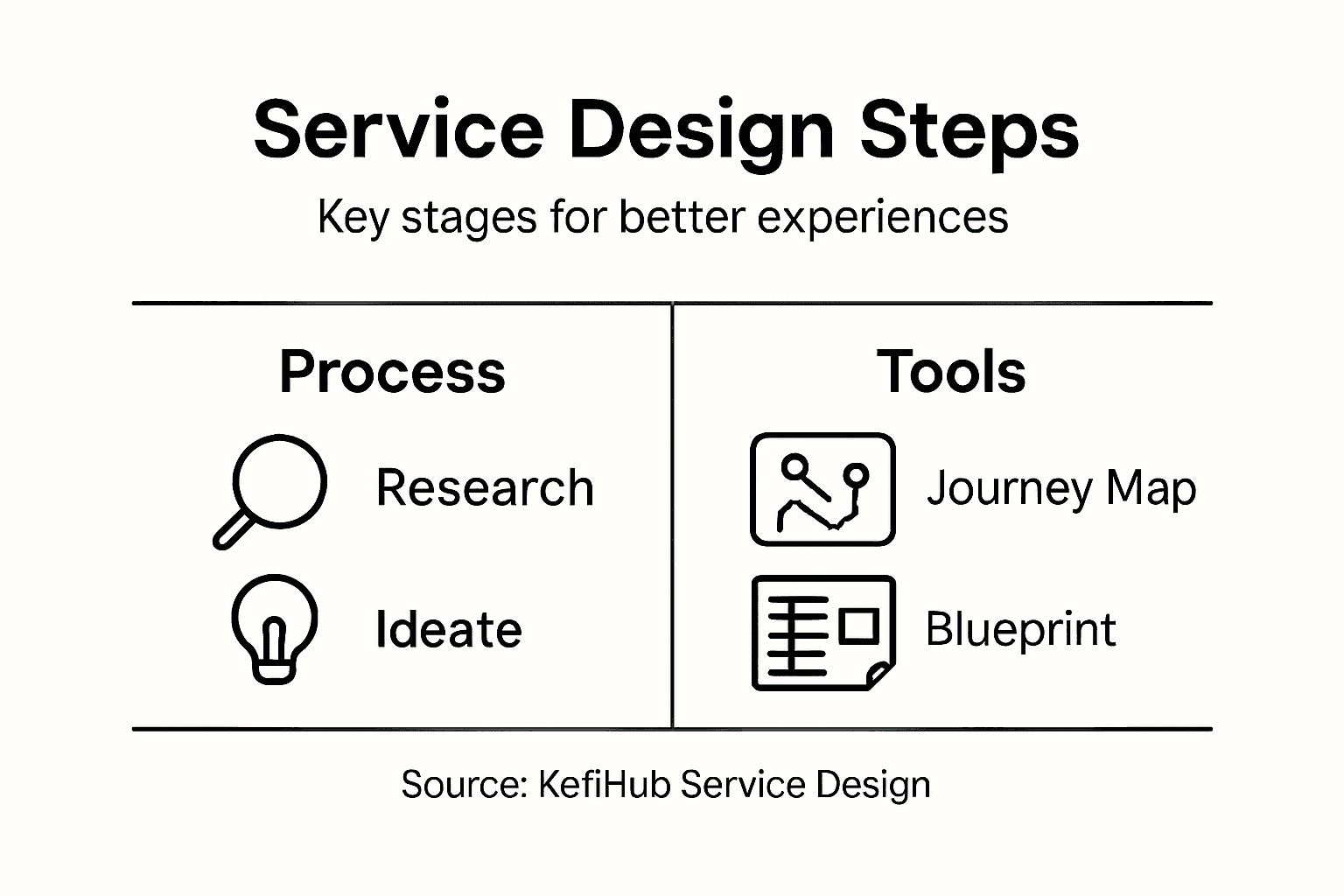
Practical approaches in service design typically involve comprehensive mapping techniques that visualise entire user journeys. These approaches help organisations identify pain points, opportunities for improvement, and potential innovations. Designers use tools like customer journey maps, service blueprints, and experience prototyping to create tangible representations of complex service interactions. By breaking down intricate processes into manageable components, service designers can develop more intuitive, efficient, and user-friendly services.

Pro tip: Invest in creating detailed customer journey maps that capture both emotional and functional aspects of user interactions to uncover hidden service design opportunities.
Key Processes and Tools in Service Design
Service design processes encompass a comprehensive approach to mapping, analysing, and improving service interactions through systematic methodologies that bridge multiple disciplines. These processes integrate insights from ethnography, management science, and interaction design to create holistic service experiences that address both visible and invisible aspects of user engagement.
Primary tools in service design include several critical techniques for understanding and visualising service ecosystems. Service delivery processes typically involve creating detailed documentation that captures both frontstage and backstage interactions. Key tools and approaches comprise:
- Customer journey mapping
- Experience prototyping
- Stakeholder interviews
- Persona development
- Service blueprinting
- Rapid iterative testing and evaluation (RITE)
Designers utilise these tools to create comprehensive representations of service interactions, identifying potential friction points and opportunities for innovation. Each tool serves a specific purpose in understanding user experiences, from capturing emotional responses to documenting technical service interactions. The goal is to develop a nuanced understanding of how users interact with services, allowing organisations to create more intuitive, responsive, and user-centred service designs.
For quick reference, here is a comparison of key service design tools, their primary use, and business value:
| Tool | Primary Use | Value for Business |
|---|---|---|
| Service Blueprint | Map service components | Reveals process improvement areas |
| Experience Prototyping | Test real-world interactions | Reduces risk in service rollouts |
| Persona Development | Build user archetypes | Tailors services to target audiences |
| Stakeholder Interviews | Gather direct insights | Strengthens collaboration and buy-in |
Pro tip: Combine multiple service design tools in your research to gain a more holistic understanding of user experiences and service interactions.
Practical Applications for UK Businesses
Service design offers transformative potential for UK businesses across multiple sectors, providing strategic approaches to enhance customer experiences and operational efficiency. Design innovation programs are specifically developing professionals who can tackle complex business challenges through systematic, human-centred methodologies.
In practice, UK businesses can apply service design principles across various contexts, including:
- Healthcare service optimisation
- Financial product development
- Digital transformation strategies
- Customer experience redesign
- Technology integration solutions
- Public sector service improvements
- Retail experience enhancement
Specifically, user experience design strategies enable organisations to develop more responsive, intuitive services. By mapping customer journeys, identifying pain points, and creating iterative solutions, businesses can significantly improve their operational effectiveness. This approach goes beyond traditional consulting by embedding user perspectives directly into service development processes.
Pro tip: Start your service design initiative by conducting comprehensive user research and creating detailed customer journey maps to uncover hidden improvement opportunities.
Benefits, Challenges and Common Pitfalls
Service design offers significant strategic advantages, but organisations must navigate potential challenges with careful planning and realistic expectations. Design strategies for public services demonstrate both the transformative potential and complex implementation landscape of service design approaches.
Key benefits of effective service design include:
- Enhanced user experience and satisfaction
- Improved organisational efficiency
- More responsive service delivery
- Reduced operational costs
- Increased innovation capacity
- Better stakeholder understanding
- Strategic competitive advantage
However, organisations frequently encounter challenges that can impede successful implementation. Design thinking approaches reveal critical barriers such as organisational resistance, limited resources, and cultural inertia. Common pitfalls include:
- Insufficient user engagement
- Lack of leadership support
- Poor change management
- Inadequate training and skills development
- Misalignment between design intentions and organisational capabilities
- Overcomplicating service redesign processes
- Failing to measure and track design impact
Pro tip: Develop a comprehensive implementation roadmap with clear metrics and secure senior leadership commitment before launching any service design initiative.
Enhance Your Service Design Journey With Trusted UK Expertise
Are you striving to overcome challenges like insufficient user engagement or misaligned organisational capabilities in your service design projects? This article highlights crucial concepts such as user-centricity, customer journey mapping, and iterative development that are key to improving both experiences and operational efficiency. At KefiHub, we understand the complexity behind transforming service design theory into practical success for UK businesses and professionals.
Discover clear, reliable guidance tailored to your needs at KefiHub. Learn how to navigate common pitfalls and implement proven strategies that ensure leadership support and meaningful change. Start with insights on human-centred design principles and explore how to embed comprehensive user research into your service delivery. Visit us now to take the next step in creating responsive and efficient services that truly resonate with your audience.
Frequently Asked Questions
What is service design?
Service design is a strategic approach focused on creating and improving services by comprehensively understanding and addressing user needs throughout their entire journey.
How does service design differ from traditional product design?
Unlike product design, which focuses on physical objects, service design examines intangible interactions and the complete user experience, considering every touchpoint between service providers and users.
What are some common misconceptions about service design?
Common misconceptions include the belief that it is solely about aesthetics or superficial improvements. In reality, it involves deep research, analysis, and iterative development to create meaningful service experiences.
What tools are commonly used in service design?
Common tools include customer journey mapping, service blueprinting, experience prototyping, persona development, and stakeholder interviews, each serving to enhance understanding and improve service interactions.
Recommended
- Role of Design in Branding: Driving UK Market Success – Kefihub
- Business As Service Guide: Unlocking Value in 2025 – Kefihub
- How to Choose the Best UK Digital Design Studio: AI vs Traditional Approach Compared – Kefihub
- 7 Key Design Trends 2025 for UK Professionals Explained – Kefihub
- How to Optimize Family Office Operations for Efficiency – Future Family Office