


Many UK professionals and small business owners perceive HMRC as a distant enforcement body focused solely on collecting tax. In reality, HMRC’s responsibilities extend far beyond simple revenue collection, encompassing benefits administration, customs control, and compliance support designed to help businesses thrive. This comprehensive guide clarifies HMRC’s core functions, explains the specific taxes affecting your operations, examines compliance challenges unique to small enterprises, and provides practical strategies to meet your obligations efficiently. By understanding what HMRC actually does, you can transform regulatory requirements from obstacles into manageable processes that support your business growth.
Table of Contents
- Key takeaways
- The core responsibilities of HMRC explained
- Taxes and duties HMRC manages for UK small businesses and professionals
- HMRC compliance and the tax gap among small UK businesses
- Tools and strategies for effective HMRC compliance and tax management
- How Kefihub supports your business growth and compliance
- Frequently asked questions
Key Takeaways
| Point | Details |
|---|---|
| Broader remit | HMRC’s duties extend beyond collecting tax to include benefits administration, customs control and compliance support for businesses. |
| Key taxes | Core taxes include Income Tax, Corporation Tax, VAT and National Insurance that affect business operations. |
| Digital tools | Making Tax Digital and related tools aim to improve accuracy, timeliness and efficiency of tax reporting. |
| Small business compliance | Small firms face unique compliance challenges and should put in place systems to manage records, deadlines and claims. |
The core responsibilities of HMRC explained
HMRC serves as the UK government’s primary revenue collection agency, but this simple description barely scratches the surface of its actual functions. HMRC is responsible for collecting taxes to fund UK public services, administering benefits like Child Benefit and tax credits, enforcing compliance, and managing customs. These interconnected responsibilities directly impact how you structure your business operations, plan cash flow, and approach regulatory obligations.
The tax collection mandate forms HMRC’s most visible function. Every pound collected funds essential public services including the NHS, education, infrastructure, and defence. For small businesses and professionals, this means your compliance efforts directly support the broader economy whilst ensuring your own operations remain legally sound.
Beyond revenue collection, HMRC administers crucial benefit programmes that many business owners themselves access:
- Child Benefit payments supporting families
- Tax credits supplementing lower incomes
- National Insurance credits protecting pension entitlements
- Statutory payment schemes for employees
The enforcement dimension addresses non-compliance through targeted enquiries, penalties, and prosecution where necessary. HMRC’s customs responsibilities include managing imports and exports, collecting duties, and preventing smuggling. Understanding this full scope helps you appreciate why HMRC’s correspondence might address multiple topics and why compliance spans various business activities.
“HMRC’s mission extends beyond collection to supporting compliant businesses through guidance, digital tools, and targeted assistance programmes designed to make tax obligations manageable rather than overwhelming.”
This multifaceted approach means your relationship with HMRC involves more than annual tax returns. It encompasses ongoing record keeping, benefit claims if applicable, customs declarations for international trade, and proactive compliance monitoring. Recognising these dimensions helps you build systems that address all relevant obligations efficiently.
Taxes and duties HMRC manages for UK small businesses and professionals
Navigating the UK tax system requires understanding which specific taxes apply to your business structure and activities. HMRC handles key taxes including Income Tax, Corporation Tax, VAT, National Insurance, Capital Gains Tax, Inheritance Tax, excise duties, and environmental taxes. Each carries distinct rules, thresholds, and compliance deadlines that shape your administrative calendar.

Income Tax applies to sole traders and partnerships, calculated on profits after allowable expenses. The personal allowance for 2026 stands at £12,570, with rates rising progressively on income above this threshold. Corporation Tax affects limited companies, currently charged at 19% for profits up to £50,000 and 25% above £250,000, with marginal relief applying between these thresholds.
Value Added Tax represents a consumption tax you collect on behalf of HMRC when your turnover exceeds £90,000 annually. Standard rate VAT sits at 20%, with reduced rates of 5% and 0% applying to specific goods and services. Registration triggers quarterly returns and careful record keeping of input and output tax.
National Insurance contributions fund state pensions and certain benefits. Class 2 and Class 4 NICs apply to self-employed individuals, whilst employers pay Class 1 contributions for employees. Understanding these obligations helps you budget accurately for total employment costs.
| Tax type | Who pays | Key threshold | Payment frequency |
|---|---|---|---|
| Income Tax | Sole traders, partners | £12,570 personal allowance | Self-assessment annual |
| Corporation Tax | Limited companies | All profits taxed | Annual return |
| VAT | Businesses over £90,000 turnover | £90,000 registration | Quarterly returns |
| National Insurance | Self-employed, employers | Varies by class | Monthly or annual |
| Capital Gains Tax | Asset sellers | £3,000 annual exemption | Per transaction or annual |
Additional taxes may apply depending on your specific circumstances. Capital Gains Tax affects profits from selling business assets or investments. Inheritance Tax considerations emerge when planning business succession. Excise duties apply to alcohol, tobacco, and fuel businesses. Environmental taxes target specific industries with carbon emissions or waste generation.
Pro Tip: Review your business activities against all applicable tax types annually, not just the obvious ones like Income Tax or VAT. Many small businesses overlook Capital Gains Tax planning when disposing of assets or miss opportunities for relief that reduce overall liability.
Understanding which taxes affect your operations allows you to build comprehensive compliance systems rather than reactive approaches that miss obligations. For detailed guidance on managing these responsibilities, explore our UK tax tips for entrepreneurs and VAT guidance for small businesses.
HMRC compliance and the tax gap among small UK businesses
The tax gap measures the difference between taxes theoretically owed and amounts actually collected, revealing compliance challenges across the economy. Small businesses with turnover below £10 million and fewer than 20 employees account for 60% of the 2023-2024 tax gap totalling £46.8 billion, representing 5.3% of theoretical liability. This disproportionate contribution reflects both the sector’s size and specific compliance difficulties small enterprises face.
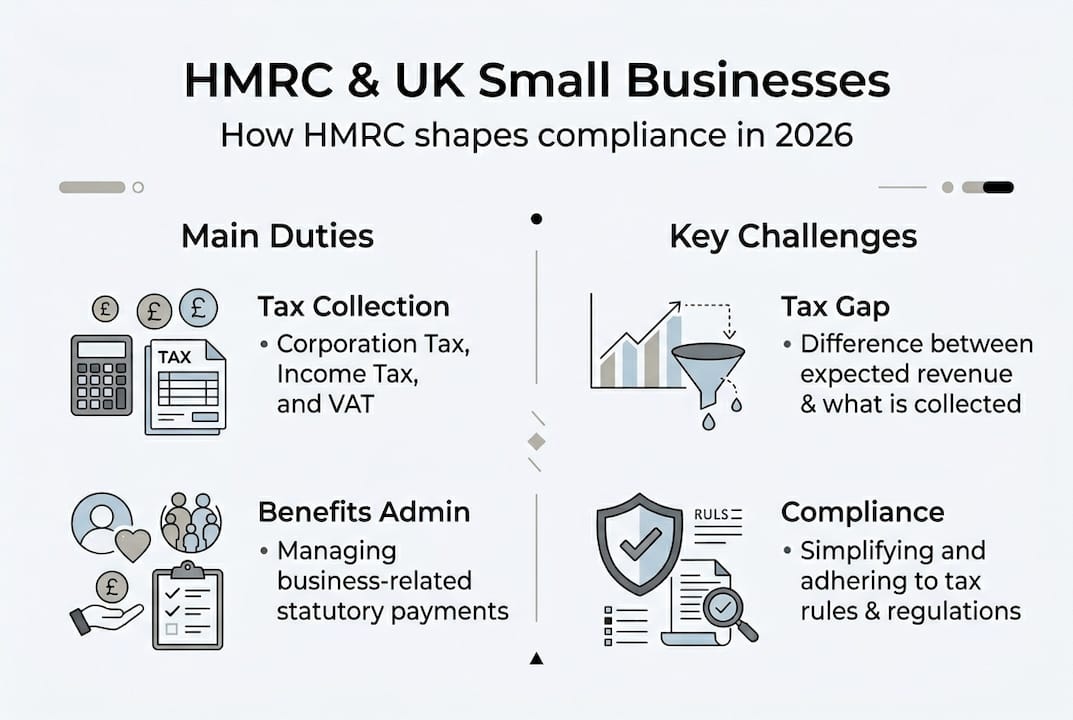
Several factors drive non-compliance among small businesses, often unintentionally. Edge cases of evasion link to cash flow pressures, unclear expense boundaries, and low perceived impact, with HMRC deploying enquiries and Gates for Compliance programmes targeting novel risk areas. Cash flow constraints tempt some owners to delay payments or underreport income to maintain operations. Ambiguity around allowable expenses leads to incorrect deductions. The mistaken belief that small amounts don’t matter creates cumulative problems.
HMRC’s enforcement approach combines education with targeted action. Random enquiries examine returns for accuracy, whilst risk-based investigations focus on sectors or behaviours showing higher non-compliance rates. The Gates for Compliance programme addresses emerging risk areas through tailored interventions before problems escalate.
| Compliance challenge | Impact on small businesses | HMRC response |
|---|---|---|
| Cash flow pressures | Delayed payments, underreporting | Time to pay arrangements, instalment options |
| Expense confusion | Incorrect deductions, disallowed claims | Clear guidance, webinars, agent support |
| Record keeping gaps | Incomplete returns, estimation errors | Digital tools, Making Tax Digital requirements |
| Low awareness | Missed deadlines, unintentional errors | Tax Confident campaigns, simplified guidance |
Non-compliance carries serious consequences beyond immediate penalties. Late payment fees accrue daily, quickly multiplying initial amounts owed. Serious cases trigger criminal investigation and prosecution. Beyond financial costs, compliance failures damage your reputation and create stress that distracts from business growth.
The public service dimension matters too. Every pound of unpaid tax reduces funding for healthcare, education, and infrastructure that support your business environment and community. Viewing compliance as civic responsibility alongside legal obligation often strengthens commitment to accuracy.
Pro Tip: If you discover errors in previous returns, use HMRC’s disclosure facility to correct them proactively. Voluntary disclosure typically results in lower penalties than HMRC discovering mistakes through investigation, and demonstrates good faith that influences how your case is handled.
Addressing compliance proactively protects your business whilst supporting the broader economy. Our small business compliance guide and tax tips for UK small businesses provide detailed frameworks for building robust systems that prevent problems before they emerge.
Tools and strategies for effective HMRC compliance and tax management
Modern compliance relies increasingly on digital tools that improve accuracy whilst reducing administrative burden. Making Tax Digital reduces errors and from 2026 impacts small businesses and sole traders for Income Tax. This reform requires compatible software for record keeping and submission, replacing paper records and manual calculations with automated processes that catch mistakes before they reach HMRC.
Many small businesses leverage professional expertise to manage complex obligations. 68% of small businesses use agents for compliance, with self-employment returns proving most time consuming. Qualified accountants and tax advisers bring specialist knowledge that identifies reliefs, optimises structures, and ensures accuracy. Whilst professional fees represent an investment, the time saved and errors prevented typically deliver strong returns.
Implementing effective compliance systems involves several practical steps:
- Choose Making Tax Digital compatible software that integrates with your existing business processes and accounting systems
- Establish clear record keeping procedures that capture all transactions, expenses, and supporting documentation as they occur
- Set calendar reminders for key deadlines including quarterly VAT returns, annual self-assessment, and Corporation Tax submissions
- Review your tax position quarterly rather than annually, allowing time to address issues and plan payments
- Maintain digital and physical records for at least six years, meeting HMRC’s minimum retention requirements
- Consider engaging a qualified tax agent or accountant, particularly if your affairs involve multiple income streams or complex transactions
Record keeping forms the foundation of compliance. HMRC requires businesses to retain records for at least six years, covering all income, expenses, and supporting documentation. Digital storage offers advantages including searchability, backup protection, and easy sharing with advisers or HMRC when required.
Key documents to maintain include:
- Sales invoices and receipts showing all business income
- Purchase invoices and receipts for allowable expenses
- Bank statements and transaction records
- Payroll records if you employ staff
- VAT records if registered
- Asset registers for capital items
Pro Tip: Photograph receipts immediately using your smartphone and store them in cloud-based accounting software. Physical receipts fade over time, but digital copies remain readable indefinitely and integrate directly with your financial records for seamless expense tracking.
Proactive tax planning extends beyond simple compliance to strategic advantage. Understanding your annual tax position allows you to time income and expenses for optimal cash flow. Claiming all available reliefs and allowances reduces liability legally. Planning major purchases around year-end can maximise capital allowances.
For businesses just starting out, proper registration establishes your compliance foundation. Our business registration guide walks through essential steps, whilst our legal compliance resource addresses broader regulatory requirements. HMRC’s Tax Confident guidance provides official support tailored for small businesses navigating their obligations.
Adopting these tools and strategies transforms compliance from reactive burden to manageable routine. Digital systems catch errors automatically. Professional advisers provide confidence and optimisation. Clear processes ensure nothing falls through gaps. Together, these elements create sustainable compliance that supports rather than hinders business growth.
How Kefihub supports your business growth and compliance
Navigating HMRC requirements whilst growing your business demands reliable guidance tailored to UK small enterprises. Kefihub delivers practical resources designed specifically for professionals and SME owners facing these exact challenges. Our small business compliance guide breaks down complex regulations into actionable steps you can implement immediately, ensuring nothing critical gets overlooked as your business evolves.
Beyond compliance, sustainable growth requires strategic planning and strong professional networks. Our business growth roadmap provides a structured framework for scaling operations whilst maintaining regulatory standards. Building valuable connections strengthens your position, which our networking guide for SMEs addresses through proven relationship-building strategies. Explore these resources to transform compliance from obstacle into foundation for confident business development.
Frequently asked questions
What is HMRC and what does it do?
HMRC is His Majesty’s Revenue and Customs, the UK government department responsible for collecting taxes, administering certain benefits, and enforcing customs regulations. It manages multiple tax types including Income Tax, VAT, and Corporation Tax whilst also handling Child Benefit, tax credits, and National Insurance. HMRC’s role extends beyond simple collection to supporting compliant businesses through guidance and digital tools.
Which taxes does HMRC manage that affect small businesses?
HMRC oversees Income Tax for sole traders, Corporation Tax for limited companies, VAT when turnover exceeds £90,000, and National Insurance contributions for both self-employed individuals and employers. Additional taxes include Capital Gains Tax on asset sales, excise duties for specific sectors, and environmental levies. Each tax carries distinct registration requirements, payment deadlines, and compliance obligations that vary based on your business structure and activities.
How can small businesses stay compliant with HMRC requirements?
Adopt Making Tax Digital compatible software to automate record keeping and reduce errors in submissions. Maintain detailed records of all income and expenses for at least six years, with digital backups for security. Consider engaging a qualified tax agent, particularly for complex returns or multiple income streams. Set calendar reminders for key deadlines and review your tax position quarterly rather than waiting until year end.
What is the tax gap and how does it relate to small businesses?
The tax gap measures the difference between taxes theoretically owed and amounts actually collected, totalling £46.8 billion or 5.3% of liability in 2023-2024. Small businesses account for approximately 60% of this gap, reflecting both the sector’s size and specific compliance challenges including cash flow pressures and unclear expense boundaries. Reducing your contribution to the tax gap through accurate reporting protects your business from penalties whilst supporting public services that benefit the broader economy.
Recommended
- Small Business Compliance Guide: Essential Steps for UK SMEs – Kefihub
- Optimise HR in UK SMEs for growth and compliance – Kefihub
- What Is VAT in the UK – Impact for Small Businesses – Kefihub
- 7 Essential Small Business Tax Tips Every UK Owner Needs – Kefihub