

Confusion around the meaning of business turnover is common among UK small business owners, especially when planning for growth. Many mistakenly use turnover and profit as interchangeable terms, yet turnover is strictly the total income from sales before expenses and VAT are deducted. This distinction matters because misunderstanding your “turnover” can lead to errors in tax reporting and false confidence about your business’s health. Clear knowledge of business turnover lays the foundation for better financial planning and smarter decision-making.
Table of Contents
- Business Turnover Definition And Common Myths
- Gross Vs Net Turnover: Key Distinctions
- How To Calculate Turnover For Your Business
- Turnover, VAT Registration And Tax Rules
- Financial Impacts And Common Pitfalls To Avoid
Key Takeaways
| Point | Details |
|---|---|
| Turnover vs Profit | Turnover reflects total sales, not profit; high turnover does not guarantee financial success. |
| Gross vs Net Turnover | Gross turnover shows total sales before deductions, while net turnover reflects actual earnings after accounting for VAT and returns. |
| VAT Registration | Register for VAT if your taxable turnover exceeds £85,000; failing to do so can result in penalties. |
| Financial Pitfalls | Avoid confusing turnover with profit and ensure accurate tracking to mitigate risks and maintain compliance. |
Business turnover definition and common myths
In the UK business landscape, turnover is a fundamental financial metric that frequently confuses entrepreneurs and small business owners. Business turnover strictly refers to the total amount of money generated from sales during a specific accounting period, excluding value-added tax (VAT). This figure represents the gross income before deducting expenses, which distinguishes it from net profit.
Contrary to popular misconceptions, turnover is not equivalent to profit, nor does it represent the number of employees leaving a company. Many business owners mistakenly believe that high turnover automatically indicates business success. In reality, turnover merely shows the volume of sales and does not reflect the actual financial health of an organisation. A company could have substantial turnover but minimal or even negative profits if expenses exceed income.
Common myths surrounding business turnover include:
- Turnover equals profit
- Higher turnover always means better business performance
- Turnover and revenue are interchangeable terms
- Employee turnover is related to financial turnover
Understanding these distinctions is crucial for accurate financial planning and strategic decision-making. Turnover provides a snapshot of sales activity but must be analysed alongside other financial indicators like profit margins, operational costs, and net income to gain a comprehensive view of business performance.
Pro tip: Track your monthly turnover using accounting software to gain real-time insights into your business sales performance and identify potential growth opportunities.
Gross vs net turnover: Key distinctions
In the complex world of business finance, understanding the nuanced difference between gross turnover and net turnover is crucial for accurate financial management. Gross and net turnover represent two distinct financial measurements that provide different insights into a company’s financial performance.

Gross turnover represents the total income generated from sales or services before any deductions. This figure captures the entire sales value, including the full price of goods or services sold. In contrast, net turnover is calculated by subtracting specific deductions such as VAT, returns, discounts, and other adjustments from the gross turnover. For UK businesses, this distinction is particularly important as it directly impacts taxation and financial reporting requirements.
Key differences between gross and net turnover include:
- Gross turnover shows total sales value
- Net turnover reflects actual earnings after deductions
- Gross turnover does not account for tax or sales adjustments
- Net turnover provides a more accurate picture of true business income
Understanding these distinctions helps business owners make more informed financial decisions. While gross turnover gives an overview of total sales activity, net turnover provides a more precise representation of actual business income. Small and medium-sized enterprises especially benefit from comprehending these nuances, as they directly influence financial planning, tax obligations, and strategic business development.
To clarify the essential differences between gross and net turnover, see the table below:
| Aspect | Gross Turnover | Net Turnover |
|---|---|---|
| Definition | Total sales before any deductions | Sales after VAT, returns, discounts |
| Usefulness | Measures overall sales activity | Indicates true income for planning |
| Impact on Taxes | Not always tax-relevant figure | Used for VAT and tax calculations |
| Typical Adjustments | None applied | Deductions subtracted for accuracy |
Pro tip: Regularly reconcile your gross and net turnover figures with a qualified accountant to ensure accurate financial reporting and identify potential areas for tax efficiency.
How to calculate turnover for your business
Calculating business turnover is a critical financial skill that requires precision and systematic approach. Calculating accurate turnover involves carefully tracking all sales and revenue generated during a specific accounting period, ensuring comprehensive and transparent financial reporting for your UK business.
To calculate turnover, start by gathering all sales invoices and revenue documentation for the chosen accounting period. Include the total value of all goods and services sold, incorporating additional charges like shipping passed directly to customers. Crucially, you must add up the full sales value before deducting VAT, as turnover represents gross income. Be sure to include all invoiced sales, regardless of whether payment has been received, as turnover reflects the total value of transactions completed during the period.
Key steps for calculating business turnover include:
- Collect all sales invoices for the accounting period
- Sum the total value of goods and services sold
- Include additional charges like shipping
- Exclude VAT from calculations
- Count invoiced sales, not cash received
- Separate trading income from non-trading sources
Precise turnover calculation is essential for multiple business functions, including tax reporting, financial planning, and understanding your company’s economic performance. Small businesses should establish consistent methods for tracking and calculating turnover, potentially using accounting software to streamline the process and ensure accuracy.
Pro tip: Maintain a dedicated spreadsheet or accounting system to track sales invoices systematically, making turnover calculations faster and more reliable each accounting period.
Turnover, VAT registration and tax rules
Navigating the complexities of VAT registration is a critical responsibility for UK business owners, directly tied to their company’s turnover. VAT registration requirements mandate that businesses must register for VAT when their taxable turnover exceeds the current threshold within a consecutive 12-month period, making precise financial tracking essential.
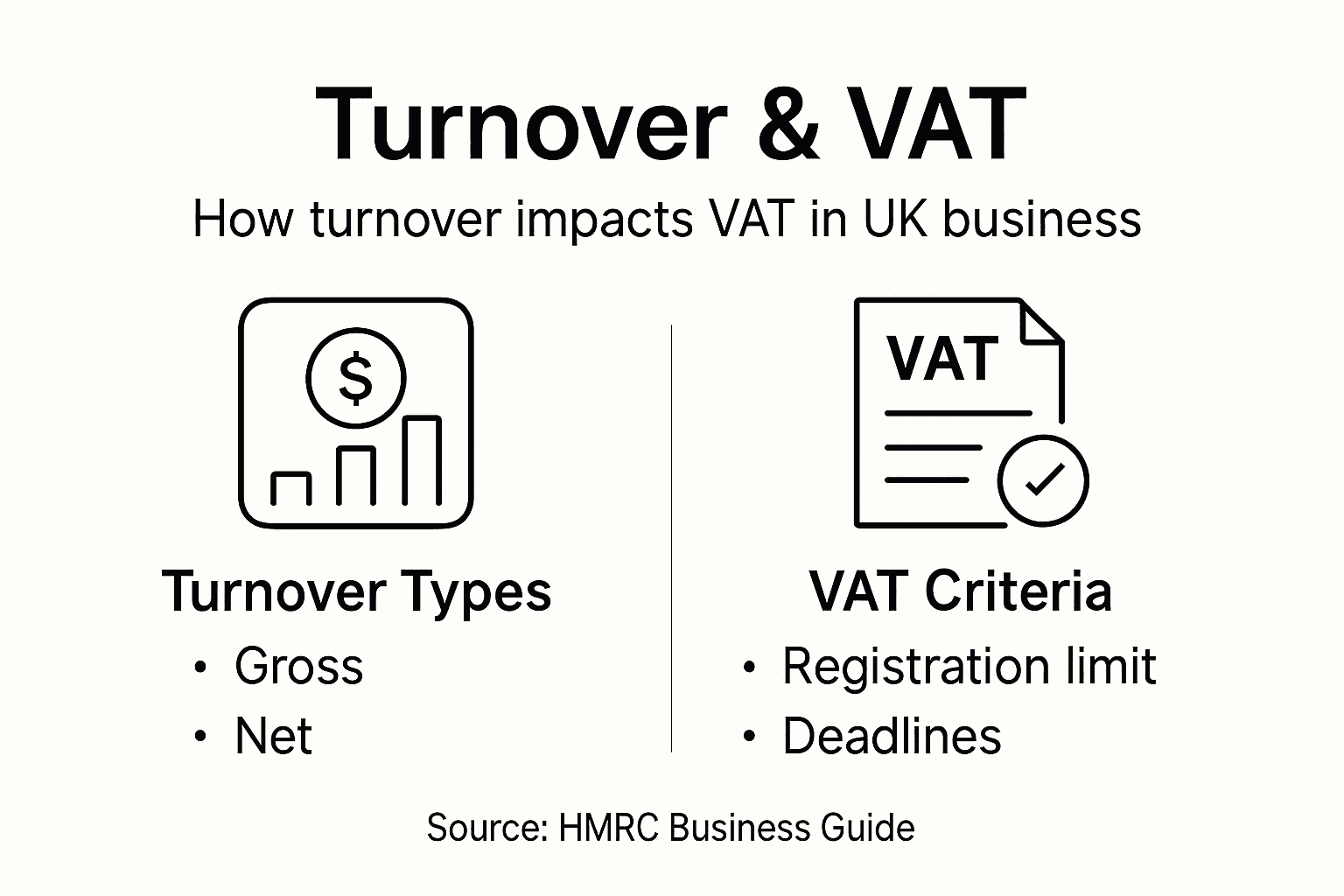
The current VAT registration threshold is set at £85,000 of taxable turnover, which includes all sales of goods and services that are not VAT-exempt. When calculating taxable turnover, businesses must aggregate the total value of everything sold, excluding only those items specifically exempted from VAT. This calculation encompasses all standard-rated, reduced-rated, and zero-rated supplies, not just the total cash received during the accounting period.
Key considerations for VAT registration include:
- Monitor your rolling 12-month turnover carefully
- Include all taxable sales in your calculations
- Exclude VAT-exempt transactions
- Register voluntarily if approaching the threshold
- Maintain accurate and detailed financial records
- Understand the implications of mandatory registration
Failing to register for VAT when required can result in significant financial penalties, including backdated VAT charges and potential fines. Small businesses should proactively track their turnover, understanding that VAT registration is not just a compliance requirement but an important milestone in business growth. Consulting with a qualified accountant can provide personalised guidance on managing VAT obligations effectively.
Pro tip: Set up quarterly turnover reviews to track your VAT registration status and ensure timely compliance with HMRC regulations.
Financial impacts and common pitfalls to avoid
Understanding the financial implications of business turnover requires careful navigation through complex accounting landscapes. Business turnover pitfalls can significantly impact a company’s financial health, with seemingly minor reporting errors potentially leading to substantial compliance risks and unexpected tax challenges.
One of the most critical misconceptions is conflating turnover with profit, which can lead to catastrophic financial planning errors. Businesses often mistakenly believe high turnover automatically indicates financial success, overlooking essential factors like operational costs, trade discounts, and tax obligations. Accurate turnover tracking involves meticulously recording all sales, understanding VAT implications, and recognising the difference between invoiced amounts and actual cash flow.
Common financial pitfalls to avoid include:
- Confusing turnover with net profit
- Misclassifying sales and income streams
- Neglecting VAT registration thresholds
- Failing to account for trade discounts
- Inaccurate timing of invoice reporting
- Overlooking seasonal sales fluctuations
Small businesses are particularly vulnerable to these financial traps, as complex accounting requirements can overwhelm inexperienced entrepreneurs. Maintaining rigorous financial records, seeking professional accounting advice, and implementing robust tracking systems are crucial strategies for mitigating risks associated with turnover reporting and financial management.
Here is an overview of the main risks and their business impact when mismanaging turnover:
| Risk Area | Potential Consequence | Recommended Safeguard |
|---|---|---|
| Overestimating profit | Misguided investments, cash shortfalls | Regular financial reconciliation |
| Missing VAT registration | Fines, backdated tax liabilities | Monitor 12-month rolling turnover |
| Poor invoice categorisation | Skewed sales reporting, compliance issues | Accurate invoice classification |
| Ignoring seasonal changes | Unexpected turnover drops, loss planning | Track sales trends throughout year |
Pro tip: Invest in cloud-based accounting software that automatically tracks turnover, generates VAT reports, and alerts you to potential compliance issues before they become problematic.
Take Control of Your Business Turnover Today
Understanding the difference between gross and net turnover and knowing when to register for VAT can feel overwhelming. Many UK business owners face challenges like confusing turnover with profit, missing VAT thresholds, or misreporting sales. These pitfalls risk costly fines and inaccurate financial planning. If you are ready to clear the confusion and gain practical insights tailored for your business needs, KefiHub offers a trusted platform focused on precisely these issues.

Explore expert guidance on critical topics such as calculating turnover correctly and managing VAT obligations only at KefiHub. Our resources help you avoid common financial missteps with clear explanations and actionable advice. Don’t wait until compliance issues arise. Visit Business Turnover Explained and start making confident decisions today with KefiHub’s professional insights.
Frequently Asked Questions
What is business turnover?
Business turnover refers to the total amount of money generated from sales during a specific accounting period, excluding value-added tax (VAT). It represents the gross income before deducting expenses.
How does gross turnover differ from net turnover?
Gross turnover is the total income generated from sales before any deductions, while net turnover is the income after subtracting specific deductions such as VAT, returns, and discounts, providing a clearer picture of actual earnings.
What common myths exist about business turnover?
Common myths include the belief that turnover equals profit, that higher turnover always indicates better performance, and the confusion between turnover and revenue.
Why is it important to track turnover for VAT registration?
Tracking turnover is crucial for VAT registration as businesses must register when their taxable turnover exceeds the set threshold. Keeping accurate records helps avoid penalties and ensures compliance with tax obligations.
Recommended
- What Is Business Succession and Why It Matters – Kefihub
- How to Hire Staff UK: Legal Steps for Small Businesses – Kefihub
- How to Hire Staff UK: Legal Steps for Small Businesses – Kefihub
- Company Formation Explained: Key Steps for UK SMEs – Kefihub
- How to Improve Conversion Rate for UK Businesses Online – Paul Baguley
- 7 Cybersecurity Best Practices Every UK Business Must Know