


Many small business owners believe updating company policies is a once-and-done task or something to tackle only when problems arise. This misconception exposes UK SMEs to serious legal and financial risks. Employment law changes frequently, particularly each April and October, introducing new obligations around statutory sick pay, paternity leave, flexible working and harassment prevention. Outdated policies leave businesses vulnerable to tribunal claims, regulatory fines and reputational damage. This guide explains why regular policy updates are essential for compliance, how to approach them practically, and what happens when policies fall behind legal requirements.
Table of Contents
- Key takeaways
- Why updating company policies is critical for compliance
- The high cost of outdated policies for small businesses
- How and when to update company policies effectively
- Nuances and practical tips for maintaining effective policies
- Explore practical support for UK SMEs
- Frequently asked questions about updating company policies
Key Takeaways
| Point | Details |
|---|---|
| Policy updates essential | Regular updates are necessary to stay compliant with evolving employment law and to prevent costly claims. |
| Compliance reduces tribunal risk | Keeping policies current reduces the likelihood of tribunal challenges and demonstrates awareness of legal obligations. |
| Regular reviews matter | Periodic policy reviews help address changes in law and shifts in business operations. |
| Practical update methods | Use audits, consultations and clear communication to implement timely policy changes. |
Why updating company policies is critical for compliance
UK employment law changes frequently, often in April and October, requiring policy updates for compliance in areas like statutory sick pay, paternity leave, flexible working and sexual harassment prevention. These biannual shifts mean what was compliant six months ago may now expose your business to legal risk. Small businesses face particular challenges keeping pace with these changes whilst managing daily operations, yet the compliance imperative remains identical to larger organisations.
Recent legislative changes have introduced significant new obligations. The Worker Protection Act 2023 now requires employers to take reasonable steps to prevent sexual harassment, making outdated equality policies a direct liability. Flexible working became a day-one right rather than requiring 26 weeks’ service. Statutory sick pay eligibility thresholds changed. Each of these shifts demands corresponding policy updates to reflect current legal standards and protect your business.
The consequences of outdated policies extend beyond theoretical risk. Employment tribunals scrutinise whether employers maintained current policies when assessing claims. A policy last reviewed in 2020 signals negligence to adjudicators, weakening your defence even if the underlying dismissal or disciplinary action was justified. Tribunals expect employers to demonstrate awareness of current legal obligations through updated documentation.
“Employers who fail to update policies regularly face increased vulnerability in tribunal proceedings, as outdated documentation undermines claims of reasonable employer behaviour and compliance awareness.”
Key areas requiring regular updates include:
- Disciplinary and grievance procedures reflecting ACAS Code changes
- Equality and harassment policies incorporating new protected characteristics and prevention duties
- Flexible working policies aligned with day-one rights
- Data protection policies following GDPR enforcement updates
- Health and safety policies addressing emerging workplace risks
For UK SMEs, staying current with UK employment law for small businesses isn’t optional. It’s foundational risk management that prevents expensive legal battles and protects your reputation in competitive markets where trust matters.
The high cost of outdated policies for small businesses
The financial impact of failing to maintain current policies hits SMEs disproportionately hard. Median unfair dismissal awards reach £6,746, whilst discrimination claims average over £29,000. Legal fees compound these costs dramatically, ranging from £10,000 to £54,000 depending on case complexity. Management time consumed by tribunal proceedings averages 4.8 weeks per claim, diverting leadership attention from revenue-generating activities during critical periods.

With over 42,000 employment tribunal claims filed in 2024/25, UK businesses face mounting pressure. Small businesses lack the legal departments and HR resources larger organisations deploy to manage claims efficiently. A single tribunal case can consume a quarter’s profits for a ten-person company, creating cash flow crises that threaten survival.
The hidden costs extend beyond direct financial settlements:
- Reputational damage spreads through industry networks and online reviews, deterring top talent from applying
- Employee morale suffers when colleagues witness unfair treatment or chaotic disciplinary processes
- Recruitment costs increase as replacing departed staff becomes more expensive
- Insurance premiums rise following claims, particularly for employment practices liability coverage
- Productivity losses accumulate as remaining staff absorb additional workloads during disputes
Early resolution through ACAS conciliation costs significantly less than full tribunal proceedings, but prevention through updated policies remains the most cost-effective approach. A £2,000 investment in professional policy review and staff training prevents potential £40,000+ exposure from a single discrimination claim.
Statistical reality: SMEs with fewer than 50 employees account for 60% of tribunal claimants yet possess the least capacity to absorb legal costs, making proactive policy maintenance a survival issue rather than administrative housekeeping.
The legal compliance importance for small businesses cannot be overstated. Every pound spent on prevention saves ten pounds in dispute resolution. Every hour invested in policy updates saves weeks of management time defending tribunal claims. The mathematics strongly favour proactive compliance over reactive crisis management.
How and when to update company policies effectively
No fixed legal frequency exists for policy updates, but tribunals expect employers to maintain current documentation reflecting recent legal changes. Best practice includes annual or biannual reviews combined with trigger-based updates from legal changes or business evolution. This dual approach ensures compliance whilst remaining responsive to unexpected regulatory shifts or organisational developments like hybrid working arrangements.
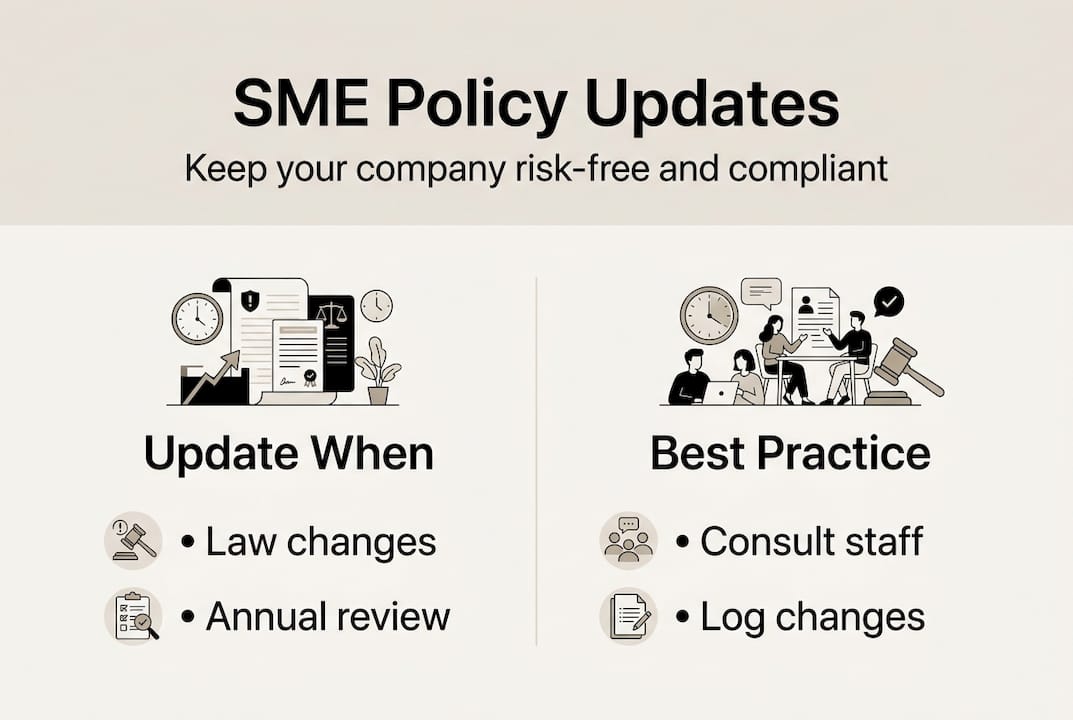
Annual reviews align naturally with business planning cycles, allowing policy updates to integrate with budget setting and strategic objectives. Biannual reviews coincide with the April and October legislative change windows, catching new regulations as they take effect. Both frequencies work effectively provided you supplement scheduled reviews with immediate updates when significant legal changes occur mid-cycle.
Trigger-based updates respond to specific events requiring immediate policy revision:
- New legislation affecting employment rights or workplace safety
- Business structure changes like mergers, acquisitions or departmental reorganisations
- Workplace incidents revealing policy gaps or ambiguities
- Technology adoption requiring data protection or acceptable use policy updates
- Expansion into new locations with different regulatory requirements
Pro Tip: Subscribe to GOV.UK and ACAS email alerts to receive automatic notifications when employment law changes affect your obligations, ensuring you never miss critical updates that require policy revisions.
Implementing effective updates follows a systematic process:
- Monitor official sources including GOV.UK, ACAS and professional HR bodies for regulatory changes
- Audit current policies against legal requirements and business realities
- Consult HR professionals or employment solicitors to identify gaps and draft compliant language
- Communicate changes clearly to all staff with explanations of what changed and why
- Train managers and employees on new procedures and expectations
- Document acknowledgement through signed receipts or electronic confirmation systems
| Review type | Frequency | Best for |
|---|---|---|
| Scheduled annual | Once yearly | Comprehensive policy overhaul and alignment |
| Scheduled biannual | April and October | Catching legislative changes as enacted |
| Trigger-based | As needed | Responding to specific legal or business changes |
| Continuous monitoring | Ongoing | Staying aware of emerging compliance issues |
The legal compliance checklist UK SMEs provides a structured framework for conducting thorough policy audits, ensuring no critical areas slip through review processes.
Nuances and practical tips for maintaining effective policies
Whilst tribunals expect up-to-date policies despite no legal mandate for annual updates, the quality of those policies matters as much as currency. Generic templates downloaded from the internet create false security, often containing irrelevant provisions or missing business-specific protections. A manufacturing SME needs different health and safety policies than a professional services firm. A remote-first company requires distinct flexible working policies compared to office-based operations.
Tailoring policies to your specific business context strengthens legal defence and operational effectiveness. Tribunals assess whether policies reflect genuine workplace realities rather than theoretical frameworks. A hybrid working policy that mandates five office days weekly when staff actually work remotely three days loses credibility and enforceability.
Communication and staff training represent essential ‘reasonable steps’ for legal defence, particularly under the Worker Protection Act’s harassment prevention duties. Publishing updated policies in a shared drive folder isn’t sufficient. Effective communication requires:
- Clear explanations of what changed and why it matters
- Accessible language avoiding legal jargon where possible
- Multiple communication channels including email, meetings and intranet posts
- Opportunities for questions and clarification
- Documented acknowledgement confirming staff received and understood updates
Pro Tip: Record brief video explanations of significant policy changes featuring senior leadership, demonstrating organisational commitment whilst making updates more engaging and memorable than dense written documents.
Emerging policy areas demand attention as workplace norms evolve:
- Artificial intelligence use policies governing employee AI tool usage and data protection
- Environmental sustainability policies reflecting corporate responsibility commitments
- Wellbeing and mental health policies supporting employee psychological safety
- Social media policies balancing personal expression with reputational protection
- Remote work security policies protecting confidential information outside office environments
Common pitfalls undermine even well-intentioned policy programmes. Avoid updating policies without consulting affected staff, which breeds resistance and reveals practical implementation problems only after rollout. Don’t copy competitor policies assuming they’re compliant, as their legal advice and business context differ from yours. Never implement policies without corresponding manager training, as inconsistent application creates discrimination risks.
The effective policy communication strategies employed by leading organisations demonstrate how clear messaging transforms compliance exercises into culture-building opportunities. When staff understand the reasoning behind policy updates, they become partners in compliance rather than reluctant participants.
For comprehensive guidance on building robust HR foundations, explore how to optimise HR in UK SMEs through integrated policy management, training programmes and compliance monitoring systems that scale with business growth.
Explore practical support for UK SMEs
Navigating employment law compliance whilst running a growing business demands reliable guidance tailored to UK SME realities. KefiHub provides practical resources helping small business owners build compliant, effective organisations without enterprise-scale budgets or dedicated legal departments.
Our small business compliance guide UK SMEs breaks down complex regulatory requirements into actionable steps, whilst the business growth roadmap for UK SMEs shows how compliance supports sustainable expansion. Building the professional networks that provide ongoing advice and support becomes easier through our networking for SMEs guide, connecting you with peers facing similar challenges and opportunities.
Frequently asked questions about updating company policies
When should I update company policies?
Update policies annually or biannually as best practice, plus immediately when significant legal changes occur or business operations evolve substantially. Monitor GOV.UK and ACAS announcements for regulatory updates requiring prompt policy revisions. Trigger events like workplace incidents, technology adoption or structural changes also necessitate immediate reviews.
What policies must UK small businesses have?
Legally required policies include health and safety, disciplinary and grievance procedures, data protection, and equality policies. Businesses with five or more employees need written health and safety policies. Whilst not all policies carry strict legal mandates, tribunals expect comprehensive documentation covering employment terms, leave entitlements and workplace conduct standards. The hiring staff legal steps UK guide details essential documentation for new employers.
How to communicate policy changes effectively?
Communicate through multiple channels including email announcements, team meetings and intranet posts, explaining what changed and why. Provide opportunities for questions and discussion. Conduct training sessions for managers implementing new procedures. Obtain documented acknowledgement from all staff confirming receipt and understanding. Clear, jargon-free language increases comprehension and compliance.
Can I use generic templates safely?
Generic templates create risks by failing to address business-specific needs and potentially including irrelevant or outdated provisions. Tribunals assess whether policies reflect actual workplace practices and current legal standards. Tailoring templates to your organisation’s size, sector and working arrangements strengthens legal protection and operational effectiveness. Professional review ensures compliance and relevance.
What happens if policies are outdated during a tribunal?
Outdated policies undermine your legal defence by suggesting negligence and lack of compliance awareness. Tribunals interpret stale documentation as evidence of inadequate employer practices, weakening arguments that you took reasonable steps to prevent issues or followed fair procedures. Current policies demonstrate professionalism and legal diligence, strengthening your position even when underlying disputes reach tribunal. The small business compliance guide UK SMEs explains how proactive compliance builds robust legal defences.
Recommended
- 7 Steps to a Robust Legal Compliance Checklist for UK SMEs – Kefihub
- Small Business Compliance Guide: Essential Steps for UK SMEs – Kefihub
- Optimise HR in UK SMEs for growth and compliance – Kefihub
- UK Employment Law – What Every Small Business Needs – Kefihub