


Staying on top of every pound spent can feel challenging for busy small business owners in the United Kingdom. Clear tracking of business expenses matters not only for minimising tax stress, but also for seeing where your money truly goes. Using thoughtful recordkeeping strategies, from manual ledgers to digital tools, brings greater financial clarity and helps protect against compliance errors. This guide gives you straightforward advice on expense types, tracking methods, and avoiding common pitfalls so your business remains organised and ready for any HMRC review.
Table of Contents
- Defining Business Expenses And Tracking Methods
- Key Types Of Expenses To Monitor
- HMRC Regulations And Digital Requirements
- Benefits For Tax Efficiency And Cash Flow
- Common Pitfalls And Mistakes To Avoid
Key Takeaways
| Point | Details |
|---|---|
| Tracking Business Expenses is Crucial | Effective management of business expenses aids financial accuracy and informs strategic business decisions. |
| Categorise Expenses Systematically | Proper categorisation helps in budgeting, tax deductions, and financial transparency. |
| Digital Compliance is Essential | Adhering to HMRC regulations and maintaining digital records is necessary to avoid penalties. |
| Regular Reviews Enhance Financial Health | Implementing consistent review processes supports identifying spending patterns and optimizing costs. |
Defining Business Expenses And Tracking Methods
Tracking business expenses is a fundamental aspect of financial management for small UK enterprises. Business expenses represent the costs incurred during normal business operations that are essential for generating revenue and maintaining daily activities. Understanding these expenses helps entrepreneurs maintain accurate financial records and make informed strategic decisions.
Business expenses can be broadly categorised into several key types:
- Operating Expenses: Daily costs required to run the business
- Administrative Expenses: Management and administrative overheads
- Capital Expenses: Investments in long-term assets like equipment
- Direct Costs: Expenses directly linked to product or service production
- Indirect Costs: Supporting expenses not directly tied to production
Effective expense tracking involves systematic recordkeeping strategies that document every financial transaction systematically. Small businesses should establish robust systems that capture detailed information about each expense, including date, amount, purpose, and supporting documentation.
Most UK businesses utilise several tracking methods to monitor their financial activities:
- Manual Ledger Tracking
- Spreadsheet Management
- Cloud-based Accounting Software
- Receipt Scanning Applications
- Digital Expense Management Platforms
The choice of tracking method depends on the business’s size, complexity, and technological infrastructure. Small enterprises might start with spreadsheets, while growing businesses often transition to more sophisticated digital solutions that provide real-time financial insights.

Here is a comparison of common expense tracking methods and their suitability for different business needs:
| Tracking Method | Strengths | Best For |
|---|---|---|
| Manual Ledger | Low cost, simple to start | Sole traders, micro-businesses |
| Spreadsheets | Flexible, customisable | Start-ups, early stage businesses |
| Cloud-based Software | Automation, real-time insights | Growing SMEs, multi-user access |
| Receipt Scanning Applications | Quick document capture, reduces errors | Mobile teams, frequent expense submissions |
| Digital Expense Platforms | End-to-end workflow, integration | Larger SMEs, businesses with complex needs |
Accurate expense tracking isn’t just about compliance—it’s a strategic tool for understanding your business’s financial health and identifying potential areas for cost optimisation.
Pro tip: Implement a consistent monthly review process to categorise and analyse your business expenses, helping you identify spending patterns and potential savings opportunities.
Key Types Of Expenses To Monitor
Successful financial management for UK businesses hinges on understanding and meticulously tracking various expense categories. These expenses represent critical financial outflows that impact a company’s profitability, tax obligations, and overall financial strategy.
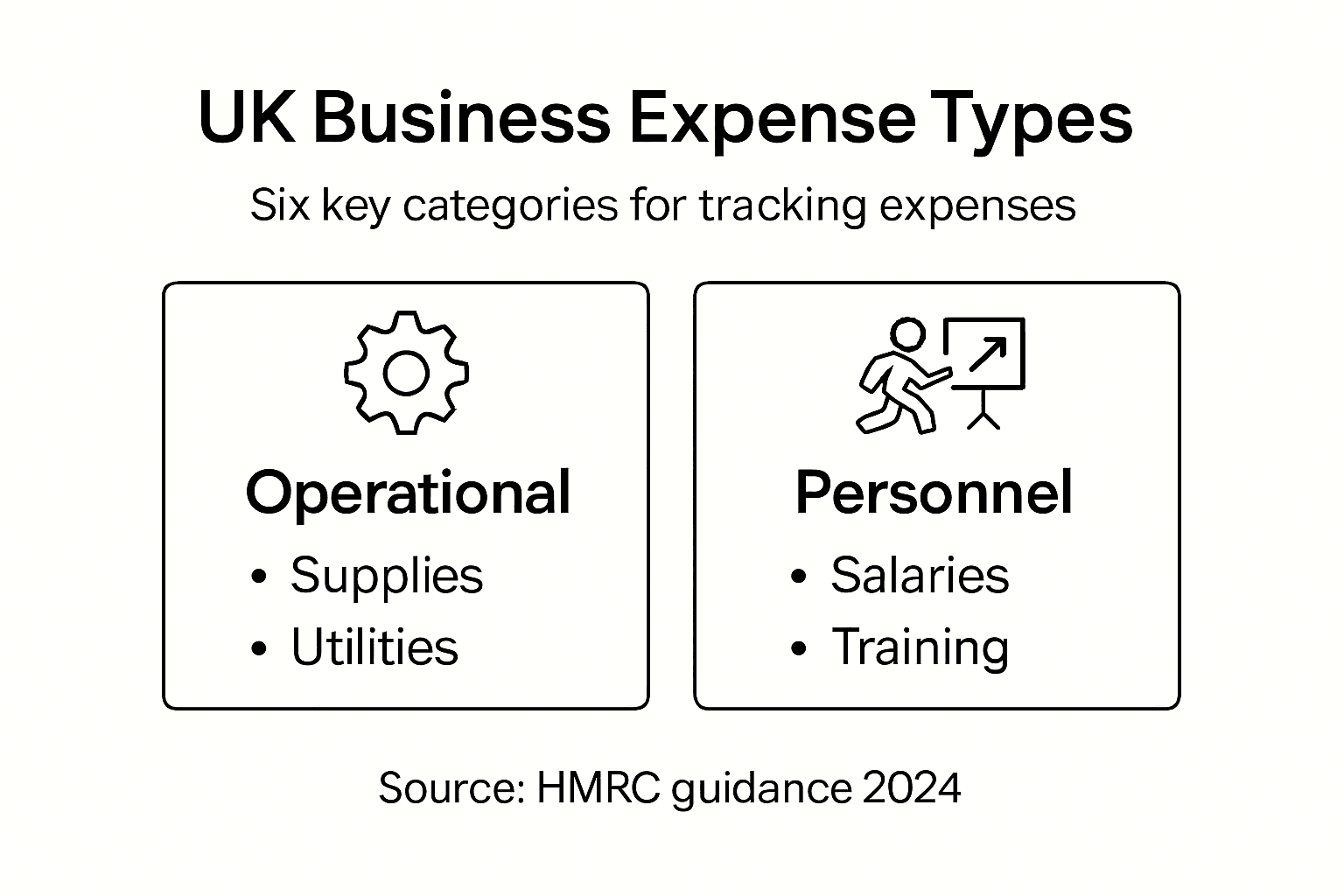
Companies typically need to monitor several key expense categories and their financial implications, which can be systematically broken down into primary groups:
- Operational Expenses: Direct costs required for daily business functioning
- Personnel Expenses: Salaries, wages, benefits, and training costs
- Occupancy Expenses: Rent, utilities, maintenance, and property-related expenditures
- Equipment and Technology Costs: Hardware, software, machinery, and technological infrastructure
- Marketing and Sales Expenses: Advertising, promotional activities, customer acquisition
- Administrative Expenses: Office supplies, insurance, professional services
Understanding these expense types allows businesses to create more accurate budgets, identify potential cost-saving opportunities, and maintain precise financial records. Each category represents a different aspect of business spending and requires specific tracking and management strategies.
Moreover, expense categorisation helps businesses:
- Prepare accurate financial statements
- Calculate tax deductions effectively
- Analyse spending patterns
- Make informed strategic decisions
- Demonstrate financial transparency
Thorough expense tracking is not just an accounting requirement—it’s a strategic tool for understanding your business’s financial ecosystem and driving sustainable growth.
Pro tip: Develop a consistent expense categorisation system and review it quarterly to ensure your financial tracking remains accurate and aligned with your business’s evolving needs.
HMRC Regulations And Digital Requirements
Navigating HMRC regulations is crucial for UK businesses seeking to maintain financial compliance and avoid potential penalties. The Her Majesty’s Revenue and Customs (HMRC) has implemented increasingly stringent digital requirements that mandate precise record-keeping and electronic reporting for businesses of all sizes.
Businesses must adhere to several key digital compliance standards, including:
- Making Tax Digital (MTD) initiative
- Electronic record-keeping requirements
- Digital tax return submissions
- VAT reporting through approved software
- Real-time information (RTI) for payroll reporting
The legal compliance landscape for UK small businesses continues to evolve, with digital transformation becoming a central requirement for financial management. HMRC now expects businesses to maintain digital records that can be easily accessed, audited, and submitted electronically, marking a significant shift from traditional paper-based accounting practices.
Key digital reporting obligations include:
The table below summarises key HMRC digital compliance requirements and their business impact:
| Compliance Area | What Is Required | Business Impact |
|---|---|---|
| Making Tax Digital (MTD) | Digital record-keeping and VAT returns | Streamlined submissions, mandatory compliance |
| Digital VAT Record Retention | Six years of digital records | Easier audits, reduced risk of penalties |
| Real-time Payroll Reporting | Electronic payroll data to HMRC | Up-to-date tax reporting, fewer errors |
| Use of Approved Software | MTD-compatible software for submissions | Saves time, aligns with tax authority systems |
- Maintaining digital VAT records for at least six years
- Submitting VAT returns using MTD-compatible software
- Keeping digital records of all financial transactions
- Ensuring data integrity and security
- Preparing for potential digital tax inspections
Digital compliance is no longer optional—it’s a fundamental requirement for modern UK businesses navigating the complex landscape of tax regulations.
Pro tip: Invest in HMRC-approved accounting software that automatically updates to meet changing digital requirements and ensures seamless compliance with current tax regulations.
Benefits For Tax Efficiency And Cash Flow
Traditional business expense tracking extends far beyond basic financial record-keeping, offering strategic advantages that directly impact a company’s financial sustainability and fiscal health. By implementing systematic expense monitoring, UK businesses can unlock significant opportunities for tax efficiency and improved cash flow management.
Effective expense tracking provides multiple critical benefits, as highlighted by comprehensive recordkeeping strategies that enable businesses to optimize their financial performance:
- Maximise legitimate tax deductions
- Reduce unnecessary spending
- Improve financial forecasting accuracy
- Identify potential cost-saving opportunities
- Create a robust audit trail
- Support strategic financial decision-making
Tax efficiency emerges as a primary advantage of meticulous expense tracking. By documenting and categorising every business expense, companies can:
- Claim all eligible tax deductions
- Minimise potential tax liabilities
- Demonstrate financial transparency to HMRC
- Reduce the risk of penalties
- Streamline annual tax preparation processes
Cash flow management represents another critical benefit of comprehensive expense tracking. Understanding precise income and expenditure patterns allows businesses to:
- Predict future financial requirements
- Manage seasonal revenue fluctuations
- Allocate resources more strategically
- Identify potential financial bottlenecks
- Make informed investment decisions
Expense tracking is not just about compliance—it’s a powerful tool for financial intelligence and strategic business planning.
Pro tip: Implement a quarterly expense review process that analyses spending patterns, identifies potential savings, and aligns financial strategies with broader business objectives.
Common Pitfalls And Mistakes To Avoid
Navigating business expense tracking requires vigilance and strategic awareness. UK entrepreneurs frequently encounter critical errors that can compromise financial accuracy, trigger potential tax complications, and undermine overall business financial management.
Businesses commonly make fundamental mistakes when tracking expenses, as highlighted by comprehensive recordkeeping guidelines. These critical errors include:
- Mixing personal and business expenses
- Failing to retain original receipts
- Inconsistent expense categorisation
- Neglecting digital documentation
- Irregular record maintenance
- Overlooking minor transactions
The most frequent expense tracking pitfalls can be systematically broken down into several key categories:
- Documentation Failures
- Categorisation Challenges
- Technology Mismanagement
- Compliance Oversights
- Financial Record Inconsistencies
Specific mistakes that can significantly impact business financial health include:
- Inadequate Record Retention: Not maintaining expenses for the recommended six-year period
- Poor Digital Organisation: Relying on manual, paper-based systems
- Inconsistent Tracking: Sporadic or incomplete expense logging
- Misclassification: Incorrectly categorising business expenses
- Lack of Systematic Review: Failing to conduct regular expense audits
Expense tracking is not merely an administrative task—it’s a critical financial risk management strategy that protects your business’s financial integrity.
Pro tip: Develop a standardised monthly expense review protocol that cross-references bank statements, receipts, and accounting records to ensure comprehensive and accurate financial documentation.
Take Control of Your Business Finances with Expert Guidance
Managing business expenses can feel overwhelming with challenges like accurate categorisation, digital compliance, and avoiding common pitfalls. This article highlights how meticulous expense tracking and understanding HMRC regulations are essential to maintain financial control, maximise tax efficiency and improve cash flow.
At KefiHub, we understand these struggles faced by UK small businesses and entrepreneurs. Our UK-based platform offers clear, practical insights and expert commentary designed to help you navigate these complexities with confidence. Whether you need guidance on implementing consistent expense tracking systems or staying compliant with Making Tax Digital requirements, we provide actionable advice tailored to your business needs.
Get ahead of financial challenges today by exploring our trusted resources. Visit KefiHub to unlock deeper knowledge and expert strategies for your business expenses. Take the next step towards clarity and control by reading more about improving your financial management here. Empower your business with insight and practical tools available now at KefiHub.
Frequently Asked Questions
What are the main types of business expenses I should track?
Businesses should track key expense categories including operational expenses, personnel expenses, occupancy expenses, equipment and technology costs, marketing and sales expenses, and administrative expenses.
How can I effectively track my business expenses?
Effective tracking can be achieved through various methods such as manual ledger tracking, spreadsheets, cloud-based accounting software, receipt scanning applications, or digital expense management platforms, depending on the size and complexity of your business.
Why is it important to categorise business expenses?
Categorising business expenses helps in preparing accurate financial statements, calculating tax deductions effectively, analysing spending patterns, and making informed strategic decisions, ultimately improving a business’s financial health.
What are the consequences of not properly tracking business expenses?
Failing to accurately track business expenses can lead to poor financial management, incorrect tax filings, potential fines from tax authorities, and an unclear understanding of the company’s financial status, which can hinder growth and decision-making.
Recommended
- 7 Key Examples of Business Expenses for Small UK Firms – Kefihub
- Business Turnover Explained: Key Facts for UK Owners – Kefihub
- 7 Smart Ways to Reduce Business Costs for UK Owners – Kefihub
- 7 Key Benefits of Registering a Business in the UK – Kefihub