


More than 40 percent of British small businesses struggle with rising workloads and limited resources every year. For business owners juggling endless admin, automation can sound intimidating or out of reach. The truth is, modern tools are designed to simplify life, not complicate it. This guide sheds light on what business automation actually means for British firms, clearing up myths and revealing practical steps so you can work smarter, not harder.
Table of Contents
- Business Automation Defined And Debunked
- Types Of Business Automation And Distinctions
- How Automation Works For UK SMEs
- Starting Out: Requirements And Best Practices
- Legal Duties, Data Security And Compliance
- Risks, Costs And Common Automation Pitfalls
Key Takeaways
| Point | Details |
|---|---|
| Business Automation Enhances Efficiency | Automation allows teams to focus on high-value activities by streamlining repetitive tasks. |
| Incremental Implementation is Key | A phased approach to automation helps businesses adapt and refine their processes effectively. |
| Strategic Technology Selection | Thorough audits of current workflows are essential for choosing the right automation tools that align with business needs. |
| Legal and Compliance Awareness | Businesses must navigate data protection and regulatory requirements to ensure successful automation practices. |
Business automation defined and debunked
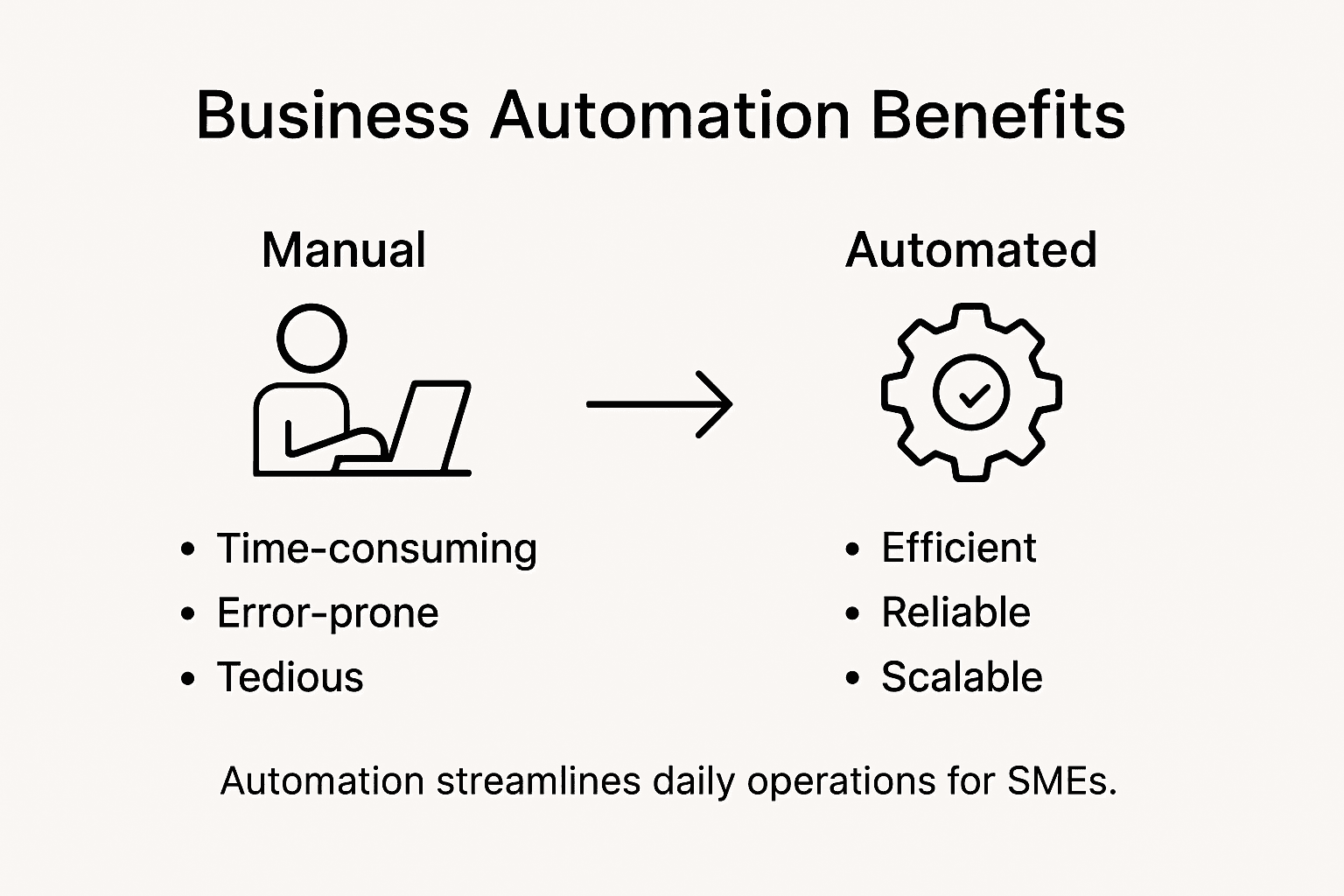
Business automation represents a strategic approach to transforming operational workflows by leveraging technology to streamline repetitive tasks, enhance efficiency, and reduce manual intervention. This systematic literature review reveals automation is not merely about replacing human workers, but creating intelligent systems that augment human capabilities.
Contrary to popular misconceptions, modern business automation is not about job elimination, but strategic performance enhancement. Automation technologies are specifically designed to handle routine, time-consuming tasks, allowing your team to focus on higher-value strategic activities. Recent professional research highlights that these tools are increasingly accessible, user-friendly, and tailored for small to medium enterprises seeking practical technological solutions.
Key characteristics of effective business automation include:
- Seamless integration with existing systems
- Scalable technological infrastructure
- Minimal learning curve for implementation
- Measurable performance improvements
- Cost-effective solution design
Pro Tip for Small Business Owners: Start small by identifying one repetitive administrative process in your business that consumes significant time, and research specific automation tools targeting that exact workflow. This targeted approach minimises risk and maximises potential efficiency gains.
Businesses must understand that automation is an evolutionary journey, not a single technological leap. It requires careful planning, incremental implementation, and continuous refinement to align technological capabilities with specific organisational objectives and human expertise.
Types of business automation and distinctions
Business automation encompasses several distinct approaches, each targeting specific operational challenges and organisational needs. Comprehensive market research reveals four primary categories that small businesses can leverage to enhance efficiency and productivity.

The first category, task automation, focuses on automating individual, repetitive actions like data entry, email responses, or invoice generation. These solutions are typically entry-level automation strategies that provide immediate time-saving benefits. Workflow automation represents a more sophisticated approach, connecting multiple tasks into seamless, end-to-end processes that reduce manual handovers and minimise potential human errors.
Two advanced automation types include:
- Robotic Process Automation (RPA): Software robots mimicking human interactions with digital systems
- Intelligent Automation: AI-powered systems that can learn, adapt, and make basic decision-making processes
Pro Tip for Technology Selection: Conduct a thorough audit of your current business processes, identifying repetitive tasks that consume significant time. Prioritise automation solutions that offer the most substantial efficiency gains and align closest with your specific operational requirements.
While each automation type offers unique advantages, successful implementation requires a strategic, phased approach that considers your business’s specific technological maturity, budget constraints, and long-term digital transformation goals.
Here’s a comparison of the main business automation types and their typical applications:
| Automation Type | Typical Applications | Level of Complexity | Business Impact |
|---|---|---|---|
| Task Automation | Data entry, invoice creation | Low | Immediate time saving |
| Workflow Automation | End-to-end process linking | Moderate | Reduced manual errors |
| Robotic Process Automation (RPA) | Digital system interactions | High | Boosted operational efficiency |
| Intelligent Automation | Decision making, learning | Advanced | Continuous process improvement |
How automation works for UK SMEs
Business automation represents a strategic approach for UK small and medium enterprises to enhance operational efficiency and competitive positioning. Recent government research highlights the critical role of digital transformation in supporting SME growth and resilience across diverse industry sectors.
Implementation typically involves a structured approach that begins with comprehensive process mapping and identifying repetitive, time-consuming tasks suitable for automation. UK SMEs are increasingly adopting technologies that integrate seamlessly with existing systems, focusing on solutions that require minimal technical expertise and deliver immediate productivity gains. Industry analysis reveals that successful automation strategies often follow a phased implementation model:
- Process identification and analysis
- Technology selection and compatibility assessment
- Pilot implementation
- Staff training and change management
- Continuous performance monitoring
Key technological enablers for UK SMEs include:
- Cloud-based automation platforms
- Integrated business management software
- AI-powered workflow tools
- Scalable robotic process automation solutions
- User-friendly digital transformation technologies
Pro Tip for Small Business Automation: Conduct a comprehensive internal audit of your current workflows, identifying repetitive tasks that consume significant time and resources. Prioritise automation solutions that offer the most substantial efficiency gains and align most closely with your specific operational requirements.
Successful business automation demands a strategic, incremental approach that balances technological investment with practical organisational capabilities, ensuring that digital transformation supports rather than disrupts existing business operations.
Starting out: Requirements and best practices
Successful business automation begins with a strategic, well-planned approach that considers both technological capabilities and organisational readiness. Comprehensive professional guidance emphasises the critical importance of thorough preparation and systematic implementation for small businesses embarking on their automation journey.
Before initiating any automation project, businesses must conduct a comprehensive internal assessment focusing on several key dimensions:
- Current process inefficiencies
- Potential return on technological investment
- Staff technological literacy
- Integration capabilities with existing systems
- Scalability of proposed solutions
Critical pre-implementation requirements include:
- Detailed workflow documentation
- Clear performance measurement metrics
- Stakeholder engagement and communication plan
- Realistic budget allocation
- Ongoing training and support strategy
Pro Tip for Implementation Planning: Create a detailed, phased automation roadmap that prioritises low-risk, high-impact processes first. Start with pilot projects that demonstrate quick wins and build organisational confidence in technological transformation.
Successful automation is not about replacing human workers but empowering them with intelligent tools that streamline repetitive tasks, allowing your team to focus on strategic, creative, and high-value activities that drive business growth and innovation.
To help UK SMEs start automation successfully, consider this summary of key prerequisites and their business benefits:
| Requirement | Why It Matters | Benefit to Business |
|---|---|---|
| Workflow documentation | Identifies areas for improvement | Enhanced process clarity |
| Performance measurement metrics | Tracks automation effectiveness | Informed decision-making |
| Stakeholder communication | Ensures staff buy-in | Smoother change management |
| Realistic budget allocation | Prevents overspending | Controlled implementation cost |
| Ongoing training | Develops staff competence | Sustained efficiency gains |
Legal duties, data security and compliance
Business automation introduces complex legal and regulatory considerations that demand careful navigation and proactive management. Comprehensive legal frameworks highlight the critical importance of understanding data protection, privacy regulations, and ethical technology deployment for UK small businesses.
Key legal considerations for automation implementation include protecting personal data, ensuring algorithmic transparency, and maintaining robust security protocols. Regulatory compliance requires businesses to implement comprehensive safeguards that address potential risks associated with automated systems, including:
- Data minimisation principles
- Clear consent mechanisms
- Transparent algorithmic decision-making
- Regular security audits
- Employee and customer data protection
The emerging governance models for business automation emphasise the need for a holistic approach to technological integration, balancing operational efficiency with legal and ethical responsibilities. UK businesses must develop adaptable compliance strategies that can evolve alongside rapidly changing technological landscapes.
Pro Tip for Compliance Management: Develop a comprehensive data protection and automation policy that clearly outlines your organisation’s approach to technological implementation, including specific guidelines for data handling, algorithmic transparency, and individual privacy rights.
Successful legal compliance is not about creating barriers but establishing a framework that protects both your business and its stakeholders while enabling innovative technological solutions that drive operational excellence.
Risks, costs and common automation pitfalls
Business automation presents a complex landscape of potential challenges that UK small businesses must carefully navigate. Professional technology analysis reveals multiple hidden risks that can undermine technological investment if not strategically managed.
The primary risks small businesses encounter during automation implementation include:
- Unexpected system complexity
- Substantial initial investment costs
- Potential disruption to existing workflows
- Security and data integration vulnerabilities
- Skills and training requirements
- Potential loss of operational flexibility
These challenges are further illuminated by comprehensive academic research, which highlights the multifaceted nature of technological transformation. The most significant pitfalls typically emerge from:
- Inadequate process selection
- Insufficient staff training
- Poor change management
- Unrealistic performance expectations
- Neglecting continuous improvement mechanisms
Pro Tip for Risk Mitigation: Implement a staged automation strategy that begins with low-complexity processes, allocates sufficient budget for staff training, and establishes clear performance metrics to monitor technological effectiveness and return on investment.
Successful automation is not about eliminating risks entirely, but developing a resilient, adaptive approach that balances technological innovation with pragmatic organisational capabilities.
Unlock the Power of Business Automation for Your SME Today
Navigating the challenges of automating repetitive tasks and scaling your operational efficiency can feel overwhelming. From understanding task automation and workflow automation to managing risks and legal compliance, UK SMEs face critical decisions that shape their growth and resilience. The key lies in taking a strategic, phased approach to embrace automation technologies that truly align with your business needs.
Take control now by exploring expert insights and practical advice tailored to UK professionals like you on KefiHub. Learn how to map your workflows, select the right automation tools, and avoid common pitfalls with trusted guidance from our dedicated platform. Don’t miss the opportunity to empower your team and accelerate your business growth. Visit https://kefihub.co.uk and start transforming your SME with confidence.
Frequently Asked Questions
What is business automation?
Business automation is a strategic approach that transforms operational workflows by using technology to streamline repetitive tasks, improve efficiency, and reduce manual intervention, ultimately allowing teams to focus on higher-value activities.
How can small businesses benefit from automation?
Small businesses can benefit from automation by saving time on repetitive tasks, enhancing operational efficiency, improving accuracy, and enabling staff to concentrate on strategic projects that drive growth and innovation.
What are the different types of business automation?
The primary types of business automation include task automation (automating individual tasks), workflow automation (linking multiple tasks), robotic process automation (using software robots for digital interactions), and intelligent automation (leveraging AI for decision-making).
What are common pitfalls to avoid when implementing automation?
Common pitfalls include inadequate process selection, insufficient staff training, poor change management, unrealistic performance expectations, and neglecting continuous improvement mechanisms. It’s essential to adopt a phased approach and prioritise training and clear communication.
Recommended
- 7 Key Examples of Business Contracts Every UK SME Needs – Kefihub
- How to Avoid Common Business Mistakes for UK Professionals – Kefihub
- Best 8 crm tools for small business – Expert Comparison 2025 – Kefihub
- Best 8 crm tools for small business – Expert Comparison 2025 – Kefihub
- Commentions | The Ultimate Facebook Auto Commenting Bot