

Choosing the right tool to manage business growth and customer relationships can feel like trying to solve a puzzle with too many similar pieces. From systems designed for busy professionals who need clear answers fast to platforms that promise powerful automation and time saving features, each option offers something distinct. Some promise simplicity and quick wins while others open the door to deep customisation or all in one control. With such a variety of solutions available it is easy to wonder which is truly suited to your team or project. Every platform brings unique strengths so knowing what sets them apart could be the key to finding the perfect fit.
Table of Contents
Kefihub
At a Glance
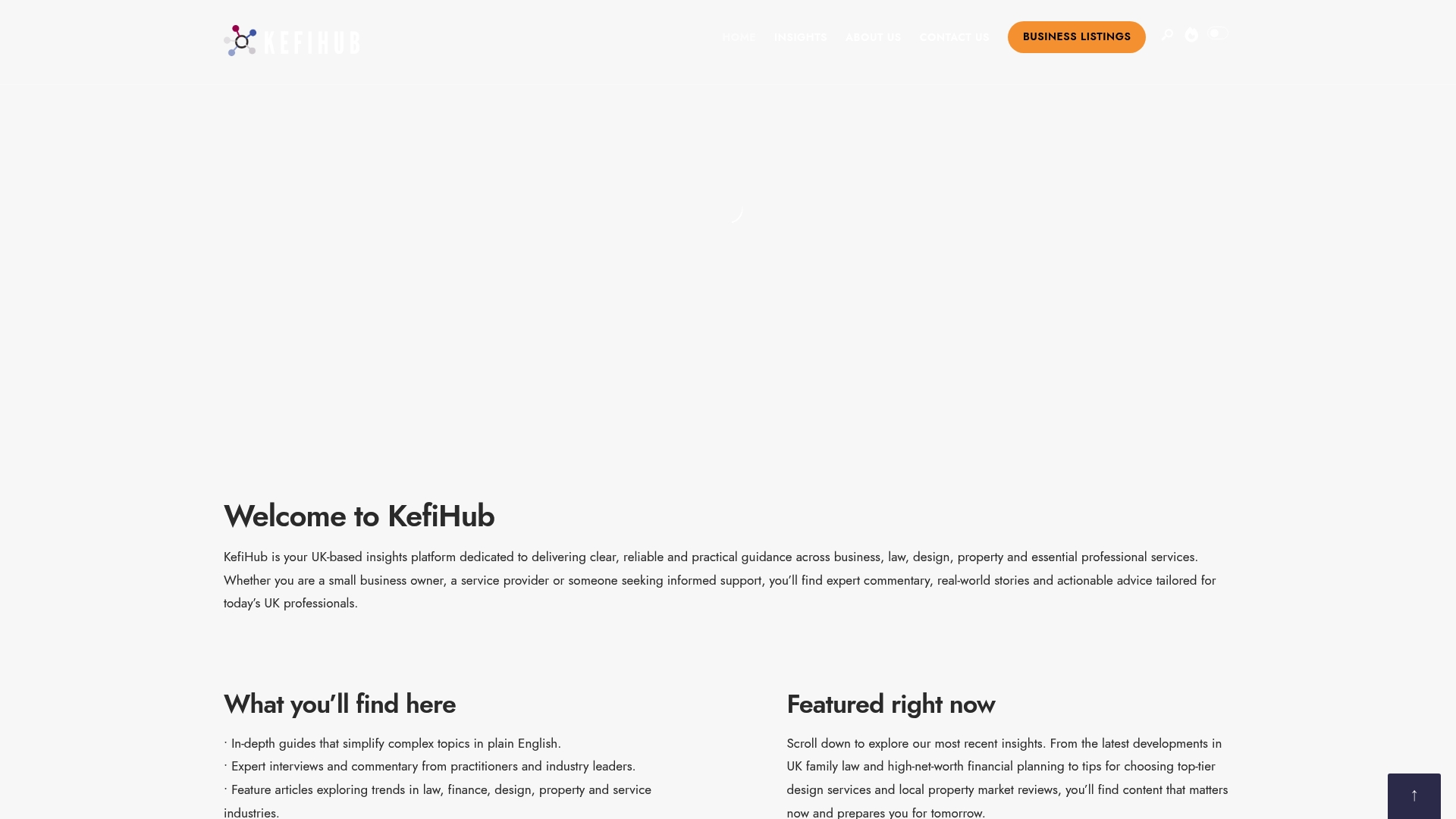
Kefihub is your UK-based insights platform dedicated to delivering clear, reliable and practical guidance across business, law, design, property and essential professional services. It helps professionals make better decisions with confidence by offering expert commentary, real-world stories and actionable advice tailored for UK professionals in 2025 and beyond. Concise, well-curated and focused on applicability, Kefihub is designed to reduce noise and surface the most relevant intelligence for busy decision-makers.
Core Features
Kefihub combines in-depth guides written in plain English, interviews with practitioners and industry leaders, feature articles that explore trends across law, finance, design, property and services, and UK-localised case studies that anchor guidance in real markets. The editorial approach is deliberately curated to respect users’ time: content formats are varied so you can read a short update, follow a deep dive guide, or study a case example depending on need.
Pros
- Provides comprehensive and practical guidance for UK professionals and businesses, ensuring recommendations are grounded in real-world practice.
- Focus on current trends and actionable insights allows you to translate reading into concrete steps for your business or practice.
- Includes a variety of content types — guides, interviews, articles and case studies — which makes it adaptable to different learning preferences and time constraints.
- Localised content specific to the UK market and regulatory environment reduces guesswork when you need jurisdictionally accurate information.
- Fosters informed decision-making and professional growth by combining expert commentary with pragmatic examples.
Who It’s For
Kefihub is built for UK-based professionals: small business owners, entrepreneurs, legal and financial advisers, property professionals and designers who need clear, timely guidance rather than opinion. If you value evidence-backed commentary, practical how-to guides and market-specific case studies to inform decisions, Kefihub fits your workflow.
Unique Value Proposition
Kefihub’s unique strength lies in the combination of UK specificity, editorial curation and a practical-first mindset. Where many platforms scatter general analysis across regions and sectors, Kefihub concentrates on UK realities — regulatory nuance, market trends and legal implications — presented by practitioners who work in those exact contexts. The result is content that’s not just interesting but immediately usable: stepwise guides, real-life case studies and expert interviews that answer “what do I do next?” rather than “isn’t this interesting?”. That focus on actionability and local relevance gives Kefihub a clear edge for professionals who must make compliant, commercially sensible choices today. Any apparent breadth is a deliberate design choice: cross-sector perspective helps you spot risks and opportunities that single-discipline sites miss.
Real World Use Case
A property developer in Berkshire consults Kefihub’s market analysis and legal guides to shape investment decisions for 2025, using local case studies to validate assumptions on planning, valuation and compliance before committing capital.
Pricing
Not specified on the website.
Website: https://kefihub.co.uk
HubSpot Platform
At a Glance
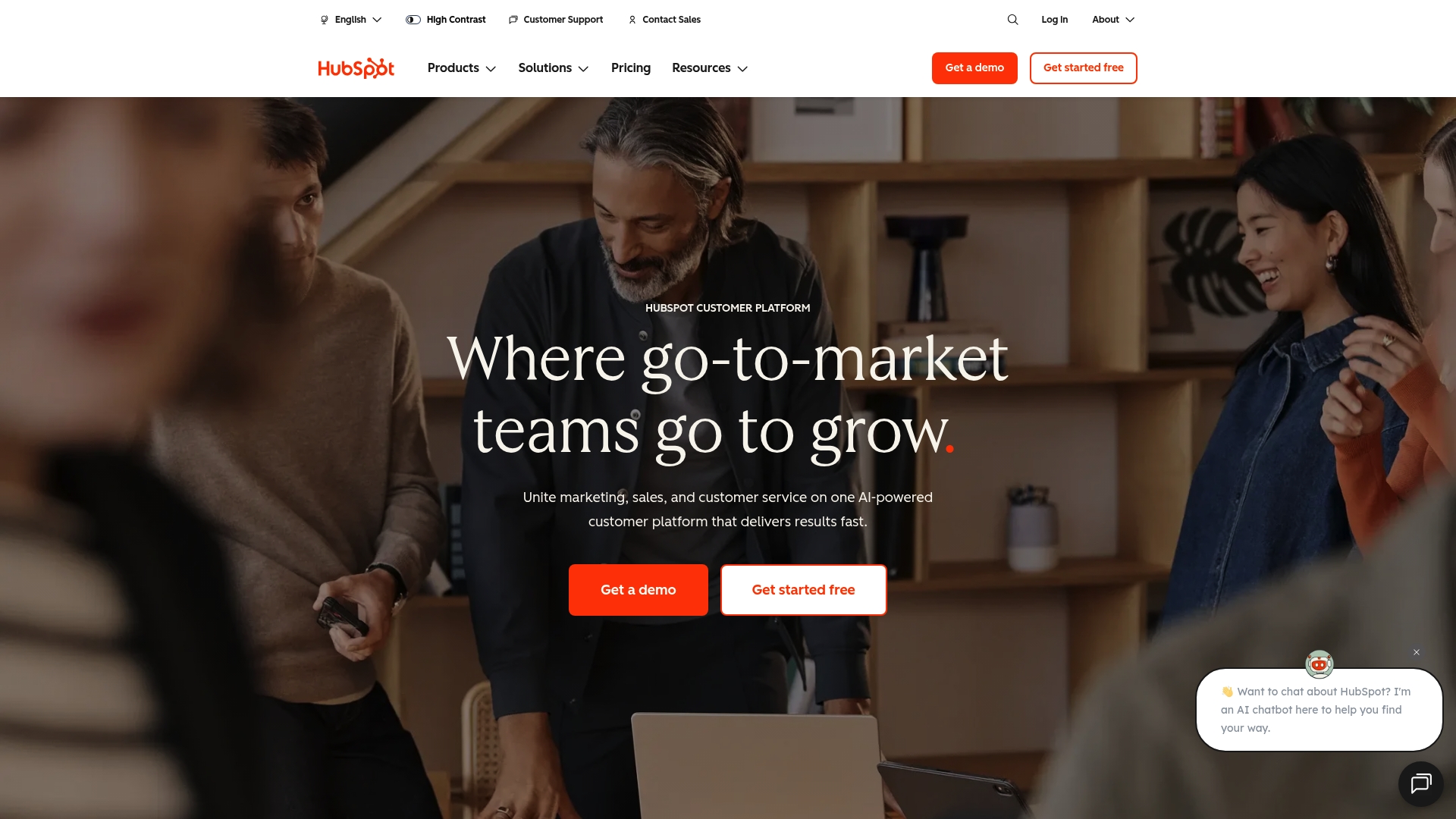
HubSpot Platform is an all-in-one customer platform that brings marketing, sales and customer service tools under a single, AI-powered roof. It excels at unifying data in a central CRM while offering automation and built-in AI like Breeze to speed routine work and surface insights. For businesses prepared to invest time in setup and training, it can replace multiple point tools and centralise workflows; for teams wanting immediate simplicity, the breadth of features can feel overwhelming.
Core Features
HubSpot provides a unified CRM that connects all business data alongside modular hubs for marketing, sales, service, content, data and commerce. Built-in AI tools such as Breeze are designed to enhance productivity and provide actionable insights, and the platform supports integrations with over 2,000 apps to extend capability. Customer support includes online training and tailored onboarding plans, which helps teams adopt more advanced features without losing momentum.
Pros
- All-in-one platform: HubSpot combines marketing, sales and customer service functions so you can manage customer journeys in one place rather than stitching together disparate tools.
- Strong automation and AI: The platform’s automation workflows and AI features are designed to reduce repetitive tasks and surface insights that help your team work more efficiently.
- Extensive integrations: With over 2,000 integrations available, HubSpot can connect to most common business apps and data sources, reducing manual data transfer.
- Proven customer outcomes: The platform includes case studies and examples showing customer growth, which indicates a track record of delivering results for varied use cases.
- Flexible plans: HubSpot offers a range of plans, from free tools up to enterprise tiers, which allows businesses to scale features as they grow.
Cons
- Complexity can overwhelm new users: The sheer scope of features means smaller teams may struggle to find the simplest path to value without structured onboarding.
- Higher cost for advanced tiers: Paid plans can become expensive at the Marketing Hub and Enterprise levels, which may stretch the budgets of smaller businesses.
- Additional costs for some features: Certain capabilities and specialised onboarding can incur extra charges, adding complexity to budgeting decisions.
Who It’s For
HubSpot suits organisations that want a single platform to manage marketing, sales and service with AI assistance and extensive integrations. It works best for small to enterprise-sized businesses that can commit resources to onboarding and configuration to unlock automation and cross-team reporting.
Unique Value Proposition
HubSpot’s unique strength is its combination of a centralised CRM, modular hubs and embedded AI that together allow businesses to unify data, automate key processes and personalise customer experiences without building bespoke integrations.
Real World Use Case
A mid-sized company uses HubSpot to unify marketing campaigns, automate sales prospecting and centralise customer support. The result is more coherent data across teams, improved lead conversion rates and smoother handovers between marketing, sales and service.
Pricing
HubSpot provides tiered plans starting with free tools, with paid options such as Marketing Hub from $800 per month and Enterprise from $3,600 per month, alongside other plan choices.
Website: https://hubspot.com
Zoho
At a Glance
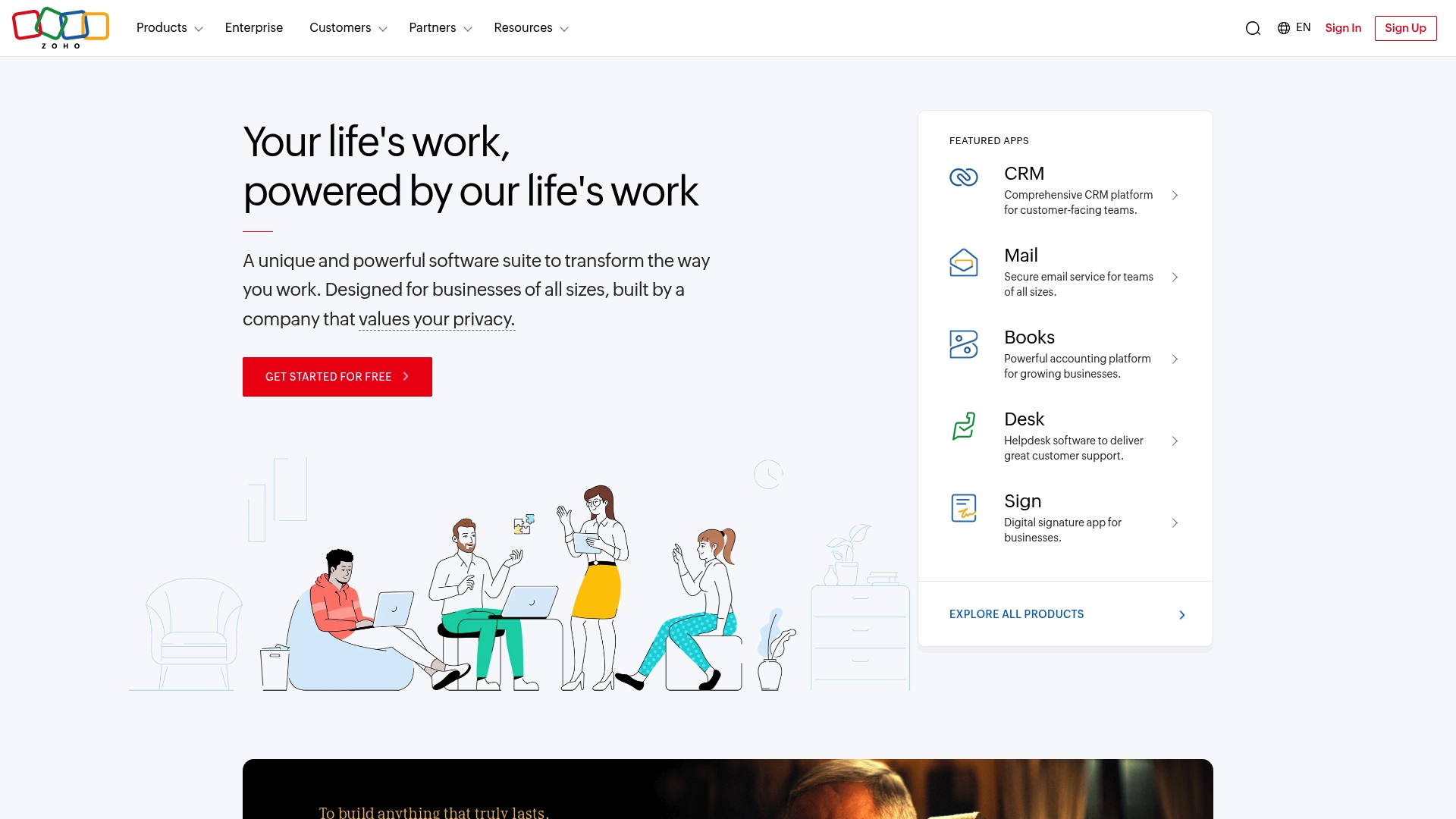
Zoho is a broad cloud software suite that aims to bring CRM, communications, finance, HR and support into a single ecosystem. Its strength is a unified approach — Zoho One — combined with AI assistance via Zia to surface insights and automate routine tasks. For businesses seeking customisation and strong privacy controls, it’s a cost-efficient alternative to stitching together multiple vendors. Expect a learning curve if your operation is simple or you lack in-house support.
Core Features
Zoho provides a comprehensive CRM for customer-facing teams, a secure business email service, an accounting platform, HR automation, and helpdesk software via Zoho Desk, all operable from a unified Zoho One suite. Zia, Zoho’s AI assistant, is embedded across applications to offer automation and insights. The platform emphasises integration, customisation and privacy, enabling teams to centralise data and standardise processes without resorting to numerous separate tools.
Pros
- Integrated suite covering many needs: Zoho bundles CRM, email, accounting, HR and helpdesk tools so you avoid juggling multiple standalone systems.
- Cost-effective option: Compared with buying several discrete solutions, Zoho’s unified approach generally reduces overall spend for businesses seeking broad functionality.
- Highly customisable and scalable: Organisations can tailor modules and workflows to their processes, making the platform suitable as teams grow or change.
- Strong privacy and security focus: Zoho positions data protection as a priority, which reassures businesses handling sensitive customer or employee information.
- AI-driven insights and automation: Zia helps automate repetitive tasks and surface actionable intelligence across the suite, saving time for customer-facing and back-office teams.
Cons
- Complex for simple needs: The breadth of features can be overwhelming for small businesses that only need a lightweight CRM or single-purpose tool.
- Steep learning curve: Getting the most from extensive customisation and integrations demands training or technical support.
- Additional licensing costs possible: Some modules or advanced capabilities may require extra licences, which can complicate budgeting.
Who It’s For
Zoho suits businesses of all sizes that want an all-in-one, customisable platform with a clear emphasis on privacy. It fits organisations prepared to invest time in configuration—especially those replacing multiple point solutions or centralising operations under one vendor. If you run a very small operation with minimal CRM needs, assess whether the platform’s scope is justified.
Unique Value Proposition
Zoho’s unique selling point is its breadth: a single vendor providing CRM, communications, finance, HR and support tools coupled with embedded AI and strong data protections. That combination allows teams to centralise operations, reduce vendor overhead and automate routine work without sacrificing configurability.
Real World Use Case
One company moved all its operational data into Zoho to create a single source of truth; the result was more consistent processes, a reported 80% productivity uplift and lower costs compared with prior CRM investments. The suite helped unify sales, support and finance workflows so data flowed between teams rather than living in silos.
Pricing
Pricing details are not explicitly provided on the webpage; interested users are encouraged to explore Zoho’s site or contact the vendor for tailored pricing options and any module-specific licensing information.
Website: https://zoho.com
Salesforce
At a Glance
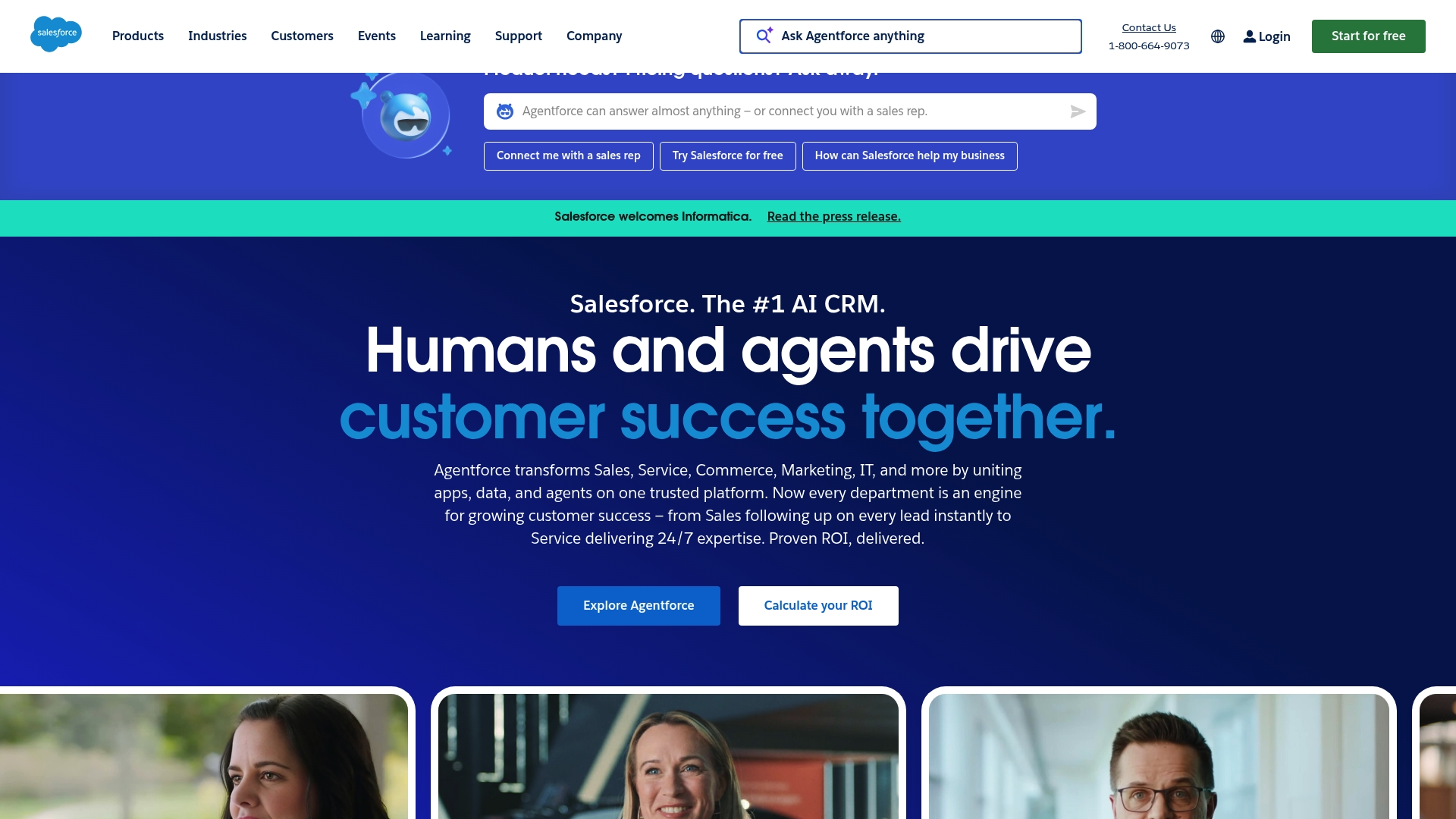
Salesforce is a market-leading, AI-driven CRM platform that unifies sales, service, marketing, commerce and IT on one trusted platform. Its Agentforce agentic AI brings automation and predictive insights to routine workflows, while industry-specific solutions help tailor the platform to complex needs. That breadth makes Salesforce highly powerful for organisations ready to invest in setup and governance, but the platform’s complexity and pricing model mean it is not always the quickest win for cash- or time-poor small businesses.
Core Features
Salesforce provides a unified platform that centralises customer data and workflows across departments, supported by Agentforce for automation and prediction. It includes industry-specific packages for sectors such as financial services, healthcare, manufacturing and retail, and offers extensive integration capabilities via Mulesoft and AppExchange. Scalability is built in, allowing the platform to grow from small-business deployments to enterprise-wide implementations.
Pros
- Salesforce offers a comprehensive, integrated platform that covers multiple business functions, reducing the need for disconnected point solutions.
- The inclusion of advanced AI (Agentforce) enables automation and predictive insights that can reduce manual work and improve decision-making.
- Customisable, industry-specific solutions allow organisations to adopt modules aligned to their sector requirements rather than forcing a one-size-fits-all approach.
- The platform is trusted by large brands and supported by robust security and compliance capabilities, which is reassuring for businesses handling sensitive customer data.
- Salesforce provides free trials, demos and customisable pricing options, which helps you evaluate fit before committing to a full rollout.
Cons
- The complexity of features might require dedicated training or expertise, which increases time to value for smaller teams.
- The pricing structure can be complex due to the wide range of solutions and add-ons, making cost forecasting more difficult for tight budgets.
- Some features and integrations may require additional costs or licences, which can inflate the overall investment beyond initial expectations.
Who It’s For
Salesforce is best suited to businesses that need an integrated, AI-powered CRM capable of unifying customer data and automating workflows at scale. If you run a growing small business with ambitious plans for personalised customer engagement, or you operate in a regulated industry that benefits from sector-specific capabilities, Salesforce is a natural choice—provided you can allocate resource to setup, training and ongoing administration.
Unique Value Proposition
Salesforce’s unique value lies in its combination of a single, extensible platform and agentic AI that spans multiple business functions. That mix enables organisations to centralise customer interactions, apply predictive intelligence across processes and extend functionality through a mature ecosystem of integrations.
Real World Use Case
A global automotive company uses Salesforce to unify customer, vehicle and retail experiences, enabling personalised communications and smoother operations across dealerships, service centres and marketing teams.
Pricing
Pricing is tailored to the specific solutions and industry needs; detailed pricing can be obtained by contacting Salesforce sales for a customised quote.
Website: https://salesforce.com
Pipedrive
At a Glance
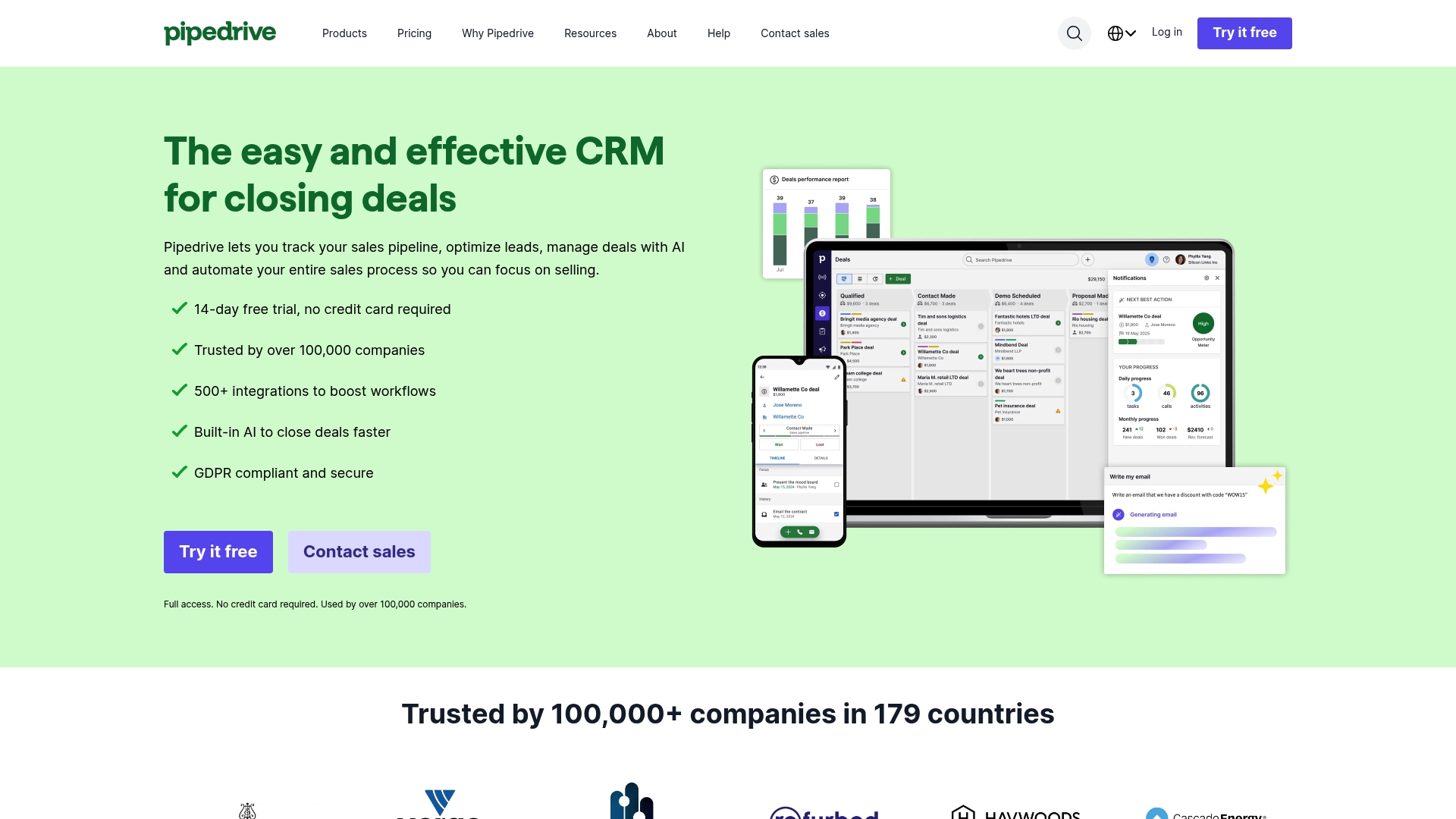
Pipedrive is a sales-focused CRM built to help small businesses organise leads, manage pipelines and close deals more predictably. It combines a Kanban-style pipeline, workflow automation and AI-powered insights to keep sales activity visible and actionable. For teams that prioritise selling over full-service CRM complexity, it delivers clear value; however, those seeking deeply bespoke customisation or the cheapest entry price may need to compare tiers carefully.
Core Features
Pipedrive centres on sales pipeline management with a visual Kanban-style dashboard that simplifies deal progression and activity tracking. It offers an AI-powered sales assistant and prompts to surface next actions, alongside real-time sales reporting and forecasting to improve decision-making. Workflow automation and automatic lead routing reduce manual tasks, and integrations with over 500 apps connect email, calendar and marketing tools so data flows where teams already work.
Pros
- Intuitive and customisable interface: The visual pipeline and drag-and-drop layout make it straightforward for sales teams to adopt without heavy training.
- Strong automation features to save time: Built-in workflow automations and lead routing reduce repetitive admin and help keep deals moving.
- Effective integration ecosystem: Connecting with more than 500 apps makes it easy to centralise sales data alongside existing tools.
- Real-time data insights and forecasting: Live reporting and forecasting give managers timely visibility into pipeline health and revenue expectations.
- Trusted by many companies globally: Its adoption by over 100,000 companies indicates maturity and reliability in real-world sales environments.
Cons
- Pricing might be higher for smaller teams or startups that need extensive features: Entry-level plans may lack advanced capabilities, pushing costs up as you scale.
- Learning curve for advanced automation and customisation: While the basics are simple, configuring complex automations and custom fields requires time and some expertise.
- Some users may find automation and integrations setup complex: Integrating multiple services and fine-tuning rules can be fiddly without a dedicated admin or support time.
Who It’s For
Pipedrive is ideal for small to medium-sized sales teams and business owners who want an easy-to-use, sales-first CRM that prioritises deal flow and activity management. If your primary goal is to organise sales activity, automate follow-ups and gain clear forecasting without adopting a bulky enterprise system, Pipedrive fits well.
Unique Value Proposition
Pipedrive’s strength lies in focusing squarely on sales execution: visual pipelines, time-saving automations and AI prompts that keep salespeople doing what they do best — sell. Its broad integration network means you can adopt it without reshaping existing workflows, which is a practical advantage for time-poor small businesses.
Real World Use Case
A digital marketing agency uses Pipedrive to track incoming leads, automate follow-up sequences and produce weekly sales reports for partners. The setup reduced missed follow-ups, improved response times and raised the agency’s closing rate by making sales activity more consistent.
Pricing
Plans start at $14 per user/per month for the Lite plan, with higher tiers offering additional automation, reporting and CRM capabilities.
Website: https://pipedrive.com
Insightly CRM
At a Glance
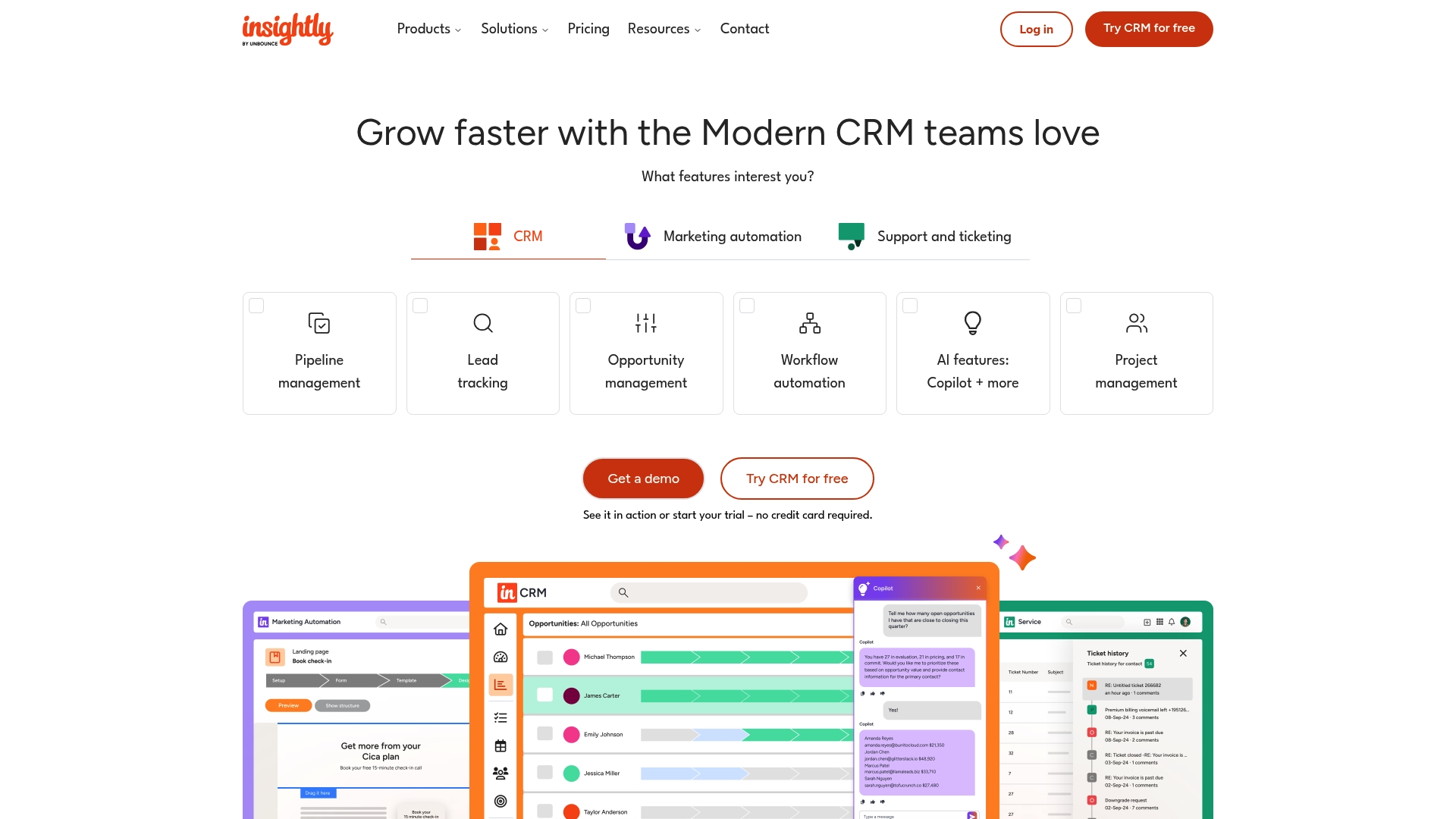
Insightly CRM is a unified platform combining CRM, marketing automation, support and ticketing to help teams manage customer relationships and accelerate growth. Rapid deployment, guided onboarding and no-code integrations make it approachable for busy teams, while AI features such as Copilot aim to reduce manual work. It suits businesses that want a single system for sales, marketing and service, though very small operations may find the breadth of features more than they require.
Core Features
Insightly offers CRM and pipeline management alongside marketing automation with campaign creation and lead scoring, plus support and ticketing that includes client portals and SLA tracking. Workflow automation is enabled through a drag-and-drop AppConnect for no-code app integrations, and AI capabilities—advertised as Copilot—assist with record updates and email summaries and replies. The platform emphasises rapid deployment, guided onboarding and support services to help teams realise value quickly.
Pros
- All-in-one platform: Insightly combines sales, marketing and customer support in a single system, reducing the need for multiple point solutions.
- No-code app integration: AppConnect’s drag-and-drop approach makes connecting third-party tools simpler and avoids heavy development overhead.
- AI features to boost efficiency: Copilot and related AI tools are intended to improve sales efficiency and data quality by automating routine updates and communications.
- Positive customer reception: High customer ratings and awards suggest the product is dependable and well regarded by organisations that use it.
- Flexible plans: A range of plans and enterprise options allows businesses to choose capacity and features that match their growth stage.
Cons
- Complex pricing: Pricing can be hard to parse because of multiple plans and potential add-ons, which makes clear budgeting more difficult.
- Advanced features behind higher tiers: Several capabilities are reserved for upper-tier plans, meaning teams that need more sophistication may face early upgrades.
- Potentially overwhelming for micro-businesses: The extensive feature set may be excessive for sole traders or very small businesses with simple CRM needs.
Who It’s For
Insightly is aimed at small to medium-sized organisations that want an integrated platform to manage sales, marketing and customer support without assembling multiple tools. It suits teams that value automation, no-code integrations and AI assistance, and those prepared to invest in a system that can scale with their operations.
Unique Value Proposition
The platform’s unique value lies in centralising CRM, marketing automation and helpdesk functionality with accessible no-code integrations and AI helpers, which streamlines processes and keeps customer data in one place for clearer decision-making.
Real World Use Case
Sport Court, a Las Vegas-based sports court supplier, reportedly grew by 242% after adopting Insightly CRM, demonstrating how the platform can materially impact sales growth and operational efficiency when paired with effective onboarding.
Pricing
Plans start at $29 per user per month for the All-in-One Plus plan, with higher tiers and Enterprise options available for larger teams and advanced needs.
Website: https://insightly.com
Freshworks
At a Glance
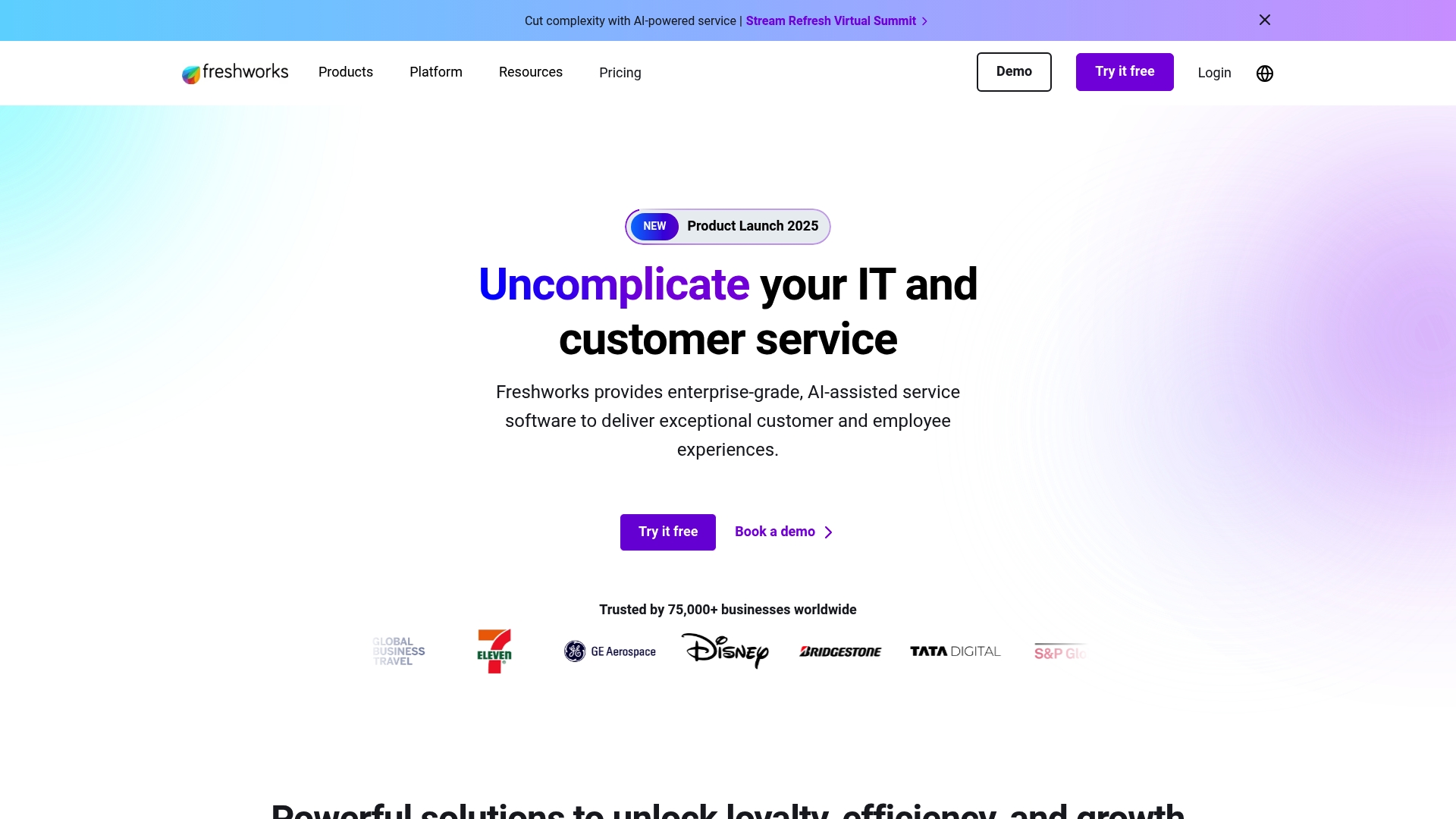
Freshworks offers enterprise-grade, AI-assisted service software designed to simplify customer and employee experiences without unnecessary complexity. It combines omnichannel support, automation and generative AI (Freddy) across customer service, ITSM and CRM products to boost efficiency and loyalty. The platform is designed for organisations that need powerful automation with a relatively straightforward interface and rapid implementation.
Core Features
Freshworks brings together AI-powered customer service and IT service management, omnichannel support, automation and real-time performance insights into a single ecosystem. Freddy, the generative and agentic AI, assists agents with automated responses, ticket triage and suggested resolutions, while real-time benchmarks highlight performance gaps and improvement opportunities. The product line includes trial and demo options so you can validate capabilities before committing.
Pros
- Enterprise-grade performance with simple interfaces: Freshworks provides robust, scalable capabilities while keeping interfaces uncluttered so teams can adopt features quickly.
- AI-driven automation reduces resolution times: Freddy and workflow automation work together to speed up ticket handling and routine tasks, helping teams resolve issues faster.
- Comprehensive product suite across service areas: The platform covers customer service, ITSM and CRM, allowing organisations to centralise workflows and data across functions.
- Strong customer satisfaction results: Reported high satisfaction metrics (97% CSAT) indicate the platform can deliver positive customer experiences when configured correctly.
- Transparent approach to pricing and implementation: Freshworks emphasises quick implementation and offers free trials or demos so organisations can assess value with limited risk.
Cons
- AI features require user training for best results: The level of AI integration means teams need time and guidance to tune models and prompts to match organisational processes.
- Complexity grows with integrations and customisation: Adding multiple integrations and advanced features can introduce configuration overhead that requires specialist input.
- Specific pricing is not published on the website: Detailed costs are provided on request or through demo rather than listed openly, which can slow procurement discussions.
Who It’s For
Freshworks is best suited to mid‑large and enterprise organisations seeking an integrated, AI-enhanced service stack for customer support, ITSM and sales. If you need scalable automation, omnichannel workflows and a unified platform that supports rapid onboarding, Freshworks is designed for you.
Unique Value Proposition
Freshworks’ edge is its combined focus on enterprise capabilities and approachable design plus embedded generative AI (Freddy) across products. That blend aims to deliver the automation and insights of a large vendor while keeping day‑to‑day use manageable for service teams.
Real World Use Case
A global digital workplace implements Freshservice to streamline IT support, deploying Freddy to automatically resolve routine tickets and escalate complex cases. The result is faster handling times and higher CSAT scores as agents focus on high‑value work.
Pricing
Pricing is provided on request or via a tailored demo; specific per‑user or tiered prices are not published on the website.
Website: https://freshworks.com
Capsule CRM
At a Glance
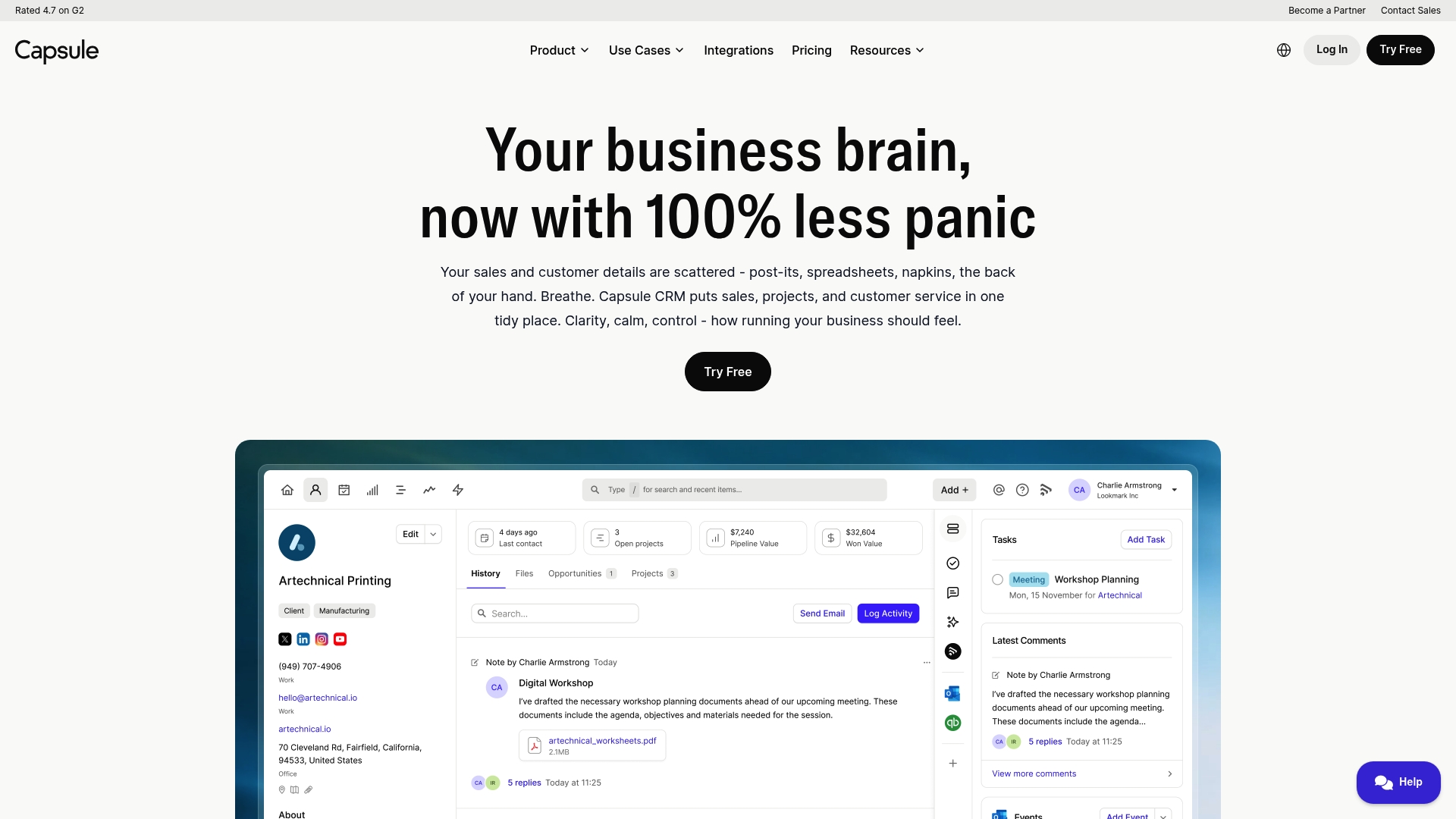
Capsule CRM is an award-winning, user-friendly CRM built for small and medium-sized businesses that need tidy contact management and straightforward sales tracking. It balances simplicity with enough depth to support growing teams, offering both a free tier and affordable paid plans. If you want a tool that shortens the onboarding curve and plugs into everyday apps like Gmail or Xero, Capsule is worth considering.
Core Features
Capsule focuses on the essentials: organised contact management, sales pipeline tracking, task and activity scheduling, and email templates for consistent communications. The platform also provides a mobile app so you can update records and progress deals on the go. Integrations with common business tools extend Capsule’s reach without forcing you into a complex setup.
Pros
- Easy setup and approachable UX: Capsule is straightforward to get started with, which helps teams adopt it quickly without heavy training.
- Affordable pricing and a free plan: There is a free tier for basic needs and paid options that keep costs low as you scale.
- Strong integrations with popular business tools: Native links to Gmail, Outlook, Xero, QuickBooks and more mean Capsule slots into existing workflows smoothly.
- Helpful customer support and onboarding: The platform is backed by good support, which reduces friction during implementation.
- Flexible plans that scale: Capsule’s tiers permit incremental upgrades so you only pay for features you need as your business grows.
Cons
- Limited features on the free plan may prompt upgrades: The free tier covers basics but many useful capabilities sit behind paid plans.
- Interface less customisable than complex CRMs: Organisations requiring deep customisation might find Capsule comparatively rigid.
- Advanced automation restricted to higher tiers: If you want sophisticated automation, you will likely need a higher-tier subscription.
Who It’s For
Capsule is ideal for small to medium-sized businesses and sales teams that prioritise simplicity, rapid adoption, and tight integration with common accounting and email tools. If your business lacks a dedicated CRM specialist and needs a practical, low-friction solution, Capsule fits well.
Unique Value Proposition
Capsule’s strength lies in delivering the core CRM functions without unnecessary complexity: organised contacts, visual pipelines, and solid integrations packaged in an accessible interface. It trades extensive customisability for clarity and speed of use — perfect for teams that want immediate value rather than a long implementation project.
Real World Use Case
A small sales team uses Capsule CRM to centralise customer records, monitor opportunities through a clear pipeline and automate routine follow-ups using email templates. The result, according to the provided data, is improved coordination and a reported 48% boost in sales conversions — a concrete figure that underlines Capsule’s impact when adopted properly.
Pricing
Capsule offers a free plan with limited features; paid plans start from $11 per user per month (billed annually) and scale through Growth, Advanced and Ultimate tiers depending on needs.
Website: https://capsulecrm.com
Professional Tools Platform Comparison
This table provides a comprehensive comparison of different platforms that offer professional tools and insights for various business needs. Each entry highlights the core features, pros, cons, pricing, and ideal user base for informed decision-making.
| Platform | Core Features | Pros | Cons | Pricing |
|---|---|---|---|---|
| Kefihub | In-depth guides, UK-specific case studies, expert interviews | Tailored for UK market, practical insights, varied content types | Pricing not specified | Not specified |
| HubSpot | Unified CRM, AI tools, extensive integrations | All-in-one platform, strong automation, proven outcomes | Complexity for beginners, higher cost for advanced tiers | Free to Enterprise ($3,600) |
| Zoho | CRM, communications, finance, HR, support within Zoho One, AI assistant Zia | Cost-effective, scalable, strong privacy focus | Complex for small needs, steep learning curve | Not specified |
| Salesforce | AI-driven CRM, industry-specific solutions, extensive integrations | Comprehensive platform, predictive insights, customisable | Requires training, complex pricing | Custom quote |
| Pipedrive | Sales-focused CRM with Kanban-style pipelines, AI sales assistant | Intuitive interface, strong automation, real-time insights | Higher cost for advanced features, learning curve for automation | From $14/user/month |
| Insightly | CRM, marketing automation, no-code integrations, AI features | All-in-one system, app integration, positive customer ratings | Complex pricing, advanced features in higher tiers | From $29/user/month |
| Freshworks | AI-assisted service software, omnichannel support, automation | Enterprise-grade, AI-driven automation, comprehensive suite | Requires user training, complex with integrations | On request or demo |
| Capsule CRM | Contact management, sales pipeline tracking, integrations with Gmail and Xero | Easy setup, affordable pricing, good support | Limited features in free plan, less customisable | From $11/user/month |
Discover the Right CRM for Your Small Business Success
Choosing the best CRM tool in 2025 comes with its challenges. Small businesses often struggle with complex setups, overwhelming features and uncertain costs. The article highlights pain points such as finding a sales-focused system that is easy to adopt, ensuring automation saves time rather than adding complexity and the need for localised, actionable advice relevant to UK regulations and market conditions. Whether you seek a seamless sales pipeline, AI-powered insights or an all-in-one platform, the goal is clear: make confident decisions that boost sales and customer relationships without getting lost in unnecessary complexity.
At KefiHub, we understand how critical it is to cut through noise and get straightforward guidance rooted in UK realities. Our expert commentary and practical advice help you bridge the gap between interesting CRM features and real-world applicability. You can explore comparisons, case studies and step-by-step insights tailored specifically to small business needs in the UK.
Ready to take control of your CRM choice and grow with confidence
Visit KefiHub today to access expert insights that help you pick a CRM tool perfectly suited to your business goals. Don’t let complexity slow your progress. Start making smarter decisions now with reliable, localised knowledge built for busy UK professionals.
Frequently Asked Questions
What are the key features to look for in CRM tools for small businesses?
A small business should seek CRM tools that offer user-friendly interfaces, contact management, sales tracking, and automation features. Consider evaluating tools that streamline workflows and reduce manual tasks by at least 20% to enhance productivity.
How can CRM tools improve customer relationship management for small businesses?
CRM tools centralise customer data, enabling better communication and personalised interactions, which can foster loyalty. Integrate a CRM tool to see improvements in customer satisfaction scores within 30–60 days.
What is the average cost of CRM tools suitable for small businesses?
Costs for small business CRM tools vary widely, often ranging from free plans to approximately £29 per user per month for more advanced features. Assess your budget and stay under £20 per user to manage expenses effectively while still gaining essential functionalities.
How long does it typically take to implement a CRM tool in a small business?
Implementation time can range from a few days to several weeks, depending on the tool’s complexity and training requirements. Prepare for a quick setup within 1–2 weeks with proper onboarding resources to maximise early productivity.
Can CRM tools help in automating sales processes for small businesses?
Yes, CRM tools often include features that automate sales tasks such as lead follow-ups and pipeline management, which can save time and reduce errors. Aim to automate at least 30% of your routine sales tasks to increase efficiency and focus on closing deals.
How can I choose the right CRM tool for my small business?
Evaluate your business needs based on factors like budget, team size, and specific functionalities desired. Create a checklist of must-have features to prioritise options, ensuring you select a CRM tool that aligns closely with your operational goals.
Recommended
- Complete Guide to the Role of Solicitors in Business – Kefihub
- 7 Smart Business Growth Strategies for UK Professionals – Kefihub
- Top Legal Document Services – Expert Comparison 2025 – Kefihub
- How to Choose the Best UK Digital Design Studio: AI vs Traditional Approach Compared – Kefihub